Monday, July 23, 2012
defining theological research
Tonight I attended, with my daughter, a high school careers night. One of the presentations outlined the Research Project, a final year independent study. It is described as an opportunity to:
- research something you are interested in
- decide how you carry out your research
- decide on the way you produce your findings
- make judgements about how successful you’ve been
The presenter noted that a new feature for 2013 includes local universities offering students the chance to join one of their projects, in areas like health and medicine. The student works with the University in one of their projects and gets named in the research as it is written up.
On the way home, the following conversation ensued.
Daughter: I liked the idea of doing research with a university.
Dad: Yes, when they talked about that, I wondered about theology offering a research project.
Daughter: Now that would be cool. They could start new types of churches and explore how people engage with those new forms.
Dad grins, pondering the rather unique view of theological research – the mix of research and practicum, thinking and doing, university and church – the daughter has grown up with.
Saturday, July 21, 2012
No one can serve two masters: academy or church
“No one can serve two masters.” Matthew 6:24
Theological colleges are pulled two ways. The university demands intellectual rigour, PhDs, conference attendance and publications. Increasingly this includes multiple layers of academic compliance.
The church expects effective mission leaders, down to earth application, ideas with legs, lecturers who can walk the talk. Often this includes multiple process around selection, formation and mentoring of students.
The contrast became clear for me in a conversation this week. One of our local ministers, a highly effective ministry leader is also a seasoned and much loved part-time College lecturer in the area of worship.
He noted that there were over 40 new books in his subject area. Which as a minister he simply had no time to read. He wasn’t sure he would be able to continue.
Who would you rather have teach? A person who leads worship every week, an effective practitioner in a complex, growing, multiple congregational church? Or a person with time to read 40 books, a university researcher?
The ideal is both. The reality is we have to choose. Do we face the university? Or the church?
(Note – Practical theology offers a way to do both. John Swinton defines practical theology is critical reflection on the actions of the church in the light of the gospel. Church and university, actions and critical reflection. However, not every lecturer is trained in this way).
Thursday, July 19, 2012
discernment in mission
It was great to be part of the Cato lecture last night and hear Kirsteen Kim, Professor of Theology and World Christianity, reflect on mission today. Her talk moved from Edinburgh in 1910 to Edinburgh in 2010, noting changes in cultures, mission theology and spirituality. She was clear, with great visuals and a dry wit. We are very much looking forward to having her with us next week at Uniting College, teaching an intensive on Spirit and mission.
Among many good quotes was the way she opened up discernment in mission.
In every context there are things to embrace and things to resist. K Kim
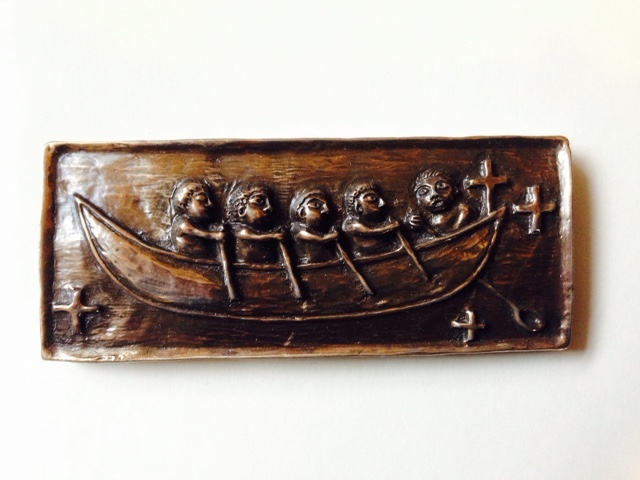
This for me is well illustrated in Luke 10:1-12, in the delightful tension between “eat what is set before you,” and “shake the dust.”

(Art from Mark Hewitt who “images” the lectionary each week here.)
In Luke 10, mission includes both embrace and resistance. New Testament scholar, George Shillington interprets the act of “shaking of dust” as a practice of giving freedom to the other, being willing to let them choose, rather than insisting on your way, your perspective, your insight. It’s the curse of Christendom, whether through the gun, guilt or gold. But it’s not the way of Jesus. Shillington concludes that “the idea of imposing a Christian culture on a receiving culture is foreign to this [Luke 10:1-12].” (An Introduction to the Study of Luke-Acts
In this we are not alone, for we have the wisdom of the church in history and today and the gift of discernment from God’s Spirit.
For more:
– Shaking the dust Aussie style go here
– Pluralism and Luke 10.
Tuesday, July 17, 2012
emerging mission: a geographic analysis
Here is something of what I’ve been writing over the last two days, the emerging church 10 years on project:
 I wish to analyse this theme of mission as integrative by paying particular attention to the way space is deployed. In other words, to consider mission through a geographic lens. Does mission invite those who participate in mission to go? Or to stay? Are the recipients of mission expected to remain? Or to come?
Let me illustrate with reference to the construction of space in Luke 15:4-7. In this parable, the shepherd leaves. When the lost sheep is found, the shepherd returns. The implications for mission are subtle, but powerful, especially in churches that consider they have a “shepherd.” The result, spatially, is to suggest they will engage in mission by sending their shepherd, who will leave them (the church) to look for the lost. When found, the objects of the mission will be brought back by the shepherd, to that which is “home” (v. 6). Mission is being constructed as a sending, of a single person, by a stationery body, who await in anticipation of fruit.
Marianne Sawicki, in her book Crossing Galilee: Architectures of Contact in the Occupied Land of Jesus
Another is ekklesia. This Greek word was originally used to designate a secular self-governing gathering. Participation was restricted, socially, to free male property-owners, physically, by the size of the building. Spatially, this suggests a “selection, displacement, and establishment of a new physical propinquity.”
A third is colonization. People from one land (in the case of New Testament times, Romans), invade another land, with severe social and economic consequences.
In contrast to these, Sawicki draws attention to the place of salt and leaven in the very early Christian communities. She suggests that salt and leaven provide very different spatial understandings of mission. Rather than leaving (as in the Exodus), they suggest a staying. Rather than changing by separating (as in ekklesia), they suggest a changing from within, by digging in and staying put, through infiltration. Rather than imposing (as in colonization), they suggest a subtle and complex resistance.
Monday, July 16, 2012
a mail male impulse buy
Monday afternoons, I have a regular date with one of my children. (For those who count hours, I work late the other 4 days of the week to keep the ledger sweet.) We’re working on a project together, making an outdoor writing hut. I pick her up after school and we use the few hours to plod away.
We’re always dreamers, accessorising before we’ve put the door on, thinking colour schemes before the walls are up. But we both need time away from reality, time to be fun and flippant.
A few weeks ago we went looking for a mail box. All houses have mail boxes, she loves writing and so it seemed a neat way to add some personality. Alas all the local hardware shops had nothing that appealed.
Too expensive, too square, too common. The list went on.
And then today she showed me this. A real mail male impulse buy.

Saturday, July 14, 2012
Spirited Missiology for a global world: our 2012 intensive
We’re delighted to have international missiologist, Kirsteen Kim, with us in a few weeks teaching our mid-year intensive.

For more information, contact the ACD Office, on college dot divinity at flinders dot edu dot au.
Friday, July 13, 2012
churches that connect
I’m currently spending three days at Ministry Education Commission. It meets annually and involves around 20 people, Principals from Uniting Church Theological Colleges (there are Colleges in Perth, Adelaide, Sydney, Melbourne, Brisbane and Darwin) and key leaders in education from the various Synods/States. Being here is a “perk” of being Principal, representing Uniting College, and continues my long list of firsts. (It’s been a HUGE first 2 weeks in the role).
Being new, it strikes me as a very obvious window into the Uniting church. Each College presents an annual report. Each College gets peer reviewed every 5 to 7 years by the other Colleges. These reviews get tabled and discussed before all the other Colleges. Issues in education and formation are discussed. For example, yesterday we discussed a recent report on Youth and families and brainstormed ways to ensure the formation of leaders includes training in working with all generations.
It’s hard work. It takes time. It demands considerable maturity, a way of being that is neither defensive nor big noting.
And it says something about being church, about being the body of Christ.
Some church denominations operate mainly as local churches. Each local church sees itself as an entity by itself and chooses what levels of relationship it will have with other churches.
Some church denominations operate in a more top down approach, with an overall leader (a Bishop or a Pope), who provides a sense of continuity and connection.
Some church denominations operate in a more inter-connected, connectional manner. They recognise a shared life, that alone they are not complete, that parts of the life of another body are embedded in each other.
Which seems to me to be what is being expressed at MEC. Uniting College is not an entity by itself, choosing what relationships it will have with other colleges. Rather it exists in web of relationships. How it acts shapes others and it needs this mirror, for accountability and feedback. How it acts is also shaped by others, other groups and Colleges.
It’s not individualism. Nor is it communism. It’s connectionism (is that a new word?), a shared life.
Wednesday, July 11, 2012
I had a dream
I awake early last week, aware that I had a dream.
 I had been given a guitar, well-worn, well-loved, well-strummed. Not mine, but a gift to tend and care.
As you do, I began to tune it, tightening the strings. Satisfied with the results, I laid it aside and went to make a cup of tea.
Returning to play the newly tuned guitar, I was saddened to see that half the strings were broken. They had not survived the tightening.
Which left me pondering. Should I have tightened the strings more slowly? Might they then not have broken?
But then again, might it be better for the guitar to have new strings anyway? The sound will be cleaner, truer.
Although, then again, new strings are also tricky. They are known for their ability to easily slip out of tune and thus require constant ongoing care and attention.
“I had a dream, and no one can interpret it. But I have heard it said of you that when you hear a dream you can interpret it.” Genesis 41.15
Tuesday, July 10, 2012
requesting permissions
I had a lovely, surprising and very encouraging email on Friday – a request for permission to publish one of my blog posts in a church resource called Seasons of Spirit – a lectionary-based resource created in community with congregations representing different denominations from Canada, the USA, the UK, Australia, and New Zealand.
The post is here – titled Theology needs art, my floor talk earlier this year to launch the Adelaide College of Divinity bi-annual art exhibition. Seasons of Spirit want to use it as a general article for Pentecost 2, 2013.
It’s wonderful to be part of a world in which spoken words in one context (a floor talk), can through the use of the internet, become a resource for another context. It’s also a reassurance that blogging does have a communicative purpose. People other than my mum do read it!!
Sunday, July 08, 2012
bread making in theological Colleges? a question (3) of Principal
This continues my “As an incoming Principal, I have plenty of questions” series – questions that I ponder as I begin a new role as Principal at Uniting College. (First question, with some responses is here and here).
Here is the third question I’m asking
What might bread making add to formation? What might happen if folk – staff and students together – gathered to knead and pray “Give us this day our daily bread” on a regular basis? How might it shape how Church, Ministry, Sacraments is taught, how New Testament is studied, how ethics is considered? How practical is such an idea?

All responses welcome. Because
yep
you got it ….
Sometimes a question, followed by a response helps one listen. Sometimes a question, followed by a response confirms an intuition. Sometimes a question, followed by a response simply reveals what the next question should be.
Friday, July 06, 2012
end of week one: a full team
One of the key challenges over the last few months has been re-building the team at Uniting College. We’ve had three appointments to make:
- in April needing to replace a Ministry Practice Coordinator (the previous person felt God calling them to plant a multi-cultural church);
- in June needing to replace a Director of Missiology (the previous person felt God calling them to become Principal) – announcement here
- now needing to find a 0.5 Principal’s PA (the previous person felt God calling them to serve the next President of the Uniting Church in Australia).
This week, the last of the appointments was clarified. On Tuesday we offered the role of Principal’s PA to Eloise Scherer. Eloise and I worked together last year on the first Adelaide msm course. She is a key leader in the South Australian Youth Camp Out (SAYCO) team and has a deep faith and passion for justice and God’s kingdom. Work wise, she is currently Regional Coordinator (Rural SA Business) for a bank, with key roles including Executive Assistant and administrator to a staff of 20, organising regular conferences and providing training materials. I’m really looking forward to working with someone I’ve worked with before, and to what she will bring in terms of Christian passion and administrative and organisational skills among us.
So that’s a full team! Very exciting. Very satisfying. We are now:
Craig Bailey, Director of Leadership
Dr Vicky Balabanski, Co-Director of Biblical Studies (New Testament)
Dr Liz Boase, Co-Director of Biblical Studies (Old Testament)
Dr Rosemary Dewerse, Director of Missiology, Post-graduate Co-ordinator
Linda Driver, Administrative Officer
Rev Jo Fulton, Distance Education Coordinator
Rev Sean Gilbert, Ministry Practice Coordinator (0.7)
Dr Peter Gunn, Manager, Educational Resources and Administration
Rev Tim Hein, Director of Christian Education and Discipleship (0.5)
Annette Latham, Administrative Officer (0.5)
Craig Mitchell, Director of Christian Education and Discipleship (on secondment to the Assembly)
Rev Beatrice Panne, Lecturer in Pastoral Care (0.5)
Eloise Scherer, Principal’s PA
Nichola Shaw, Administrative Officer
Rev Dr Steve Taylor, Principal
first team meeting
This week has been a endless string of firsts as Principal – first Leadership Formation day, first job contracts to sign, first email as Principal. Yesterday was the first leading of the team meeting, which happens weekly.
I was awake at 5.20 am, unable to sleep, which I suspect is some evidence of the stress being generated, my body needing to process the move from team player to team leader, my awareness of the giftedness embedded in the team and the skills that will be required to lead that giftedness with clarity and grace.
Some of my emotion and anxiety took me back to my first team day at Opawa, back in 2004.
It was my 1st day at my new church (Opawa) today. I asked the 4 other paid staff to gather.
I gave them all an egg – fragile, yet hopeful. I talked about the church as the bride of Christ … beautiful … hopeful … yet fragile and nervous.
I said that I felt a bit nervous and fragile in this new role. I said I thought people at Opawa were probably a bit nervous and fragile about having a new young minister on board. I said I wondered if the staff were a bit nervous and fragile, wondering how they would fit with this new young minister.
And so we prayed for each other, that in our fragility new life would emerge. (Here)
For the record, yesterday I asked each of us to bring a symbol of our work. We began, first, by reflecting on some thoughts from one of our colleagues from a chapel time earlier in the week, about the Kingdom vision which we all share. It was nice to begin with an insight from within the team.
We then read together the gospel reading for the week. Ironically (!!) it was Mark 6:1-13. Ironically, because it has echoes of one of my favourite missional texts, Luke 10:1-12. We shared what struck us, which included the need to let go and travel light, the invitation to recognise what was new, the sense of God calling us on a journey, the realisation that won’t be easy and that should not surprise us. Lots of richness and the realisation again of the uncanny way that Scripture reads us, rather than we read it.
We then shared our workplace symbol, something about ourselves and how our work life is an expression of the Kingdom vision with which we began together. Our practicality, our reality, in the midst of vision.
A good time, a rich time, a privileged time. Which leaves me hoping I’ll sleep better next Thursday.
Wednesday, July 04, 2012
Church out of clergy: Report to Synod says “It’s crunch time …”
The Journey, the Queensland Uniting Church Newspaper, in October 2002, led on the front page with the following headline
“Church: just out of clergy: Report to Synod says “It’s crunch time …”
The Future of Ministry Task Group brought what was described as a “shock finding” that between 60-80% of ministers would retire in the next 15 years.
“It’s crunch time for the church, said Rob Adsett, who chaired the Task Group. “We need to start recruiting young men and women to the ministry and provide flexible and alternative pathways for training them.”
That was some 10 years ago. Last year I walked into the foyer at Uniting College. Four candidates were sitting there. One was training with a focus on overseas mission. Another was Sudanese, with a heart for mission and people. Another was training as a deacon, with a desire to plant a fresh expression. Yet another was also training as a deacon, with a heart for workplace and everyday spirituality.
Each had a shared God, to serve Christ. Each sensed that would be expressed in unique ways.
Each was waiting to be part of a Formation Panel, a group of 4-6 from within the church who would talk with them about their call, help them design a unique pathway.
Flexible. Yes.
Alternative. Definitely.
The four would be followed by 21 others during the day. Currently the College is training more candidates than there are placements. It is tempting to “cap” numbers but instead we are trusting that God is up to something, that the mission of God might just be running ahead of what the church currently requires.
It’s exciting, scarey and risky. It seems a long way from the crisis of 10 years ago.
(Hattip Andrew Dutney for pointing out the article)
Posted by steve at 07:03 PM
Tuesday, July 03, 2012
Prometheus: a theological film review
Each month I publish a film review, for Touchstone (the New Zealand Methodist magazine). Here is my most recent, a reflection on creation, Prometheus and original sin.
Prometheus
A film review by Rev Dr Steve Taylor
Director Ridley Scott returns to familiar territory, tracing his “Alien” exploration back to the beginning. While cinematic references to other Alien movies are cleverly interwoven, “Prometheus” still works as stand-alone sci-fi horror. The lighting is superb, the soundtrack appropriately haunting, a visual palette of blacks and white providing a rich array of foreboding textures. The acting of Noomi Rapace is a standout, showing that her central role as Lisbeth Salander in The Girl with a Dragon Tattoo was no fluke. The result is a movie for the strong in mind and stomach (obscure “Alien” reference intended).
On a remote mountain, an alien life-form releases DNA into the waters of life. In caves on the Isle of Skye, archaeologists find symbols of alien life-forms coming from distant stars. On the space vessel Prometheus, the crew emerge from hibernation to face an alien planet and their own conflicted agendas.
The narratives are woven together, as tension builds. Rocks ooze a sticky liquid. Water unexpectedly surges. A storm front approaches. Alien life breaks forth from within and without, inflicting a bewildering array of horror on all those sailing the good ship Prometheus.
The movie cracks open an endless series of moral dilemmas. Should science propel the quest for new life on new planets, when science generates weapons of mass destruction? Should business pay for the quest, when economic gain risks reducing people to dollars and cents? Can faith exist amid the rationality of the scientific quest? Should one die to preserve the many?
At one level the Christian narrative is obvious. As the movie concludes, we see Elizabeth Shaw (Noomi Rapace) reclaiming a cross missing from around her neck, while affirming her belief in faith.
In a beautiful cinematic sequence, David (Michael Fassbender) will dance, almost worshipfully, among projected planets, an affirmation of creation’s beauty and mystery.
Yet throughout the movie, at a molecular level, DNA is portrayed as vulnerable to distortion, destruction and death. Thus the movie becomes a way to conceive the Christian doctrine of original sin. Well-known early church theologian, Augustine of Hippo, suggested that from birth, humans are infested with sin’s destruction. Creation might be created good, but in human time, has become deeply infested with an inbuilt bias toward depravity.
In hindsight, we are now aware that Augustine was working with a mis-translation, a corruption of the Latin text, interpreting “in him all sinned,” as a reference to Adam. More recent translations from the original Greek now suggest a very different reading (for example, the NIV, “ because all sinned”).
Yet the question remains. Are all babies born singing God’s good name? Or is all creation infested by destruction, needing a cross? In the “Prometheus” movie, the destructiveness of DNA is placed alongside a belief in the power of a cross and the need for faith. “If they made us, can they save us?” This concluding question propels Elizabeth Shaw into what will undoubtedly be yet another Alien movie.
“Prometheus” is a beautifully shot, albeit sometimes bewildering cinematic journey into questions foundational to philosophy and faith.
Rev Dr Steve Taylor is Director of Missiology, Uniting College, Adelaide. He writes widely in areas of theology and popular culture, including regularly at www.emergentkiwi.org.nz.


 )
)