Tuesday, September 15, 2026
Books, silence and sacred listening paper proposal acceptance
While I waited last night to talk about my knitting research on Radio New Zealand’s The Panel, an email arrived with good news in relation to another research project. My paper proposal for the 2026 Centre for the Book Symposium has been accepted.

The 2026 theme for this annual conference, hosted by the Otago Centre for the Book, is “Books and Silence.” Since I have done action research on spiritual practices, including lectio divina as a movement between reading Scripture aloud and holding silence, I decided to pop in a proposal.
Books, silence and the transgressive complexity of sacred listening
Silence and the reading of books have a complicated history. Reading from books was originally a vocal activity, and the cost made reading a shared and social experience. This paper explores the entanglement of silence and reading by focusing on the practice of sacred listening, or lectio divina.
The paper begins by tracing in history the valuing of the heart as a structure of cognition in monasticism, along with the development of reading aloud in Benedictine monasteries. It observes the shift from reading as a regulated community exercise to an individual activity focused on intellectual study.
The paper then presents empirical action-research conducted in 2025 in Ōtepoti Dunedin, in which participants (n=20) from two religious communities spent eight sessions exploring lectio divina as a form of sacred listening. This involved repeated movements between reading aloud, silence and communal sharing. Pre- and post-intervention psychological measures of listening, socio-emotional connection and religious intensity were used to gather quantitative data. Observation, participant research diaries and focus groups were used to gather qualitative data.
The findings suggest that entangling silence with reading aloud has a disruptive yet generative impact. Participants described new insights that fit the definition of “experiential reading,” defined by Natalie Depraz (in Steinbock 2022) as speaking to the heart in ways that invite hearers to enter the experiences described in the text. Silence disrupts. It opens a transgressive space, challenging scientific forms of knowing and the privileging of rational approaches to reading.
Rev Dr Steve Taylor, Director AngelWings Ltd, Research Affiliate, University of Otago | Ōtākou Whakaihu Waka
My paper will share findings from when I was a Fellow in the Psychology Cross-Training for Theologians Project, delivered by the University of Birmingham and funded by John Templeton, including a coffee conversation with Dr David Leech, Senior Lecturer in the Philosophy of Religion, University of Bristol during the biennial International Association for the Psychology of Religion last year. David was researching different ways of knowing including how the Christian mystics described their encounters with God and gave me some helpful ideas that made sense of some of my empirical research.
I’m looking forward to trying to join the dots on November 27, 2026 at Books and Silence.
Monday, September 14, 2026
Needling for change article in the media
I’m thrilled to have some of my Ordinary knitters research picked up by the media.

- Needling for change: the surprisingly political history of knitting appeared in The Conversation on Friday.
- Needling for change: the surprisingly political history of knitting, the same piece, appeared in The Spinoff on Saturday.
- I am booked to appear on the Radio New Zealand The Panel on Monday (Edit- here’s the link now that details have emerged).

The backstory to the Needling for change media pickup is that I posted a few bluesky comments about the history of knitting in Parliament in response to the online comments outraged about Deborah Russell knitting in parliament. My bluesky posts generated reposts and likes, including, most importantly for me, a like from Deborah Russell.
Given the interest, in my role as a Research Affiliate, Centre for Theology and Public Issues, University of Otago, I pitched to The Conversation. The Conversation Australia and New Zealand is a unique collaboration between academics and journalists that is the world’s leading publisher of research-based news and analysis. Academics and journalists work together to turn knowledge and insights from academics into easy-to-read articles.
They said yes and over 4 working days I wrote an 800 word article and responded to several rounds of editorial feedback.
The much longer backstory is that I became curious about knitting as a force for social change in around 2018, when I became aware of people yarnbombing knitted Christmas Angels in the North of England to bring “glad tidings” of joy to their local communities. So during 2019, I researched how people responded to being found by a knitted angel, analysing social media. This resulted in a journal article and a book chapter.
Next during 2022-2025, I researched knitters to understand their motivations. Initially Christmas angels, then Climate Scarves, strawberries and a peace loom. This resulted in a journal article in 2025 and several conference presentations (one in Rwanda, another in South Africa). Currently I am working on a book-length project and have around 45,000 words analysing the results. I am remain curious about why people knit for change and why some people seem to get so needled!
As I write, the media interest and public feedback (currently 108 comments and 234 shares on The Conversation facebook page. Plus 14 shares to the Ravelry Facebook page!) are so helpful.
Friday, August 14, 2026
first issues of Colloquium from 1967

Monday, August 10, 2026
research as marathons and sprints
Some research is like a marathon. There are months involved in co-designing the research design, making connections, seeking participants and writing up results.
This particular 2026 research project has been the opposite. It’s been a sprint, from the moment the funder contacted the team at AngelWings Ltd just before Easter until the report was done. Over a 13 week period, there were 99 interviews, an average of 7 per week. Some of the groups the funder wanted to hear from were hard to reach and required “double introductions” – connecting with a denomination and gaining confidence in the project in order for them to pass on an invitation.
Over the last few weeks, the pace has changed, from sprint to gentle warm down. There has been the verbal presentation to the funders. This needs to occur once the written report is digested. Which is then followed by agreeing on a public summary of results and a thanking of participants. All of which takes time and feels like a slowing walk at the end of a period of intense (sprinted) exercise.
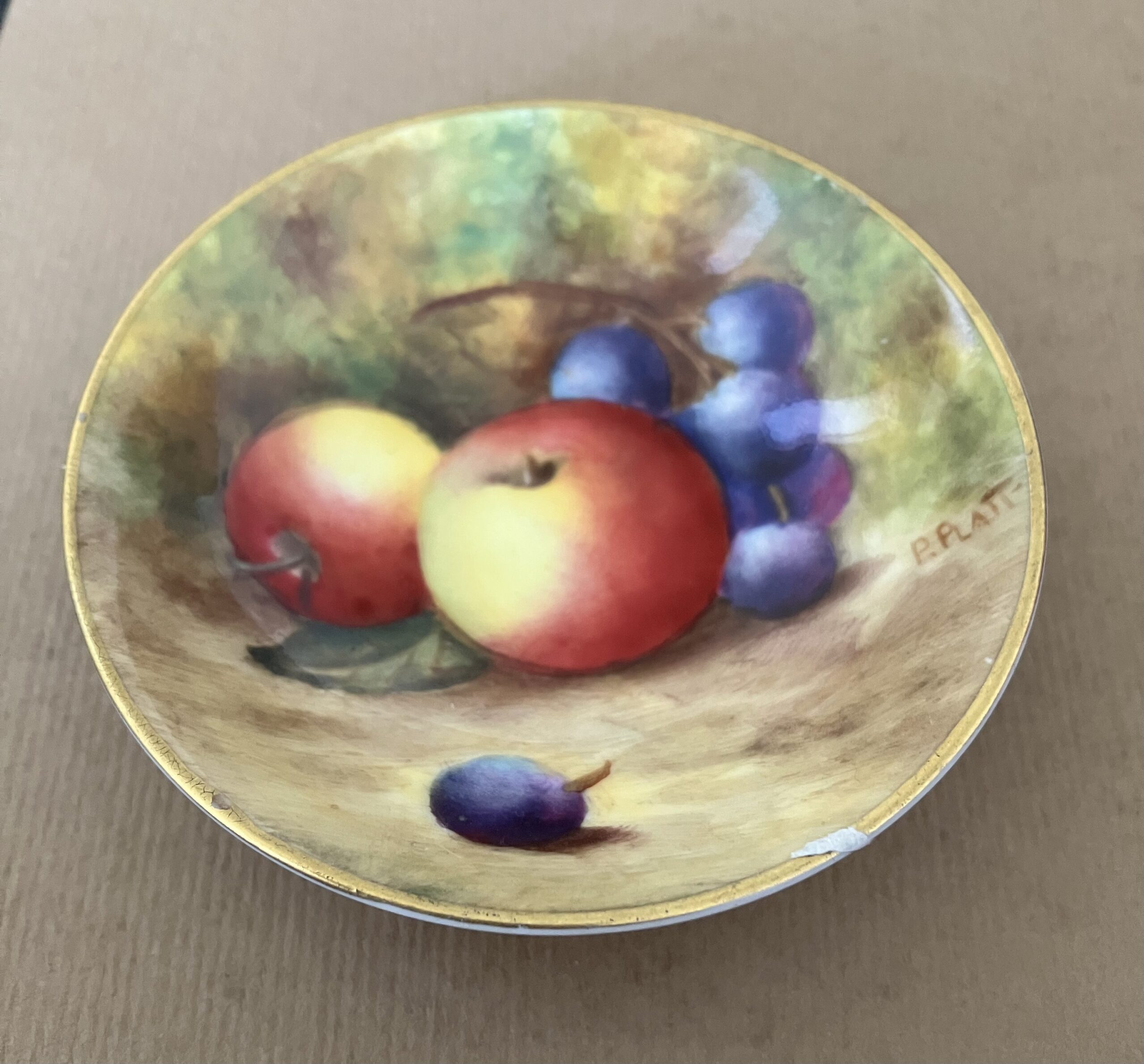
But the slower pace has allowed some time to wander the second hand shops and choose an ending symbol. I’ve written before about the importance of marking the end of a major research project and how I look for an object, generally in a second-hand shop, that symbolises the project.
i do this because I want to make visible the work done – in this case the work of finding people to interview, including groups that are harder to reach, the craft of turning hours and hours of interviews into themes with supporting quotes and the developing of findings.
I choose this object for this particular research project because of the colours – the reds and purples of the fruit in the bowl. I also choose it because fruit in a bowl is the result of hours of work – pruning in winter, weeding in spring, watering in summer, fighting birds in the autumn. And this particular project has the potential to yield fruit for the next few decades and the research played a key role in guiding decision-making around where and how to investment.
Which is research worth sprinting for. And fruit worth savouring as the project ends.
Tuesday, July 21, 2026
IAMS 2026 presentation: The role of digital technologies in the diffusion of handmade missional innovation

A late night.
But a privilege to present some of my Ordinaryknitters research at International Association of Mission Studies (IAMS) in South Africa this evening.
I am so grateful to the IAMS conference organisors for allowing hybrid participation. It takes more work but it makes conference attendance possible in a world of climate emergency and tightening budgets.

My presentation, on Making as connecting: The role of digital technologies in the diffusion of handmade missional innovation was part of the Christian Communities and Mission thematic stream.
One of the overall themes of IAMS was on the digital, so the call for papers allowed me to look at my interviews with knitters of Christmas angels through the lens of the digital. I knew there was plenty of evidence of making as connecting (the title of a great book by David Gauntlett) in real time in local congregations. But did the digital contribute to connecting?
Relooking through the interviews with knitters provided plenty of evidence of the value of websites, social media, QR codes, social media and YouTube videos playing a role in how the knitted angels spread. It was appropriate to then be able to present on the digital in an online setting.
The conference organisors asked for a 2000 word paper 2 months prior, which was available to be read by participants. The presentation time was given over to a brief summary, followed by conversation.
Hence there were plenty of great questions including
- can I have a knitted angel pattern please?
- did the engagement and motivations for knitting change over time?
- is there longterm fruit from the knitted angels?
- how to understand the digital connecting, given the value of face to face connecting in craft?
- does it matter if the open source website that began the project is not longer online? how to understand the transitory nature of the internet?
- could my research generate a website that shares knitting-as-mission and craftivism projects?
- what happens to symbols, like angels, when they cross cultures?
In preparing the 2000 word conference paper, I ending up drafting a full 5,000 word journal article, which with a few days of tidying up footnotes, is worth submitting.
Wednesday, June 24, 2026
tidy interviews
I borrowed a space yesterday to conduct another round of interviews in a commissioned research project. A local church kindly lent me their lounge space for a series of interviews I was doing with members of their church staff team. The photo captures the end of my time, with a take away coffee kindly supplied by the local church and my water bottle.

I have done 70 interviews for this project online, seated at my computer. The last 15 interviews have been face to face, traveling to meet folk in their spot. Tidying up my stuff after this round of interviews, then taking the photo, got me reflecting on how much is involved in an interview. Tucked away in my backpack after this interview was the following.
- My interview script with run order and questions prompts
- My laptop, with the visual of a theoretical framework that I am testing and refining as I listen to people’s lived experience
- A device to record the interview (I use my Iphone)
- A research journal for taking notes – and in case the recording doesn’t work or is accidentally deleted
- Pen for writing and a highlighter in case something is said I want to quickly come back (either later in the interview by way of a followup question, or during analysis afterward)
- A consent form, in case people want to re-read the consent details I have emailed them prior
- My demographics data capture sheet, one per interview
- A QR code for the participant to be able to complete a form and give their details to receive a followup thanks
- A few paper based forms, in case the participant chooses not to use the QR code
Having to pack and tidy up after an interview is a reminder that research is never as simple as talking and listening. There is hours of preparation, thinking through questions and workshopping various possibilities, as part of creating a smooth process.
Monday, June 01, 2026
making a single sock and the work of academic writing
I’ve just knitted my first ever sock. I’m feeling very pleased.

This sock is the result of several years of effort. A few years ago, I was given a book of knitted sock patterns. The book came with a bookmark carefully inserted, suggesting a place to start. So I brought the wool and began to knit.
But I’m a slow knitter. And I tend to pause when I get to tricky bits, especially tricky bits where I might need help from others, who might not currently be available. (My partner is a much more experienced knitter than I and a very helpful voice of calm when I find my knitting tricky).
So this week, after nearly 2 and a half years, I have knitted my first sock. While there were months of no knitting, often related to a tricky part approaching, it is clear that knitting socks is – for my slow fingers – a long and slow labour of love.
However socks come in pairs. And so amid the elation of completing a first sock, is the realisation that I am only half way there. It is a strange thing to feel both pleased and daunted and both at the same time.
This week I also submitted a 2,000 word conference presentation. It began as a possible idea in December 2025, 250 words submitted from a hotel room in Rwanda. Then a few weeks ago, I carved out a few hours and realised the data I was working with was far richer than I had remembered. Then a week ago, I carve out another few hours and realised that I could adapt a theoretical framework from some earlier writing.

So this week I completed a sock and 2,000 word conference presentation. These milestones got me pondering how knitting is like writing.
The data for the conference presentation comes from analysing 12 interviews from my Ordinary knitters research project. I was working with interviews from 2019 through to 2024. Five years! The theoretical framework comes from reading done in 2012, which became part of my First Expressions book published with SCM in 2019.
So the conference words are also slow words. And the Ordinary knitters research project is something I hope to turn into a book. Of which I have about 40,000 words, of a possible 80,000 word book project.
So I’m half way to a book and half way to a pair of socks. I’m feeling pleased with progress, yet daunted by progress. At this stage, I can learn about writing from the processes of knitting.
Both writing and knitting are projects too big to do in a single burst. But one stitch, repeated, makes a row. One row, repeated, makes a leg.
Friday, May 15, 2026
online interviews
A big week on zoom with 25 online interviews for an AngelWings Ltd research project, commissioned to research pathways to ministry across denominations. The big week brings the total number of interviews to 65, across ten denominations.
 Hence, as per the visual, this week also included the need to break out a second research journal, to help me take notes and record impressions from each of the interviews.
As my eyes got tired, I needed to touch the soft and tactile journal covers to remind my online wired brain of other senses, like touch, that help us feel and be in life.
To help me pay attention to each interview, I not only take notes. I also gain permission and use record. This allows me to play back the interview when I move from data gathering to data analysis.
In addition, I also keep a track of demographics of my participants. This involves a set of questions, drawn from the New Zealand Census, that clarifies ethnicity, age and qualifications. Plus three questions I developed myself around denomination and congregational connections. I record the responses after each interview, which allows me to keep a running check against national averages.
The mix of taking notes in journals, recording interviews for later playback and regular checking on the demographics of my population guides my research practice.
Friday, May 08, 2026
the digital in the making
I’m loving being back and re-reading interview transcripts in my Ordinary knitters research.
I’m working on my “Making is connecting” conference presentation for the International Association for Mission Studies IAMS. Today involved trawling through some of the 50 interviews with knitters who knitted angels, scarves and strawberries in church projects.

I was looking for the role of the digital in these knitting projects, like the Whatsapp group that began as a space to share knitting progress within a congregation and became a space for prayer. “I thought this was about bits of wool but actually this is about discipleship” observed one of my focus group participants.
It’s fascinating how material things – wool and technology – are spaces within which faith grows.
Tuesday, May 05, 2026
Digital faith-based activism: grassroots and indigenous insights special journal issue
The news is public.
As described in the Editorial for Issue 1, 2026, from Ecclesial Futures journal …
“Looking ahead, we have a cutting-edge Special Issue coming next entitled Digital faith-based activism: grassroots and indigenous insights, and having engaged with the submissions, I am sure this will advance scholarship in our field in several directions.”
This special issue, due in August 2026, on Digital faith-based activism: grassroots and indigenous insights is something I initiated and been quietly working away on in different ways over the last 18 months.
It began with my IASH Research Fellowship in Edinburgh, where I spent time researching around methods and methodologies for engaging in grassroots Pacific Christian digital climate activism. As my time at IASH ended in July 2024, I proposed a research colloquium, hoping to gather other scholars into the conversation, reflecting from their context. IASH accepted my research proposal and worked with me on a call for papers and a colloquium held in April 2025, as part of the IASH 50th anniversary celebrations.

This brought together 6 scholars, exploring grassroots and digital activism in diverse contexts in Asia, Africa and Oceania. All the initial paper proposals were blind peer-reviewed. In addition, there was review feedback by Dr Nuam Hatzaw and Dr Alex Chow at the end of the April colloquium.
I then initiated followup with these scholars, seeking feedback on if and how they might want to turn their spoken colloquium contributions into writing. Together we agreed on targeting a journal and I wrote a special issue proposal for Ecclesial Futures, connecting the aims of the journal with themes present in the various colloquium papers. The co-editor of Ecclesial Futures, Dr Nigel Rooms passed the special issue proposal around the Editorial board for feedback. A special issue was approved in August of 2025, slated for August 2026.
 In the meantime, I worked on a methodological introduction to the project, which was published as a journal article in Theology in 2025.
Visualizing online climate change activism: public eco-theologies in grassroots climate-justice organizations. Theology 128(4), 247-256. https://doi.org/10.1177/0040571X251354942
The full papers for the special issue were submitted in January 2026. Along the way, we gained a 7th paper, from a researcher in Europe. The co-editor of Ecclesial Futures handled the blind peer review process, engaging both members of the Ecclesial Futures editorial board to ensure consistency with the aims of the journal and review by scholars with expertise in digital theologies and indigenous ways of knowing.
With all the authors having responded to peer review, the 7 articles are now moving toward copy-editing and publication in August 2026. An idea in 2024 will become a reality in August 2026. And not just any reality, but a “cutting-edge” reality that will “advance scholarship in our field in several directions.” I’m so delighted for the field of climate activism and digital theology, for each of the 7 authors and for the local activists from grassroots and indigenous contexts whose work will be made available open access.
Friday, April 17, 2026
Psychology Cross-Training for Theologians resources
 Through much of 2024 and 2025, i was privileged to participate as a Fellow in the Psychology Cross-Training for Theologians Project, delivered by the University of Birmingham and funded by John Templeton. The Project encouraged collaboration between theology and psychology and fitted well with the empirical research I do for AngelWings Ltd, studying how change happens in communities and religious groups.
The Psychology Cross-Training for Theologians Project involved three visits to the University of Birmingham, for training in psychology engaged theology, along with 12 months of online meetings for research project development, complemented by online mentoring from an experienced psychologist. This was excellent professional development, particularly in qualitative and quantitative research skills and updating me on developments in open science approaches.
The Project also included small grant funding for a research project. For many years I have explored listening processes in educational and community settings. So I used the small grant funding to reflect on these experiences. Specifically, I conducted research into the social impact of spiritual practices, focusing on several practices that encouraged listening. I drew together cohorts of people in local congregations to share in a repeated spiritual practice of four or eight weeks. I gathered data on people’s experience including pre and post surveys, focus group reflection and research diaries.
 I have presented initial findings of this research at several conferences, including a poster at the Psychology-engaged Theology Conference and papers at the International Association for the Psychology of Religion (IAPR) and Ecclesiology and Ethnography. I have submitted two journal articles which are under peer review and am analysing data for two further journal articles.
The Psychology Cross-Training for Theologians Project has now made some of the resources available to the public. These include:
- a training course aimed towards researchers. This includes the modules, “Introduction to Psychology for Theologians,” “Foundations of Psychology-Engaged Theology,” “Research Methods and Practices,” and “Research Outputs and Dissemination”.
- a podcast series aimed towards practitioners, bringing current psychological research into practical dialogue with theological and pastoral questions:
- a resource list aimed towards RE teachers (or potentially those teaching undergraduate psychology of religion). This includes introductory animations developed by our team, including an “orientation to psychology of religion”:
- a blog series featuring reflections and reports from cross-training team members, fellows, mentors, and friends
I am delighted that some of my work during the Project occurs in these publicly facing resources.
Two blog posts I wrote are online. Interruptive Interviews at the Intersection of Psychology and Theology is co-authored with two other Fellows Dr. Alison Woolley and Dr. Allen Jorgenson. It reflects on our experience of semi-structured interviews in dialogue with psychology and how interviews can be spaces of hospitality that support the wellbeing of participants and deepen the spiritual encounter with self and others. Listening with Purpose II: A Theologian Reflects on the Interface between Theology and Psychology and reflects on what practical theology can learn about listening from psychology.
Finally, in the podcast series aimed towards practitioners, I have an interview reflecting on The social impacts of listening in community settings. I talk about initial findings from the research, how different congregations engaged and how spiritual practices can benefit congregations and community organisations. (While for some reason the Episode is listed as “coming soon” it’s still good to be profiled as producing practitioner resources!)
- Episode 1 – Ageing as a liminal experience in theological and psychological terms
- Episode 2 – Moral injury, spiritual damage, and abuse in Catholic ecclesial contexts
- Episode 3 – God and self-representations among Christians with intellectual disabilities
- Episode 4 – Necessary interdisciplinary reflections on racism in the Church of England, informed by psychological research
- Episode 5 – Associations between perceptions of God’s “where-being” (transcendent, immanent, or indwelling) and contemplative prayer practices
- Episode 6 – Patient and chaplain perspectives on the success of spiritual care visits
- Episode 7 – The social impacts of listening in community settings
At a personal level, while the Psychology Cross-Training for Theologians Project has finished, I continue with various dimensions. I have since used several psychology scales in survey design and in my writing. I am hosting with Dr Lynne Taylor a monthly Soul Space in our local congregation, which introduces a spiritual practice, locates it in Scripture, names the psychological benefits and invites sharing about what we as a congregation are learning as we practise a practice. I have continued research, including working with 7 congregations on a quantitative study around Lent. I continue to analyse data, hoping to write at least two further journal articles.
Tuesday, March 31, 2026
you’ve got research mail

Getting mail is the very exciting and deeply satisfying part of research.
And not just any mail, but parcels from the postie! Some local parcels from other parts of Aotearoa New Zealand. Some parcels from overseas.
Not just any parcels from the postie, but parcels with data! Inside the parcels are research diaries and survey forms. These contain insights from participants in the two different studies I’ve been running during Lent. One qualitative, the other quantitative, as I’ve researched the social impact of shared spiritual practices.
Much of the data collecting across the 7 congregations I’ve been working with this Lent has been electronic, through online surveys. But paper is more accessible for some participants. Which means more work at the start to print off copies and source research diaries. But at the end, it results in the exciting arrival of parcels 🙂.
I think I will be excited for a few more days before I pick up my orange and blue highlighters to signal the grind of analysis.
Friday, March 27, 2026
action research into spiritual practices takes the cake
I’m grateful for cake to mark the ending of another cohort of shared spiritual practice action research last night. It was a delightful gift from a grateful research participant. “But you’ve given so much,” they kindly explained.

During Lent 2026, I’ve shared silence with 5 folk face to face and 9 folk online. Silence for 10 minutes in week 1, 20 minutes in week 2, 30 minutes in week 3 and a focus group reflecting on the experience in week 4. I’ve gathered research data by seeking participant feedback on the experience through surveys start and end, individual diary keeping, the focus group and my observation.
It’s been enormously rewarding personally, to sit in silence with others and then to reflect with them on the benefits and challenges. The shared silence has also been a significant extension on the John Templeton funded research on spiritual practices I was doing last year. As a result of this year’s work, I now have 4 cohorts and 22 participants from 3 congregations who have shared silence over a four week period. My researching means that I have lots of reckons about the social impact of shared silence and it’s impact on individual, group and societal vitality. But before I share my reckons, I need to analyse the data.
After cake of course!
My thanks to the private trust who are making this slice (pun intended) of the research possible. And if other private trusts are interested in funding high-quality research into the impact of spiritual practices on congregational vitality, do get in touch 🙂!
Friday, February 27, 2026
the qualitative research box
This is my research box. For one of my qualitative research projects!

I’m researching the social impact of spiritual practices again.
Again, because during 2025, I conducted qualitative action research. I gathered four groups in church foyers and homes. I offered shared spiritual practice. Three groups shared lectio divina for eight weeks. One group shared silence for four weeks.
I gained ethics consent through the University of Otago and gathered feedback on the experience. This involved four different data gathering tools, including my observation, a focus group and a survey at the start and end. Participants also kept a research diary, with weekly prompts to help them reflect on their experiences of the practice.
During Lent 2026, I’m back conducting qualitative action research. I’m working directly with a local congregation and indirectly and online with another congregation.
Which meant last night I packed up my qualitative action research box.
Candle and matches to encourage silence. Cheese and crackers for snacks to encourage connection. Research diaries to give to participants. Manila folders with consent and survey forms. Pen, highlighter and my own research diary to keep notes. Various items to encourage engagement, like a resource book to wave and take home handouts.
Having a research box is such fun.
But having a research list is even better. Thankfully when I opened my file from last year, I find my “to take” list that I made at the end of each week in 2025.

And so hi, ho. With box and list, a researching I will go. Gathering insight into how people experience spiritual practice. Listening to understand social impact.


 )
)