Thursday, June 11, 2026
lost words and the spiritual discipline of journal keeping
I lost some words yesterday.
Travelling long haul from Germany to New Zealand, jet-lagged arriving into Singapore, I left my personal journal in the seat pocket of 57K.
I’ve lodged a lost and found claim with the airline. And while I wait – and hope – I ponder these lost words.
I journal regularly. I find it a helpful spiritual discipline to buy a blank journal, have some pens that feel good and to take time daily to write. What do I write?

The Psalmist writes of numbering our days. So on work days, I begin my daily writing by taking note of how I spent my time in the day gone. For example – 9 am – write; 10 am – research project – sending out 9 emails … and so on.
Next, I will write notes in response to the Lectionary reading. Often what results are reflections on the day gone in light of the Scriptures. Or a prayer for the day ahead.
Finally, I will record memorable moments from the day. It might be some words of encouragement. Or that I cooked up some apples, met a deadline, or tackled something I would rather avoid. I write my feelings and consider what that is saying about who I feel I am called to become. Occasionally, I will paste in an email or a concert ticket, and write about the experience.
How do I write? When I journal, I use different coloured pens. Days of rest tend to be green. Holidays tend to be orange. I will often use purple pens during Advent and Lent, and black or brown or blue during Ordinary time. Emails that I feel are significant are in red.
I will also often use symbols. A letter shape for an email. A hand drawn car when I drive somewhere, for example to grab a coffee or visit in town.
Why do I write? I write mainly to help me process. So that I remember things done well, or moments I’d rather forget. Which means that this element of my ongoing spiritual journey has not been lost. The words might be lost in the seat pocket of 57K. But in the moment of daily writing, I have already gained the benefit of pausing, reflecting, praying. For the gift of reflecting and praying and committing, I am deeply grateful.
What I have lost is the opportunity for review.
I review what I write weekly, often on the weekend. Looking back over the week helps me gain a sense of how I spent my working time over a week – I count up hours in relation to various project – and then consider that in light of my sense of vocation. I will also use a tick symbol and note what has been achieved. Number of runs for exercise. Billable hours. Significant conversations. These all help with gaining perspective. So what I have lost are my weekly reviews since I opened this new journal, back in March.
I also review the year annually. This involves taking time during summer holidays to read back over my entries for that year. I sit with the emotions. I ponder recurring patterns. This helps me plan my way forward, as I think about the year ahead.
So unless my lost words are found, it looks like this year I have lost 3 months of review. But I will still have nine months. Plus the 12 months of the daily discipline of spiritual journal keeping and the gift of time to pause and pray. That has not been lost. And for that I am grateful.
Monday, April 20, 2026
the practice of breath prayer in the Gospel of John
 Breath prayer is present in the ministry of Jesus. In John 20:19-23, Jesus greets the disciples after the Resurrection. This Gospel account is generally theologised in relation to the Spirit (Receive the Spirit) and connected with creation and new creation (God breathing the breath of life into the Adam in Gen 2:7). The Gospel account is also a matter of theological dispute, with different denominations debating the relevance of John 20:22 for the practice of the Christian sacrament of confession.
Amid these theological debates, what is regularly overlooked is the practice by Jesus of breath prayer – defined as “a form of contemplative prayer linked to the rhythms of breathing: (1) breathe in, calling on a biblical name or image of God, and (2) breathe out a simple God-given desire” (Calhoun, Spiritual Disciplines, IVP, 2005, page 204).
The actions of Christ (“breathed on them” John 20:22) are a drawing in of oxygen and out of carbon dioxide that is mixed with saying of words of peace. In breathing, Jesus is offering a calm physical practice to a group of “freeze, flight, flee” people. We’ve all been told to “just breathe” when we feel strong emotions, because breathing reduces stress and promotes well-being. So the “peace be with you (John 20:19; 21) is not only words. It is the embodied act of breathing when your “doors are locked for fear of the Jews” (20:19). The practical shared practice of breath prayer is present in this Biblical text.
Further, the practical shared practice of breath prayer provides another way of interpreting verse 23 – If you forgive anyone (breathe out in release), they are forgiven … if you do not forgive (hold breath and not release), they are not forgiven. These words, said after Jesus has offered the disciples breath in verse 22, provide a way of interpreting the words about forgiveness in verse 23. The in and out of breathing illustrates the in and out of human forgiveness. We are hurt and we hurt. It is better to release than to hold on. In breath prayer, we can physically explore what it means to breathe in peace and forgiveness, in order to breathe out peace and forgiveness. Sometimes in the simple act of doing something, our emotions find new pathways.
Try it with me. As you consider how someone betrayed you, deeply breathe in God’s peace, hold for a few seconds, then imagine breathing that peace from God out over the person who betrayed you. Repeat these with ongoing deep breaths. This is not something you start, or feelings you need to manufacture. Rather, it is something you share, as you join God’s first and initiating breath of peace in all of life. Sometimes in the simple act of doing something, our bodies find new possibilities.
Friday, February 27, 2026
the qualitative research box
This is my research box. For one of my qualitative research projects!

I’m researching the social impact of spiritual practices again.
Again, because during 2025, I conducted qualitative action research. I gathered four groups in church foyers and homes. I offered shared spiritual practice. Three groups shared lectio divina for eight weeks. One group shared silence for four weeks.
I gained ethics consent through the University of Otago and gathered feedback on the experience. This involved four different data gathering tools, including my observation, a focus group and a survey at the start and end. Participants also kept a research diary, with weekly prompts to help them reflect on their experiences of the practice.
During Lent 2026, I’m back conducting qualitative action research. I’m working directly with a local congregation and indirectly and online with another congregation.
Which meant last night I packed up my qualitative action research box.
Candle and matches to encourage silence. Cheese and crackers for snacks to encourage connection. Research diaries to give to participants. Manila folders with consent and survey forms. Pen, highlighter and my own research diary to keep notes. Various items to encourage engagement, like a resource book to wave and take home handouts.
Having a research box is such fun.
But having a research list is even better. Thankfully when I opened my file from last year, I find my “to take” list that I made at the end of each week in 2025.

And so hi, ho. With box and list, a researching I will go. Gathering insight into how people experience spiritual practice. Listening to understand social impact.
Friday, February 13, 2026
pen labyrinths and centring prayer
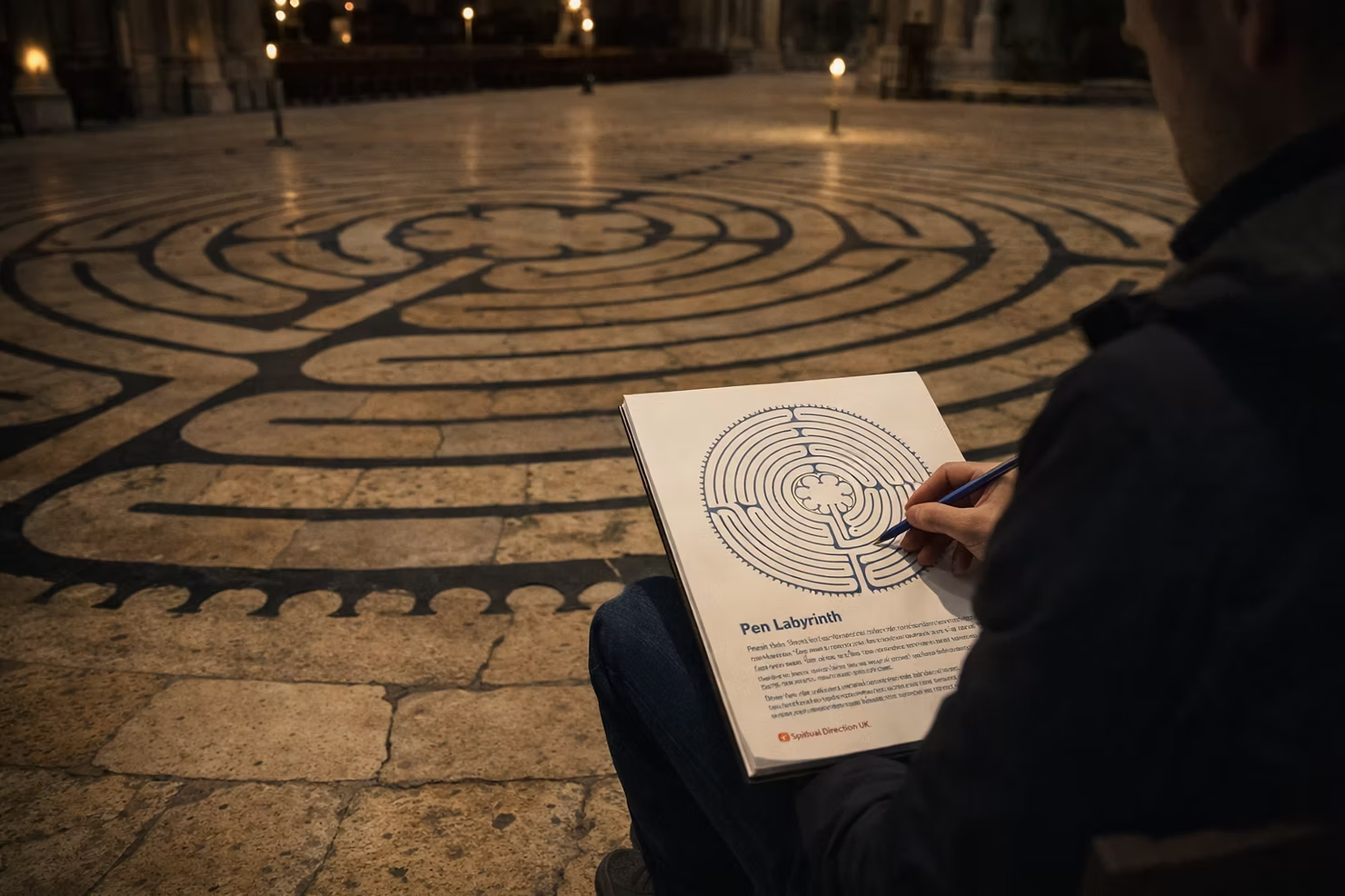
For those interested in cultivating spiritual practices, the article (“How to Use a Pen Labyrinth for Reflection or as a Centering Practice“) provides some very practical resources for centring prayer and reflection. The author, Bruce Stanley, has a track record of design, innovation and spiritual care. He brings all these dimensions together to offer some paper labyrinths, that can be printed out.
You can walk the labyrinth without leaving home!
The designs are based on real places, which is connects with real places (Ely in England, Chartes and St Omer in France) and the spiritual lives of thousands of people who have, and continue, to walk these paths. You might be at home but you are not alone!
Bruce also offers suggestions for how to use the labyrinth as a tool for reflection and centring prayer.


 )
)