Tuesday, November 17, 2009
advent blessings: worship 2 go 2009 resource
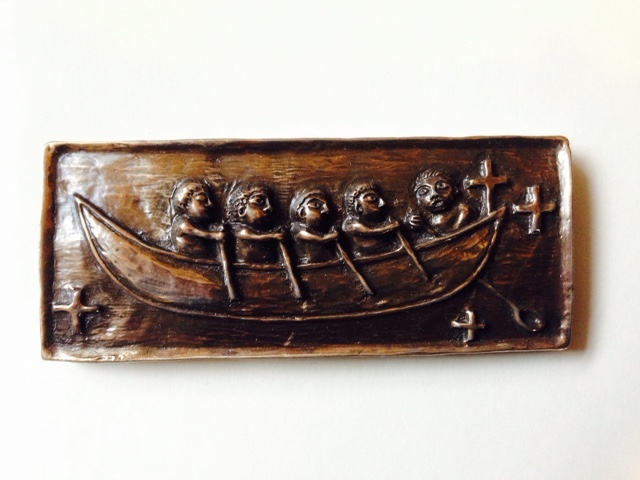
 These are a draft copy of our 2009 Advent resources. It marks a different Advent approach. Rather than journey with either Christmas art (and copyright issues) or Lukan story or the Old Testament prophecies, it takes the theme of blessings.
Specifically, four blessings – Numbers 6:23ff, 2 Corinthians 13:14, Jude, Luke 1:42. Each blessing is also an ending, and so as the year ends, what does it mean for Christmas to be about blessings. Each with a reflection, an invitation to consider blessings of God and faith embodied. Each with suggestions for practical blessing to do during the week. A spirituality2go resource.
The art work is done to include the possibility of turning the cards into banners. This allows Sunday worship to interface with the cards. We are also working on a video, to be played in and around the blessings.
They go to the printers on Friday 20 November, 3 days away. So if you want to to share the “blessings” of shared costs, ie piggyback, you have 3 days to let us know. $2/set of 4, plus postage and packaging.
Monday, November 16, 2009
if you need me to fed you
“how do we get fed? – You pick up a spoon! What are you… a baby?!” Great quote from Andrew Hamilton.
I had not come across this “need to feed” until I came to Opawa, when after a few months, I was told my preaching was not feeding some people.
Which on reflection, really got me scratching my head. It suddenly occurred to me that the people needing feeding had been around the church a long time. Some had even got to Bible Colleges. Presumably they’d heard a lot of sermons. And been to a lot of weekly Bible study home groups. Presumably matured.
If they needed feeding, then what did that say about all preaching, not only my preaching. And what did that say about their own patterns of feeding, daily?
Which raises again the perennial question – what is the point of preaching? And more pointedly, what is the point of preaching “in such a time as this”? To feed? To inspire? To open windows?
And leads nicely into this blog series by Scot McKnight, on preaching underpinned by a thoughtful, integrated educational approach. Scot’s approach intuitively rings some bells for me.
A very early influence on my preaching was a communication seminar I attended, led by an adult educator. Who asked a whole lot of educational questions about how people are formed. And then applied them to preaching.
So I like Scot McKnight’s instincts – refusing to throw out the baby with the bathwater by scorning preaching. But equally, refusing to somehow treat preaching as sacrosant, above educational insights. In so doing, he opens the door for us to begin to take seriously how all of our church life can be forming people – worship, small groups, billboards, websites, video …
Saturday, November 14, 2009
a spirit of wonder: imagining a church creatively immersed in culture

This is one of the first courses, I’ll be involved with next year in Adelaide. Teaming with Jonny Baker, Cheryl Lawrie and Tim Hein pondering topics such as spirituality and the imagination, intuitive leadership, forming pioneering leaders….and plenty more.
When: 8-12 march 2010
What:
* input on spirituality & the imagination, intuitive leadership, spirituality & contemporary culture, fresh expressions of church, forming ‘pioneer’ church leaders, worship ‘beyond the fringe’, scripture, spirit & culture
* artistic installation at Adelaide Fringe Festival event – “The Landscape of Desire”
* visit to CitySoul – new young adult faith community in the city centre
* involvement in the Adelaide Fringe Festival and Adelaide Hills wineries
Sponsored by Uniting College for Leadership & Theology in association with Pilgrim Uniting Church. The events may be undertaken as an Masters Ministry course (that’s been my contribution so far, suggesting a vehicle by which people can integrate their experience into formal, existing structures through reading and participation as action/reflection).
Cost & Registration details available from here.
Wednesday, November 11, 2009
Sharing faith across cultures
A reality of our times is that we live in a pluralistic world. This has been incredibly important in sharpening how we think about other faiths. We live between two (unhelpful IMHO) poles: silence, in which a person is too scared to share the sacred story of God’s work in their lives and hostility, in which the way a person shares is rude, intolerant and antagonistic.
These poles apply to all faiths. I sat in a taxi a few weeks ago in Australia. When I mentioned I was a church minister, for the next 40 minutes the taxi driver lectured me on his faith. He was struggling with the two poles, not wanting to be silent, but in his monologue, ending up rude and intolerant.
Richard Sudworth is a CMS missionary, working in a Muslim majority part of the (English) city of Birmingham. He is part of a Christian-Muslim Forum launched their “10 Commandments of Mission”, offered as a conversation starter in an attempt to establishing honest and workable relations between faiths that allows for freedom of conscience.
Here are their 10 commandments of Mission.
1. We bear witness to, and proclaim our faith not only through words but through our attitudes, actions and lifestyles.
2. We cannot convert people, only God can do that. In our language and methods we should recognise that people’s choice of faith is primarily a matter between themselves and God.
3. Sharing our faith should never be coercive; this is especially important when working with children, young people and vulnerable adults. Everyone should have the choice to accept or reject the message we proclaim and we will accept people’s choices without resentment.
4. Whilst we might care for people in need or who are facing personal crises, we should never manipulate these situations in order to gain a convert.
5. An invitation to convert should never be linked with financial, material or other inducements. It should be a decision of the heart and mind alone.
6. We will speak of our faith without demeaning or ridiculing the faiths of others.
7. We will speak clearly and honestly about our faith, even when that is uncomfortable or controversial.
8. We will be honest about our motivations for activities and we will inform people when events will include the sharing of faith.
9. Whilst recognising that either community will naturally rejoice with and support those who have chosen to join them, we will be sensitive to the loss that others may feel.
10. Whilst we may feel hurt when someone we know and love chooses to leave our faith, we will respect their decision and will not force them to stay or harass them afterwards
Now, I want to place this alongside Luke 10:1-12. Jesus sends disciples out in mission. They are not to be quiet. Rather they enter the culture with the instruction to speak “peace.” This fits with (1) and (7). It also is an endorsement of (8), in that it names faith clearly.
If peace is returned, then the disciples are to dwell at table, eating and drinking what is placed before them. This seems to me to fit with (4) and (5). The disciple is placed as a receiver of hospitality, depend on the culture. As such, they must be willing to do (6), to find ways to name the Kingdom in ways congruent with table fellowship. It also allows due care (9), to occur in a natural and relational way.
If our message is rejected, the disciples are to leave. Mission is not coercive and does not overstay it’s welcome. It retreats when it is not wanted. Reading Luke 10:12 can sound judgemental, but when placed alongside Luke 9:51-56, it suggests a willingness to let go in gracious humility. This fits with (3). It is also essential to (10).
Essential to Luke 10:1-12 is the fact that the disciples are sent ahead of Jesus, yet reliant on the work of the Spirit in order for hospitality to be enacted. This fits with (2).
Or, in the words of An Introduction to the Study of Luke-Acts

“From this description of mission ‘strategy’ we could not possibly draw the notion of domination in any way.” (89) and “It is a mystery how this sense of the text could have escaped colonialist-minded missionaries. The idea of imposing a Christian culture on a receiving culture is foreign to this text.” (90)
People used to being in control, at the centre of a culture and a conversation (whether Christian or Muslim) will not find this easy. However, our Biblical story, the narrative of Luke 10:1-12, offers us resources. So “Lukan/Biblical” applause to Richard Sudworth and the Christian-Muslim forum for finding a creative way beyond those two poles of silence and hostility.
Tuesday, November 10, 2009
what European colonisers had done
“[I] should have instead referred to what European colonisers had done.”
So said Hone Harawira today. As Hone was speaking, I was reading Buddy Mikaere, Te Maihora and the promised land, (Reed 1998). Here’s some statistics from the book, which throw some light on “European colonisers” in the South Island.
– In the 1840’s, Maori sold to the European all the land from Kaiapoi to Otago, 8 million hectares, stretching from one coast of New Zealand to the other.
– They were paid 2000 pounds. For 8 million hectares!
– In exchange, they were promised “large” reserves. However the size of these reserves was not undefined. It ended up being 2.5 hectares per Maori, about 3,500 hectares. That’s quite a reduction when you used to have 8 million!
– The deal also promised schools and hospitals. Those never really materialised.
– When they complained to Parliament, the so-called highest law courts, they realised that was by vote, and Pakeha outvoted Maori!
I wonder how I would feel if that happened to my ancestors?
I’ve already blogged a bit about the apology. But I end up admiring a guy who can say this publicly:
Mr Harawira said his wife saw the email shortly after it was sent and told him that he should not have sent it. “What I should have done is ask her to look at it first before I sent it,” he said. Asked if she was angry, Mr Harawira said: “love conquers all”. Here
making news: a lived Christian faith
Monday nite news. TV 3. A quirky story about a man who finds $20,000 in a lamp up for auction.
And then in the final 5 seconds comes the question: what set of rules shape that sort of behaviour? And the camera pans to the mans T-shirt. WWJD. Check it out.
Great example of a lived Christian faith!
Monday, November 09, 2009
film reviews: Four holidays, Doubt, Gran Torino, Pink Panther 2
I’ve fallen badly behind in posting on the blog my film reviews. The assignment: 500 words, monthly, offering a Christian perspective on contemporary film, paid, for Touchstone (Methodist) denominational magazine. Here are my 2009 reviews for the year to date.
Four Holidays. As we light Advent candles, so does Hollywood, trying to dazzle us, not with hope, peace, joy and love, but with Bad Santa (2003), Polar Express (2004), Deck the Halls (2006) or Fred Claus (2007). This year’s Christmas cracker, Four Holidays, gave little bang for its buck … for more.
Doubt. Doubt has always suffered an uneasy existence among people of faith. Even after the resurrection of Jesus, the disciples of Jesus are divided between worship and doubt Matthew 28:17). For Frederick Buechner, “Doubt is the ants in the pants of faith, it keeps it alive and moving.” Yet the space between pants and skin is never for the faint hearted. In this space enters Doubt … for more.
Gran Torino. In the downhill journey to Easter, a central figure is Caiphas, the Jewish high priest, who announces that it is better that one man die for the people than that the whole nation perish (John 11:50). Such understandings, of the power of sacrifice to ensure community transformation, are ingrained in Christian faith and make Gran Torino a gritty contemporary exploration of these themes in our world today … for more.
Pink Panther 2. The Pink Panther is back, and the return is welcome … for more.
stars from our Grow in Parikaha peace service
Great night at Grow last night. The theme was Grow through local peace stories and we kicked off with the Parihaka story. (Tuahawi and Taroro coming up in future weeks!). Mark Grace was a star, speaking really well, weaving his story, the Bible story and the Parihaka story together.
Those gathered were all stars, with some excellent table sheet interaction. God was a star, with stories that affirmed God’s Spirit alive and well at Parihaka.
And the playing of this fantastic video was also a star. They need to produce a youtube clip for the Parihaka Peace Festival 2010, with Tiki Taane or Dallas Tamaira (Fat Freddy’s) trumping that little Irish-man (Bono the Vox).
Sunday, November 08, 2009
communion anabaptist style
Worship. Which I often define as all that we are responding to all that God is. It includes our bodies, our seating relationships, our words of prayer. Today we continued our series on Turning points in history and the focus was the radical reformation. Especially given that the Baptists are 400 years old this year.
A perfect time to rearrange our church seating, swinging some of the pews into a “U” shape. So that we took communion looking at each other, at the body of Christ, rather than the person at the front. Lots of positive feedback on this very simple change in our church architecture. An embodied realisation that we gather as human people.
A perfect time to pull out this communion liturgy written by Balthasar Hubmaier, an early Anabaptist theologian. I pulled out some phrases I considered noteworthy and invited us to pray them together.

Brothers and sisters, If you will love God before, in and above all things. Response: I will
If you will love your neighbour and serve with deeds of love. Response: I will
If you will make peace and unity and reconcile among yourselves. Response: I will
If you will love your enemies and do good to them. Response: I will
So eat and drink with one another in the name of God the Father and the Son and the Holy Spirit. May the Lord impart to us his grace. Amen
Note the fascinating progression in the theology of this communion prayer: -> God -> neighbour -> church community -> enemies. At times Baptists are considered functional pragmatists. These words suggest in fact a deeply relational and missional theology, expressed in the acts of worship and engaging the reality of everyday life. It sounds quite contemporary for a prayer written over 400 years ago!
Saturday, November 07, 2009
reading our R-rated Bible
The Bible has some appalling moments: R-rated stories of violence and violation. In preparing for worship for this Sunday, the Lectionary reading suggested is Isaiah 24. To use that text then demands almost a sermon in explanation. However doing a sermon (thus making 2 for the service) was not the task given to me as curator of worship this Sunday. Instead, I chose use the Psalm of the day as the Lectionary reading. And felt guilty all week. Then read this from Maggi Dawn.
Pretty often I edit our lectionary very liberally on the basis that the unthinkable, unimaginable horror stories in scripture should only be read in services where there is an adequate space to address them, and when it’s a read-sing-pray service, the readings have to be selected appropriately. That’s not at all the same thing as editing out the dodgy bits – it’s about choosing when and where they are read, with the possibility of addressing the strange and difficult readings.
So that’s two options for dealing with the R-rated:
1. edit when there’s little time
2. make time to deal with the tough texts. Like I hope we at Opawa have tried to do with our Bible days this year. As we start a new Bible book, we offer a 2 hour Saturday seminar on tools for reading that book and how to deal with the tough texts. The feedback has been very positive over the year and we’ll continue the pattern in 2010.
Maggi has a great 3rd suggestion, changing the congregational response. Rather than “Thanks be to God”, she suggests: “This is an outrageous story to our ears – what does the ancient text have to tell us about what they thought about God then, what we think now, why we still read it at all?” I like. It allows us to be honest. It names the two horizons – that ancient world and our world. It affirms that this text is important enough to keep reading and in a way that invites curiousity and question, not outright rejection.
So that’s 4 options:
1. Steve Taylor’s choose the easier reading
2. Maggi Dawn’s keep but edit the hard bits
3. Opawa’s offer Bible days
4. Maggi Dawn’s change the congregational response.
What do other reader of the Bible text do when they hit the R-rated bits?
Growing in unpeace stories: an updated response to Hone Harawira
Updated: Hone has apologised. This includes in relation to my point 1, in which he adds a very helpful nuance, specifically that of “colonisers.”
“He should have instead referred to what European colonisers had done … He accepted his language had damaged Maori-Pakeha relations and he apologised for demeaning women. The controversy had damaged his credibility and he would be doing “serious bridge building” with his caucus.”
And he commits himself to bridge-building. I honour that sentiment in him. Now will Pakeha, and the media, give him the space to move and grow?
Public disclaimer: I have been very tempted to vote for the Maori Party at the last two elections. I felt that the Foreshore and Seabed legislation was an injustice, a misuse of political power and a disgrace to New Zealand’s commitment to the Treaty and that we needed a Maori voice in Parliament, not hobbled within a larger party.
So it’s interesting to hear the following Maori party opinion on my voice, culture and ethics.
“Gee Buddy, do you believe that white man bullshit, too, do you? White motherf***ers have been raping our lands and ripping us off for centuries and all of a sudden you want me to play along with their puritanical bullshit.”
So wrote Maori political party member Hone Harawira recently.
Well yes, at Parihaka (which we remembered on this blog only a few days ago) white men did. It was a sad and shameful day that I wish it had not happened.
But Hone do you really think that the best way to move the discussion forward is to
1 – Lump me and my white friends today in with that story? You run the risk of connecting me to history solely by skin colour. And that’s racism isn’t it?
(When I seek to grow people in peace through mediation techniques, I suggest a groundrule, that we stick to the issue, that we play the ball, not the person. That includes racist cultural comments)
2 – Assert that a historic wrong by one culture gives another a culture a right to different codes of behaviour? If you don’t like the codes (in this case being sent to work in Europe on political business and using a day to be a tourist in Paris), by all means protest the codes. But do that before you go. Not after you’ve been caught.
(When I seek to grow people in peace through mediation techniques, I suggest a groundrule, that we deal with issues one at a time. If you have concerns with history, we seek to listen to each other around history. If you have a concern with puritanical ethics we seek to listen to each other around ethics. If you have a concern with how the relate together, we seek to listen to each other around all three. But jumping from issue to issue is rarely helpful.)
3 – Hone, the city of Paris was built partially on French colonial pillage. So it seems quite rich for you to enjoy the Parisian pillage, and then protest the pillage upon return?
(When I seek to grow people in peace through mediation techniques, I suggest there are times to apologise, not just with words, but by outlining ways that the person will act in the future to ensure the behaviour is not repeated. What could look like in this situation Hone, so that you and I can move on, so that we are not forever referring back to this moment in history, so that I can have confidence to vote for your party in the next election?)
Wednesday, November 04, 2009
Parihaka day: Growing in local peace stories
We need to be blessed by peace stories and peacemakers. Desperately. Even more, we need to be blessed by local peace stories and local peacemakers. Hearing allows us to grow in peace. So join us
Sunday, 8 November, 7-8:20 pm, Opawa Baptist Church foyer, part of our Grow service.
Mark Grace, Tertiary Students Christian Fellowship will share some of his life story. It includes growing up Pakeha, becoming a Christian and as an adult starting to discover his Maori roots. Including a local Kiwi peace story, the events at Parihaka between Maori and Pakeha. A local peace story over 100 years old, that has grown, blessed and challenged his understanding of Christian faith.
Updated: For more on Parihaka here’s something I wrote for radio a few years ago (more…)
death and dying: contemporary trends and Christian life
A fascinated opinion piece by theology professor, Tom Long in the New York Times. It’s on cultural trends in funerals. I have just finished a course on reading contemporary culture. We look at cultural icons – at Nike shoes and play stations – and the implications for being human today. How then to live, and to live life to the full (John 10:10)?
Reading Long pushes me to think about another dimension of contemporary cultural change, that of recent trends in the funeral industry.
For the first time in history, the actual presence of the dead at their own funerals has become optional, even undesirable, lest the body break the illusion of a cloudless celebration, spoil the meditative mood and reveal the truths about grief, life and death that our thinned-out ceremonies cannot bear.
The context of course, is Halloween, that day in which a society faces death by dressing up and trick or treating. Long surveys contemporary funeral practices. Such as increasingly gaudy coffins. And the trend to no longer accompany the body to the crematorium or graveside, but instead to let the body be driven, while the cup of tea is poured back at the church.
Long concludes
“Show me the manner in which a nation cares for its dead, and I will measure with mathematical exactness the tender mercies of its people,” William Gladstone, the British statesman, is said to have observed. Indeed, we will be healthier as a society when we do not need to pretend that the dead have been transformed into beautiful memory pictures, Facebook pages or costume jewelry, but can instead honor them by carrying their bodies with sad but reverent hope to the place of farewell. People who have learned how to care tenderly for the bodies of the dead are almost surely people who also know how to show mercy to the bodies of the living.
It brought to mind a similar conversation with a New Zealand funeral director a few years ago, alarmed at industry trends in which families are being encouraged not to accompany bodies to the place of burial. And the contrast between Pakeha funerals and Maori funerals, in which the body stays at the house and on the marae for a number of days. And how it allows a different type of grieving, a greater acceptance of death, a wider range of emotions, a greater relational connection.
And the contrast with that common euphemism “passed away.” So easy to use weasel words that mask the reality that life matters and things hurt when what matters becomes broken.
The church has many options for doing mission today. They include helping people face death with honesty, reality and Christian grace.
Tuesday, November 03, 2009
a genuine Salvation Army trumpet call? updated with resources
I am with a group of Salvation Army leaders today. Flying up to Wellington, then driving to Masterton. Then speaking for 3 sessions, on mission, change, leadership. Then driving back to Wellington, and home for a (late) dinner.
It is the fourth time I’ve been with a group of Salvation Army leaders here in New Zealand speaking in areas of mission and change. I have yet to see a genuine trumpet and a real uniform! But I remain hopeful.
The best thing is that this group has requested a copy of my The Out of Bounds Church?: Learning to Create a Community of Faith in a Culture of Change
Updated: For those interested here is a summary of my sessions, the questions raised and the booklist that was missed off the bottom of my notes. Duh! (more…)


 )
)