Tuesday, August 09, 2005
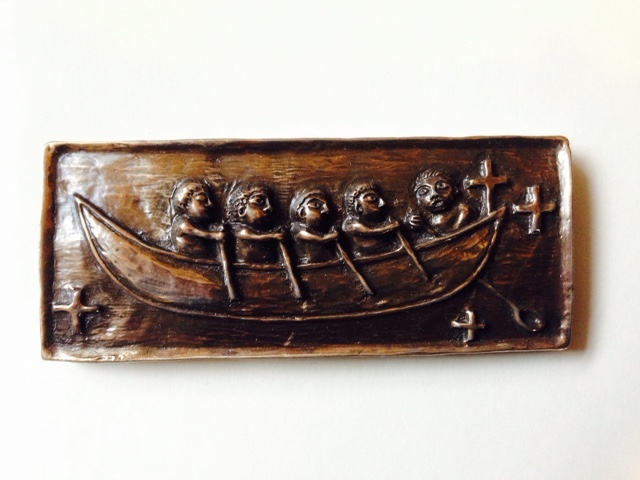
the liberation of a missional leadership text
On Sunday I began a series on leadership (the sermon is available here, along with some discussion questions for study groups). I am concerned that leadership is often reduced to certain styles and personalities. So I find 1 Corinthians 3:5-4:21 liberating. Paul uses 6 different images to describe his leadership.
Paul has planted some house churches in Corinth (done the “apostolic” thing). Now there appears to be conflict over leadership. Paul continues the “apostolic” thing (perhaps working to protect the missional DNA of this early church plant?), by tackling understandings of leadership. He then offers 6 different images of leader; Servants; Workers; Builders; Resource managers; Cross carriers; Parents. To me this is wonderfully liberating and offers a whole new range of leading.
In honour of Al Hirsch, and in some good-natured Tasman-banter, I am calling this the “SWBRCP” model (not as easy to say as APEPT, and therefore unlikely to be as catchy, I know:)). A few weeks ago, when I wondered aloud about the APEPT model, Alan commented back:
“suspect many of you would not like to be part of genuine missional movements because of your reserve on so many things. How are we every going to change things if everyone is so touchy about basic biblical ministry?”
So in honour of being so “touchy” about being Biblical and missional, I offer the “SWBRCP” model; arising from the missional ministry of 1 Corinthians. For in the wonderful diversity of God, some are called to be apostolic leaders as servants; others as workers, others as builders; others as resource managers; others as cross carriers; others as parents.
Now I am not suggesting that this “SWBRCP” model should have books written about it. Heaven forbid. Rather, I wonder, if given that Paul can suggest both SWBRCP and APEPT, perhaps we are being offered uniquely creative leadership for every different context. I find this missionally liberating.
Monday, August 08, 2005
post-it prayers

This has worked well the last two Sunday evenings. Invite two people to stand with their backs to the audience. Give out post-it stickers and invite the rest of the congregation to write “thanks God for” prayers on the post-it’s, and place them on people’s backs.
Its a fun and interactive way to pray. It uses gifts of encouragement (which, according to the apostle Barnabas, are at the heart of the missional church). For it’s impact, on Amy, (who is part of the ministry team at Opawa) read here.
Friday, August 05, 2005
colouring our worship
Context: I have been thinking about how to name the wide range of emotions and experiences people bring to church. I am going to try this on Sunday and am wondering if it could become a regular part of our Sunday morning congregation.
Environment: cross at front, colour paint chips in baskets around church.

Thursday, August 04, 2005
Excuse me while I scream
I had to send the following email yesterday:
Hmmm. I think a major oops has happened here. I have nursed a guilty conscience all this year cos you sent me an email after [the conference] asking for something written and I didn’t think I’d sent anything, hence my nursed guilt.
Then in June I met [another of the conference organisers] and he thanked me for my contribution to the [conference] book. I was puzzled.
Now I understand. At the end of the conference I gave participants a copy of part of a chapter from my out of bounds church book. And it appears that you have typed in by hand, then edited that chapter (you will be the 3rd person to do it, since Zondervan did it twice also!) Big scream all around – either of laughter or pain, I am not sure.
The upshot …
Wednesday, August 03, 2005
some good news
For those who don’t read the out of bounds church? book blog, I’ve been smiling for the last few days because a complimentary copy of my out of bounds church? book arrived on Monday, with the news that my publishers have commissioned a second print run. So I am quietly thanking all those who have brought copies and made this possible.
Note: (I set up the out of bounds church? book blog to offer various extras in relation to the book – like the original postcards in colour, like sections cut in the editing process, like my responses to questions emailed to me by book readers and also to collect all the reviews and blog comment/ary on the book.)
Tuesday, August 02, 2005
it is a beautiful book

Early this year I was asked to write an article for a German artist, Sieger Koder. I said yes, intrigued, but a bit cynical about what would result.
I got the result over the weekend. It is a beautiful book. It is hardcover and A4 size. It is full colour on glossy pages. It features the gorgeous art of Sieger Koder. It is written in German, apart from one chapter, written in English. That chapter is mine. I am very proud to be part of such a beautiful book. I love the fact that in the grace of God I get to write words for an artist in a foreign country. It’s a long way from a scrawny kid growing up in a jungle in Papua New Guinea.
For more on the book go here. For a summary of the article, go here.
Sunday, July 31, 2005
fat freddys drop live review
Saw Fat Freddy’s Drop live at the Town Hall last nite. I first saw them live in 2003 and loved their unique mix of lanquid songs nourished by phat beats, and the spacious sounds within which are woven a unique blend of vocals to a unique mix of reggae, jazz, even soul. They are one of the best live music bands I have seen.
An opportunity for all my overseas readers to check out some of the best in current Kiwi music. European dates:
Saturday, July 30, 2005
the real nature of apostolic leadership in a post-Christendom context
times of transition and rapid change require grieving. And there is the key. Women are much better at grieving than are men, who tend to simply amp up the energy.. full speed ahead, damn the torpedos.. we tend to reach higher rather than embrace the call to fall.. to look inside.. to slow down.. to weep. We arent good at liminality.
So.. here is an opportunity.. to learn from our women, to listen to those we love and cherish, and who cherish us in return.. to listen to those who are often pushed aside, those we have often thought weak. I think if we can learn from women how to grieve, we have a better chance of moving forward into the things the Lord wants to release to us. Women are the ones who give birth anyway..
Remember FOTR..Galadriel says that these are the times when love is now mingled with grief
Friday, July 29, 2005
slow learner
How to talk about church membership in our contemporary world? How to raise the bar around participation and values, while being open-handed and hospitable? I’m learning. Slowly.
I’m learning
1 … every few months to offer a newcomers cafe …. nothing structured, just a time to eat and a few get to know you questions.
2 … every few months to offer a membership evening.
3 …. to start by asking people what they are praying for about the church. You see, membership evenings can be “sales” evenings. But Opawa is actually a very human church. We’ve got lots of warts. Asking people what they’re praying for about the church gives me feedback on some warts, and reduces the “sales” pitch factor.
4 … to talk about the journey we’re on, including our Denominational past. I mean, we as humans, we’re all shaped deeply by our parents habits. Apply that to church and we have lots of strange corporate habits. So talking about our past might make it easier to understand our strangeness.
5 … offer concrete ways to participate. I give people a participation survey form. I try to keep it to one page, but offer lots of ways to get involved. This goes into a database. And it can be given back to them annually, to allow them change and flex and growth.
6 …. finish with Ello, kids lego. Invite people to use Ello to make their prayer for the church. People talk, people laugh, people explain, and it’s a spiritually real way to end.
(Context. I ran a membership evening last nite.)
Thursday, July 28, 2005
postgraduate emerging church research
Bryan has emailed, asking for research citations (ie postgraduate research, not some lightweight fluff) regarding the emerging church, as he begins to prepare for his Ph.D. This is what I am aware of. Have I missed anything?
Baker, Jonny, “The Labyrinth. Ritualisation as Strategic Practice in Postmodern Times.” MA thesis, Kings College, 2000.
Flores, Aaron, “An exploration of the Emerging Church in the United States.” MA thesis, Vanguard University, 2005.
Guest, Matthew. Negotiating Community: An Ethnographic Study of an Evangelical Church. PhD thesis, Lancaster University, 2002.
Taylor, Steve. “A New Way of Being Church.” PhD thesis, Otago University, 2004.
Note of clarification: Thanks for the comments already. I too am aware of lots of books and journal articles, but in this post I am looking only for post-graduate primary research. Not to be elitist, but because this was the context of the email request.
i kid you not
The exclusive brethren have their own website. It looks like a serious attempt to correct public misconceptions. They tell us that …
Virtually all marriages among the Brethren endure for a lifetime.
Over 95% of all Brethren Families own their own homes.
There is practically no unemployment among the Brethren.
I was using them in my being Kiwi, being Christian class as an example of extreme cultural withdrawal. But then to discover they have a website!
Wonder who built it? Wonder if they use technorati to keep track of referrals? Wonder if they’ll drop by to say hi?
Update: For a political comment on the Election Pamphlet funding by Exclusive Brethren business leaders, go here.
note to self: perhaps i’m not mad
Im noticing this kind of discussion happening over at Steves blog since he questioned the APEPT model of leadership as the only model portrayed by Paul in his ministry and letters. After his post Alan commented with:
And I suspect many of you would not like to be part of genuine missional movements because of your reserve on so many things. How are we every going to change things if everyone is so touchy about basic biblical ministry?
Its the words basic biblical ministry that send the same shivers down my spine … Its the idea that someone is pointing out a truth that cant or shouldnt be questioned. Its also that it seems that when one questions a model like APEPT its seen as an attack rather than someone asking questions that might need to be asked.
And the idea that by questioning it makes one touchy or reserved also worries me … That being said, I do like the APEPT model, but do believe that Paul offers us more models for leadership that come out of the community in which he is planting a church. Perhaps people like Steve are asking some questions that the others dont want to hear or accept, and that is why they get such a weird response
Perhaps hes asking questions in much the same way that a Prophet would in the APEPT model? The Prophet is rarely liked, because they ask questions that the others dont like.
[ironic musing: arguing against the APEPT model by using the APEPT categories?]
Tuesday, July 26, 2005
Biblical leadership
Further to my post on APEPT, let me quote Clarke…
“church life in each of these communities [eg, Corinth, Romans, Phillipi, Thessalonians, Galatians, Philemon] varied considerably. As social groups, these churches did not fit neatly into a uniform, theological schema of Paul. It is also clear that each of these social groups was also part of the broader society in which the early Christians lived. They were, accordingly, influenced by the patterns of leadership which prevailed around them.” Clarke, Serving the community of God, p. 207.
“Although the early Christians had a range of models of leadership or community organization available for them either to adopt or adapt, it becomes plain that Paul associates himself with none of these. Instead, his perception of the nature of leadership within the Christian church derives from his understanding of the unique nature of the Christian church, and the basis on which that community is founded.” Clarke, Serving the community of God, p. 209.
My point is simply this ; APEPT is one of many New Testament ways of leading. And so I ponder; Why are we taking Ephesians on leadership and not say Thessalonians on leadership lead a quiet life work with your hands or Phillipians on leadership live as citizens? Perhaps we are reading the Biblical text rather than letting the Biblical text fully read our leadering?
Wednesday, July 20, 2005
a foreign language day
Today I
: finished an article on the emerging church for the september/october edition of a magazine called australian christian women!
: received confirmation that an article I wrote on artist Sieger Koder for a German publisher has just been printed.
Yep, translated into two foreign cultures in one day!
I also did a re-write of a co-authored piece (The Post-Evangelical Emerging Church: Global Innovations in New Zealand and the UK) I am doing with Matthew Guest for the International Journal for the Study of the Christian Church (who are doing a themed issue on the topic of the Emerging Church).
I’m now meant to be on holiday for the next few days, apart from being part of the first ever Holy-wood Free Film Festival, with spiritual films, film church and film debate. So I might not be around my blog much.


 )
)