Thursday, April 05, 2012
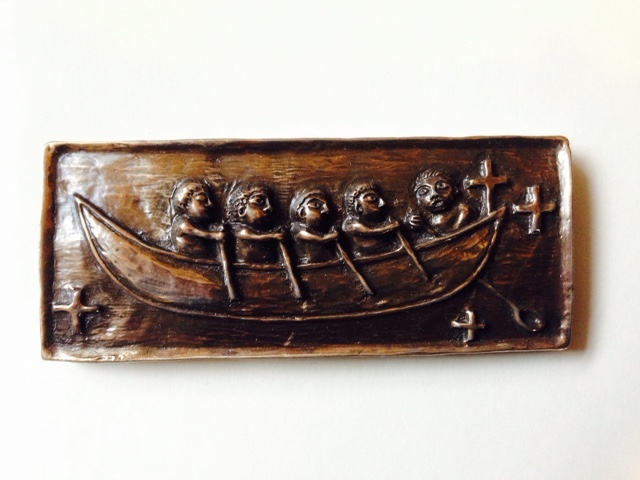
Seven Sites, Seven Words: indigenous Tennebrae Easter service
We had the privilege yesterday evening of being part of Seven Sites, Seven Words, an indigenous Tenebrae Easter Service.

The service was located at Pilgrim Uniting and involved a journey outside, around the central city. Scripture passages that tell of events leading to the death of Christ were laid alongside readings of parallel stories of white engagement with Australia’s Aboriginal people, of betrayal, denial and death. Symbolic gestures – the coins of betrayal, the whip, moments of white denial – found fresh meaning.
The service has been developed by Geoff Boyce, adapting from Norm Habel’s ‘Healing Rites at Seven Sites.’ It was a wonderful reframing of the tradition of Tenebrae (Latin for ‘shadows’ or ‘darkness’), capturing the darkness of the events leading to Easter Friday and the pain of colonisation.
The sites were skillfully chosen, ensuring that Easter is not hidden in a church, but public for bystanders to see – as it was in the original. Theologically, the process of identifying Christ with indigenous suffering is an appropriately disturbing, destabilising act. The movement and the invitation to participation added to the personal engagement.
Seven Sites, Seven Words is an event that needs to be experienced by all Anglo-Australians.
Wednesday, April 04, 2012
we’re “calling”
Uniting College seeks a Director of Missiology (0.5) and a Post-graduate Studies Coordinator (0.5). Both positions are crucial for developing effective leaders for a healthy missional church. The Director will lead, teach (undergraduate and VET) and coordinate pioneer leader cohort. The Post-graduate Coordinator will organise, teach and supervise (postgraduate level). Joint applications are encouraged. Enquires to Craig Bailey – craig dot bailey at flinders dot edu dot au. Applications close 11 May, 2012.
More specifically …
Director of Missiology (0.5 FTE)
Uniting College is seeking a leader and lecturer to develop missiology within the life of the Uniting Church in South Australia and the College. This position will suit a person keen to play a role in developing leaders who are passionate, Christ-centred, highly skilled, and mission oriented practitioners.
Tasks will include:
1. Developing the missiology stream at under-graduate and VET level
2. Lecturing (areas may include systematic theology, mission history, missiology)
3. Co-ordinating the B.Min practice stream including the Pioneer leader cohort
4. Participating in the life of the College
Post-graduate Studies Co-ordinator (0.5 FTE)
Uniting College is seeking a lecturer to strengthen our growing and dynamic post-graduate Master and Doctor of Ministry studies programme.
Tasks will include:
1. Teaching at postgraduate level in areas of specialisation (areas may include practical theology, ministry practice, Christian education or leadership)
2. Tutoring in research skills
3. Supervising post-graduate students
4. Developing administrative structure and research capacity
5. Co-ordinating the Journal of Ministry Practice
Joint applications for this position and the Post-graduate Studies’ Coordinator position are welcomed. Applications close 11 May 2012, with expected commencement at the beginning of Semester 2, 2012.
Tuesday, April 03, 2012
Easter scattered: a resource
Folk looking for Easter resources on this blog (there are quite a few of you, judging by the current search queries folk are using to get here) might find this helpful …

It is a holiday pack, in which we offered an Easter service that folk could do as groups/families if they went away for the weekend. It emerged out the tension between church gathered and scattered (for more on some theological framing of this see here and here).
How to put energy into Easter, without sending the “come-to-us” signal? The result was designing a service that could be done both gathered and scattered. This took quite a bit of creative thinking, but once done it allowed us to say: if you’re going away for the weekend, grab an Easter holiday pack. If you’re staying around for the weekend, join the services. The Sunday after Easter becomes a bit of a show and tell, as whether we were staying or going, we can reflect with each other on what Easter meant. For more go here. For the actual “scattered” service (more…)
Monday, April 02, 2012
feel the seasons change
Today marks a personal and vocational transition for me. From 1 April to 1 July I’m on study leave, three months break from teaching to read and write.
As Faculty at Uniting College, we gain 6 months study leave after every three years of service. I was due to take this in Semester 1, 2013. However, with my appointment as Principal, which begins 1 July, it would have meant that 6 months after I became Principal, I would have been absent for 6 months. Which is not ideal. So the suggestion was made that, for the sake of leadership at the College, that this be split into two 3 month blocks, with one taken before I start.
So of the next three months, I am based on Adelaide, head down, writing. My major project is a book on emerging church sustainability. This builds on my PhD research, which explored in (great) detail an emerging church in Auckland, New Zealand. Last year, I returned to the same church to repeat the research. This provides what I think is a world-first, an close up inspection of an emerging church over a 10 year period. My hope is to turn this data into a book, tentatively titled “Emerging ten years on”, yielding important insights around leadership, continuity and sustainability.
I also have a number of smaller projects I want to play with – turning my recent mission conference presentations into written pieces available as internet accessible downloads, either as “singles” or as an “album” – tentatively titled “Feelings of Jesus and the mission of God.” I also want to paint an icon, as a way of reflecting on the change of role I am undergoing.
Then in December-March 2012 (3 months plus 3-4 weeks for holidays), I hope to go to the UK. I’d like to base myself (and family) within a UK College training missional leaders. (I’m having a conversation or two about this, but nothing definite has emerged yet).
I’m happy to speak to groups about the data emerging from “Emerging ten years on.” I also want to extend the research – specifically by re-interviewing the 10-15 UK emerging church communities I interviewed back in 2001.
So this morning, rather than head to the office, I’m at home. I’ve turned off my google calendar. What has been so jam packed for the last few months, is now basically empty. I’ve loved being able to say no to basically every speaking invite for the next 3 months.
Although I can’t quite start writing yet! There are still a few things in the “in” tray – some assignments, some Masters processes that need to be enacted.
Sunday, April 01, 2012
holy week at the movies
 Last year, in the week leading up to Easter, each day I posted a movie a day that I consider speaks directly to the challenges, unsettling questions and faith demands of Jesus’ journey toward the cross. It is one way to respond to the importance of popular culture in faith expression –
The fact that popular media culture is an imaginative palette for faith … the church has to take that imaginative palette seriously… if part of the pastoral task of the church is to communicate God’s mercy and God’s freedom in a way that people understand then you have to use the language that they’re using, you have to use the metaphors and forms of experience that are already familiar to them. Tom Beaudoin
This year, I’ll summarise it here as a resource:
- On Monday, The Insatiable Moon (2010), while reading Mark 11:15-16.
- On Tuesday, Serenity (2000), while reading Mark 14:3.
- On Wednesday, Gran Torino (2008), while reading John 12:23-14.
- On Thursday, Dark Knight (2008), while reading Mark 14:10.
- On Friday, Never let me go (2011), while reading Mark 15:33.
- On Sunday, Never let me go (again) and Invictus, while reading Mark 16:6-7.
Saturday, March 31, 2012
palm sunday worship as mission – with more time
Creationary: a space to be creative with the lectionary (in this case, visual images on themes of pilgrimage). For more resources go here.
I posted earlier this week some Palm Sunday resources, first some creative prayer stations and second some soundtrack ideas. They were in relation to the 20 minute chapel services we do as part of our prayer life at Uniting College.
If I had more time, both in preparation and in length of service, I would have added two further stations – indoor spirit signs and outdoor spirit signs.
Indoor spirit signs – this would involve some large street maps and some stickers, probably circles and in different colours. I would invite people to consider the city through Jesus eyes. I would invite folk to place the stickers on the map in places they consider spiritually significant. For examples, places that Jesus might weep over, temples that Jesus might want to overturn, annointing places where Jesus might unexpectedly be annointed with perfume. I would want to keep the maps and place them on the walls around the church/chapel, as places for ongoing reflection and prayer in the months ahead.
Outdoor spirit signs – this would involve giving people chalk (washes off in water) and invite them to walk their streets. As they walk, to draw signs on the pavement that might symbolise the entry of God into their neighbourhood. Perhaps tears, perhaps rainbows, perhaps broken perfume bottles. And perhaps to take pictures of these, to text back into the church, which could be added into a powerpoint.
If I had even more time, I would get people to make the symbols prior to walking, as stencils (see here and here).
The aim of both of these are an attempt to connect worship and mission, our neighbourhoods today with the activities of Jesus in Holy Week.
Thursday, March 29, 2012
finding voice, losing mine!
Today I spoke to Catholic Education, to about 120 staff, gathered for a day of annual retreat, providing the keynote input over about 90 minutes. In discussion with the organisers, I spoke on the theme of “Finding Voice, telling stories.” It was a slight adaptation of a presentation I gave back in September last year, to the Australian Religious Press Association, which seemed to go well, both then, and again today.
I began by using a film, The King’s Speech
because I have a voice
to open up the topic of how we find voice, individually and as communities. Then under 3 headings I explored
- a theology of finding voice – Moses, Elijah, the short ending of Mark (16:8), then drawing on The Divine Voice: Christian Proclamation and the Theology of Sound
and Sense Making Faith Body Spirit Journey

- finding voice today – some contemporary cultural analysis, including the way that Douglas Coupland, in 1991, in Generation X: Tales for an Accelerated Culture
, focuses on telling stories as a way of finding voice, and then returns to that theme some 19 years later, in Generation A: A Novel
.
- three stories of finding voice that inspire me, to conclude (specifically the Parihaka story, Brooke Fraser and Paul Kelly).
As I spoke, I pondered the irony – that as I spoke on finding voice, I was losing mine. You see, today was my last public speaking engagement for the next 3 months. From 1 April to 1 July, I am on sabbatical and I’ve been able to politely say “no” and “sorry”, to a whole range of speaking, preaching and teaching, clearing space in order to focus on some writing. (More on the shape of that next week, when I actually start).
Which seemed to me, as I spoke, to be such an important irony to live within, the need to pause one’s mouth in order to think, process, reflect, read, re-stock. To find voice, but in a different way – with written, not spoken words!
Wednesday, March 28, 2012
the J(esus)POD on Palm Sunday
So if Jesus were entering Jerusalem today, what songs would be on rotate on his ipod? (4 other Palm Sunday prayer stations are here).
Here are the contributions so far from the twitter-verse and facebook-verse.
- U2 – City of blinding lights, Yahweh, New York, Angel of Harlem, Elevation
- Jefferson Starship – We Built This City
- Diana Ross and the Supremes – Stop in the name of love
- Lou Reed – Walk on the wild side
- Elvis Costello – What’s So Funny About Peace, Love, & Understanding
- Laura Marling – All My Rage
- Arcade Fire – Abrahams Daughter
- Fleet Foxes – Helplessness Blues
- Ben Harper – Pictures of Jesus
Tuesday, March 27, 2012
creative palm sunday worship stations
Creationary: a space to be creative with the lectionary (in this case, visual images on themes of pilgrimage). For more resources go here.
Chapel in Palm Sunday week – an invitation to enter a week of activity
(Update: This resource was further developed here – the J(Pod) shuffle on Palm Sunday – and here – Palm Sunday as mission.)
Rad-Adalaide station
Take an Adelaide road map. Draw on the map the route of your most recent “entry into the city.” Draw your feelings as you drove/trained/bussed/biked? Mark with a cross where you thought you were most likely to find Jesus. Reflect on whether your expectations were met and if it matters?
iPOD station
So if Jesus were entering Jerusalem today, what songs would be on rotate on his ipod? List the top 5.
Make palm crosses
Instructions have been provided. As you fold pray for people you know, people who are being “creased” by life.
Colouring station
Colour in the icon. Simply enjoy it. As you do ask God to speak to you through the activity.
Walking on the pavement station
Take some time to wander outside. In this Palm Sunday week, please walk only on concrete footpaths. As you do, silently pray for people who have walked before, and who are walking behind you. What might it mean for you to encounter the Christ in them?
At 12.22, a bell will ring. We will gather, to share communion on the Tuesday/to share what we experienced on the Wednesday.
Sending prayer
Jesus, when you rode into Jerusalem
the people waved palms
with shouts of acclamation
Grant that when the shouting dies
we may still walk beside you even to a cross …
Sunday, March 25, 2012
the spirituality of justice: Loyal to the Sky
One of the great things about Kindle is the chance to read in new areas. This has emerged for me primarily because of the resourcing this website, which lists free and vastly reduced books. I’ve found myself looking books on trends in beer, production of comics and the history of salt. If they were paperback, I probably wouldn’t touch them, but being electronic, they seem worth a browse. And some of them get read and as a result, my world becomes larger.
One I’ve just finished is Loyal to the Sky: Notes from an Activist
What makes it appealing is the autiobiographical window into the growth of a protestor. This is not a book filled with anger, but a search for a better world, through the evolution of a passionate, caring person.
Here are some of the quotes that struck me:
The impact of protest
For a single day, our action carved out a space for justice—a space to remind people, in the midst of their busy lives, that there is a larger canvas. That the Palestinians are suffering. That our tax dollars are fueling an occupation. And people on the streets listen. Bystanders take our flyers. Supporters honk their horns as they pass. Journalists record our words. Priests and officials come to speak. The police try to negotiate. We make the evening news. I spend the day high on adrenaline
About a new way of leading
For larger actions, affinity groups gather in clusters. Decisions regarding specific actions or campaigns are made via consensus process at spokescouncil meetings, which are attended by representatives from affinity groups. While consensus process can be thorny and at times protracted, what consistently amazes me is how well it works. A proposal is offered, clarifying questions are asked, discussion is held, concerns are raised, amendments are made, concerns are resolved. Each person’s needs and qualms are heard and incorporated into a process that arrives at decisions and moves forward.
About a new type of leader
Soft-spoken and temperate, David exercises the sort of understated leadership that consistently provides wise guidance and strategic acuity to a movement that is relentlessly nonhierarchical and anti-authoritarian.
About the fact that new forms of church need not be large
In the global justice movement, the affinity group is the basic unit of direct-action organizing. Groups are composed of five to twenty members; the prevailing idea is smallness and, by extension, trust
About the busyness of life in Western culture
I think of my life back home: constantly rushing to meetings and appointments, constantly feeling pulled between activism and music and social obligations and every other essential thing on my endless list. I have to pencil in “nothing” when I want an evening off. Every activist I know is similarly overburdened and stressed, staggering around like Atlas beneath a world only we can save. It can’t be helping our work.
About the ethics of change
Is it possible to effect change without dehumanizing others? Without someone to hate? Can we connect with each other as we have this week—can we build a movement—without a common enemy?
How much of my activism has simply been a vehicle to justify my own anger and hatred?
The mission framework I make is this: that often new forms of church emerge around gathering and worship. But these are not the only forms of spirituality. There is also an activist spirituality and one of the fertile areas for fresh expressions to explore is new forms of church that cohere around mission, around combined Kingdom projects.
Friday, March 23, 2012
the task of forming leaders for mission
Here’s some current thinking. I reckon the forming of leaders involves three things and one direction.
The three things are
- skills – this involves the learning to do things – to preach, to influence, to care, to exegete culture
- vocation – this often involves increased knowledge, about our tradition as church, about the big tradition of the church in history, the shape of ministry
- personhood – this involves self-awareness and spirituality – who we are in the process of living and learning
The one direction is that of mission, that in our post-Christendom context, we need skills and vocation and personhood pointed toward a life lived for the world.
Now here’s my current theory, that in forming leaders, we all start in one of these places. Some of us start with skills (for example supervised field education or immersion experiences or homilectics or worship curating). Some of us start with vocation (for example the way many folk teach theology or Christian history). Some of us start with personhood (for example CPE or pastoral care or personality testing).
This leaves a place that forms leaders with four key questions
- Is the balance right? Some colleges are dominated by vocation type learning. Others are keen to teach skills. If all three are needed, then we need a curriculum that pulls all three into the mix.
- Is each starting point handing the person on – is skills pointing to vocation and personhood, while is vocation pointing to skills etc? Too often colleges default to a dualism of either practice or theory, when the challenge is to model integration, a spiralling between all three, in an ever deepening circle? Where we start is often shaped by personality and by our learning styles – we learn in particular ways, so we assume that others learn our way. Are we able to get beyond the way we learn?
- Timing? When in the formation of each unique individual, do they need to be in which sector? Which skills do they need at the beginning and which at the end? Which building blocks of knowledge are needed when and where? When is the best place to invite self-reflection?
- Is the direction clear? Is all our skills and vocation and personhood being shaped by a life lived for the world?
Thoughts? Have I named the task of forming leaders accurately?
Thursday, March 22, 2012
We lift up our livers to the Lord: the richness of culture crossing
“There’s a PhD in this moment.”
On Monday I found myself crossing cultures. The occasion was a visit to a gathering of local Kaurna speakers at the University of Adelaide. The reason was that I was wanting to explore, in our College worship, the use of language indigenous to the First Peoples of the Adelaide plains, as a way of honouring those on whose land the College meets. (I’ve described how this came about here). There is also the national tri-ennial Uniting Church Assembly happening in Adelaide mid-year, so what might it look like to use indigenous language as part of that event?
So I trotted along, with some key phrases from one of the most common Uniting in Worship communion service. Phrases like –
The peace of the Lord be always with you: And also with you
The Lord be with you: And also with you
Lift up your hearts:We lift them to the Lord
Let us give thanks to the Lord our God: It is right to give our thanks and praiseHoly, holy, holy Lord, God of power and might, heaven and earth are full of your glory. Hosanna in the highest. Blessed is he who comes in the name of the Lord. Hosanna in the highest.
Christ has died. Christ has risen. Christ will come again.
And here was some of the the discussion.
The Lord. Well there is no word for Lord in the Kaurna language. The concept is foreign. Kaurna has a word like Ihowa. But that is a transliteration of what the early missionaries said. So it’s still, really an Anglo-Australian word. We also have a word for captain. But that was often used to related to the person who sailed the boats. (Do you want the word of the person who brought the colonisers to our shores to be linked with God?)
Kaurna does have a word of respect for an elder brother. And I know from my reading in global theology that Jesus as the elder brother is used in African theology. It is a lovely image, full of relationships and of Jesus humanity. But I’m also thinking about the Arian controversy – calling Jesus “Son” suggesting he is a lower state of being than God, and thus misrepresenting the Christian understanding of Trinity.
The Lord be with you: And also with you. Is it plural or singular? In English the word captures both. But not in Kaurna. Further complication is that it depends who says it in English. If the presider says it to all, then it is plural. But if the congregation then greet each other with the same phrase, it is singular, isn’t it!
It was at this point that one of those present got up and started taking pictures. “This moment needs to be recorded” he said after. “This is historic. There’s a PhD in this!”
Lift up your hearts. Well, in Kaurna culture, the centre of the person is their liver, not the heart. So, can we say “Lift up your livers.”
Let us give thanks. Well, thanks is not a concept in Kaurna culture. Why should you thank someone for something that just is? If you believe God is Creator, then of course the Creator will be giving life. So why do you need to say thanks for what, is, just, well, is?
And as we got up to leave, the best question of all. “You are aware that our language is 40,000 years old, while your understanding of Christianity is based on a person who lived 2,000 years ago. So how will you, in your communion respect this? Which of course links with the Uniting Church Preamble (“The First Peoples had already encountered the Creator God before the arrival of the colonisers; the Spirit was already in the land revealing God to the people through law, custom and ceremony. Paragraph 3).
I left with my head reeling and the adrenaline flowing. In the space of 60 minutes I’ve been internally sifting ways of knowing and being human, how to understand Trinity and theologies of revelation. Simply because I asked some questions across cultures, found myself in spaces not my own. “There’s a PhD in this moment.”
There certainly is.
Wednesday, March 21, 2012
appreciative inquiry and mission through Jess’s eyes
I’m speaking on appreciative inquiry and mission with folk in a Catholic leadership formation programme today. In preparation I’ve been re-reading Mark Lau Branson’s wonderful Memories, Hopes, and Conversations: Appreciative Inquiry and Congregational Change
And loving this video, young Jessica affirming all that is good about life.
I’ll use this to seque into the theological foundations for appreciative inquiry, in Luke 10:1-12 and in the Pauline letters. But for now, I’m thankful for my dad, my house, my pyjamas …. Yep, you get it, go Jess … 🙂
The Gospel: Luke 10: Where is Appreciative Inquiry in this Biblical text?
1 After this the Lord appointed seventy-two[a] others and sent them two by two ahead of him to every town and place where he was about to go. 2 He told them, “The harvest is plentiful, but the workers are few. Ask the Lord of the harvest, therefore, to send out workers into his harvest field. 3 Go! I am sending you out like lambs among wolves. 4 Do not take a purse or bag or sandals; and do not greet anyone on the road.
5 “When you enter a house, first say, ‘Peace to this house.’ 6 If the head of the house loves peace, your peace will rest on that house; if not, it will return to you. 7 Stay there, eating and drinking whatever they give you, for workers deserve their wages.
Note:
- Peace is shaped by Old Testament concept of “Shalom” – love of God, love of neighbour, love of alien, love of earth. Go looking to bless, looking to affirm
- Disciples look for response. They don’t force ourselves. But where there is “life”, we stay.
- Assumes “common ground,” that we are not the only people who desire the wellbeing of our communities.
Letters of Paul: 1 Corinthians: Where is Appreciative Inquiry in this Biblical text?
4 I always thank my God for you because of his grace given you in Christ Jesus. 5 For in him you have been enriched in every way—with all kinds of speech and with all knowledge— 6 God thus confirming our testimony about Christ among you. 7 Therefore you do not lack any spiritual gift as you eagerly wait for our Lord Jesus Christ to be revealed. 8 He will also keep you firm to the end, so that you will be blameless on the day of our Lord Jesus Christ. 9 God is faithful, who has called you into fellowship with his Son, Jesus Christ our Lord.
Note:
- Paul writes to a church in conflict. Yet he starts with thanks.
- It is important to note that each letter of Paul’s has a unique, specifically, different “thanks.” In other words, the thanks (the AI) is specific.
- As it is specific it can thus only connect as it truely names.
- Key “problems” in the church (for example spiritual gifts, eschatology) at Corinth are engaged in the “thanks.” Hence its not Pollyanna!
Tuesday, March 20, 2012
use of social media ministry learnings from Kony12
The last few weeks in class (Reading Cultures/Sociology for Ministry) has been focused on contemporary global cultures. Last week, a student asked about the Kony viral video campaign. It seemed a case study worth processing as a class, as it was so current, and yet raised so many questions about the use of social media to bring about change.
So the class were invited to view the video for “homework.” Upon return today, I invited them to choose a place on a continuum, from “it was not right” to “great use of social media.” This produced a great discussion with those on opposite ends of the spectrum making some really insightful observations.
To help ground the discussion, I reminded the class that our aim is to help churches think about being part of effective change. And at some point, a church might want to get involved in social media. So, what might we learn from the Kony campaign.
Here is the list we created: things to consider if you’re thinking about using social media.
- It can be highly, highly impacting
- It can have real potential for educating, especially for a generation that doesn’t watch the television news
- Social media can emerge from anyone, especially from people with the right creative and media savvy skills
- Think about how you communicate. Media can be manipulative and abusive. Will you focus on head or heart? Will you try and be simple, or seek to nuance complexity?
- Consider the ethics of who you use, who you film and how you film them
- Reflect on whether your “author” and your “author’s life” is important to your story
- Social media can only be a starter. It needs to be supported by more information and next steps
- What you do can form a precedent
- Learn from other campaigns
- Be prepared for backlash
- You can’t control other users, and they can spin your campaign
What do you think? What else would you want to add?


 )
)