Saturday, August 28, 2010
art and faith Australian style: the window that is the Blake prize
This is a fascinating resource: the Blake Prize, exploring the religious and spiritual in art.
The Blake Prize is one of the more prestigious art prizes in Australia. Since 1951 the Blake Society has been awarding a prize for works of art that explore the subject of religious awareness and spirituality.
Here are all the art entries for 2009, and here are the art finalists. Then the catalogue of winners is here, stretching back to 1978. There were over a 1,000 entries in 2009! That’s a lot.
The 2009 winner was artist Angelica Mesiti for a silent video work entitled [Rapture (silent anthem)].
(silent video! edited – 40 seconds of a 10 minute original)
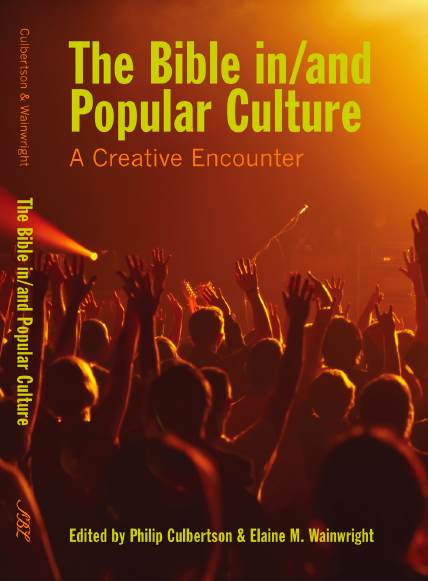
Filmed from a concealed position beneath the stage at a rock concert, it caught the judges eye for its beauty, emotional intensity and technical virtuosity. “An enigmatic work that operates on many levels, Rapture depicts the joy of being alive while also hinting at the darker aspects of religious emotion.”
I find it fascinating because it is art acknowledging the place of pop.culture. First in medium – video winning an art competition (See the Sydney Morning Herald byline: How videos killed the painting stars). Second in theme (crowds at a rock concert) in religion and spirituality. While there is some Christian thinking in this area, it still remains a bit of a challenge to us in our churches and theological colleges!
Anyhow, I will be using this in my Sociology for ministry paper. And perhaps in the future as an introduction to my attempts to sketch a pneumatology for pop.culture. And there is a journal article in this, using the finalists in the competition over the year, to explore the development, or not, of religious and spiritual in Australian culture.
Friday, August 27, 2010
fresh expressions adelaide vision day: putting legs on the local
Key words: dreamers and sponsors, wonderers and strategists
Key sense: taste
Key question: How can fresh expressions emerge within and alongside local congregations, agencies, schools ?
Had an excellent 90 minutes planning a (1st ever?) local Adelaide Fresh Expressions vision day with the Synod Fresh Expressions Core team. Put a ring around November 27, 11-3:30 pm, Christ Church Uniting, Wayville. Having had a swag of outside input on Fresh expressions, this day is ideal for local communities thinking about putting local legs on local fresh expressions.
Programme (draft):
11-12 pm – Introducing Fresh expressions: Who, What, Where, Why, How – Steve Taylor. Being Uniting, being emerging? a CMS team
12-1 pm – Local lunch – people are invited to bring local produce to share
1-2 pm – Putting legs on the local – interviews with three diverse local fresh expressions. A rural story, an art story, a justice story (TBC). Exploring how dreamers and sponsors work in life-giving partnerships.
2-3 pm – Conversational workshop – share challenges and opportunities in conversation either with local dreamers or local sponsors.
3-3:30 pm- Space with candlelight reflections community.
Friday, August 13, 2010
Fresh expressions. Import or Local (South Australian) produced?
I wrote the following for New Times, the monthly denominationl magazine here in South Australia. Others beyond might be interested.
South Australia is famous for our local produce – Kangaroo Island honey, Riverlands dried fruit, McLaren Vale reds. So it is worth reflecting on Dave Male’s recent Synod input in light of what is happening locally in South Australia.

Dave suggested that a fresh expression goes through a number of stages in their formative journey. This starts with “listening to God’s call”, moves to “loving service”, then is followed by “forming community” and “disciple-making”. The result is “church” emerging in a fresh space, opened up in response to the creative work of God’s Spirit.
So in light of Dave Male’s input the Fresh Expressions team cast an eye over what is being locally grown here in South Australia.
Candlelit Reflections at Modbury have sensed God’s call and their “loving service” has involved creating a quiet, meditative space. The next step in their “fresh expression” journey includes how to appropriately gather individual seeking spiritual searchers into community.
Fresh expressions are never only urban. In the Barossa, Greenock Uniting Church have seen people begin to gather around a building used for “loving service” not on a Sunday, but in a mid-week café with local art and craft. The next step in their journey also involves the challenge of “forming community.”
Hungry no more, at Mt Barker, has seen their “loving service” naturally lead into “forming community.” Their challenge now includes “disciple-making,” with the realisation that the people they are ministering with have unique needs. Hence discipleship and church will definitely need to take shape as a “fresh expression.”
A fresh expression journey is never linear, as is evident in the Esther project. An initial dream to form church around theatre production then took shape in 2009 around storytelling. Community began to form, but recent changes are causing a re-think.
City Soul or Eco-church would be an example of Dave Male’s final stage, “church” taking unique shape, whether around student life or environmental concerns. Both are locally grown, and missionally creative, fresh expressions.
The Synod Fresh expressions team are keen to build on these, and to encourage other locally grown products. The Regenerate pub conversation serves as a bi-monthly resource (for information contact Nicola Shaw at Uniting College). Plans are underway to offer a Fresh expressions vision day on Saturday, 27 November, 2010 and Fresh Expressions training through the Mission-shape ministry course in 2011.
Steve Taylor, Director of Missiology, for Fresh Expressions team
Wednesday, August 11, 2010
What is worship? the theology of Francis Webb
And for me always the grave great peace is stronger
In flaring colours, and a laugh, and a careless singer
Two lines from “Cap and Bells” by Australian poet, Francis Webb.
I have been amid much talk of worship and church in the last two days. Talk of liturgy and order, of emotion and diverse giftedness. Sitting in the bath this morning, reading a new found friend, Francis Webb, those two lines quoted above stood out – the gift of colour, the sharing of humanity and celebration of risk.
For me that’s what worship is, a space to encourage humanity. In so doing, it makes Incarnational, possible, what 2nd century theologian Irenaues wrote:
The glory of God is man fully alive
That’s what Webb is articulating, the peace that comes amid colour, laughter, creativity. I want to find those people, those spaces, be part of forming those sorts of Christian communities here in Adelaide
Saturday, July 24, 2010
FOSMT (free and open source missiology textbooks)
Helpful post here by AKMA on steps to an open source theology. He is discussing the Old Testament, but so very easy to apply to missiology. In sum
- First, work out an overall structure and uniform presentation.
- Second, find authors to write initial chapters to flesh out the structure
- Third, edit chapters for uniformity and place on web.
- Four, arrange a PoD publisher to sell papercopy
- Five, encourage uploading of alternate points of view.
The result:
Bing, bang, bong, you have an open-source, free as in beer, free-to-reconfigure, free-to-supplement or even -alter (provided you give credit and don’t offer the altered version commercially without the author’s agreement) textbook. And that textbook is now useable anywhere English is read, for free. And that textbook is putting your name(s) in front of students and teachers all over the world, especially in places where they can’t necessarily afford the doorstop hardbacks that the textbook publishers love to charge so much for. And that textbook can easily be kept up-to-date. And if some agency were to fund it (and such funding needn’t even come to very much, in the world of granting — small to moderate honoraria for authors, editorial/production support, and so on), they could slap their name (or a prominent donor’s name) right there on the cover and on every title page
So I am wanting to develop for next year
a) mission-shaped course for Australasia
b) Mission then and now history and theology paper.
I wonder what these would look like FOSMT. Anyone want to partner in either step one, work out an overall structure and uniform presentation; or on step two, author a chapter; or on step three, being an editor, or on step zero – being the initial funder in order to position/brand your organisation as an innovative, missionary-focused, partnering type?
Monday, July 19, 2010
asylum seeker facts
- The vast majority of people seeking asylum in Australia arrive by plane.
- 95% of asylum seekers arriving by boat are found to be genuine refugees.
- Just 3441 asylum seekers were given refugee status in Australia last year, roughly 1% of the total migration program for that year.
- In comparison, around 50,000 people over-stayed their visa last year alone – mostly people with business, student or holiday visas.
- Australia only accepts 1% of the worlds’ refugees.
- At the current rate of refugee arrivals, it would take 20 years to fill the MCG.
- It is not illegal to arrive in Australia seeking asylum.
From here.
- Ruth, part of genealogy of Jesus, was a refugee.
- Moses was seeking asylum when he fled Egypt.
- So was Jesus when his parents fled from Herod’s military might.
From here
Sorry, I’m sure this issue is more complex than such simple sound bites.
Wednesday, July 07, 2010
this is classic: emerging church danger!
Two strangers met at an academic conference. One was me, new to Australia, new to lecturing in the Uniting Church. The other was retired, also a lecturer, a figure large in the life of the Uniting Church. Over lunch we compare notes, talking about the history of theological education in Australia. Wanting to listen, I, the new one asks a broad, opened ended question:
New one: So what is the most important thing a person coming new to the Uniting Church from New Zealand needs to know about the Uniting Church?
Retired one: The danger of the emerging church. The Uniting Church is founded on the Creeds and Reformers and the emerging church is a danger to that.
The mouth of the new one falls open in surprise, amazed at this turn in the conversation!
New one: Oh, I thought the Basis of Union encouraged a pilgrim people, a people always on the journey. That’s why we are called Uniting, not United. So wouldn’t some sort of commitment to the emerging church be some sort of commitment in the Basis of Union to the emerging church?
Retired one: Yes, but a prior article in the Basis of Union says we have a commitment to the worldwide church and to our relationships. The emerging church is a danger to that.
New one: Oh, we’ve recently as a Synod had speakers from the Anglican church in the UK. They, in partnership with the Methodist church, are working on fresh expressions. So they suggest some sense that emerging church is part of the worldwide church conversation.
Pause. Genuine pondering on both sides.
New one: What is interesting is that they called it “fresh” not new. They do not want this to be seen as something new, denying the Reformation, but simply as the challenge for each generation, to be a faithful and pilgrim people in their generation.
The conversation moves on … true moment
free (Timor) parking (of asylum seekers)! Uniting church response to Gillard
For my Australian readers (and for Kiwis who care about social justice and wonder how Christians in New Zealand would respond to people seeking asylum and arriving by boat if we didn’t have a large land mass called Australia sheltering us), here is the Uniting Church response to the Gillard proposal – what the New Zealand Herald called “Canberra sticks out unwelcome mat to arrivals“.
Some quick points.
1. This is one outstanding advantage of being a connectional church, as opposed to a three Tikanga Kiwi Anglican church, or a congregationalist ie Baptist, that the church is able to speak quickly on rapidly evolving social issues.
2. The importance of treating all humans as people, and not slogans like “queue jumpers” or “illegals.”
Saturday, June 19, 2010
Fresh expressions formalised in South Australia: updated
Exciting weekend here in South Australia, with the Uniting Church Synod (council of all Uniting churches in South Australia), voting to accept a number of resolutions including the following:
- develop Fresh Expressions and Church Plants throughout South Australia
- develop a network/community of Pioneer Ministers
- ask the Uniting College (of which I am a part) to take the lead in developing training for Pioneer Ministry, both for lay people and for those wanting to live out their ordination as Pioneer Ministers
(Updated: full resolutions here)
So there we are – a church denomination making Fresh expressions a priority, and formally charging it’s training arm to train pioneer leaders.
It dovetails beautifully with the fact that as a Uniting College staff, we’ve been putting in hours of work in the last few months into developing a unique pathway by which to train pioneer leaders. This will be as part of our new B.Min degree programme. If our application is successful it will mean we are offering two training paths. One path will be a more conventional mission and ministry degree.
The other path will also offer a B.Min degree, but with a focus on innovation and pioneering. It will offer learning by doing, in situ in a fresh expression, observational intensives so people can broaden their vision and practice of ministry, expect mentoring – both individual and in community – along with integration through study in areas of leadership, mission, Bible and Christian discipleship. So if you sense God calling you to train as a fresh expressions pioneer leader, we at Uniting College just may be able to help you.
All quite exciting.
Wednesday, June 16, 2010
faith outback: planting rural fresh expressions

The feature story in the Australian Outback magazine (June 2010) is titled Faith:Belief in the bush. It’s pretty hefty – 22 pages – and explores how people have coped with the adversity of recent drought. There’s an appeal to a faith rooted in land and that is sensitive to indigenous issues. And all as the lead article in a commercial magazine. Secular Australia? Really?
There’s some challenges to theology.
For rural Australia to succeed and grow we need people who are prepared to take risks and try different approaches. Faith can be a huge driver for change. Equally it can be a form of avoidance. There are some who put all their faith in God or industry leaders to fix the problems. Having faith in yourself, your family and your community means accepting that you are accountable. Cheryl Philips.
There’s a nice nod to fresh expressions – rural style – including the rise of lay ministry, discussion groups and home churches.
For rural people, having their lives enriched spiritually through their relationships with others is where it’s at. If that leads to going to church, then that’s an added benefit. The church now wants to be a legitimate working part of the community. Ross Neville, Uniting church rural consultant.
A few weekends ago I taught at a lay training event called Grow and Go. My topic was Mission-shaped community. To break up the monotony of Steve Taylor talking for 8 hours, each person was given an overhead projector acetate. Each acetate had the following headings:
- A new insight:
- A new idea and/or resource:
- An inspirational story:
And I spread a whole lot of resources around the table – short articles, booklets, a few computers with websites to browse. The group had 30 minutes to browse, read and fill in the acetate if they found a new insight, idea or story. And then we had a great reporting back session – various ones sharing with the group a resource they had discovered. The most popular resource were those I dug out on rural ministry. Like the Grove Books – a veritable treasure trove – for example some of these. Rural ministry in Australia dying? Really?
Friday, June 11, 2010
a brilliant ending: teaching sociology for ministry
I am still buzzing at the presentations of students in my Sociology for Ministry class. They had done so much work! Outstanding in their creativity and their attention to both sociology and theology. One group presented an idea of opening a Sudanese cafe as a way of welcoming migrants on the fringe of an existing church. Another suggested a video making competition as a way to work alongside unemployed working class youth. Another suggested a multi-purpose spirituality centre in a new build community and even built their own website. Their presentations each took over 45 minutes each, carefully attending to context, articulating clear theologies of ministry, emerging from grounded research of existing communities and existing ministries.
Sociology for ministry is a compulsory introductory level paper in the degree. The aim is to explore at the interface between society and ministry in the Australian context, developing skills so students could research their communities and reflect about the implications for ministry.
Not being a local, and only having been in the country a few weeks, a foreigner teaching Sociology for (Australian) ministry could have been a disaster. What do I know about Australia?
Equally, not being a local, teaching Sociology for (Australian) ministry could have been an advantage. Rather than show my knowledge, could I show them the research tools I am using to try and understand my new local context? So each week I used a different type of sociology tool – poetry, songs, movies, demographics, fiction novels, sacred places, history – to cover a range of topics including family, work, leisure, religion, plurality, spirituality, globalisation, IT cultures.
In order to facilitate shared learning, I decided to set a group learning assignment. (For more on creating class learning communities see here.) Each group got given a prepared case study, a real local community. Each case study noted some community strengths and some community challenges. The task was – as Sociology for Ministry consultants – to present to a church leadership team (me) some ways forward that were faithful to both the sociological context and had a clearly articulated theology of ministry. While all of us – lecturer and students – were a bit nervous, the results exceeded all of our expectations.
If this is the future of Australian ministry, there are some real possibilities brewing. It was also an endorsement of the essential formational nature of papers on contextual ministry, of group learning processes and the potential of case studies to bring energy and grounded focus into a class.
Sunday, June 06, 2010
climate change, justice and social welfare. In 1 Kings?
I preached at the Corner Uniting Church this morning. The lectionary text was 1 Kings 17:8-16 and the more I studied the story, of Elijah and the widow of Zaraphath, the more impressed I began. It’s an ancient story, yet suddenly seemed to start speaking to climate change, social justice and missional theology today. Let me try to explain.
First, the story starts in drought and thus addresses climate change. In 1 Kings 17:1 :Now Elijah the Tishbite, from Tishbe in Gilead, said to Ahab, “As the LORD, the God of Israel, lives, whom I serve, there will be neither dew nor rain in the next few years except at my word.”
Here in Australia, the Prime Minister is famous for suggesting that “Climate change is the great moral challenge of our generation.” I’m not wanting to debate the politics of the statement, simply to note how climate change is linked to human values and the decisions we make about how we live our lives.
Same for Elijah: that in his country “split into two factions.” (16:21); one wanting to follow Baal – fertility god, who sends rain to mark the end of drought. Another faction wanting to follow YHWH, the Lord of creation. So drought is framed as a moral issue – live in the way of YHWH? Or the way of Baal? Climate change becomes tied to cultural values and the decisions we make about how we live our lives.
Second, it’s a story about being missional. As a consequence of the drought, Elijah heads to Sidon: 1 Kings 17:7-9: “Some time later the brook dried up because there had been no rain in the land. Then the word of the LORD came to [Elijah]: “Go at once to Zarephath of Sidon and stay there.”
Sidon is a town mentioned in the previous chapter: 1 Kings 16:30: “Ahab …. married Jezebel daughter of [the] king of [Sidonians] and began to serve Baal and worship him.” So to spotlight the moral issue, Elijah heads to Sidon. To the place where Jezebel, the Kings wife was born, to the place where Baal worship is strong and thriving.
Often I see Christians tempted to flee from belief systems that are different from ours. Yet here Elijah heads for Sidon.
Third, the moral issue of sticks. Elijah finds a woman gathering sticks. Which introduces a second moral issue. Climate change impacts people.
To quote from a Bible commentary
They always talk in the news media about needing to find the human interest story. Well here in 1 Kings is the human interest story. YHWH, the God of the Old Testament, has a human interest in widows. This is surely theology at it’s best, locating God and the activity of the people of God in and among the poor and dispossessed. (And it doesn’t just happen once in Kings, but repeatedly).
Fourth community empowerment. I am fascinated by the way that Elijah doesn’t give her a handout. Instead he empowers her. Invites her to simply give what she’s got.
One book (Elijah and Elisha in Socioliterary Perspective
Here’s a way to work with the poor, in ways that do not leave them victims, but invited to use what they have got – the twigs they can collect, their flour and oil.
1 Kings 17: A text in which we see a God who cares about climate change, who invites us to do mission and theology in ways that bring to the fore the human interest stories of the poor, and to work with them in ways that empower.
Or am I pushing an ancient text too hard?
Sunday, May 23, 2010
where does the hope come from? words of mission in mission
Today is a transition day – flying from Maroochydore to Bathurst via Sydney; from Queensland Synod lecture to working for with New South Wales ELM centre (lay ministry training); from one-off talk to two days of rolling conversation around the theme of transformers.
Last night I talked with the Queensland Synod about a word of mission. (Update: summary and even audio are here).

It’s a (neglected?) part of Uniting church worship and I used it as a framework to explore my ministry experience with Opawa Baptist. What were the words of mission in our change process? What did we do in actual ministry practice as a result of those words of mission? What were the leadership understandings that helped our journey?
So I looked at
- the Pentecost story and the word of mission in Acts 2:6 people hearing “in their own language and how that helped shape our multi-congregational model.
- and the Parable of the sower (I used a children’s book, Bodge plants a seed, by friend Simon Smith as a encouragement to lead by nuturing green shoots
- and the story of Mary and Elizabeth, as a word of mission to Elizabeth’s to speak words of courage and life to the new things of God in our midst and for the church to be open to the unexpected innovation from Mary’s
And I reflected on the leadership understandings
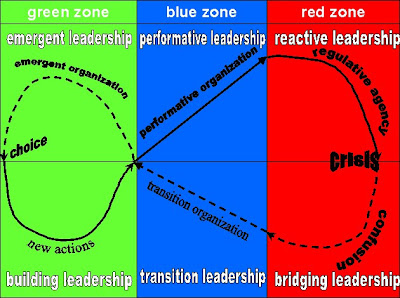
- Roxburgh and Romanuck – organisational development diagram
- leadership as process and verb, not position and noun, and the 2009 NCLS resources that let us build leadership teams and invite us into shared processes.
At times as I spoke I felt that my attempt to weave the word of mission and the ministry practice and the leadership lessons were too ambitious for an hour lecture on a Saturday evening after a long day. I wished I could have been clearer, but alas, it is too late once one is speaking! And my powerpoints were not good enough. However, there was good group interaction and some thoughtful questions and some fascinating after-ward conversations.
May God’s peace rest upon the Queensland synod.
Friday, May 21, 2010
Lament? Or Joy? Multi-cultural worship and Psalm 126 in an indigenous voice
Tonight was the opening of the Uniting Church Queensland Synod. It happens every 18 months and Queensland being a big place, people drive for hours, so it’s quite a big deal.
The night was fabulous – worship rich in respect for indigenous people and multiple cultures. Visually astute, well choreographed, musically diverse and tasteful. Check out the communion table, shaped as a boomerang, draped in the flags of those who participated.

As with pretty much all Uniting worship I attend, the Bible was read. Tonight, being special, included four readings – Psalm, another Old Testament reading, Epistle and a Gospel. (It’s interesting, by the way, to compare Uniting Bible reading practises to New Zealand Baptist Bible reading practises, both at local church level and at a Baptist Assembly level!)
The Psalm that was read was Psalm 126.
1 When the LORD restored the fortunes of we were like men who dreamed.
2 Our mouths were filled with laughter, our tongues with songs of joy. Then it was said among the nations, “The LORD has done great things for them.”
3 The LORD has done great things for us, and we are filled with joy.
4 Restore our fortunes, O LORD, like streams in the Negev.
5 Those who sow in tears
will reap with songs of joy.
6 He who goes out weeping, carrying seed to sow,
will return with songs of joy,
carrying sheaves with him.
But it was read by a local Aboriginal man. So read it again, imagining hearing the voice of an indigenous Australian.
I’ve always heard this Psalm as a Psalm of joy, of praise for Gods’ provision.
Tonight it became to feel more and more like a psalm of lament. It seems to me that very few Indigenous people in Australia can claim their fortunes are restored and they have joy in the land. A Psalm of lament?
Or a Psalm of intercession? What might it mean for a Uniting church, of predominantly Anglo-Australian’s, to actually hear an Aboriginal man read this Psalm? Might it not call us to ongoing pray and proactive protest, that indeed fortunes will be restored and songs of joy?


 )
)