Monday, August 02, 2010
Joining in with God’s Spirit: a great missional resource
God’s mission is greater than any church, and it is in this wider movement of the Spirit that all the churches in the world participate. It is within the greater purposes of God that we find our unity. The missio Dei is not confined to any locality; it spills over, crosses boundaries and is carried across the world by the wind of the Spirit. It does not have a single origin or one direction but comes and goes as the Spirit wills. However, it is one movement because the Spirit witnesses to a unique person, Jesus Christ of Nazareth, crucified and raised, who reveals the Father in heaven, source of all things. We have yet to realize that the cosmic Christ is manifested in the unity of local churches in the mission of the Spirit. When we do, we will connect world church with local mission. We will be able to join with the Spirit who moves over the earth sustaining our world and our life – the Spirit of Jesus Christ, who is given to bring about good news in the whole creation.
Conclusion from Kirsteen Kim’s Joining in with the Spirit
Books like these are essential to the missional church conversation. They offer the Western missional church the gift of dislocation. When you read chapters that start with the insights from contemporary mission in Africa and Korea and India, you are offered a missiology that is so much richer than your own. You are reminded that the missional God is up to so much more than patching up a declining Western church. That mission is so much deeper, richer and wider than bringing back the young people!
So I used Kirsteen Kim’s quote as a devotional beginning at our Masters of Ministry class last Monday. Each of us were invited to sit with the quote and as we did, to identify the phrase that most spoke to us. After sharing, we then prayed for the person on our right. Then together we said the Lord’s Prayer. Just a few minutes, but a great way to place ourselves, each other and our ministries in the caring context of God’s globally local mission.
Friday, July 30, 2010
planting fresh expressions down under: a tale of seven churches
Here in South Australia we recently enjoyed the visit by Dave Male. One of the big helps for me was when Dave talked about the size of the core team in planting fresh expressions. He was making the point that the smaller the team, the slower the progress, but the more likely it would be radical re-expression of missional life. In contrast, the larger the core team, the more quickly the plant might grow, yet the more likely the new plant can end up look like it’s planting parent.
It helped me make sense of my fresh expressions experience.
My partner and I planted Graceway in 1994. That was last millennium, when noone was talking about fresh expressions or emerging church. But we knew that our mates were dialling out of church, yet still were encountering God. We started reading the literature on cultural shift and out of that emerged Graceway. We had values of community and creativity and participation, so we met cafe style, always had food, had a barstool for open sharing and explored the whole-body in worship. The planting team was small and it was such a long, hard slog, real pioneering.
There was simply none of the infrastructure and conversations and books that there are around now. We endured at times quite active hostility. But we learnt heaps and plugged away. We made mistakes but we saw God move. We saw some unchurched find faith, developed a distinctive way of life, built networks with the community and found ways to serve and love people. After 9 years we moved on. Graceway was fragile but had some good leaders.
We moved to Opawa in 2004. We were at Opawa six years and in that time had a go a planting six fresh expressions. One per year is good going when you think about it! (I talk about the multi-congregational ethos, which gave this initial shape elsewhere on this blog).
First was espresso, a Tuesday night discussion community for those wanting to explore faith questions is a conversational, open way.
Then came the hymn service, soup on Sunday afternoon, choosing of favourite hymns, a testimony and a sermon. connecting with those for whom hymns was an important part of faith formation.
We tried a number of experiments for spiritual seekers, running a journalling course in a local cafe, offering Sense Making Faith course. Each was important in connecting us with spiritual seekers, but none developed into a cohesive congregation. (Still important, still a great learning, still saw folk baptised.)
We re-planted our evening service in two different forms. One was a monthly Soak service, as a time to “soak” in God. Not so much a pioneering work, but more a contemplative space for people to make time to engage (soak in) God. Sung worship, lectio divina and then a range of stations. Lot of attention paid to the space, which, being in main auditorium was always big and worked really well in terms of contemplation.
The other was Grow which used the table as the main metaphor. People gathered in groups and on each table was an A3 sheet of paper in which people were invited to reflect on two theological questions – who is God and who are humans. Grow had a three week focus and each evening used multiple inputs – video clips, interviews, during the week challenges, top 10 quiz, sermon, prayer.
Another trial was made with the Gathering, which used a local community cottage to work with folks local and close to the church building. Lots of food, gathered around a big wooden table, Bible open.
Looking back, using Dave Male’s lens, helped me see that Opawa was a totally different way of planting fresh expressions than Graceway. Rather than lone “ordained” pioneers, we were involving teams of lay people. (Which you simply don’t have when you are the lone pioneer). Each expression looked for 4-5 people who gathered around an “itch” to explore new possibilities. Each faced the downside, the danger, of becoming a new form of worship, rather than a genuinely missional new form of church.
As Dave says, both types have their strengths and weaknesses. Multiple congregational planting with lay teams is much easier, while pioneering is much more radical.
I’m not sure what the point of this post is. (In fact, I’m not actually often sure what the point of this blog is.) Perhaps someone might find some resonance in one of these tales of seven fresh expression churches.
Wednesday, July 07, 2010
this is classic: emerging church danger!
Two strangers met at an academic conference. One was me, new to Australia, new to lecturing in the Uniting Church. The other was retired, also a lecturer, a figure large in the life of the Uniting Church. Over lunch we compare notes, talking about the history of theological education in Australia. Wanting to listen, I, the new one asks a broad, opened ended question:
New one: So what is the most important thing a person coming new to the Uniting Church from New Zealand needs to know about the Uniting Church?
Retired one: The danger of the emerging church. The Uniting Church is founded on the Creeds and Reformers and the emerging church is a danger to that.
The mouth of the new one falls open in surprise, amazed at this turn in the conversation!
New one: Oh, I thought the Basis of Union encouraged a pilgrim people, a people always on the journey. That’s why we are called Uniting, not United. So wouldn’t some sort of commitment to the emerging church be some sort of commitment in the Basis of Union to the emerging church?
Retired one: Yes, but a prior article in the Basis of Union says we have a commitment to the worldwide church and to our relationships. The emerging church is a danger to that.
New one: Oh, we’ve recently as a Synod had speakers from the Anglican church in the UK. They, in partnership with the Methodist church, are working on fresh expressions. So they suggest some sense that emerging church is part of the worldwide church conversation.
Pause. Genuine pondering on both sides.
New one: What is interesting is that they called it “fresh” not new. They do not want this to be seen as something new, denying the Reformation, but simply as the challenge for each generation, to be a faithful and pilgrim people in their generation.
The conversation moves on … true moment
Friday, June 18, 2010
new forms of church: eco-festivals
In my The Out of Bounds Church?: Learning to Create a Community of Faith in a Culture of Change
- Art collectives
- Postmodern monasteries
- Weekly participative communities
- Festival spirituality
Some were dreams, needing legs. So it was wonderful to see this …
an ecofestival
(hat tip Michael)
St Johns, Durham, 11am-5 pm, in the church grounds, with locally sourced food, live music, a range of activities for all ages including stalls with info about renewable energy, where cyclists can have their bike serviced, learn more about Durham Wildlife Trust, buy Fairtrade, take part in craft activities. The afternoon will end with beer and hymns. There’s even public intercession (a balloon release with prizes, with the balloons carrying messages of how visitors would like the world to be in years to come)!
Fantastic. Outside the church, resourcing body, mind and soul. All age friendly.
This from the 2008 church Annual report:
A final mention must go to the Neville’s Cross ’08 EcoFestival. This was an ambitious
undertaking on the part of St John’s to conceive, plan and bring to fruition a large-scale
community festival. The event was entirely planned by church members and took place in and
around the church buildings. A variety of events, activities, stalls, games, music, debate, advice
and so on was on offer, all relating to the themes of Trade Justice and Climate Change (which had
grown out of a parish away-weekend 10 months earlier). On the day we were blessed with
splendid weather alongside the dedicated enthusiasm of all involved, and it was a delight to see the
whole church precinct alive with people of all ages throughout the day.
It all sounds grand, but it emerged so simply. Chew over an idea. Commit to give it legs in a way that involves a variety of gifts. Take a deep breath and have a go!
Thursday, June 10, 2010
transforming space into place: great example of culture making
The video below is a fascinating example of culture making. “It is not enough to condemn culture. Nor is it sufficient merely to critique culture or to copy culture. Most of the time, we just consume culture. But the only way to change culture is to create culture.” So says Andy Crouch, in relation to his great book Culture Making: Recovering Our Creative Calling
So here’s a fascinating example of culture making, emerging from a vision for community among the city suburbs. In the words of Simon Holt: “A spirituality of the neighbourhood is one that embraces its most immediate context as a place of God’s presence and rich with sacred possibilities.” (God next door, 100)
(For more on culture making as it applies to church go here and workplace mission, go here).
Friday, May 07, 2010
mission that’s out of the valley 4: grounded in a local church community
(Last post in this series I promise. For the introduction go here, for the motivation go here for the material go here.)
5%.
Last week I blogged the fact that according to 2006 National Church Life Survey data, only 5% of Uniting churches had offered significant training at a congregational level for lay people in evangelism.
5%.
That’s not many. Which got me thinking about my ministry. You know, the old “reality” check – was I a leader in a community practising what I was/is preaching? So I shuffled through the following dates ….
2004 – Evangelism as process – I preached 2 sermons on the topic of evangelism. A good deal of energy resulted. A church community forum was held and as a result a number of new community contact initiatives were launched – including Koru, a youth programme and a family film night.
2005 and 2006 – Opawa’s energetic Evangelism Ministry leader, Hugh, used a video series to offer training in faith sharing. This happened once in the church foyer and a second time in a local home group
2007 – God at work – a 3 week course on “Where is God on Monday?” run by (then) Anglican ministry candidate, Nigel Wright, all the way from UK. About 25 Opawa folk participated, reflecting on being salt and light in all of life. As a result a God at work group formed and met regularly, keeping each other accountable in this area of faith-sharing mission.
2008 – Biblical pictures of witness – A four week preaching series that explored the themes of
- being a mate – sharing with friends
- having a yarn – announcing the good news
- crossing the ditch – incarnational mission
followed by Wednesday evening discussion evenings. (For more, see here.)
2009 – Mission collectives, including the living collective. This meet four times a year, led by a lay person, in their workplace, (See here for an overview and here for an example of a night). It sought to offer encouragement, resource, prayer, ideas in terms of faith sharing.
Why blog this?
First, it’s a list of dates that I found mighty encouraging, because it shows a regular, year by year commitment, to encouraging and resourcing faith sharing.
Second, it illustrates one way to look at leadership, not as a linear process, but as a spiral, rotating around certain themes. Hopefully not a rut! but a spiral, building on what has gone before, learning from the past, recircling to allow new people to join, unavailable people to check in.
Third, it’s just one embodied example of what encouraging in faith-sharing can look like in a local community context.
Fourth, I hope it might spark you to think about what has happened in your context. Let’s share our ideas. What things have you seen done, or been part of, that would be ways to get beyond that 5%?
Tuesday, May 04, 2010
mission that’s out of the valley 3: evangelism as mission
- being a mate – sharing with friends
- having a yarn – announcing the good news
- crossing the ditch – incarnational mission
(These are highly Aussie phrases and they came to mind while reading Darren Cronshaw’s most excellent Credible Witnesses, Companions, Prophets, Hosts and Other Australian Mission Models, Urban Neighbours of Hope, 2006, and that give shape to the most useful Picturing Christian Witness: New Testament Images of Disciples in Mission
Being a mate – sharing with friends
Look at how people find Jesus in John 1. It’s through friends – Andrew, Philip – who simply invite people to “see.” So mission that’s out of the valley starts with inviting people to see lives changed. It’s not words, but seeing lives changed.
And so a discussion question: How were you evangelised? How do you feel about that now? A chance to remind ourselves that overwhelming the gospel is transmitted through relationships. Equally a chance to share negative stories and so detox ourselves from
Having a yarn – announcing the good news
The book of Acts is interesting, for a third of the content is public speeches. There are 20 speeches in total and grouped together, give us a window into how the early church had a yarn/announced the good news.
An extremely useful exercise can be to place them alongside each other. Take Peter in Acts 2, Paul and Barnabas in Acts 14, Paul in Acts 17. Look at what resources they use in announcing, consider their punchline and analyse the response.
What do we learn? That there is no one way to announce the good news. The content changes, the resources used range from Scripture to creation to contemporary culture.
In other words, having a yarn is not about dropping a body of content on someone, it’s about starting with what makes sense in their world. This for me is where the gates of the cross becomes so useful.
For discussion: Does any gate make sense of how you find God? Or do you need another, 11th gate? Share that with the person beside you.
On Saturday a great burst of noise arose, as people shared how God found them. And I had great joy in giving them feedback: I see a whole bunch of people announcing the good news, in ways uniquely appropriate.
Crossing the ditch – incarnational mission
When I read the Zaccheus story I realise that mission happens in Zaccheus house. It is so easy to get caught up in thinking that mission is about people coming to us and our (church) space.
Mission as crossing the ditch is about going to Zaccheus home. Hang out with Zaccheus mates. We form a church at Zaccheus place, not our place. This changes the way be a mate – We join Zaccheus youth group. This changes the way we announce the good news – we start with what God is doing in Zaccheus world.
And if you want a contemporary example, check out the work of Richard Passmore, working with young people outside the church. (Hat tip Jonny Baker). He depicts mission as crossing the ditch in 5 stages:
- A Contacting Community – Through detached youth work
- A Growing Community- Through ongoing contact and residential
- A Connecting Community – Through undertaking a rite of passage committing to journey together
- An Exploring Community – Through connecting stories and life
- An Ecclesial Community – Through living together with a missionary DNA
And for a powerful example of announcing the good news in this context, check out his story of Abs and Flow. It’s a superb example of post-Christendom, Western, contextualisation.
My next post is about how this works in an ordinary congregation ..
For earlier posts in this series on mission that’s out of they valley, go here
Monday, May 03, 2010
mission that’s out of the valley 2: motivations for Uniting mission
So on Saturday I spoke to about 70 local Adelaide youth leaders. My topic was mission. Here is what I did.
I started by talking about motivation. Why bother spending a gorgeous autumn afternoon talking mission, especially with a Showdown looming?
- first, mission is in my blood, and I introduced my background
- second, mission is in your (Uniting) blood. To explore this I presented a visual summary (hat tip Craig Mitchell) of the Basis of Union. People commented on the priority of words like church and (members/people) and (God, Jesus, Christ). This suggests a great motivation, than mission is simply God transforming lives, not of the clergy, but of the whole people of God. So mission is simply changed lives and it’s essential to the Uniting blood.
- third, mission is also in our history, positively, and I told the story of Brendan the Navigator and the values of risk and edgy adventure
- fourthly, mission in our history negatively, and I told the story of Samuel Marsden. Who in New Zealand is a mission hero, but in Australia is the flogging chaplain, an appalling mission example as he dealt excessive punishment to convicts. So as we think about mission, we need to own our past, both positive and negative and be aware of how that history shapes our imagination.
- fifthly, the fact that only 5% of Uniting churches have offered the whole people of God training in faith sharing. That’s a tragic statistic for a denomination in which church and (members/people) and (God, Jesus, Christ is in their blood. So, while mission is broad, in the Uniting context, evangelism as mission, certainly deserves some sort of intentional focus.
So, I wanted to talk about mission as evangelism and I intended to explore that under three headings
- being a mate – sharing with friends
- having a yarn – announcing the good news
- crossing the ditch – incarnational mission
(These are highly Aussie phrases and they came to mind while reading Darren Cronshaw’s most excellent Credible Witnesses, Companions, Prophets, Hosts and Other Australian Mission Models, Urban Neighbours of Hope, 2006.)
That was the first part of four segments. For what I said –
1) in relation to faith sharing, go here,
3) in relation to practice at an ordinary church, go here.
Sunday, April 11, 2010
the use of art in growing a fresh expression: being church in a time of cultural change
Church as rugby club? Or touch team? I referred last week to this question, quoting an article by Kevin Ward, in which he explores changes in voluntary groups and ways people belong. (Kevin’s article is here, my post last week is here). As I wrote in the Sociology for Ministry lecture:
So, consider that alongside the decline in church, is a widespread decline in all voluntary associations: from Lions to labour unions, from political parties to bowling clubs.
In New Zealand in 1970’s about 400,000 people played rugby. By 1990’s it had plummeted to 100,000.
Why? Factors include authoritarian and controlling environment, rigid structures, high institutional overheads, dress code, conformist culture, lack of choice, repression of individual for sake of community.
At the same time, touch rugby, while only started in an organised sense in 1990, had by the year 2000 over 272, 000 registered participants.
Why? It is minimalist, gender inclusive. Individuals can choose their own team, while teams can choose their uniform and name. Time is limited and there is a high value on socialising and fun.
In other words, traditional structures based on long-term commitment and exclusive loyalties are less attractive than single stranded, less formal, smaller groupings.
It helped me make sense of a most stimulating Sunday afternoon I’ve just had at a Resurrection and Art seminar. It’s one of four Sunday afternoons being offered by the local Catholic Theological College, exploring Jesus passion and art; resurrection and art; Mary and art; Trinity and art.
Two hours, great visuals, a mix of history, theology and spirituality. Along with a nice afternoon tea. It was a most worthwhile afternoon.
I came away reflecting that here was an institution (Catholic Church) providing a way to play touch, resourcing people’s spirituality without requiring them to in any way be part of the institution.
What intrigues me is how this can be self-resourcing and self-starting. There were about 40 people booked, each paying $20 a session. Take out a bit for facilities (which would be unused in most churches at this time of day anyhow, the advertising (which is giving you profile even if no-one turns up), and the morning tea and you still have around 30 hours for a staff person to work up a lecture. That’s enough time to put together a pretty good talk.
(I tried to do this a number of times at Opawa, but the person I kept tried to lure to start the conversation was too booked up and I was too busy and the energy required by the Easter and Christmas Journey made other forms of creativity harder to initiate).
Do it for Easter/Pentecost. Do it again at Advent. Do it again on Waitangi Day/Australia Day, using indigenous art.
Each time, provide a set of art pieces as postcards. After a time, invite people to do more research on the artist and the theology and meet again to share their findings. Or simply to gather in a few weeks to reflect on how their artpiece as helped their journey. Slowly you are building a new community – being church in a new form in a time of cultural change.
Friday, March 26, 2010
a pretty radical (8th century) image of church
I’m teaching a paper this semester called Church, Ministry, Sacraments. In approaching the paper, I’ve wanted to dispel the idea that when we think of church, we simply draw a line from Jerusalem to Rome to Europe. The reality is that for the first 1,000 years of the life of church, Christianity was a global faith, covering three continents – Asia, Europe and Africa. This gives a dynamism and diversity that offers a very different approach to church.
“In the West, attention centred … on the clergy … ecclesiological discussion in our time nearly always centres on, or degenerates into, disputes about clergy and bishops, the result being that the question of the nature or being of the Church is rarely allowed to come into view.” Gunton in On being the church, 49.
A really helpful resource for me has been Readings in World Mission


Anyhow, this is church, for Bishop Timothy, of the Syriac church, in the 8th century, living in a pluralist world and asked to debate his faith with the caliph al-Mahdi, the leader of the Muslim world at that time:
we are all of us as in a dark house in the middle of the night. If at night and in a dark house, a precious pearl happens to fall in the midst of people, and all become aware of its existence, every one would strive to pick up the pearl, which will not fall to the lot of all but to the lot of one only, while one will get hold of the pearl itself, another one of a piece of glass, a third one of a stone or of a bit of earth, but every one will be happy and proud that he is the real possessor of the pearl. When, however, night and darkness disappear, and light and day arise, then every one of those people who had believed that they had the pearl, would extend and stretch their hand towards the light, which alone can show what everyone has in hand. The one who possesses the pearl will rejoice and be happy and pleased with it, while those who had in hand pieces of glass and bits of stone only will weep and be sad, and will sigh and shed tears.
Which is a pretty radical position for what was at the time, a major Christian leader to take. For Timothy, the pearl is true faith and it had fallen to earth and each faith believed it alone had possession. All humans can do – Christian, Islamic (today atheist?) is offer their evidence for believing, or disbelieving, that they have the real pearl. But the final truth can not be known on this side of reality.
Was he selling out? Or was he modeling a humility which should actually be at the heart of Christian witness?

Thursday, February 25, 2010
images of church in society: Why we need salt not exodus
Exodus is a powerful and repeated Biblical motif. For Israel, and for many oppressed people’s through time, it has defined a profound liberation from bondage and a life of service in response to a God who led through perils to a new land.
But spatially, Exodus relies on a “going out.” The people are to leave behind what is bad.
 Contrast the metaphor of exodus with the metaphor of salt and leaven, which work only by staying within. Salt needs meat, leaven needs dough and so the metaphor acts spatially, in a startlingly different way than Exodus. Rather than leave in order to become God’s community, we become God’s community from within, by digging in and staying put, by infiltration, rather than by separation and removal.
Marianne Sawicki suggests that this metaphor, of salt and leaven, was actually the dominant metaphor for the very early church.
“Jesus’ first followers knew that there was no escape, no place to get away from the civil war and personal evils confronting them. They had to figure out how to live in a landscape compromised by colonial oppressions. They would seek and find God’s kingdom precisely in the midst of that.” (Marianne Sawicki, Crossing Galilee: Architectures of Contact in the Occupied Land of Jesus
, 155)
She describes this as a “stealth operation” that looks for the Kingdom of God in the midst of (Roman) oppression. “It presumes that imperial structures will remain intact so that they can be infiltrated. This is a resistance that exploits the empire; it does not defeat, neutralize, kill, or escape from its host.” (162) She draws both on the parables and on the missionary text that is Luke 10, in which the disciples “indigenize themselves by attaching to the family that employs them.” (163)
This is a pattern of cultural immersion. It’s deliberate.
It’s also a pattern of cultural resistance. Salt not only preserves, it also corrodes. In other words using the metaphor of salt and leaven to understand ourselves as the church, allows “the gospel to be both corrosive and preservative like salt … to be infectious, expansive and profane like leaven.” (155) As a metaphor it still encourages the church as a contrast community, refusing to bless the culture.
Sawicki suggests that perhaps the church today – globalized, enmeshed in consumerism – might find the salt and leaven metaphor a most useful stance in relation to our world:
The kingdom of God is not free-standing. It has to be sought in the middle of something else … [it] can take the form of small-scale refusals to comply with the alleged inevitability of the pomps and glamours of middle-class life … the commuting lifestyle; so-called “life insurance” and retirement funds; careerism; the “soccer mom” syndrome and the overscheduling of adolescent activities; fast food; fashionable clothing … (174, 175)
It strikes me as a fantastically practical, deeply Biblical way for Christians to see ourselves in the world today.
Thursday, December 10, 2009
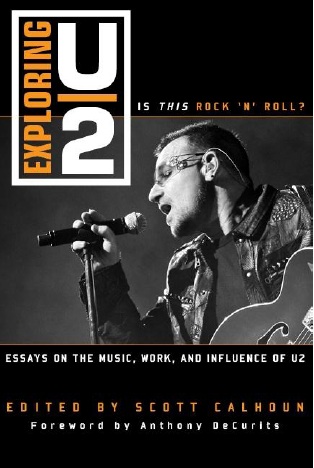
bono: third way’s icon of the month
 I’ve been beating my head for the last few weeks around a couple of sentences in a chapter I’m writing: struggling to know how to express what I consider messianic pretentiousness in Bono’s claim in this Youtube video that songs can change the world.
So it was a relief to find Bono’s messianic pretentiousness captured by no less a luminary than Bruce Springsteen, who
observed, when inducting U2 into the rock and roll hall of fame that ‘every good … front man knows that before James Brown there was Jesus’. And Bono, as the Boss suggests, seems to know this better than most.
A quote as part of the December edition of Third way magazine, who have named Bono as their icon of the month. (They do an icon a month and it’s a fantastic resource for cultural studies, which I drew on for my Gospel in post-Christian class earlier this year with every student reflecting on the use and abuses of such things as – Nike, football pitch, play station, widescreen TV – in our world today.)
Which needs to be placed alongside John Drane’s incisive little book Celebrity Culture
- that our fascination with celebrities reminds us that for many humans, truth is embodied and experienced as relational and personal
- that we no longer expect our celebrities to be completely perfect. Indeed, that their pain as they struggle to be a person of value is good news, for it portrays a form of honest discipleship that is deeply Biblical.
- the contemporary human fascination with the warts and all of life, including the spiritual search, asks questions about how authentically open are most Christians in their spiritual search
And for a wonderful exposition of this theology of “celebrity culture”, see the Drane’s post on the death of celebrity Jane Goodie.
So thanks Bono, for even if your songs can’t change a world, nevertheless, in your stubbled way, you help me stumble toward my being formed in the way of Christ.
Tuesday, December 08, 2009
Christmas Journey floats in Santa Parade
The Christmas journey is up in Latimer Square, Christchurch, again this year. About 1,000 bales of hay are used to create a labyrinth, in which various stations reflecting on peace are staged. Latimer Square is a major thoroughfare in the central city, and a redlight area at night, so it’s a neat place to offer Christian spiritual practice.
To help with promotion, the Journey placed a float in the citywide Santa Parade. The sides are painted by a local community youth trust. The four towers, with Advent words are set in the four corners. The centre peace is a laminated list of names from the phone book, with Pentecost symbols, to denote the Spirit at the Anunciation.

From the rear, a grassed area is visible, on which are stuck some “stick people” (driftwood, with eyes). These are given at the start of the labyrinth and people are invited to place them at the central stable area. Over 2,500 of these stick people were given out at the Santa parade, with the hope they will bring them to the labyrinth when it opens just before Christmas.

The Christmas journey represents one of the key evolutions in “emerging church” in the last 5 years – that of large scale outdoor creative engagement. The creativity and contextuality often used to re-frame worship has now been focused on the public square, to offer spiritual practice outside the church. These types of initiative are important in keeping alive the Christmas story, in a society where the Christian story is less known. The downside is that they are extremely labour intensive and can rely on the creativity of a few. They also make problematic the relationship between individualised experience and Christian community.

Thursday, December 03, 2009
Double Rainbow: a missiology for the least of these
I’ve been really enjoying The Double Rainbow: James K Baxter, Ngati Hau and the Jerusalem Commune
Here’s part of the introduction.
“When Maori and pakeha do these things together, the double rainbow begins to shine.” The double rainbow is Baxter’s symbol for a mutually regenerative bicultural relationship … Pakeka culture’s material dominance was accompanied by an arrogance and ethnocentrism which left it spiritually impoverished. “The Maori is indeed the elder brother and the Pakeha the younger brother. But the [younger brother] has refused to learn from the [elder brother]. He has sat sullenly among his machines and account books, and wondered why his soul was full of bitter dust.”
The book explores Baxter’s forming of the community at Jerusalem. It describes the impact of Parihaka on Baxter and how it turned him toward Maori culture. So much of Baxter’s arrival at Jerusalem has echos of Luke 10:1-12, of Baxter arriving barefoot and throwing himself on the hospitality of the local Maori.
The book moves beyond Baxter’s death, describing the emphasis on the least of the these, nga mokai, the fatherless and nga raukore, the trees who have had their leaves stripped, and the place of relationships and love in the healing of broken people and mental illness. It is a totally unique story: a Pakeha community built on Maori terms.
A lot of my creativity and reading in the last month has been around Kiwi mission themes (Parihaka, local peace stories). I’ve found it energised and humbling. And perplexing. Why, when I’m moving to Australia, am I so challenged? Isn’t it a waste? Shouldn’t I be staying, continuing to thrive in this Kiwi soil? I have no answers, simply wanting to name my confusion.


 )
)