Wednesday, May 30, 2007
kiwi Christians watching Kiwi film
I teach a course called Gospel and Film. One of the learning outcomes is for students to identify ways in which film may be utilized as a point of engagement for the gospel within contemporary society.
I have suggested to the class that we build a class wiki together. In other words, let’s look at a New Zealand film from a theological perspective and place our work on-line. This will occur over the weekend of August 3, and in preparation I’ve just built the wiki here. It took about 10 minutes using a site called www.wetpaint.com.
There are 8 members in the class and I will pair them, with each pair doing 2 New Zealand films each. Now we as a class are are open to suggestions. So, what are your top 3 New Zealand films that you would want considered from a theological perspective (asking questions like: In this film where are we? Who are we? What is wrong? Is there a remedy? What time is it?).
Leave your suggestions in the comments …
Monday, May 21, 2007
film reviews: blood diamond and miss potter
Here are two recent film reviews I have written. The first is reviewing Blood Diamond, in which I conclude by pondering Danny (Leonardo Di Caprio) as a type of Christ figure.
The second is reviewing Miss Potter, in which I attempt a creative re-writing of The Tale of Miss Potter: “Once upon a time there was an author, and her name was Miss Potter. She lived with her mother in a home in London, underneath the shadow of overly protective parents. As a young woman, she was told one morning, “You may go into tea parties and (be chaperoned) down the lane with eligible young bachelors, but dont go into the garden that is commercial book publishing.”
My other film reviews over the years have included;
Saturday, March 03, 2007
Lobotomised Christians and the Colonial Cringe of New Zealand: Interview with Steve Taylor
The latest CS Arts magazine is out (March 2007). The magazine is Christchurch produced and aims to resource the arts community from a Christian perspective. The design and layout is always top notch. This edition is called “The Big Picture” and the focus is film. It includes an interview with me; titled “Lobotomised Christians and the Colonial Cringe of New Zealand.” Here is my 2 favourite parts:
“I often think Christians are lobotomised, walking around with heads that have no appreciation of beauty, creativity or image. Art, or engaging with film, reminds us that we are made whole in ‘the image of God. To be authentic disciples, to be a true church, a whole church, we have to have these kinds of discussions.”
and
“The danger for the church is that it thinks it always owns the conversation. Film is a chance for us to listen to someone else’s voice. We need to listen in a way that respects that voice and doesn’t colonise it. That’s the danger of using film. The other danger is it just becomes an illustration of your point. So the use of movie clips in sermons etc. It’s like going to kindergarten, it’s a good start.”
For the entire edition, go here. I am on pages 6 and 7.
Friday, February 23, 2007
Reel spirituality
I read this to start my Reel spirituality class at BCNZ last nite. It was a great night. I’d forgotten how much I loved teaching this class in 2005:
I have a secret. It is deeply personal, so please treat it with respect. This is my secret: God speaks to me in the dark. With my eyes wide open.
I am talking of course, about movie watching. My secret is that my spirituality has been profoundly shaped by movie moments, including the ending of The Matrix and the honesty of The Interpreter.
And I am not alone. While historically many Christians grew up thinking film was bad, the reality is quite the opposite. Movies today are an essential vehicle for the formation of spiritual and cultural identity.
In fact, if the apostle Paul were to wander our cities today, I have a hunch he would stop outside our movie cinemas. He would point at the latest movie blockbuster. Just like in Athens (Acts 17), he would applaud the box office for taking religion seriously.
Movies are a mirror on contemporary culture. If Paul took the time to read his culture’s poetry, then Christians today should take movie going seriously. And I am not only talking about The Passion of the Christ or The Lion, Witch and the Wardrobe.
The task of being a Christian has always been a conversation between faith and culture, between our stories and Gods story. The apostle Paul had developed the skills to engage the spirituality of his culture. Can we?
“Who are we?” is the question being asked by movies like Sione’s Wedding. “What is wrong?” is the question being asked by Crash or Out of the Blue. “Is there a remedy?” is the question being asked by Shawshank Redemption, The Interpreter or The Three Burials of Melquiades Estrada.
(A piece that I wrote for CS Arts and Touchstone back in December06).
Tuesday, February 20, 2007
out of the blue film review
Here is my latest film review; of the New Zealand film Out of the Blue.
This is the conclusion:
“Out of the Blue” proclaims that there is more to the New Zealand film industry than special effects at Weta Studios. We have Kiwi filmmakers who can tell our stories with style and maturity … Such questions allow the Kiwi story of Aramoana to become a universal story. It allows us to move beyond a well-made docu-drama of courage under fire, to begin to ponder the moral and ethical questions of being human in a society full of metal things “well made.” more.
My other film reviews include;
Three Burials of Melquiades Estrada; Inconvenient Truth; Over the Hedge; The Da Vinci Code here; Siones Wedding here; Praire Home Companion here; Pirates of the Caribbean Dead Mans Chest here; River Queen here; Brokeback Mountain here; Narnia here; Serenity here; The World’s Fastest Indian here; Sedition, a New Zealand film about the fate of conscientious objectors in World War 2, here; Charlie and the Chocolate Factory, here
Further film resources:
Film as a point of gospel engagement (PDF).
Film and spirituality web resources.
Why gospel and film?
Saturday, January 13, 2007
three new film reviews
I keep forgetting to put these up – monthly film reviews I write for a Denominational magazine, who kindly allow me to place them on the web once they have gone to print. With apologies, here are my 3 most recent film reviews:
my October review, in which I explore the cinematic use of sound to carry redemption in Three Burials of Melquiades Estrada;
my November review, in which I ponder the place of God in an Inconvenient Truth;
my December review, in which I enter the animated world of Over the Hedge;
I am teaching Gospel in film (Reel Spirituality) at Christchurch Bible College of New Zealand again this year and have just been to see New Zealand film Out of the Blue. It made me realise once again how much theological work is being suggested by our contemporary film makers and how important it is for us as Christians to be part of the conversation. Bring on the Gospel in film (Reel Spirituality) classroom.
My other film reviews include;
The Da Vinci Code here. (I also have written on the Da Vinci Code here; here and here; Siones Wedding here; Praire Home Companion here; Pirates of the Caribbean Dead Mans Chest here; River Queen here; Brokeback Mountain here; Narnia here; Serenity here; The World’s Fastest Indian here; Sedition, a New Zealand film about the fate of conscientious objectors in World War 2, here; Charlie and the Chocolate Factory, here
Further film resources:
Film as a point of gospel engagement (PDF).
Film and spirituality web resources.
Why gospel and film?
Thursday, November 09, 2006
cans film festival and spirituality2go
Last year, in speaking to Anglican curates in Nelson, I compiled a list of ways churches uses film under the following headings:
1. Environments
2. Devotion
3. Communication
3.1 Illustration
3.2 Dialogue
3.3 “Roll your own”
4. Community building
5. Missional dialogue
6. Film Festivals
(Full notes are here.)
I’ve just found another: 7. Spirituality of food. The Cans Film Festival is a clever title and great idea. Donate a can of food and you get free entry to participating (big hat tip to Hoyts, Readings, Sky) cinemas. The can of food goes to The Salvation Army Christmas Appeal. (For more go here). So film is being used to fundraise.
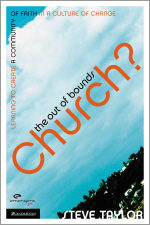
Now if I was the Salvation Army I would add in one more component. They’ve made a great start and could add significant value by considering spirituality2go. I discuss the theology of spirituality2go in my book (Out of Bounds Church?
So, the Salvation Army should make up a spiritual film takeway. This could be given to people when they donate their can of food. It should thank people for sponsoring the Christmas Appeal. It should contain a link to a website so that people can see exactly what their can of food is being spent on. It should also contain a list of film questions, to help families discuss the film later. For example, the Taylor family donated 4 cans to watch Over the Hedge. Film discussion questions could include:
– Who was your favourite character and why?
– What was the impact of the new suburb on the animals?
– How would RJ describe the eating habits of your family?
– What can our family learn from this movie about including people?
Such questions help resource ongoing film reflection. This could all be attractively presented in the shape of a can … you give a can, you get a can. In so doing, a great event (the Cans Film Festival) becomes a process.
Sunday, October 08, 2006
da vinci code resources
I was asked to preach on the Da Vinci Code and the Bible at a local Anglican church this morning. I looked at how we can understand Scripture as inspired, and finished with some Winnie the Pooh and Piglet theology, as an example of the understanding of Scripture as the inspired word of God in community. It was a lot of fun. For those interested in the sermon download here
More resources:
Here is another sermon: Decoding Da Vinci – which explores 3 fictions and 2 facts about the movie.
Here is yet another sermon: Something about Mary – which explores the place of Mary and women in the Christian tradition.
Here is my film review of the movie.
Wednesday, September 13, 2006
four new film reviews
Here are 4 of my recent film reviews. I write these for a monthly Denominational magazine, who kindly allow me to place them on the web once they have gone to print. I’ve been a bit slack on the blog. My apologies. Feel free to review:
my May review, in which I ponder make believe, of The Da Vinci Code is here. (I also have written on the Da Vinci Code here; here and here;
my June review, in which I am disturbed by the place of domestic violence in comedy, in Siones Wedding is here;
my July review, in which I recommend avoiding Praire Home Companion, unless you are bored in Idaho or want to help a dying church reflect on their future in a changing world, is here;
my August review of Pirates of the Caribbean Dead Mans Chest is here. I conclude: Considering the trajectory of character and narrative in Dead Mans Chest offers an “All aboard” to Christian film reviewers wanting to probe beyond a puritanical fascination with the presence, or absence, of bad language and female breasts.
My other film reviews include; River Queen here; Brokeback Mountain here; Narnia here; Serenity here; The World’s Fastest Indian here; Sedition, a New Zealand film about the fate of conscientious objectors in World War 2, here; Charlie and the Chocolate Factory, here
Currently I am reviewing The Three Burials of Melquiades Estrada.
Further film resources:
Film as a point of gospel engagement (PDF).
Film and spirituality web resources.
Why gospel and film?
Sunday, July 16, 2006
leonard cohen film review: i’m your man

In an effort to keep awake, I went movie hunting. I took a punt on Leonard Cohen: I’m your man and it was a great choice. The movie is a chronological journey through the life of a man I consider a lyrical genius. This is mixed with live concert songs from Came so Far for Beauty; artists like Nick Cave, Beth Orton and Rufus Wainwright singing Leonard Cohen’s songs. There is also lots of interviews with Leonard, plus comment from Bono and the Edge which adds depth to the songs.
There is a crack, a crack in everything
That’s how the light gets in
I found lots to ponder in relation to creativity and spirituality and humanity. It was probably the jet lag but I find the movie quite moving. Now I am just hoping they release the sound track.
Trailer here
Thursday, June 01, 2006
crash lands well: film review
Here’s my latest film review: of Crash. I’m really pleased with these few lines… “I like movies that play with linear time and demand audience concentration. But such movies, when mixed with diverse characters and diverse plots, have to work harder to provide a satisfying ending. Crash lands well.” For the full review go here.
I do these for a Denominational magazine, who allow me to place them on the web once the monthly magazine has been published. My other film reviews include; River Queen here; Brokeback Mountain here; Narnia here; Serenity here; The World’s Fastest Indian here; Sedition, a New Zealand film about the fate of conscientious objectors in World War 2, here; Charlie and the Chocolate Factory, here
Next month I review (no prizes for guessing) Da Vinci Code.
Further film resources:
Film as a point of gospel engagement (PDF).
Film and spirituality web resources.
Why gospel and film?
Saturday, May 20, 2006
pondering a Da Vinci spirituality
I went to The Da Vinci Code movie yesterday. The espresso congregation are using it as the topic of spiritual conversation. And I’m preaching on it this Sunday. I’ll write a movie review at a later date, but in the meantime here are some questions I am pondering:
1. If Brown hoped that this would rekindle interest in “topics of faith”, then how attractive to you is the vision of spirituality offered by Brown?
2. Was it not the Gnostics who celebrated the spirit as much more important that the body. Doesn’t that lead to a body-bad, self-flagellation at odds with the body-affirming, creation loving way of Jesus?
3. Doesn’t all the symbolism smack of some deeper level elitism. A spiritual search involving a Harvard professor, the curator of a famous museum, a police cryptographer and an enormously wealthy English doesnt exactly sound to me like a very accessible spirituality.
4. a) I am struggling to understand why Mary Magdalene is so important. If it’s because she’s married to Jesus, then her identity is sourced in marriage. But isn’t that a bit demeaning to woman, that they only become famous because of who they are married to? Doesn’t that undercut the “sacred feminine” so central to the book?
b) And if Jesus is just a human who died as Teabing suggests, then Mary is just the wife of another human. So why search for her grave 2000 years later?
5. In the movie, Robert Langdon recounts a story of experiencing Jesus present with him as a child. If Jesus has died, then how can this presence be? Or does this leave the door ajar to a risen Jesus?
Wednesday, April 19, 2006
river queen
Here’s my latest film review: of River Queen … The film follows Sarah’s search for her child, a search set against the backdrop of the viscous fighting between Maori and Pakeha that is part of the history of the Whanganui River. for full review
I do these for a Denominational magazine, who allow me to place them on the web once the monthly magazine has been published.
My other film reviews include;
Brokeback Mountain here;
Narnia here;
Serenity here;
The World’s Fastest Indian here;
Sedition, a New Zealand film about the fate of conscientious objectors in World War 2, here;
Charlie and the Chocolate Factory, here
Next month I review Crash.
Further film resources:
Film as a point of gospel engagement (PDF).
Film and spirituality web resources.
Why gospel and film?
Friday, March 17, 2006
brokeback mountain film review
Here’s my latest film review: of Brokeback Mountain. I do these for a Denominational magazine, who allow me to place them on the web once the monthly magazine has been published.
Brokeback Mountain. A film review by Steve Taylor. The date is 1963. The location is Signal, Wyoming and the mountain is Brokeback. Two young unemployed cowboys (Jack Twist, played superbly by Jack Gyllenhaal, and Eniss Del Mar, played by Heath Ledger) will spend the summer on its slopes. Mustering sheep against a stunning backdrop … For the full review click here
My other film reviews include;
Narnia here;
Serenity here;
The World’s Fastest Indian here;
Sedition, a New Zealand film about the fate of conscientious objectors in World War 2, here;
Charlie and the Chocolate Factory, here
And look at next month for review of a New Zealand film called River Queen.
Further film resources:
Film as a point of gospel engagement (PDF).
Film and spirituality web resources.
Why gospel and film?


 )
)