Thursday, October 01, 2009
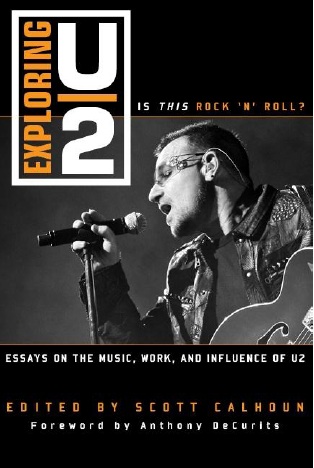
the evolving performance of Bullet the Blue Sky: U2 paper to speak
Just finalised my paper for the U2 conference. Huge relief to have it done, leaving the flight to work on the powerpoint. Just for fun, here is one of the sections. It is the 6th section, of 7, titled:
Installation: an art by any other name
“it was the total experience of a U2 set that counted.” (U2: The Early Days
Having used narrative mapping to analyse key features of the evolving live performance of (Bullet the Blue sky) BBS, one way to consider the data is through the lens of installation art.
A key element in installation art is what De Oliveria calls the “unexpected awakenings of communal memory.” (Installation Art in the New Millennium: The Empire of the Senses
Installation Art in the New Millennium
This is not escapism. Rather it can be framed as what Installation Art in the New Millennium
An outcome is that in a culture which “mourns the loss of public space” a concert is one of few “public space experience” left in our culture. (Installation Art in the New Millennium
What seems to be happening is a sort of humanisation. Through the evolving live performance of BBS, war is no longer a disembodied experience in El Salvador or Iraq. It is what happens to “those brave men and women of United States,” the “sister or a brother overseas and they’re in danger or whatever.”
Thus my argument is that the lens of installation art enables us to appreciate the evolving live concert performances of BBS. A song grounded in a specific context, through the practice of installation art and the technique of sampling, becomes a facilitator of communal awakening.
Select bibliography:
U2 by U2
U2 Show: The Art of Touring
Joshua Tree (Remastered / Expanded) (Super Deluxe Edition) (2CD/DVD)
U2: An Irish Phenomenon
Bono on Bono


I’ve found grace inside the sound: a benediction of incarnation
“I found grace inside the sound,
I found grace, it’s all that I found”
Breathe, from U2’s NLOTH album.
This works for me today as a benediction of Incarnation. Bono has made his career from “sound,” living inside the rock world all his adult. While initially warned to avoid “the secular world” of rockmusic, while enduring scorn and criticism for his actions over the years, here he sings of finding grace inside that “sound”. Unexpected favour. That is my prayer today: that in the midst of my life, my uncertainties, my insecurities, in my taking decisions to follow Jesus, grace is what I found.
There is a strong personal note to this blogpost. It’s now my 7th day on the road and I’m missing home. My three speaking engagements have been enjoyable, fulfilling and gone well, but have all been demanding and nervewracking. Today I begin my odyssey/long weekend road trip to the US for the U2 conference and concert. All exciting, but it will involve about 40 hours of flying and 10 airport connections. I have 55 minutes in Los Angeles and I will be lucky to make the connection. Yesterday I had 5 appointments, meeting key people in relation to my new job. I came away excited, but also quite daunted by the processes of change I am stepping into. In the last days I’ve had visits to 4 schools and phoned 2 more, keen to find supportive learning environments for my two “migrant” daughters next year. I’ve started to look at home and rentals and simply been overwhelmed by the choices facing us and the complexity of unknowns we as a family face. I’ve started to doubt the wisdom of our decisions. In other words, I’m needing today to be placing my hope in finding grace, inside the sound of US travel and Adelaide migration, and at a whole range of personal and ministry levels.
Rather than fret, I need to, as Breathe begins:
Walk out into the street,
Sing your heart out.
PS. I actually hate Breathe as a song. Love the lyrics, don’t like the tune.
For more U2 NLOTH reflections see here and here.
Tuesday, September 29, 2009
getting excited
Today I will walk past this letterbox.

Tucked in behind Tabor College, where I will speak on Discerning the emerging church in the afternoon. Then in the evening I will speak on Picturing Christian Witness at Coromandel Uniting.
But first I will walk past this letterbox. It was shown to me last year by Mark Stevens and lies on the way to the funky Brown Dog cafe.
At this letter box, I will pause. And give thanks for creativity and spirituality and culture. And count down the hours until.
Thursday, September 10, 2009
it’s work. honest! U2
So today is a writing and research day and you would have seen me at the library, checking out the U2 digitally remastered The Joshua Tree. It’s work.
Honest.
You see the boxed set includes DVD includes concert footage, Paris, 1987. The performance includes Bullet the Blue Sky. Now, fast forward years 17 years, to 2004, and the Vertigo DVD. The concert includes a performance of Bullet the Blue Sky. Same song. But 2004 is a radically different context than 1987. As Bono notes, a song can change the world. But what happens when a world changes around a song? How might the “ancient text” sound in a culture of change?
Now address the question by using a method called narrative mapping. Look not just at the narrative of the lyrics. Look also at the narratives of sound, of lighting, of visuals, of theatrical performance. Any changes? How has the performance evolved? What might we learn – about culture, about context, about communication?
Such are the questions I’m researching. It’s work.
Honest!
All preparation for my paper for the U2 Academic Conference, initially planned for New York in May,

then postponed, now happening in Durham in October. I’m speaking alongside Beth Maynard, looking forward to her paper and seeing face to face a cyberfriend, looking forward to talking U2, feedback and hype, over a weekend. Of work. Honest!
Sunday, August 16, 2009
u2 downunder
“Part of the tour will finish in Australia and another part of the tour will finish in South America, where people could use a nice concert pavilion in a park, which has an ability to take 200 tonnes of kit hanging under it,” Mark Fisher [stage designer said).
The article talks about how U2 want to see their innovative “claw” concert stage used as a local park concert venue, as their tour ends.
So on behalf of U2, this blog is taking nominations for parks downunder. Please leave your reasons in the comments section.
Thursday, June 18, 2009
Lament and hope in U2’s N/One Tree Hill
(Some writing today, for a paper on contemporary Baptist worship, July 15-18 in Melbourne – and dedicated to anyone planning for the U2 conference Oct 2-4, or dreaming of Oct 3.)
A number of explicit Biblical references in “One Tree Hill” lend itself to a reading of the song in relation to lament and hope. The subject referred to in the first line of the chorus changes through out the song: the initial “You ran like a river oh, to the sea” becomes, by songs end, “We run like a river to the sea.” This is an articulation of the inevitability of death, as expressed in Ecclesiastes 1:7: “All rivers go to the sea, yet never does the sea become full. To the place where they go, the rivers keep on going.”
The song journeys through lament; (We turn away to face the cold, enduring chill; The moon is up over One Tree Hill, We see the sun go down in your eyes) to become a protest not just against one death, but against all death (And in our world a heart of darkness, A fire zone where poets speak their hearts). This is linked with being human and the Cain and Abel narrative in Genesis 4:10 (You know his blood still cries from the ground).
Yet lament is not the last word, for the song ends with the hope of reunion (I’ll see you again). This is not a naive belief that all will be well in this life (I don’t believe in painted roses or bleeding hearts, While bullets rape the night of the merciful). Rather it is an eschatology in which the world is changed at the end of time, (I’ll see you again When the stars fall from the sky, And the moon has turned red over One Tree Hill”). It has echoes of Revelation 6:12-13: “Then I watched while he broke open the sixth seal, and there was a great earthquake; the sun turned as black as dark sackcloth and the whole moon became like blood. The stars in the sky fell to the earth like unripe figs shaken loose from the tree in a strong wind.” Despite the need for lament in the midst of our present darkness, there will be reunion with those we love, and have loved, coupled with judgment on present evil. A message of hope indeed.
Wednesday, June 10, 2009
is it worth it? will I be pushing it just a bit to far?
So the U2 conference I was due to give a paper at in May got postponed. It’s now on again, October 2-4, in Durham, USA.
That’s a bad time for me, stuck between a teaching commitment and a family engagement. Both have been graciously flexible, but here’s my decision …
Do I want to teach for 4 days straight in Adelaide, Australia,
jump on a plane to fly for 20 hours,
to arrive on the opening day of the u2 conference (Friday)?
with U2 actually playing the next day (Saturday)
and me then doing my paper (Sunday)
to then turn around and fly back to New Zealand
I’m not getting any younger and it’s a lot of air miles, a lot of jetlag, for a once in a lifetime opportunity.
Saturday, May 09, 2009
being human in U2’s no line on the horizon part 2
So the new U2 video for their single Magnificent is out. It’s all North African and white sheets. Ho hum. And the lyrics seemed to make no sense. “Only love, only love can leave such a mark” as the white sheets are pulled off buildings. They are all drifting and the bird is flying overhead unnoticed.
Which makes no sense. How can sheets leave a mark? They billow and drift. What a dumb graphic for a visual, I think.
Or is it ironically subtle?
You see, I have already suggested that the song Moment of Surrender includes a wonderful theology of being human. Take those lines:
I was punching in the numbers at the ATM machine
I could see in the reflection, A face staring back at me
At the moment of surrender, A vision of a visibility
– and consider that the face looking back at the ATM is ours, transformed by the moment of surrender. Only then does the human person become fully human, fully visible. This is God en-fleshed, for the silence of the incarnate sound finds voice, and thus visibility in us. In so doing, the two lines of the horizon are integrated, for vision has become visibility. (for more go here).
So is this theology of being human at work again in Magnificent. As the sheets are pulled away, do they not actually reveal the real thing, the real Africa, the real shape of buildings and people. Is this the mark left by love? Layers that once obscured and masked are in fact removed. Such is the mark of love.
Theologically, this would have echoes with Genesis 1, in which humans are made in the image of God. Then in Genesis 3, sin enters and so clothes are worn, obscuring and masking that which God has made good and whole. Then in the Incarnation, Christianity affirms Christ as fully human and fully divine. Thus the invitation to be in Christ must be understood as the invitation for us to enter fully into our humanity, to refind ourselves as the image of God. Such is love, the return to full humanity.
If this is so, it’s no wonder Bono also sings in Magnificent: And sing whatever song you wanted me to, I give you back my voice, From the womb my first cry, it was a joyful noise
Is this what it means to get “in the sound”, as each human, in response, finds their own unique voice, that which was a gift in the womb? This is love, and this love is twofold; for not only is the original voice re-found, but is found, for “Justified till we die, you and I will magnify, The Magnificent” Is this justification theological, the invitation to be fully human, revealed in all our honesty by love.
Or perhaps it’s simpler to accept, dumbly, that the visuals of the video really do have nothing to do with the lyrics. And that the lyrics of one song really do have nothing to do with the other songs in the album.
Wednesday, March 18, 2009
being human being Christian in U2’s no line on the horizon
Art is not theology. And lots of theology is certainly not art. But art is an attempt to make meaning and in that attempt at meaning making, theological echoes and insights can occur. While such insights should respect the voice of the author and the sound of text, neither should they ignore the reader/listener/viewer.
 The U2 album has got me doing some serious theological pondering, particularly on what it means to be human. Who are we and how then should we live? The following is a reader/listener response that seeks to honour the sound of the text and the complexity of the author … (more…)
Friday, December 26, 2008
merry Christmas
it just keeps on raining
veiled tears for the virgin’s birth
… They sold me a dream of Christmas, they sold me a silent night, they sold me a fairy story
but I believe in the Israelite.
nice! may this Christmas serve to sustain your belief in the Israelite,
Thursday, December 18, 2008
U2 academic conference: New York and me
YESSSSSSSSSSSSSSSSSSSSSSSSS!
My paper proposal – Sampling and reframing: the evolving live concert performances of “Bullet the blue sky” – for the U2 Academic conference has been accepted. My plan is to use work by Walter Brueggemann and the metaphor of DJing (as developed in my Out of Bounds Church? book). With near 100 applications, I wasn’t holding my breath, but New York, May 13-15, 2009, here I come.
It was a cold and wet December day
When we touched the ground at JFK
New York, like a Christmas tree
Tonight this city belongs to me Lyrics from Angel of Harlem, by U2
PS. Given the state of the New Zealand dollar, international airline tickets are a bit steep, so if there was anyone in New York or nearby, or on a stopover like Los Angeles, Chicago or San Francisco, wanting to pay for some (international!) input either side of May 13-15 on topics like: emerging church beyond US, missional church in established church settings, the Bible in contemporary cultures, creativity in mission and worship, theologies of popular culture. I could also do a paper preview! and explore the implications of U2 for mission and worship!
I can wear a variety of hats – academic PhD, or writer, or senior pastor, or emerging church planter – whatever – then drop me a line steve at emergentkiwi dot co dot nz.
Wednesday, November 22, 2006
Will they sing One Tree Hill?
Kiwis feel an extraordinary sense of affinity with U2 because they wrote a song about us. One Tree Hill is a real place in New Zealand. So U2 are singing about a real place in our country. The song is dedicated in memory of Kiwi Greg Carroll, who worked with U2 and died tragically in a motor bike accident. U2 brought his body back to New Zealand and participated in his tangi (Maori funeral).
Will U2 sing “our song”? It is rumoured to have been heard at soundchecks.
And if they play it, how will they change the lyrics? U2 have an extraordinary ability to change context and add layers to songs.
A few years ago, the tree on One Tree Hill was cut down in an act of political process. Many Kiwis now call the tree “No tree Hill.” So, if U2 sing “our” song, what, if any, changes will they make?
Tuesday, November 21, 2006
U2 and my lifescape
Play my U2 album catalogue and you replay my life.
Baby rocker: Under a Blood Red Sky was one of the first albums I ever brought. I was 15 and discovering rock music. I dreamed of playing 3 chords and the truth with Edge and climbing stadium speakers to plant white flags with Bono. The fact I have no rythm and no singing voice meant that my adolescent dreams remained dreams. But the passion and drive of U2 awoke something in me.
Early Christianity: One of the first sermons I preached was a reflection on I still haven’t found what I’ve looking for. It was 1989 and books on U2 sermons were still 14 years away. But I was stuck in a charismatic moment and the lyrics of the song whispered to me, of not-yet seen dreams of the Kingdom come.
Early love: Too poor to buy tickets, my wife to be and I parked outside what was then Lancaster Park, Christchurch for the November 4, 1989 concert. We parked in her parents Hillman Avenger and managed to sneak a view through a wire mesh fence.
The digitising of life: I sort of lost touch with U2 during their ZooTV phase. I was listening to the Zooropa album last night and was struck by the flatness of the drums. It makes me wonder if the U2 ZooTV era was best appreciated visually rather than aurally. I was also at seminary. The big influence was Karl Barth, screaming “Nien” (No) to natural theology. While U2 were going visual, I was needing to find God not in the mysterious ways of Karl Barth, but as the slow dance of the Spirit in the world that God loves.
All that you can’t leave behind: I travel to Auckland tomorrow. Together with my wife, family and friends, I’ll listen to a group that have been the soundtrack for much of my life to-date; adolescence, faith, love, career. I am not sure what the future holds for me or for U2. Here are a few lines from a sermon I preached a few weeks ago:
Every now and again, when I listen to Bono, I just want to pack my bags and head off to undertake community development in Africa.


 )
)