Wednesday, June 20, 2012
Finding words for worship
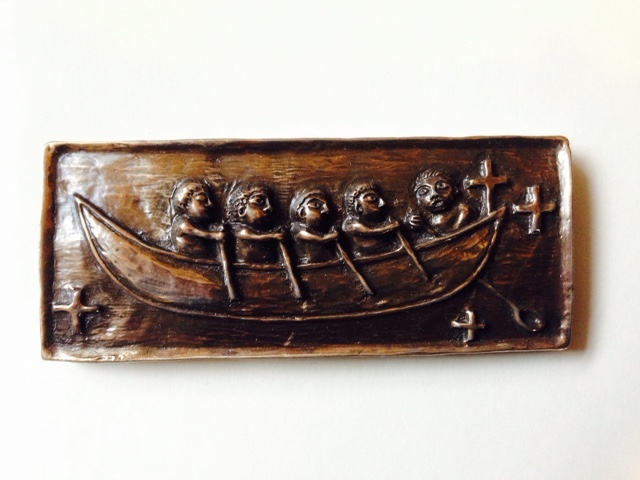
I’ve been asked to provide a call to worship at the Church Synod on Friday evening. My general rule of thumb is to work with what’s engaging me. Last week I posted this,

Pukehinahina Cross, St Georges Anglican Gate Pa. Used with permission.
Which, with a bit of research, over the weekend I have shaped into the following Call to worship –
Leader: The cross,
offering reconciliation, making enemies friends,
All: May we, reconciled and reconciling, feel again Your call to mercy
Leader: The greenstone,
an item of treasure and value in Maori culture
All: May we, Your treasures in earthen clay, hear afresh Your call to value each other
Leader: The fishhook, carved in reference to Jesus invitation,
Come follow me: I will make you fishers of people
All: May we, Your fisher folk, experience anew Your call to mission
Leader: The fishhook, a pattern commonly carved in Maori culture
a symbol for a journey, speaking of the need for shared courage, wise leadership and safety in troubled times
All: May we, Your pilgrim people, find together new courage, wise leadership and surprising joy,
Leader: In our shared journey, Shaped always by this cross of Christ. Amen
Monday, June 18, 2012
Men talk more: more than a guy thing part 4
Men tend to talk more. And in doing so, they tend to silence women. Men tend to talk in certain ways. And in doing so, they tend to silence women.
“Studies of classroom behaviour suggest that men and women exhibit different manners in their speaking, and that (western European) men’s style is the valued pattern. Men are more likely to use: highly assertive speech, impersonal and abstract examples, and competitive or adversarial interchanges … This style and ethos are not only favored, but they tend to be perceived to be more intelligent and authoritative behaviors.” (Carol Hess, Caretakers of Our Common House: Women’s Development in Communities of Faith
106)
In contrast, women’s speech patterns tend to use a more tentative tone. Rather than seek adverserial assertion they are more likely to make encouraging or supportive comments, wanting to draw out the contributions of others.
What to do if you want more equal conversation, if you want to be part of an Acts 2 church, in which you hear “your daughters prophesy”?
- Listen more carefully for tentative talk and as you hear it, take care to publicly affirm it.
- Create ways for people to share not only through abstract ideas but also with personal storytelling.
- Be very aware of gender exclusive language. It might not silence you, but it could well be silencing others.
- Encourage collaborative explorations as opposed to individual or competitive interaction.
(This continues my reading around gender, leadership and faith development (here, here and here).)
living in cultures of change
Spotlight, a leading national craft and curtain shop, sells raffia. This simple fact is important for local indigenous expression.
Yesterday Team Taylor enjoyed the annual open day at the Warriparinga Living Kaurna Cultural centre. We enjoyed the live music, watched the kids play a traditional game, kicking around a possum skin (yep, possum) and joined the local basket weavers.
As we chatted we learned that traditionally basket used reeds and grasses. However such things disappear in modern industrial cities. Either the practice of basket weaving dies. Or else the cultural adapts.
Hence the importance of raffia from Spotlight.
It reminded me of a conversation a few weeks ago. I was wine tasting and some older folk were chatting beside about the impact of technology. Will our children be able to read and write, in an age of screens and e-readers? They were concerned about cultural death.
I pointed out that my children are reading more widely and broadly as a result of the purchase of Kindle’s. To which they shrugged, sighed and said “I guess you’ve got to just so with the times.”
The resignation in their voices, the words they use, were very similar to what I hear in church circles. It suddenly occurred to me that
One, responding to change is not just an issue for the church, but for all cultures. It is a shared human challenge.
Two, that avoidance or assimilation, fighting or acceptance, are two very limited responses.
Three, that Christians who think about culture-making, about a variety of practices by which to live in change, that the adaptive resources from within indigenous cultures, are a helpful resource for living in change – not just for the church, but for all humans in modern society.
Friday, June 15, 2012
blue view from my balcony

I’ve spent the last two days in Sydney, enjoying time “on the balcony.” It’s a phrase from Ron Heifitz, who argues that if life is a dance, we need time to get far enough above the fray to see the key patterns, to gain perspective on conflict, to nurture relationships, to find sanctuary and recover a sense of purpose.
My supervisor for this “Principal” phase I’m about the enter into suggested I join him “on the balcony”, to look at the view, to talk leadership and team and capacity building, to reflect on how I might transition and begin.
It’s been fabulous. (The photo is of the Three Sisters, in Blue Mountains, and yes, there is the shadows of me and my supervisor!)
Thursday, June 14, 2012
art as public mission
The South Australian Art Gallery has gone public, in a fascinating way. They have taken 13 paintings out of the Gallery and hung them, in public, in locations around Adelaide
Art Gallery director Nick Mitzevich says once the artworks are found, people might photograph, add to or take possession of them. “The surprise [of] where people have found the work is really part of the project,” he said. “Putting the works within the public domain allows everyone to be a part of it, so the work isn’t the artwork itself, it’s the whole project and how it might play out. (More here)
I love the risk involved (what if the art got wet, stolen, disfigured?), the creation of curiousity in public spaces.
I immediately wondered what “art” the church might want to place in public? What 13 “acts of service” could be “hung” to be discovered? More liturgically, what about doing this around a church festival, say Holy week, invite artists to make a station and rather than invite folk to your church to watch it, simply hung them in public? More worship orientated, why not a church service, where your theme was “hung” around the building and children (big and little) had to play hide and seek to find the various parts?
It reminded me of bookcrossing, plus the work of Ric Stott in Sheffield, in placing clay figures outdoors during Lent. It’s all art as public mission, a way to invite curiousity, to find our story beyond church walls.
Wednesday, June 13, 2012
a contextual visual for mission 2
Other visual theologies of mission here and here.
Pukehinahina Cross, St Georges Anglican Gate Pa. Used with permission.
Carved by James Tapiata for St Georges Anglican Church at Gate Pa. Used by permission. Not to be used in any form without permission from St Georges.
The greenstone Maori fish hook is entwined around the cross, to remember Christ’s mission as a fisher of people and to show the ties between two people – Maori and Pakeha. Greenstone is of immense importance in Maori culture, both spiritually and historically. Although not stated on the church website, the fish hook is likely to reference “Hei-Matau”, a common Maori carving pattern, in which fishing was simply a way of gathering food. In this context, it would symbolise prosperity, determination, leadership and good health, as well as safe journey over water.
Tuesday, June 12, 2012
missiology and salt-making
I’ve been slowly plowing my way through Salt: A World History
It takes that everyday household – salt – and explores it through history, it’s role as currency, as instigator or wars, in shaping empires and inspiring revolutions. It’s a fascinating walk through human cultures, as seen through something we all take for granted. I couldn’t help reading it with a missiology eye. (For more on a missiology of salt, see here, insights from Marianne Sawicki’s Crossing Galilee: Architectures of Contact in the Occupied Land of Jesus
The importance of social action
Soon after that, a cleric named de la Marche distributed potatoes to poor parishioners and was nicknamed d’eskop ar patatez, the potato bishop.
Imagine being known, honoured even, as the “potato bishop.” Yes to mission as social action, as care for the poor.
The importance of listening
At the time of the American invention of the jar, a western missionary, one Father Imbert, had gone to China to study the ancient wells of Sichuan. He reported on more than 1,000 ancient wells drilled to great depths and brine lifted in long bamboo buckets. He also observed that the Chinese had elaborate techniques for recovering broken drill shafts. In the West, such obstructions were often the cause of a well being abandoned.
Here is the missionary as learner, as researcher, as culture explorer. In so doing, we are reminded of the creativity of Chinese culture.
The colonising impact of cultures
Unlike the French and the Spanish, English settlers and their American descendants tended to bring salt with them rather than find it where they went.
Might there be something in English/American cultures that prefers to impart rather than contextualise, import rather than nourish what is? Yet in contrast, in the midst of a recipe, the following made me think.
silphium root [a rare plant from Libya much loved and consequently pushed to extinction by the Romans]
Yet here is a Roman culture that is responsible for not nourishing what is local. We often hear Western industrialised cultures blamed for environmental damage, yet here is an early culture killing a plant species.
The contemporary cultural shift
The book finishes with our contemporary world. It describes the rise of monopolies, the two global multinationals that now dominate world salt production. Yet it notes a shift, first in young people moving back to traditional salt-making areas to farm their own salt and second, in consumer demand.
Unlike with the big companies, here the future is quality, not quantity. They command high prices for their salt because it is a product that is handmade and traditional in a world increasingly hungry for a sense of artisans.
It all resonated for me with John Drane’s, After McDonaldization: Mission, Ministry, and Christian Discipleship in an Age of Uncertainty

Uniformity was a remarkable innovation in its day, but it was so successful that today consumers seem to be excited by any salt that is different.
The place of contextualisation. The potential for artisan church.
Monday, June 11, 2012
“All the locals said it couldn’t be done”
A long weekend here in Australia and my family decided it was time to drag me away from the renovation project. We found some accommodation on a beachfront and have had a rich time. This is the sun setting on Sunday evening out our front window.

Highlights included
– the Queens Birthday banquet. In what is becoming an annual tradition, Team Taylor decide an extensive menu with different family members taking responsibility for different courses. This year it was eight courses – nibbles, soup, fish/meat, vegetables, salad, dessert, cheese platter and drinks.
– beach walks, coffee, bakery pies from Port Noarlunga.
– Star Trek. We are making our way with the kids through the movie series.
– meeting an entrepreneur in Myponga, chatting with him about how he took a disused mushroom factory and turned it into a farmers market. “Locals told me it couldn’t be done and it wouldn’t last more than 2 months. That was back in 2000.” I love those sort of stories and meeting these sorts of people.
– exploring Old Noaralunga, including the historic St Philip and St James Anglican Church and the Onkaparinga River. I think I’ve found a “thinking place” – close to the city, yet so isolated – that might serve me well in the next season of ministry that is beckoning me.

Friday, June 08, 2012
still blogging 10 years on
Apparently Saturday marks my 10 year blog-versary. I say apparently because my original webhost is long gone, so there’s no “public” record of birth.
My midwife was blogger, which after a few months, got hosted in as part of the Graceway church website. When I transitioned city (Auckland to Christchurch) and churches (Graceway to Opawa) at the end of 2003, it seemed appropriate to leave the resources of the blog at Graceway, but I continued to blog, using wordpress (first entry here). Going back through blogger archives, this is the earliest post I can find is dated 9 June, 2002.

Ten years ago. Before Facebook, iPhones and twitter.
I remember the day I put my first post up and within a few hours, had comments from Andrew Jones, Prodigal Kiwi and Rachel Cunliffe. That sense of amazement over a digital word and how strangers become linked.

All 3 remain friends – Rachel visiting us this Easter, Andrew stayed at our house last year, while I enjoyed a beer in Auckland with Paul last August. A virtual world, yet with enduring relationships.
I’ve often pondered whether to continue blogging. And then there will be another random connection – a comment in response to a post that gives me fresh vistas, a email asking to borrow a prayer resource. And I will be reminded of the gift of connection, the new worlds made possible through the web-verse.
I can’t picture a world in 10 years time, nor whether I will still be blogging. But I still like to remain open to the sheer wonder of human connection.
Local Adelaide folk can you help? I need a PA
The Uniting College for Leadership and Theology has a part-time (0.5 FTE) 3 year fixed term opportunity for an energetic, enthusiastic and highly organised Personal Assistant. The role is an interesting and varied one, which involves a wide range of secretarial and administrative responsibilities. Additionally you will manage and coordinate projects, provide research assistance, and develop promotional materials. (Position re-advertised)
Enquiries to Peter Gunn at peter dot gunn at flinders dot edu dot au
Thursday, June 07, 2012
Kony 12: An optimist, a cynic and a theologian ..
Each month I publish a film review, for Touchstone (the New Zealand Methodist magazine). Here is my most recent.
Kony 12
An optimist, a cynic and a theologian sat down to share a latte and change the world.
The optimist wanted to do something…anything. He left the cafe and flew to Africa. His heart broke, bled in a thousand pieces in a country he didn’t understand, among a culture that was never his.
Being a Westerner, he came armed with a video camera. He used it to shoot footage of crying children, dense bush, and men with guns.
He returned to form an organization, and coined it ‘Invisible Children’. He gathered donations – a third for film, a third for expenses, a third for programmes grounded in Africa.*
He began to recruit, drawing together a staff skilled in film-making and media industries. Carefully they edited the video, manipulated the sound bites, added graphics and sourced the emotional background music. And so was born Kony 12.
The cynic snorted when he saw it. A lifetime exposed to world hunger and media manipulation had left a well-practised sneer. He googled ‘Kony 12’ and pressed ‘like’ on all the criticisms.
What is the budget? Who funded this? Where is the conspiracy? What if it fails? Is the US there simply because of oil? Will this simply inoculate people against the next tragedy?
While he complained, ‘Kony 12’ became a media sensation, watched on the Internet by nearly 90 million views.
The theologian’s teenage child suggested she watch the video on YouTube. Pressing play, she smiled at the gospel echoes in the sound bites – ‘the value of all human life’, ‘a bunch of littles could make a huge difference’, ‘the unseen became visible’.
She pondered the difficulty of fitting story, slogan, sound bite into the words ‘nuance’ and ‘complexity’. She recalled the words of challenge from African youth leader Teddy Ruge: “Did I ask you to sell my story for an action kit to make uninformed college students feel good?”
Time went by and later, the optimist, the cynic and the theologian bumped into each other once again on a crowded city.
Proudly, the optimist noted how Kony was now a household name. ‘We’re making the world a better place,’ he said.
The cynic was unconvinced. ‘Surely there must be more to life than making Facebook a better world.’ He mentioned the ‘S’ word – ‘slacktivism’ – the idea that sharing, liking or re-tweeting across the social web will solve a problem.
The theologian pulled a book from her handbag and read from Teresa of Avila. “I particularly notice in certain persons … that the further they advance … the more attentive they are to the needs of their neighbours.”
Which means, suggested the theologian, that Kony serves a purpose. It is a way to pay attention to the needs of our neighbour. Yet Kony must advance. Eyes that watch a video, and hands that ‘like’ a link, need feet that carry them to meet their needy neighbours face to face. Wouldn’t that be a video worth making!
*Publicly available financial accounts of Invisible Children suggest nearly 25 percent of its $8.8m income last year was spent on travel and film-making and about 30 percent went toward programmes in Africa.
Rev Dr Steve Taylor is Director of Missiology, Uniting College, Adelaide. He writes widely in areas of theology and popular culture, including regularly at www.emergentkiwi.org.nz.
Wednesday, June 06, 2012
Female atonement images: Hunger games film review
Each month I publish a film review, for Touchstone (the New Zealand Methodist magazine). Here is my most recent.
The Hunger Games
“The Hunger Games” is a deeply disturbing movie. The camera opens on a bleak future, a life of subsistent, subservience in slavery to a wealthy Empire. Annually, as some sort of depraved atonement ritual, 24 children are chosen by random ballot, to fight for life in a televised death match. Roman Gladiatorial style human-tertainment is repulsive enough applied to adults, but to conceive of it for children takes a particular chilling imagination.
The film is based on a teenage novel written by American television Suzanne Collins. The transition from page to screen suffers from the common problem, of how to express in a visual medium complex written internal monologue. The result is a beginning too long, followed by a middle too short, shorn of the internal dialogue that makes intriguing the heroine, Katniss Everdeen (Jennifer Lawrence). Some redemption is provided, in an ending twisted enough to ensure suspense despite the seemingly inevitable Hollywood style good girl wins.
Technically, the film gains four stars. Well directed by Gary Ross, the acting is tight, the musical score fitting, the scenes a dramatic contrast of high-tech beauty, subsistence squalor and bush-leaved prison.
Conceptually, the dimensions of reality TV ensure this sci-fi future feels uncomfortably close to home, while the giving of gifts by a watching TV audience evokes complex levels of participation in us, the watching film audience.
So what sort of role model is Katniss Everdeen? First, she is a woman. In a film industry dominated by the macho and male, it is pleasing to watch a quick-witted woman emerge a star. Second, Katniss embodies care and character, a willingness unto “death-do-us-part,” to seek another world of possibility.
So what sort of mirror is the film for a watching church? It should certainly provoke discussion around how to understand that central Christian symbol, the cross.
“The Hunger Games” is built on substitution, the willingness for some to die for the peace of all. On screen it beggars belief. What sort of society would sacrifice an innocent few for the sake of many? On screen we are faced with the moral repugnancy that is substitutionary atonement.
Is innocent death really the best, the only way, that God could conceive to deal with human rebellion? Thankfully, even the quickest flick through history is a reminder that substitution is only one of a number of understandings of the cross held through by the church. (Others include Anselm’s satisfaction, Gustaf Aulen’s Christ the Victor and Abelard’s moral theory of atonement).
Intriguingly, the actions of Katniss provide further ways to frame atonement. In a scene of tender drama, Katniss loving lays white flowers on the chest of Rue, one of her dying Hunger Games competitors. Unknown to Katniss, her care for another, an enemy made friend, sparks a riot among the watching. Love liberates, releases a repressed communal desire for freedom.
This surely is the possibility buried in Easter. Love liberates, questions the values, attitudes, paradigms that shape one’s world. In the willingness, even unto death, to live differently, we find another world of possibility.
(For other cinematic reflections on female atonement images, see Kathy in Never let me go and Sue Lor in Gran Torino.)
Rev Dr Steve Taylor is Director of Missiology, Uniting College, Adelaide. He writes widely in areas of mission and popular culture, including regularly at www.emergentkiwi.org.nz.
Tuesday, June 05, 2012
An Australian migrant theology?
In Robe (where I spent the weekend) when you enter West Beach, you are invited to beware of migrants. Specifically, migrant birds.

What sort of migrant theology might emerge from this type of posture?
It would expect migrants to arrive exhausted, recognising they have travelled far, they have seen much, they need lots of space to “conserve their energy.”
It would expect migrants to “rest and feed”, to find resources to renew them, to prepare them for the next stage of their journey.
It would offer them space, be willing to change direction and “walk and drive below the high tide mark.”
A pattern that has been happening for thousands of years before any white fella arrived, a pattern in which the land of Australia has sought to serve, renew and restore migrants.
(This is another entry in dictionary of everyday spirituality, under the heading M is for migrants).
Monday, June 04, 2012
refreshed by Robe
It was a rich weekend just gone. The destination was Robe, a holiday beach town 3.5 hours drive south of Adelaide. The occasion was the invitation to Refresh, to explore mission with rural churches from the South East of the state. With a theme of refresh and with the destination a holiday place, I decided to go early and stay on. Which meant I woke on the Friday to this

and on Saturday to this

The theme of Refresh was Getting on with mission. I did three sessions, one on what is mission, another on the place of church in mission and a third on engaging the community through practices of listening and presence. Plus I lead worship and communion. (This was one result, folk writing in liquid chalk on the lovely chapel windows a word that summarised their weekend.)

I talked about the importance of asking “What is God up to in the world?” which was picked up superbly by one of the other worship leaders, who invited folk to make a windsock, writing on it where they were seeing the Spirit in their community.

They made such a bright and beautiful addition to our life together. It was probably one of the most enjoyable groups I’ve worked with in a long time. I’m still trying to reflect on why. Perhaps it was that I was more rested, being on study leave and going early. But I think it was also their honesty and realness.
Which still gave me time on Sunday to tuck up in bed, listen to the pelting rain, read The Time That Remains: A Commentary on the Letter to the Romans


 )
)