Friday, December 09, 2011
urban advent installations
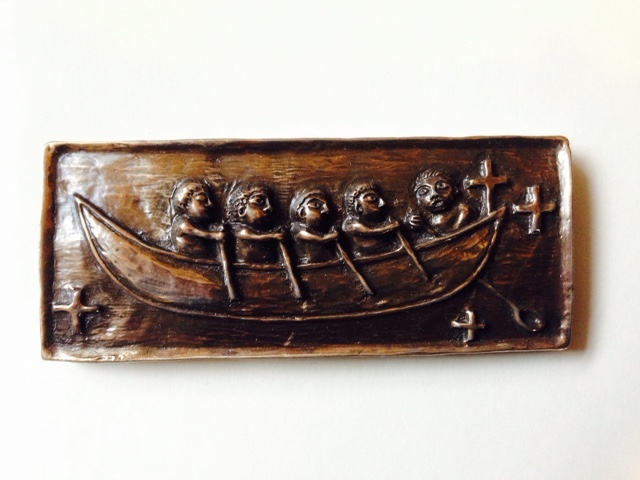
Great urban Advent idea from Sanctus1 in Manchester. They have created 24 advent shrines all over the city centre. A different artist has taken responsibility for the 24 days of Advent and the “shrines” are then placed in different locations around the city centre.
This is for December 7th, located in the Midland Hotel.
This is the second of five shrines to be located at the hotel, occupying a no-longer-in-use phone booth. Hotels and inns have been places of gathering, shelter and hospitality for centuries. This shrine relates to part of the Christmas story, where Mary and Joseph were trying to find somewhere to stay in Bethlehem, but all the hotels were booked up. Pray for those needing shelter and warmth on these cold winter nights.

I like the transient nature of these, the sense of here today, gone tomorrow surprise that is engendered as these pop up around the city.
I like the vulnerability, the sense that these are precious art, yet could be damaged, graffiited, destroyed. That in itself is a Christian and Advent message, the sense of being given a precious gift, that we can chose to ignore.
I like the everydayness of these, that you are invited to pray not at special times inside a special building, but in the midst of your working, walking life.
I like the public nature of these acts of worship, the Christmas story started not inside a church, but in the public domain, in the bustle of life.
What remains unresolved for me in all these public spiritual installation art is the relationship between authentic presence in a branded culture. Or as I wrote a few years ago in relation to the Christmas Journey:
The tension between whether the [public spiritual installation art] should act like an interactive signboard or the foyer of a building. Should each [public spiritual installation art] stand alone, as a signboard? Or should the [public spiritual installation art] be like a foyer, that welcomes and points people toward church or Christianity in some way? The concept of gift is important. Many churches offer subtle switch and bait operations. Should the [public spiritual installation art] be offered as a gift, with no strings attached? Or should they come with a subtle price tag. (This could include invitation to church services, a Christian tract, a takeway resource). Yet society at Christmas is so dominated by consumerism and when the church offers “switch and bait” have we not bowed down to the gods of consumerism in our culture? Each year this is debated. In 2006 the [public spiritual installation art] simply offered a takeaway potential of a memorable moment.
In terms of resourcing this, it could easily be the main focus of the energy for a community, that is used first in public during the Advent season, but are then all collected and offered as gathered worship (come see all the 24 advent stations) for Christmas eve services, with space, mulled wine, artist floor talks, ambient music and carols. In other words, the creativity is shaped by mission but woven into the worshipping life.
Well done Sanctus1 (and thanks Ben for the hat-tip).
Wednesday, December 07, 2011
What to Remember When Waking: a poetic opening into Incarnation
I’ve been sitting for the last two months with a poem by David Whyte (What to remember when waking). My supervisor gave it to me, first in response to some prayers I was writing: short tweets type prayers as I sought to turn into prayer my first waking moments. Like these:
Gentle patter of falling rain is a healing, relational gesture. God help me treasure your active participation in the world today.
Mist, a mystery, gently striding the hills, a humble quest suggested. God, courage please, for every question in that quest today.
Sparrows you flit, in effortless flight, through God’s wide world. Today, God may I share in playful participative play.
My supervisor connected my prayers with the first line of the first verse:
In that first hardly noticed moment in which you wake
As I say with it, it began to provide a way to pray as I considered the Principal role, especially the last verse:
What shape waits in the seed of you
to grow and spread its branches
against a future sky?
Then, as we have moved into December, into Advent, as I’ve been pondering the Christmas message, the 3rd verse has become significant.
To be human is to become visible
while carrying what is hidden as a gift to others.
To remember the other world in this world
is to live in your true inheritance.
It suggests a way of understanding Incarnation, God-in-flesh. God choosing to become visible in Christ, Christ carrying a gift of love to others, a gift not from this world, but from the Eternal, a gift defined not by these world’s values, but from the life and love of God.
It’s amazing how a poem can live on, find increasing depth, resonate with different parts of my life. Anyhow, for those interested here’s the poem, offered in the sense it might be useful to others in this Advent season.
Tuesday, December 06, 2011
public theology indigenous style: Rev Dr Djiniyini Gondarra
“You put it on the spoon and then you put it in my mouth. Like a baby”
You stole everything from us and then you say to us, live like a white man, think like a white man … You are setting the rules for my children.
Where is my liberty? Where is my people liberty?
Rev Dr Djiniyini Gondarra is a Uniting Church minister. Here he is addressing the Australian Labour Party national conference, responding to the ‘second Intervention’ otherwise known as ‘Stronger Futures in the NT’, a new Commonwealth Government initiative which will maintain key powers introduced through the NT Intervention. This message was screened in Sydney on Saturday December 3.
Monday, December 05, 2011
Mission and evangelism network
Over these 3 days, I’m hanging with the Assembly mission and evangelism network. It’s a gathering from around Australia of Uniting church folk who at a state level, provide leadership in areas of mission and evangelism.
The folk are mainly Synod workers and I’m the only person from a Uniting College. Not sure whether that is a random fact, or whether it says something about me or the network or the other Colleges or Uniting College.
The gathering meets twice a year and becomes a place for relationships, for sharing of resources and for engaging current issues. For me, it helps keep me grounded among the real life issues of the church and what it might mean to be a training place that serves those needs. Plus the group are fun.
Sunday, December 04, 2011
this is the house that Up built
The Up house is for real. And for sale.
A house modelled after the home featured in the animated movie “Up” has been sold to a family who are self-described Disney and Pixar fanatics … Builder Adam Bangerter has said the blueprints for the house were drawn based entirely on details found in the popular movie. Much of the home had to be custom-designed. (here)
It’s amazing to consider how an animated movie, can shape real life.
It’s also amazing to consider how that animated movie has shaped my real life. It was September 14, 2009 and we had taken the kids to see the movie. We loved it and I blogged about it here.
It’s the plot that makes Up great; that good old-fashioned ability to engage an audience by telling a story, in this case of childhoon dreams lost, the pain of life and the possibility of imagination rekindled.
At the time, we were considering whether or not to move to Adelaide, as the founding Director of Missiology at Uniting College. I was getting cold feet, considering the pain it would cause for us, for Opawa, for our family and friends. Watching Up, I felt it had some messages for me. Would I be like the old man in Up, Carl Fredricksen, who had been too scared to actually put an adventure into reality? Or would I, and team Taylor, be willing to trust God and go on a new adventure? Which became worship that Sunday. And was a part of our discernment and journey toward Australia.
So again, an animated movie shaping real life. The power of popular culture. To quote Tom Beaudoin:
The fact that popular media culture is an imaginative palette for faith … the church has to take that imaginative palette seriously… if part of the pastoral task of the church is to communicate God’s mercy and God’s freedom in a way that people understand then you have to use the language that they’re using, you have to use the metaphors and forms of experience that are already familiar to them.
Friday, December 02, 2011
current Australian attitudes toward religion and Christianity
There is a great resource just out, exploring attitudes toward religion and Christianity in 21st century Australia. It emerges from Olive Tree media and is based on focus groups and a national survey of 1,094 Australians.
Almost half of Australians consider themselves open to religious change
Key obstacles are not around belief, but around behaviour (like abuse, hypocrisy, judging attitudes). For example, some 76% consider themselves repelled by church abuse.
There is a high quality, attractively presented four page summary here here, while the entire report, 32 pages, can be purchased from here.
It’s a resource I will be using it in my Reading Cultures class, and will be weaving the data into mission shaped ministry.
Thursday, December 01, 2011
mission shaped ministry Adelaide calls it a dawn
Endings became beginnings, as the Adelaide mission shaped ministry course concluded last night.

The evening began in celebration, with food and sparking wine. Around tables folk looked back, reflecting on what the course had meant. They looked forward, reflecting on first next steps and what ongoing relational connections they wanted:
- coaching
- learning networks
- regular reunions
The evening concluded with worship, a thanks for all we had experienced and then a commissioning into the dawn that is God’s new possibilities.

Spontaneously the lights were turned out and the leaders thanked. Each lit candle represented a person from the course, better equipped to be light in their communities. Each unlit candle represented the potential of future courses, (Semester 2, 2012) to ignite more lights into the community. A new dawn.
Throughout the night we shot video, interviewing folk about what the course meant to them, hoping to create an Aussie accented mission shaped ministry promotion. The camera person commented how they were blown away by what people shared and the sort of life changes they were speaking of, which was really neat to hear.
Wednesday, November 30, 2011
the place of apt liturgy in fresh expressions
In marking, I tend to engage in student work with at times quite extensive written comments. Here, with an introduction to give some context, are some thoughts I wrote in an assignment I marked today.
“Apt liturgy” is a wonderful phrase, from Ann Morisy in her book, Journeying Out: A New Approach to Christian Mission
“Liturgy if it is to be described as “apt” needs to express people’s deepest fears and hopes. Apt liturgy should also enable people to put their fears and hopes into a wider context by sensing the resonances between their own situation and humankind as a whole. One of the costs of the low level of religious literacy in our society is that people are deprived of the conceptual tools which could help them to locate their circumstances, both positive and negative, in a more universal framework. Apt liturgy is a way of providing a framework of understanding which helps people to move beyond self centered and narrow horizons.”
This invites the role of poet, the gift of seeking to name/give voice to the work of Spirit. I find it helpful to frame this by considering the work of the Spirit. Such thinking will begin with Romans 8:23, the Spirit groans in the world. Thus, good apt liturgy will give voice to this groaning. To be faithful, it must start by listening to people, to popular culture, to the world outside the church and to naming their groanings.
This listening must be seen as part of a process. As it is in Romans 8, for after verse 23 comes verse 27, in which the groaning of Spirit is always a groaning toward God. Thus apt liturgy is a way to participate in the Spirit (the One who is at work in the foundational domain, to use another term from Ann Morisy) in the journey from Romans 8:23 toward 8:27.
Another way to understand “apt liturgy” is in reference to Luke 10:1-12, and in light of the proposal “any experience is an educative experience” (Robert K. Martin, “Education and the Liturgical Life of the Church”, Religious Education 98:1 (Winter 2003), 61). Luke 10:1-12 assumes that mission begins with the ability to listen. As this happens, one will recognise healings, interpreted in light of the speaking of peace/shalom. This draws on the Old Testament understanding of God who cares for people and place and thus healing can include physical, spiritual, relational and with the whole of creation. In Luke 10, it is only after healing is recognised that the Kingdom is named as near.
This is “apt liturgy”, recognising healing in a context and linking it with the Kingdom mission of Jesus. In this way, the experience, the participation in healing, becomes educative of the Kingdom.
This calls for a different kind of liturgy leader skill set. One still needs to know the tradition, to know of the Kingdom, and not just superficially, but at such depth, that we can connect it with experience ie what is happening, rather than bringing a liturgy package from the shelf/book/internet.
Tuesday, November 29, 2011
a moment in the process of becoming a Principal
Solvitur Ambulando
“It is solved by walking.” – St. Augustine
On the morning of Monday 28 October I was interviewed for the role of Principal of Uniting College. After lunch, I went for a walk. Uniting College is located on the grounds of the Adelaide College of Divinity, which has a labyrinth. So rather than walk the block, I walked the labyrinth, praying the Lords prayer.
The phrase “Your Kingdom come, Your will be done” was particularly meaningful, as I prayed for myself, for the Joint Nominating Committee, for the other applicants.
The labyrinth at Adelaide College of Divinity campus was specifically designed by an Adelaide stained glass artist Cedar Prest. The opening is in the shape of a large communion cup, laid in beautiful mosaics, while the centre is in the shape of a central wafer. As I paused at the centre, I had a strong impression, the realisation that there is plenty of space in the centre to be truly me.
I began to walk out, reflecting on how the pattern of the labyrinth take you from edge to centre, and out to the edge again. It struck me that there were parallels with my own life at that moment, that my interest in mission and fresh expressions might be seen as on the edge, while being a Principal of a theological college is getting pretty close to the centre. It is a role that comes with plenty of expectations of what a Principal should do and be.
And the impression returned: that there is plenty of space in the centre to be truly me.
At that moment, my cell phone rang. It was an ironic moment, interrupted by a cell phone in the midst of the peaceful contemplation of a labyrinth. It was a delightful moment for the call was about the matter I was praying about, a request to attend a further interview in the Principal process.
Standing there holding the phone, it all felt profound, that in praying Your Kingdom come, Your will be done, might I actually be able to experience plenty of space in the Principal role to be truly me.
Monday, November 28, 2011
growth in mission please
I’m fielding some lovely requests from folk inquiring about our Masters in Ministry (missional cohort). Pastors and leaders in context, just wanting to grow in their skills.
Like this one:
I would be very interested in pursuing a M.Min (distance) with you guys – your reputation is growing! – as I believe the practical, mission-focussed aspect of the College offers the type of environment I am seeking.
or this one
when S. approached me to discuss continuing education he was quite clear that he wanted to have the opportunity to grow as he has seen me grow [through the Masters programme) this year.
The goal is to add 4-5 new folk each year, and we’ve already got 4 solid enquiries for 2012, which is just great. (The logic is that because the Master of Ministry can only be undertaken by those in ministry ie part-time over 4 years, if 4-5 join each year, we develop a cohort of 15-20, an ideal size for the personal interaction we want to foster).
(I’ll blog some of our 2012 offerings in the next few weeks. In the meantime for more on the general shape of the programme go here).


Sunday, November 27, 2011
social media and music participation: Black Seeds ‘Pippy Pip’
Fascinating use of social media by Kiwi band The Black Seeds. They have a new album to be released early next year and they want to create a big group vocal for one of their new songs, ‘Pippy Pip’. So they are calling on their fans to record themselves singing, to upload it online and to be mixed into the song! (Those taking part will also be able to purchase a special edition CD that includes their names in the album credits!)
Open to anyone. You don’t need to be a great singer – you just need a web cam/camera and some headphones.
And here’s some examples
So get singing!
Friday, November 25, 2011
happy “international” thanksgiving
We’re not Americans. But last night was Thanksgiving and it somehow seemed important to gather some folk to be thankful with. A friend and their family for each of the kids. Some international folk known to Lynne and I.
An invitation, to bring food your whole family were thankful for. A school night, so an offer of a prompt start and the promise of a early night.
The meal began with bubbles, passed around the group, blow some bubbles. naming things were thankful for. Kiwi, Australian, Scottish accents. Folk unknown to each other, now connected by food, laughter, companionship.
It felt spiritual, in a very earthy, thankful, friendly sort of way.
(This is another entry in dictionary of everyday spirituality, under the heading T is for thanksgiving).
Thursday, November 24, 2011
Why faith schools are hot
There is a really interesting article in North and South, a New Zealand magazine. Titled “Brand Catholic: A (Not so) Private education,” (Joanna Wane, 40-52, North and South, November, 2011) it explores the reasons for the popularity of faith-based schools.
It notes the irony, that “[Western society] may indeed be an increasingly godless society …. Yet despite that spiritual drift, parents are flocking to faith-based schools, with one Auckland principal describing Catholic education as a “very hot” brand.” (42)
While peculiar to New Zealand (where private schools can chose to integrate with the government, thus qualify for government funding, while retaining a “special character.”), the place of faith-based schools is also a crucial part of mission in other countries, like Australia.
So why are these schools hot?
One suggestion is that this is part of a cultural shift toward a values-based education. “There is a lot of hopelessness around in the world today. In a faith-based school, you can provide meaning and hope in the lives of kids in a way that you can’t in a school that has to be basically secular.” says Pat Lynch from Association of Integrated Schools (44).
A second is that they are a great greenhouse. Says one parent of a Catholic school, “It’s a very nurturing environment and by and large the girls come out with a nicer worldview that from the private schools.” (42).
A third suggestion it that it is because of an underlying pragmatism. They are good value of money. They show quality academic performance indicators, all at a cheaper rate than independent private schools.
Not everyone is convinced that being hot is positive. New Zealand PPTA President Robin Duff expresses concern over the potential for group think and asks whether government money should be spent on potentially sectarian communities.
Yet a contrasting experience is noted by a non-believing teacher at a Catholic school, who shared in the article how comforting it was for her to be in a close-knit community in the days following the Christchurch earthquake (46).
As a missiologist and as someone interested in fresh expressions, the article clarified for me a number of questions around the relationship between faith and community.
- Are faith-based schools a “soft” expression of Christendom, in which the school becomes a “carrot”, used by churches to enforce church attendance upon families seeking admittance?
- Are faith-based schools in fact a new form of church – offering formation, care and mission? Is this a logical place for fresh expressions? Or does this simply increase the dangers of group think? And how would inter-generational relationships work in the complexity of being a teenager today (going to church at school with my parent!)
- How should faith-based schools connect with the ministry of the surrounding local churches? What is the impact for the local church when the school does Easter and Christmas, in term ie before the holidays, perhaps better than the local church?In a network society, should parents who send their children to faith-based schools be taking a break from their local church?
Lots of room for further (post-graduate) research me thinks!
Facet5, You know me so well
A few years ago, wanting to enhance our team work at Opawa Baptist, we involved an external human resource person. She in turn introduced us to a tool called Facet5.
the most modern and advanced measure of personality available. Used by organisations and consultants worldwide, Facet5 is applied in people development, individual selection, team integration and organisational strategy, adding real value to an organisation
We invited our key staff, incoming and existing, to complete the tool. It helped not only in recruitment, but on into staff development, giving each of us insight into how best to lead, and to be led.
It then provided a great way to team build, with each of us able to share more clearly who were were. Which gave us a way to appreciate each others uniqueness. Which in turn allowed a greater degree of vulnerability, as together, we affirmed our willingness to be team in helping each other not just in our strengths, but our weaknesses.
In the last few days, I’ve dug out and dusted off my Facet5 profile. Read it to Lynne and laughed in sheer relief. It knows me so well. Like this bit of advice:
“Be prepared for Steve to have changed or modified his plans in response to new information and events.”
Or this!
“Offer an informal working environment where intuition and spontaneity is valued and a sense of humour is welcomed.”
It’s very weird, yet totally refreshing, to hear oneself reflected back so well. To be reminded both of my uniqueness and yet the uniqueness of every human I encounter.


 )
)