Tuesday, October 26, 2010
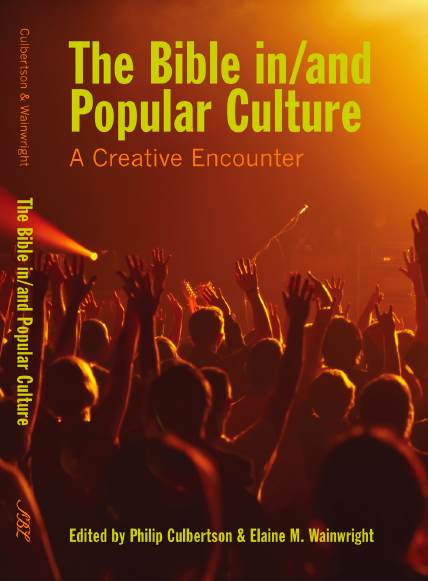
new book release: Bible in/and Popular culture: a creative encounter
 I have a book chapter in a new release, out this month. Titled The Bible in/and Popular culture: a creative encounter, it is an exploration of how the Bible reads pop.culture – and how pop.culture reads the Bible. (Available for purchase on Amazon
A lot of writing has done on the Bible and film. This book charts a different path and focuses on areas including the Bible and other popular media like hip-hop, graphic novels, animated TV cartoons, apocalyptic fantasy. Mine is a chapter on Bro-town, an animated TV cartoon, set in Pacifica urban culture. The title is “Reading “pop-wise”: the very fine art of “making do” when reading the Bible in bro’Town.”
Updated: By request, here is the full list of contributors
Introduction by Elaine M. WainwrightSome Novel Remarks about Popular Culture and Religion: Salman Rushdie and the Adaptation of Sacred Texts by Michael J. Gilmour
Red Dirt God: Divine Silence and the Search for Transcendent Beauty in the Music of Emmylou Harris by Mark McEntire
“Here, There, and Everywhere”: Images of Jesus in American Popular Culture by Dan W. Clanton Jr.
’Tis a Pity She’s (Still) a Whore: Popular Music’s Ambivalent Resistance to the Reclamation of Mary Magdalene by Philip Culbertson
Spittin’, Cursin’, and Outin’: Hip-Hop Apocalypse in the Imperial Necropolis by Jim Perkinson
The Bible and Reggae: Liberation or Subjugation? by Noel Leo ErskineHelp Me Make It through the Night”: Narrating Class and Country Music in the Theology of Paul by Tex Sample
Jesus of the Moon: Nick Cave’s Christology by Roland Boer
Prophetic Voices in Graphic Novels: The “Comic and Tragic Vision” of Apocalyptic Rhetoric in Kingdom Come and Watchmen by Terry Ray Clark
Reading “Pop-Wise”: The Very Fine Art of “Making Do” When Reading the Bible in bro’Town by Steve Taylor
Daemons and Angels: The End of the World According to Philip Pullman by Tina Pippin
Close Encounters: The Bible as Pre-Text in Popular Culture by Laura Copier, Jaap Kooijman, and Caroline Vander Stichele
Pop Scripture: Creating Small Spaces for Social Change by Erin Runions
Personally, career-wise, I am pretty stoked. The publisher is the Society of Biblical Literature, which is the oldest (1880) and largest (8,500 members) international scholarly organization in the field of biblical studies, so it’s neat that first, they are publishing in this area and second, for me to have work published in such a place.
NB 1. One of the talks I gave at Spurgeons College in September drew on this.
NB 2. For a description of my method and some of the resources I used, go here.

Monday, October 25, 2010
creationary: Zacchaeus story in Luke 19
A creationary: a space to be creative with the lectionary. For more resources go here.
The lectionary text this week is the Zacchaues story in Luke 19. It’s such a familiar story. In preparation, I have been finding this poem helpful, Martin Wallace, City Prayers, Canterbury Press, 1994
As you and I walk down this terraced street
Where all the houses seem to be from a common mould
And each door looks the same,
It would be easy to be mistaken
And assume that those inside each house
Are from a common mould.
You and I know, Lord,
That each household has a different story
Of happiness, heartache, and health,wealth, weariness, and worry,
sadness, solitude, and sickness,
energy, encouragement, and excitement.I see pictures of biblical villages,
With square white houses all the same,
When the same assumption could be made.
Yet you cut through all of that
And treated everyone differently:‘Follow …’; ‘Return …’; ‘Give away …’;
‘Be reborn …’; ‘Tell everyone …’; ‘Keep silent …’.Keep me alive, Lord,
To the special uniqueness
Behind each door.
Saturday, October 23, 2010
DIY soul: a social enterprise fresh expression
Today, as I have wandered Adelaide on a Saturday, I decided I would like to open a missional social enterprise.

It is to be called DIY Soul and it’s purpose is to fund the spiritual search. It’s income would be derived from selling DIY/make your own spirituality resources. This would include
- prayer stools
- icon painting
- make your own angels
- make your own candles
- seeds for gardens of healing
- make your own journals
- books that to encourage the pursuit of Christian spirituality
It would also have a coffee machine and a few tables. Some space would be provided so that people could simply DIY in the shop. It’s community would be built around
- this DIY in the shop
- workshops on the above ie using prayer stools, painting icons, angel spirituality, sense making faith, journal writing (some people might call this pastoral care)
- coaching and mentoring (some people might call this pastoral care)
- spiritual direction (some people might call this pastoral care)
- urban retreats (some people might call this pastoral care)
- community gatherings to share food, stories and spirituality resources (some people might call this church)
I suspect that my DIY idea could initially start part-time, say 12-2 pm. So perhaps it could be staffed part-time.
It would require a venue. However there might be a few empty church buildings in Adelaide that are hardly used during the week that might be of use. They might require some alterations though. However, this would be a way for them to fulfill their mission, so they could be delighted to consider this possibility.
Friday, October 22, 2010
How real is your church?
Church is “the history of particular persons realizing by the Spirit’s gift the new potential for human nature.” A challenging quote from Ponder These Things: Praying With Icons of the Virgin

It echoed this insight by Neil Ormerod:
“major divide in ecclesiology, between those who study ecclesiology as an idealist Platonic form in some noetic heaven, and those who study it more as a realist Aristotelian form, grounded in the empirical data of historical ecclesial communities.” in The Routledge Companion to the Christian Church

The temptation to construct church in ideal forms. To deal with metaphors and images and DNA’s rather the particular communities that are with us now. If we just rearranged our DNA, if we could just start again, if we could just return to the early church, if we could just have a few more musicians or young people.
Yet the true grace of transformation is that God could take particular humanity, the reality of what is, and through that catch a glimpse of the Kingdom.
Almost, like, yes, an emerging church 🙂
So as part of prayer, I began to place particular persons, specific names, actual communities in the phrase. Church folk I have argued with. Communities I have been disappointed with. People I wish would change.
It was hard. I kept wanting to trade up for idealisms. But the Incarnation of Christ walked among the real, the local, the particular.
God, through these particular persons, unfold your new potential.
Thursday, October 21, 2010
too blunt? the mirror held by early church preaching
I have a column over on the kiwimadepreaching website. Here’s my introduction:
Is the phrase “Biblical preaching” simply too blunt? I began to wonder this as I gazed into the preaching mirror held by the early church.
With over forty years of missionary service in Africa, David Dunn-Wilson has made a study of the sermons of the early church. In his book, A Mirror for the Church
(Eerdmans, 2005) David points out how sermon change – in style, in subject – as the needs of congregations and contexts change.
The chapter headings tell the story.
I then explore categories of missionary preachers, apologist preachers, mystic preachers, theological preachers, homiletical preachers. For the full article, or to make a comment, head on over
Wednesday, October 20, 2010
faith making sense?

Senses play
Bodies create
Humans diversify
see
hear
smell
taste
touch
Christianity. Is yours
making
good sense?
Tuesday, October 19, 2010
spirituality of change leaders
A fascinating list of suggestions, almost a spirituality, for change leaders (“Rules of thumb for change agents”, a chapter by Shepard in Organization Development Classics
- Stay alive – care for yourself and keep a life
- Start where the system is – empathy for the group and the people
- Look for green zones – places of promise
- Innovation is as simple as a good idea, initiative and a few friends – work with the willing
- Celebrate well – build in lots of success milestones
- Light many fires – utilise the complexity of any group by seeking movement in as many places as possible
- Keep optimistic – with a focus on the better future
I note the list after sitting with a number of groups in the last few days who are considering mission and are faced with change.
It certainly resonated with my Opawa experience, particularly the look for green zones (for more on leadership and green zones you could try here), simplicity of innovation and light many fires. (And in hindsight, at Opawa we could have celebrated more).
And it sits well alongside Paul Aitken and Malcolm Higgs Developing Change Leaders: The principles and practices of change leadership development
Friday, October 15, 2010
rural fresh expressions: resourcing Yorke Peninsula
Today has been a rich day, preparing to lead a camp, helping 10 rural congregations who are coming together to think about their mission. Here ‘ss how it is shaping up.
1. What is church
What is church? Why it exists? What is its purpose?
Use video clip from Yes Minister What does the hospital exist?
2. Four images of church (taken from some material by George Lings)
- institution
- managerial
- horticultural
- relational/familial
For each one – group discussion – Why does church exist? Divide the group in two and invite them to answer from perspective of lay and clergy?
3. Rural fresh expressions of church
video – What is a fresh expression?
It is not a new expression.
It is not a townie thing
It is not saying what existing church is wrong
It is not a bridging project to real church.
I will then give them 14 rural types of fresh expressions I have hunted down. Each has an example, to give flesh. I’m hoping this encourage with it’s diversity.
- Alternative worship
- Base ecclesial communities
- Cafe church
- Church from community initiatives
- Midweek congregations
- Multiple congregations
- Network focused churches
- School-based churches
- Seeker services
- Traditional church plants
- Youth congregations
- Traditional forms of church inspiring new interest
- New monasticism – Northumbria community
- Festivals
4. Rural Challenges
We will then kick the tires around 10 rural challenges, from this resource, by David Muir, a pioneer minister in Devon.
- Do some serious homework on the social realities in your area. The countryside is hugely varied, so beware of generalisations about what ‘country people’ are like.
- Do assume that countryside people are well disposed to the Christian faith. Most are. So think hard before using language like ‘becoming a Christian’.
- If you are new to the countryside, get involved. Traditional countryside people will always see you as an in-comer, but it will only take a couple of years to be accepted as an ‘OK in-comer’.
- Beware of the idolatry of nice village life. This is a temptation for the traditional inhabitants of the countryside and for in-comers seeking their rural idyll.
- A community centred on its own well-being is a form of selfishness. The church must challenge this rather than collude with it to gain acceptance.
- Support the church building. It is a social symbol that continues to have some Christian opportunities. Attending funerals will open some doors.
- Accept that we have lost the battle for weekly public worship. ‘Public’ worship was a Christendom idea and we need to let go of it. Think about how else to give expression to a living faith community.
- Support the vicar. People still want clergy for baptisms, weddings and (most of all) funerals. So support ministers in their traditional roles, and find ways to link their ministries to whatever fresh expression of church you feel called to develop.
- Refuse to be trapped by geography. Countryside people travel, often quite long distances, to things they really want to go to. So think wide. Doing something ‘just for our little community’ is killing the countryside socially.
- Think ‘sustainability’ rather than ‘funding’. Evangelism by largesse is another Christendom idea that needs to die. It fosters dependency rather than initiative. Grants run out. So keep it simple. Start what the group can sustain.
Thursday, October 14, 2010
Why church? some thoughts via the humour of Yes Minister
What is church? Why does it exist? What do you use to assess it’s purpose? I’m doing some work this weekend with Uniting folk in the Yorke Peninsula. In preparation I’ve been mulling over this video from Yes Minister. (Hat tip Andrew Hamilton). A bit dated, but still quite thought-provoking.
What is the purpose of a “hospital? How do you assess it?
- For the Prime Minister, a hospital is to heal the sick (although it starts with “how does does it cost?”)
- For the Union rep, a hospital is to employ staff.
- For the Florence Nightingale award judges, it is hygenie.
Any links to church – how much does it cost? what about the needs of those who serve? how important is keeping people and things pure?
Wednesday, October 13, 2010
P is for posture: dictionary of everyday contemporary spirituality

A recent visit to the Tate Modern saw me parked in front of the art of German photographer Thomas Struth. It was his Museum series, in which he takes seemingly ordinary shots of people entering churches, museums and other public places. (So this is my photo of his photo. The people are in the photo!)
I loved the layers; me looking at others who are looking.
I was fascinated by the wee girl looking in. You almost think she’s wanting to climb in and be with Jesus, until you realise she’s just a viewer. Like me. So how do I position myself in relation to the way of Jesus and his table manners? Am I climbing in?
And then those who look away. They seem to be passing by. You wonder how closely they looked. And you begin to wonder if viewing is a discipline and a practice. That how we position ourselves is a decision.
When I look at the work of Thomas Struth, I think about posture. (In this sense, very similar to the works by another German, Sieger Koder, whom I have written about in another context (summary here)). How do we place ourselves in relation to the world around us and the story of Jesus? Are we walking on by, bored and busy? Or are we taking the time to pause and enter?
For the index in the Dictionary of Everyday spirituality, go here.
Tuesday, October 12, 2010
a cyber blessing
At the end of a busy day, a lovely cyber blessing
thanks, Steve 🙂
The way you give away your resources is both a blessing and a model to others.
More than that, your commitment to creative engagement, and the way you go about stirring up faith for the value and possibility of creative engagement in places where it has not been known, are a real inspiration.
May you know God with you, and carry his presence in the world to all you meet, today.
from here
mission shaped ministry training Aussie style
There is a development in the whole area of ecumenical co-operation in mission that might be of interest to some of my (Aussie) blog readers.
The development is some discussion regarding offering ecumenical Fresh Expressions type training starting here in Australia. The discussion currently involves folk from the Diocese of Adelaide, Uniting College, Diocese of Canberra, Church army, Uniting synod of NSW, Vic/Tas and South Australia.
To this end an initial discussion is planned here in Adelaide on November 9, from 1-5 pm, at Uniting College. The aim is simply to gather folk interested in exploring ways to stimulate training and interest in fresh expressions. The initial idea is to look at offering a Australian variant of a one year, lay focused course called Mission shaped ministry, coming from the UK.
Mission shaped ministry is a one year part-time course equipping in planting and sustaining fresh expressions of church, currently running ecumenically in over 30 centres across the UK. It has been hugely important in developing a mission mindset in the UK context. The course is for leaders and members, clergy and lay people, learning side by side, who want to focus on either preparing to start a fresh expression of church or because they want their existing church to be more mission-shaped. There is more on the website here.
The temptation will be to cut and paste from another context and so the more Aussie, local and diverse denominational voices that can be part of a local planning, the more likely we are to workshop something that might genuinely serve the breadth of the church in this country.
I am also aware that Forge historically has been doing a variant of this for a while here in Australia. However, there is a lot of energy coming out of Fresh Expressions in the UK and this has caught the interest of some mainline folk here in Australia, who want to explore ways to train. This might provide a window of opportunity, yet another fresh breath of the Spirit.
Ecumenically, from my perspective, the more the merrier, so I have decided to blog this. I am also really keen that from the beginning, this not be a solely Anglo-Australian table. So I am asking that you, my blog readers, might pass this information on to appropriate folk in your denomination ….
Monday, October 11, 2010
creationary: worship as a journey on Sunday October 17
A map from Cheryl Lawrie sparked my thinking as I engaged the lectionary texts for this week. She had made up maps, using a 1896 Scottish Geographical Magazine, which was then photoshopped to remove names.
Which sparked for me, because the Revised Common Lectionary Bible readings for this Sunday, October 17, involve journey and travel and movement – Psalm 121 is a pilgrimage psalm, Genesis 32:22-31 is the narrative of a faith encounter by a man on a journey. I am speaking to Uniting churches from the Yorke Peninsula over the weekend. They too are on a journey, inviting me to explore with them their mission future.
So the map is an apt metaphor for them and invites a conversation with the Biblical texts. Having an actual physical map would work as a gathering point. Shorn of detail, it is more likely to allow a focus on the Biblical text.
So for those interested, here’s a potential participative framework that includes thanksgiving, confession, hearing, prayers for others (more…)
Bachelor of ministry information days

We are having two Bachelor of Ministry information days on campus this week. They are a chance to meet lecturers, fellow students and see the 2011 timetable. There might also be a chance to talk about the potential development of the Bachelor of Ministry, including Integrated learning, new topics, the 4 streams (Mission, Leadership, Discipleship, Bible) and the flexibility offered by the interplay of majors and minors (This is all subject to the degree being re-accredited). So if you are in Adelaide and thinking about study, come along
- Tuesday 12 October, 12:15-1:15 pm
- Thursday 14 October, 5:15-6:15 pm


 )
)