Saturday, October 09, 2010
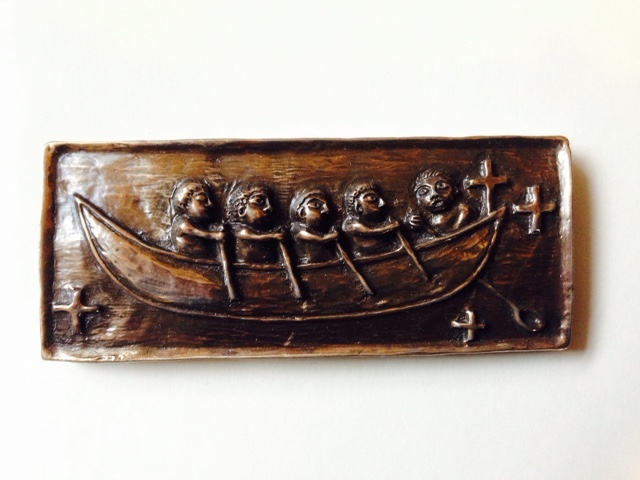
dictionary of everyday contemporary spirituality: O is for origami boats
Over last weekend I spoke to a group about hospitality and mission. I began with Brendan the Navigator and his story of Irish pilgrimage, of setting sail in response to God’s call, with 12 friends but without a rudder. It’s a powerful story of simple trust – trust in the wind (of the Spirit) to lead and guide!
Given they are all adult-learners, who learn in different ways, I then paused and invited them to engage the theme not only by ears, but also by hands. I invited them to make and to name their “mission” boat. This would involve me supplying paper and an origami pattern, and them making a boat out of origami. And as they played, to reflect upon what word or phrase might best describe their mission dreams. If you like, to christen their mission boat.
Much fun, laughter and group work began. As there should be among adult learners! We broke for a cup of tea and upon return, I invited reflection on what people might have been thinking and processing as they made their origami mission boats.
It was a great exercise, was the common response. We enjoyed the creativity.
But it got me thinking, one person commented. As I made my boat, I was so intent on following the origami pattern, so worried about getting it right. Then I remembered the story of Brendan the Navigator. That had no pattern. That had no instructions.
So I stopped.
And so I started my boat again.
I’ve thrown away the pattern and I’m just having a go. It might not work. The boat might sink. That’s the risk. But isn’t that always the risk of mission? Sometimes, don’t we need to throw away the pattern and just explore?
What a great response, I commented back. There is so much pressure to read the books, buy the programmes, keep up with the “name” church down the road. And yet so much of our mission challenge today is about simply listening to the unique work of the Spirit in us and in our communities.
(This is another entry in a dictionary of everyday spirituality. While God is everywhere, sadly sometimes Christianity reduces God to Sunday and to buildings. In honour of a God who by definition belongs in all of everyday life this blog is developping a dictionary of everyday spirituality. For an index of all the entries, go here).
Friday, October 08, 2010
a dictionary of everyday contemporary spirituality
God is everywhere. While sadly sometimes Christianity reduces God to Sunday and to buildings, God by very definition belongs in all of everyday life. In honour of this, I’m starting a new major category on my blog – a dictionary of everyday spirituality. My goal is to build, from A to Z, a dictionary of everyday contemporary spirituality.
Here is the project so far …
B is for billboards.
B is also for blossom. And here, as a workplace moment of grace.
C is for clutter
C is also for crafts.
F is for furniture restoration
H is for hairdressers
L is for lamsp – pocket lamps.
M is for magpies
M is also for marketing
M is also for mat (specifically a mat on the floor of a central city business).
M is also for migrants.
M is also for milestones
O is for origami boats
P is for peace-treating.
P is also for a Pentecost practice of slow growth.
P is also for posture
R is for renovation.
S is for saints.
S is also for spring
S is also for sh*t
S is also for supermarket trolleys.
T is for thanksgiving.
T is also for transitions
U is for undercoating.
W is for white doves.
W is also for work
Thursday, October 07, 2010
evaluating fresh expressions september 2010 UK trip report
 I spent a very rich 7 days in the UK – London and Durham – in September, speaking, networking, participating in the Evaluating Fresh Expressions Research consultation (papers planned to be published to celebrate the re-launch of Anvil)
For any interested, here is my report, which does include a page of my reflections on the UK Fresh Expressions scene as I heard/experienced it.
Insatiable moon rising: film review
The Insatiable Moon is launched in New Zealand cinema’s today, while the UK premiere is in London screening at Cineworld, Haymarket on the 11th October at 7:30pm. (Tickets from the cinema.) Do go and see it, it’s a grand mix of life, humour, spirituality and ethical dilemna. (A list of New Zealand venues is here). Below is my Touchstone review (an interview with screenwriter Mike Riddell is here)
 It has taken many a month for the moon to cast its golden glow on this Kiwi film. Mike Riddell, currently writer, and formerly Ponsonby Baptist church minister, wrote his first work of fiction in 1997.
Titled “The Insatiable Moon,” it introduces John, walking the streets of Ponsonby, with a commitment to bless every passing wall and bench and his friend Arthur, who believes he is the second son of God. With their boarding house under threat from Ponsonby gentrification, Arthur senses a mission from God, first to save his psychiatric haven and second to shower his love on the Queen of Heaven.
Kiwi movies tend to be bred with a dark underbelly, from the haunted hills of “Vigil” to the secrets buried “In My Fathers Den.” “The Insatiable Moon,” a film dealing with the clash between mental health and urban gentrification, has a similar potential. Happily, the movie demonstrates a simple commitment to bless contemporary life, infusing human pain and suffering with an earthy humour and gentle mystery.
 The movie, directed by Mike’s wife Rosemary, includes a number of well-known Kiwi actors, including Rawiri Paratene (best known as Koro in “Whale Rider”) as Arthur and Sara Wiseman (Danielle in “Outrageous Fortune”) as Margaret the Queen of Heaven. However any Kiwi Oscars surely belong to Arthur’s boarding house companions, including Ian Mune, Lee Tuson and Rob McCully.
Two scenes – one pastoral, the other prophetic – remain etched in one’s memory long after the final credits roll. These scenes showcase Mike Riddell’s remarkable talent, the artist’s ability to sketch life, the mystic’s eye for the spiritual in the ordinary.
The first is the funeral of John (Mike Innes) and the pastoral drama created by the open mic and the pain of colliding narratives. It allows a superbly theological reflection on God and the suffering of being human. The scene is a must see for all those who stake allegiance to a God of love in a world of suffering.
The second is the public meeting, another collision of narratives, this time of developer with Ponsonby locals. Arthur’s entrance is superb, a powerful enactment full of strength, oratory and tenderness. Another must see scene for all those who yearn for prophetic transformation in our urban communities today.
“The Insatiable Moon” debuted in July at the New Zealand Film Festival and becomes a general release at Rialto cinemas throughout New Zealand from October. Pleasingly, it gained commendation from the Mental Health Foundation. Less commendable is the efforts of the New Zealand Film Commission, who pulled their promised funding. This means that credits can only roll for the persistence of Mike and Rosemary and many other believers in the power of story and the potential of human creativity.
Nevertheless, “The Insatiable Moon”, casts a few shadows. Plot purists will point to a proliferation of characters that make for a slow paced beginning. Theologians will expect more evidence than a cold Kiwi pie as proof of resurrection. Ethicists will remain uneasy about the centrality of adultery for human transformation.
Gladly, such shadows seem to grow strangely dim in the light of the magic cast by “The Insatiable Moon” and it’s celebration of people, Ponsonby and human possibilities.
For another Kiwi take, go here.
Wednesday, October 06, 2010
spirituality of spring as a season of random magpie attacks
Parker Palmer, author of Let Your Life Speak: Listening for the Voice of Vocation
Go for a walk.
Reflect on the outdoors.
Walk a bit slower.
Enjoy the outdoors.
Reflect on the questions:
In this period – whether spring or study or candidacy – in what ways is God surprising you?
What words (or colours) would describe your response to that surprise?
Return, to share and pray for each in our formational journey.
I met a magpie. Black and officious and strutting. I hate magpies. Especially in spring, when they get aggressive and dive bomb-ey.
Focus Steve. What is surprising you.
Oh. I grin wryily. This is. And what words (or colours) would describe my response. The orange of fear and the mud of anxiety.
Which, when I gain some distance, is actually a bit, well, over the top.
So this is becoming quite fruitful. I begin to wonder what in my life is “magpie” like? What causes emotions that are like a bit, well, over the top? I mean, a magpie attack has never hurt me. Surprised me, sure. But never hurt me. And they only swoop one season in four.
So this is now a question worth pondering. What in my life is “magpie” like? What is causing emotions that are a little bit, well, over the top? And suddenly I’m facing an invitation to take a longer view of my life. To put spring magpies in yearly perspective.
The spirituality of spring.
Tuesday, October 05, 2010
communion amid the Coromandel clutter
On Sunday I led communion at the Coromandal Valley Uniting Church Camp, as part of their Sunday gathering. They are a great group, lovely range of ages, people who have a lovely, natural way of connecting with God and with each other. And serve some fabulous vegetarian tucker!
Anyhow, during the communion service, amid the buzz of all ages, I got my tongue tied over the “cup” and the “supper” and managed to produce the following:
In the same way, after the “clutter”, Jesus took the ….”
Which was funny. And embarrassing.
And in some ways exactly what I’d been banging on about all weekend – Jesus amid the “clutter” of Zaccheus table (Luke 19), Jesus sending us ahead of him to the “clutter” of the towns and villages of Luke 10, discipleship amid the “clutter” of mealtime habits (Luke 14).
Our ordinary, everyday relationships and their place in God’s mission. Not that I was quick enough to say that on the day! All they got was some embarrassed Kiwi tongue-“clutter.”
Sunday, October 03, 2010
Interviewing the Insatiable Moon’s Mike Riddell
The Insatiable Moon is due into New Zealand cinema’s this week. In celebration, here’s an interview I did with screenwriter and creative inspirer, Mike Riddell. (An edited version appears in this month’s Touchstone Magazine). I’ll post my review of the film on the day of public release, Thursday, October 7. (Film updates here, while for a list of New Zealand venues, see here).
 Mike, it’s such a Kiwi film. What were some of the inspirations for the movie? Not only kiwi, but very local in the sense of emerging from the urban village of Ponsonby. I’ve always believed that the details of geography, culture and human life are more universal the more specifically they’re based. The main inspiration for the film was of course the person Arthur, who used to come and visit me and try to persuade me he was the second son of God. But beyond that it was my encounter with the psychiatric community and other down and outs tucked away in boarding houses in the back streets of Ponsonby. As the area became gentrified, there was a delightful culture clash which provided plenty of humour and pathos. I love the black humour of people who’ve suffered and have nothing to lose. Interestingly, given that it is such a kiwi movie, we’re getting a great reception in the UK (where we have a distribution deal) and the US.
Very few New Zealanders are published fiction writers, let alone find their fiction becoming a movie. Tell us about the journey from book to screen? It’s very unusual for an author of a book to be involved in the adaptation of it for the screen. The main reason for that is that novelists are too precious about their material to allow it to be chopped around in the way that’s necessary for the screen. When I was approached by the UK producers to do the screenplay, I jumped at the chance – but knew very little about screenwriting. It’s a specific form of writing, and I had to learn it from scratch. I was lucky that we spent 8 years in development – it gave me a chance to learn the craft, and put some distance between the novel and the script. A lot of subplots in the novel have disappeared, along with some characters. But I think the story is strengthened by being pared back.
It was a long and difficult journey. What kept you going? To be honest it was a combination of stubbornness and belief in the story. There are a lot of people around the world trying to make films, but not many of them get there because of the constant hurdles to be overcome. But as a long time writer, I’ve learned that if you don’t have confidence and belief in your own work, you’ll never survive the process of getting it into the public domain. The core creative team associated with the film always believed that it would be well received by audiences if we could just get it before them. I personally also felt something of a responsibility to tell Arthur’s story. But it has been a difficult journey. There was a week in September of 2009 when it seemed there was no alternative but to fold the project, and that was a very dark time. We faced the possibility of writing off 7 years of work. In the end we decided damn the torpedoes, we were just going to make it with whatever resources we could pull together.
You once talked about the importance of fiction for your own spiritual journey, including the writing of Graham Greene. What do you see the Insatiable Moon offering to the contemporary Kiwi quest? Immersion in stories is the essence of spiritual growth – they have the power to engage and lead us forward at very deep levels. The Insatiable Moon is a story about people on the margins, and the humanity and insight that exist in their midst. To use a Cohen line – “There’s a crack, a crack, in everything; that’s how the light gets in”. Broken people often have an innate spirituality which is fresh and raw in comparison to institutional religion. I think the film is an affirmation of the very real spirit that exists everywhere in human life – and of course a championing of the divine in the most unlikely places. At the same time it’s an examination of conventional notions of normalcy – what actually is ‘mad’ behaviour? At what points does convention become insanity, and madness full of insight?
In hindsight, do you see the inevitable budget constaints helping, or hindering, the film? With that wonderful instrument, the retroscope, it’s clear to all of us that the film has become something much better because of the constraints we were under when producing it. Losing our big name stars (Timothy Spall, James Nesbitt, John Rhys Davies) and our Scots director (Gillies Mackinnon) meant that we made a truly kiwi film. It also meant that no one was involved who didn’t want to be. The commitment of the cast and crew was a wonder to behold, and the veterans in our midst all said it was the best film set they’ve ever worked on. We also adopted the philosophy of ‘Frugal Filmmaking’ espoused by our Director of Photography Tom Burstyn, with beneficial results. That involved using less gear, making the crew light and mobile, and concentrating on story and performance as being at the heart of the film. So in a strange way, the NZFC did us a huge favour by declining funding – not that any of us felt particularly grateful at the time!
Saturday, October 02, 2010
feasting as the way, the truth, the life
Off to talk about hospitality and mission this weekend with Coromandel Valley Uniting. Pretty much a re-run of what seemed to go so very well in Tasmania. So I shouted myself to some extra reading in the area of Christian hospitality and came across the following fabulous quote by Luke Bretherton, Hospitality as Holiness
To be drawn into the messianic feast, anticipated now in the feastings of the church, every area of life and every person must be transfigured. However, no new totality is created. There can be no overview or single principle that orders the feast. The myriad of conversations, encounters and exchanges, which in turn generate surplus to be exchanged, cannot be contained or directed. Neither is there a single pattern to conform to: each person has a gift, and each exchange takes place between distinct and unique persons whose particularity is established and enhanced through these exchanges. Thus, feasts and festivals are ways to anticipate and respond to the inbreaking messianic age that initiates true freedom and generates transfigured patterns of human sociality.
My mind went scrambling in all directions. I thought of the meals I am part of recently, the random chaos of a Taylor table when we are all in fine form and the conversation can go anywhere, each one adding a new and rich twist.
I thought of the modern Western mind, which loved truth as individual, intellectual and objective, and yet the sense here of truth as relational and embodied.
I thought of the theological battles over the location of heaven and whether some will be left behind, in contrast to this image of new human relatedness.
I thought of Jesus, hosting the Last Supper at the end of three years of ministry of table fellowship.
Friday, October 01, 2010
pioneer leaders as attending to birth narratives (thanks Rowan Williams)
A few days later, I wrote a post reflecting on the need for pioneer training not as technique and structure, but as a way of deepening spiritual and emotional intelligence. I read the following quote this morning:
“And the sense Christ makes is not in his masterly reorganization of the world, his provision of explanations and programmes, but in his comprehensive loving, forgiving attention to the world that has somehow brought him to birth.” (Rowan Williams in the brilliant Ponder These Things: Praying With Icons of the Virgin
).
This fits with my presentation at the Evaluating Fresh Expressions Research Consultation, including the image that I used during the presentation, of fresh expressions emerging from the Orans icon.

Christ is wanting to be made real in the world. As Mary says yes, so to we are invited to say yes, to be part of bringing to birth fresh expressions of the body of Christ.
This is not steady as she Sunday goes leadership. This is why I major on listening and discerning in my leadership courses. In the 21st century, new forms of church are being brought to birth and we are invited to pay attention to what is being brought to birth, to recognise the contours of Christ. This is leadership that seeks to be both spiritually and emotionally intelligent.
Thursday, September 30, 2010
was tallskinny (even though a) kiwi wrong? a theology of names
Kiwi’s come in different shapes and sizes. Some come tall, others come short.
Kiwi’s can take different approaches, including to recent mission history. So with gentle reverence at the most amazing ministry of Andrew Jones AKA TallSkinnyKiwi, I’ve left a comment on his far superior blog, offering him a theology by which to repent of his decision to drop the name “emerging”!
names. in the Bible it starts with Genesis 2, humans are invited to name, to use words tdescribe what they see.
and so humans name what they see. but wait – the word “elephant” shuts out a mouse, the word “dove” shuts out a “hawk.” do we drop the words? seek the generic “animal.”
but wait. that exludes plants.
was is wrong to name – in Genesis? in recent church history? wrong to seek to describe a cultural shift? a new way of being church? an outward posture?
or might naming invite the elephant/postmodern/modern/social entreprenuer to be comfortable in their skin?
be a way of creating dialogue, extending the diversity that is God’s Kingdom dream?
steve
still
www.emergentkiwi.org.nz
(For those who like words to augment poetry, I’ve written a fuller, more personal account regarding being Kiwi, being emerging here.)
Updated: my minister adds some thoughts here.
church in the city: inspiration beyond our walls
After two excellent days of input at the City Church conference – first from Tim Costello (on leadership and the city), second from a group of city planners (City as Contested space) – it was my turn today! (A little mutter at this point about lack of blog response when I asked for help!)
I divided my time around 3 church:city questions and 10 possibilities.
For those interested here’s my visuals (video’s edited out, you’ll need to see the notes below for URL’s)
and here is my – Inspiration outside our walls: Being church in the city – handout (more…)
Wednesday, September 29, 2010
cities as contested spaces and some church possibilities
Outstanding presentation by Jason Ting, from Planning SA, this morning at the Church in the City 2010 conference. Under the theme “Cities as contested spaces” he made the following points.
1 – Our cities are growing – A world milestone a few years ago, with more than 50% of world’s population in urban settlement
2 – Our cities are aging – 75% of elderly live in cities and this needs to be placed alongside a rising age dependency ratio (the number of people retired compared to the number of people working)
3 – Our cities are diversifying – (even) Adelaide is diversifying. In Australia, 85% of immigrants choose to live in cities.
4 – Our cities are becoming more expensive
5 – Our cities are sprawling – Australian cities are 3 to 4 times the size of comparable population sized cities in Holland
6- We fragment our space – He apologised for 20th century urban planning frameworks, which had separated residential from industrial from economic. This was driven by the human love affair with the car.
7 – We sanitize our space – The irony that especially the middle-class like to keep spaces clean. However graffiti and grunge for some, including youth, means edgy and exciting
8 – We commodify our space – Public spaces are often paid spaces. For example shopping centres which do not encourage seating in order to move on “non-paying” customers.
He then argued for three innovations:
- Spatial innovation – What spatial entrepreneurship could church contribute to? Possibilities include places to sit, to cycle, to walk, spaces that are not commodified.
- Social innovation – Possibilites mentioned included urban community farm, deck chairs in parks, pedestrian friendly footpaths (outdoor table tennis tables that I saw near Liverpool Station, London)
- Spiritual innovation – how can churches encourage diversity in this area?
Tuesday, September 28, 2010
what do you need to be a pioneeer leader?
Tim Costello, currently CEO of World Vision, Australia, kicked off the Church in the City 2010 conference today. He spoke about his experience at Collins Street Baptist in Melbourne and the formation of Urban Seed. It was a mixture of challenge and inspiration.
During discussion was when Tim really (for me) excelled, a great mix of practical wisdom, reflection and astute cultural observation. He talked a number of times about the place of leaders as both prophet and leader, as taking risks and challenging the status quo. He ended with a fascinating quote (from my notes):
Our leadership issues are not to do with our structures. They are more to do with our spiritual intelligence. And our emotional intelligence.
I couldn’t agree more. Starting things is about seeing both what is and what might be. That takes honesty and vision. And faith, to believe in what is not yet. And the ability to align that with the stories of Jesus. In other words, spiritual intelligence!
And between what is and what is not, is the status quo. And inertia. And people who like the status quo. So to see change means challenging people. And leading through change. And dealing with conflict. That takes emotional intelligence!
So many times I feel when speaking to leaders the desire for easy answers and quick fixes. It’s hard to say, “There aren’t any. It’s just hard work.” The quote by Tim today gives me another frame and an affirmation, that of the need to deepen one’s spiritual and emotional intelligence, to let the slow processes of composting – emotional and spiritual – happen.
It made me glad of the Missional Church Leadership course I run, which seeks to offer spiritual practices, and to focus on Biblical narratives, especially Luke 10:1-12 and Luke 1:39-45. No easy answers, just invitations to listen, to discern i.e. spiritual and emotional intelligence.
Here at Uniting College, we’re working on three further ways (alongside the Missional Church Leadership) to access pioneer training
- a one year Mission-shaped ministry course, hopefully taught ecumenically, introducing mission, church, leadership
- the new Bachelor of Ministry which will include an “innovation” focus, allowing have-a-go learning
- a Masters in Missional Church Leadership, which offers in-service training, with a mix of coaching, peer group support, reading and a praxis/theory thesis in which people work, over 4 years, on missional leadership in their own context
Tim’s input was a great reminder that in the midst of all of these changes, the greatest gift that can be offered is fostering spiritual and emotional intelligence.
All in all, a great start to the Church and the city 2010 conference.
Monday, September 27, 2010
needing help: church in the city 2010
I have a tough gig on Thursday. I need help. I have been asked to speak on the theme of mission as it relates to being church in the city in 2010. The conference is a first-ever and it’s a GREAT idea – to resource city churches in mission.

I’ve applauded the idea from day one, such a practical way to gather a unique mission group. City churches have unique mission challenges. Their location is both crisis and opportunity. Their history is both crisis and opportunity. It’s a delight to be involved. But I still need help.
The other keynote speaker is Tim Costello. Following Tim is a tough enough gig! And yes, I have taught before around celebrating the city and urban mission. But I feel like I need something fresh, some stories of hope, something that might inspire a bunch of hard-working, inner-city ministers.
So, perhaps my blog readers can help: what stories do you know of city churches doing contemporary mission well?
And ideas: if you were a city church minister, with all that heritage and all that opportunity, what would you do, to be part of city transformation?


 )
)