Wednesday, July 21, 2010
church for the (kiwi) man in the shed
My interests include the relationship between church and society, gospel and culture. What is the role of the church in the world? How does the world see the church?
I’m currently enjoying The man in the Shed, a collection of short stories by Kiwi writer, Lloyd Jones, published in 2009, a commercial follow-up to the success (Commonwealth Writers Prize and shortlist for Man Booker Prize) of Mister Pip
One story, Lost Cities, begins with Alice, who is painting her (rural Canterbury) town, building by building.
“And after the theatre, she plans an eating house and, next to it, a bar, and across the street a police station and gaol. And at the end of the street, a church of sharp cheekbones and high forehead. Within view of the church Alice adds the farmhouse.” (52)
A typical rural town, complete with to be expected church. The pages of the short story continue to turn.
Over time, Alice’s husband dies and her son, Mark grows. In time, Mark leaves for the bright lights (of Sydney). All the time, Alice continues to paint, the same picture, touched and re-touched, a visual reflection on her changing life in changing times. She paints and repaints. The tree grows, the buildings are modernised, threatres and restuarants are added, the city crowds are coloured in.
“Milling among the crowd over the ‘historic’ flagstone area are hotdog vendors, jugglers, pickpockets, thieves of all descriptions. There are yellow cabs, policemen on horseback, a flotilla carrying a beauty-pageant queen.” (59-60).
It’s a gorgeous sentence and a fascinating way to visualise change. The painting work as the still point, the canvas which captures change. So what will be the place of faith, the church, as times they are a changing?
“Over the church hovers Alice’s paintbrush. She hesitates to demolish it because the city will need a soup kitchen for the lives stranded short of the promised land.” (60).
It’s a fascinating glimpse, one perspective, on the future of faith in a culture of change. In the imagination of Kiwi author, Lloyd Jones, the future obviously needs a church. The reason is based on what Lloyd sees as the role of the church in contemporary society – to care for the broken and dispossessed. As it does that, it earns the right to remain in a contemporary painting, as it exists as a beacon of hope.
Yet such a place for the church, remains for Alice simply a painting. She might be grieving, she might be oh so creative. However, church remains for her an object painted for “them.” Never, for creative, middle-class, grieving Alice.
A fascinating way to paint the body of Christ into society today!
Tuesday, July 20, 2010
wind of Spirit blows on and on and on: valuing takeaways

Tim Keel just dropped me a line to share a lovely story of the gracious, caring, unpredictable Spirit. He describes being part of a worship experience I lead in Pasadena, back in 2005. (I blogged about it back here.) The story then blows on, taking shape some 5 years later. Tim writes …
I returned to my office to clean it out. That involved box a lot of things up. But I also took the opportunity to go through old files to see what I wanted to keep and what could be thrown away. Going through old conference files, I found this postcard. Because of the impression Steve’s prayer made on me at the time of the conference, I wrote it out on the back of the postcard … To randomly find a postcard from a place I would soon being leaving for…I can’t adequately describe how powerful it was to read and then pray that prayer at a time when everything in my life felt like it was being blown apart.
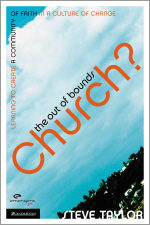
It’s a lovely, encouraging, inspiring story. What strikes me is the importance of things that make worship tangible. I talk about this in my book, The Out of Bounds Church?: Learning to Create a Community of Faith in a Culture of Change
Walter Brueggemann describes the task of mission in a postmodern world as one of funding, of providing the bits and pieces out of which a new world can be imagined. The emergent church needs to see itself as “funding” tourists, providing a deep and wide enough passage to enable postmodern people to navigate their way to God.
Sourcing tourism through the provision of spiritual products can be a key mission task of the emerging church. This builds on some of the current worshipping practices of the emerging church. It invites a move beyond gathered worship to consider how the church can be missionary, offering its spirituality resources as spiritual product to a spiritually hungry world, without expecting the crossing of a threshold of a church door. Let me give a few practical examples.
Most tourists buy souvenirs. When I talk of souvenirs, I am not thinking of kitsch. I’m thinking of photographs, personal mementos, shopping bags and those soaps, shampoos, and sugar packets from hotel rooms. These are souvenirs. When the tourist returns home, the handling of these takeaway souvenirs rekindles memories. The emerging church is asking itself what kind of physical souvenirs we can send home with those who journey with us.
For the last few years, churches like Graceway and Cityside have used art as part of the Advent experience in the Sundays leading up to Christmas. Each Sunday, a different piece of art was introduced and reflected upon. The art pieces were printed on postcards and distributed. Attendees could take them home as a spiritual memento for the week and perhaps return to the reflections of Sunday’s experience. They served as spiritual takeaway, a souvenir to hang on the fridge door.
At this juncture, the souvenirs become missionary. Everyone remotely connected with the church can be sent a pack of four postcards. The church as tour guide is now offering spirituality to people both gathered and scattered. The e-mails and letters of gratitude flow in.When churches start adding physical souvenirs, people have access to spiritual resources without having to open a church door. A theological stake has been driven into the ground. The church has recognized that people are at different places in their spiritual journeys. The church is loving people enough to go into the “highways and byways,” trusting the wind of the Spirit to do its work in people’s lives.
Five years on from when I wrote that, my thinking still holds. Our worship needs tangible shape. I don’t see a separation between the wind of the Spirit and the practicality of a takeway. Rather, drawing on Eugune Rogers, After The Spirit: A Constructive Pneumatology From Resources Outside The Modern West
This wind of the Spirit blows on the material world, and essential to our engaging the Spirit is our working with God’s creation. Like postcards.

Monday, July 19, 2010
asylum seeker facts
- The vast majority of people seeking asylum in Australia arrive by plane.
- 95% of asylum seekers arriving by boat are found to be genuine refugees.
- Just 3441 asylum seekers were given refugee status in Australia last year, roughly 1% of the total migration program for that year.
- In comparison, around 50,000 people over-stayed their visa last year alone – mostly people with business, student or holiday visas.
- Australia only accepts 1% of the worlds’ refugees.
- At the current rate of refugee arrivals, it would take 20 years to fill the MCG.
- It is not illegal to arrive in Australia seeking asylum.
From here.
- Ruth, part of genealogy of Jesus, was a refugee.
- Moses was seeking asylum when he fled Egypt.
- So was Jesus when his parents fled from Herod’s military might.
From here
Sorry, I’m sure this issue is more complex than such simple sound bites.
Sunday, July 18, 2010
new minister for Opawa Baptist
The church I used to pastor, Opawa Baptist has called a new minister and over the weekend, the Petrini family (Rob, Monique, Isabella, Alex and Jessica) were welcomed and Rob inducted as Senior Pastor.
Rob is Australian, while Monique is Mexican. The family have been located in USA, where Rob has been involved in a number of pastoral ministry roles. Rob brings a heart for discipling the first 3rd of life, worship and apologetics. The search committee chose to advertise the role internationally. (I thought they were nuts!) The downside was having to wade through over 100 applications! the upside was what could be a really interesting cross-cultural combination.
We wish to Petrini’s and Opawa all the best in their next stage of the journey. Part of the Taylor family sense of call was a very strong request to trust God – that the God who gave us such good friends and church family in New Zealand would be able to do that also for Opawa, as they looked for the next piece of their pastoral team.
For those interested, below are the greetings that we sent, first as Opawa considering calling a new senior pastor, and second for the commissioning … (more…)
Friday, July 16, 2010
Aussie headbutts: worse than the underarm?
It looks like another low blow in Trans-Tasman sporting relationships, with an Australian cyclist, Mark Renshaw headbutting a Kiwi, Julian Dean, in Stage 11 of the Tour-de-France. (Video footage is here).
Renshaw, Cavendish’s leadout man on HTC Columbia, rammed his head three times into the shoulder of Dean, the leadout man for Tyler Farrar on Garmin-Transitions, in an apparent bid to push him out of the way during the final sprint. Dean was leading the pack at the time. (Link)
The incident, on a stage more public even than the infamous Trevor Chappell underarm incident, is sure once again to throw the spotlight on what it is that constitutes the true character of Australian sporting identity.
Thursday, July 15, 2010
a depression prayer worth pondering
Father God,
it is hard to hope each morning,
to look forward to new treasures and mercies,
discovered when we are alive to your presence in all that we encounter.
Open our minds to the endless possibilities of life and power and thought.
Help us to meet you in our everyday life, in our anxieties and difficulties,
for you are there with us in our pain and sorrow.
Lift us from despair to new hope. Restore and renew us each returning day,
so that we may find joy in our journey with you. Amen
A prayer from the Mozarabic Sacramentary (10th century), that I’ve been finding profoundly helpful the last few weeks, as my workload has slowly ground the joy out of living. (Hat tip)
Wednesday, July 14, 2010
when non-priests pray – as Spirit making a world habitable
Here in an excerpt from my recent paper – When non-priests pray: A conversation between Sarah Coakley and Bono Vox regarding incorporative pneumatology and priestly prayer.
Yet at the heart of the incorporative pneumatology of Romans 8 is that of the Spirit at work in all creation, in spaces and places both inside and outside ecclesial. Such Spirit-ed activity makes sense of a number of “non-priestly” stories within the Biblical narrative. Consider Melchizedek in the Abrahamic narrative (Genesis 14), Balaam’s blessing of Israel (Numbers 22-24) and the worship of the Magi (Matthew 2). All of these are moments in which people outside the faith community offers public prayer. All can be claimed to be some expression of the activity of God’s Spirit.
Bono has often been called a prophet. Yet the argument that “Mysterious ways” is a call to worship suggests that Bono, arms raised, is serving as a contemporary cultural priest.
Bruce Marshall in The Holy Spirit: Classic and Contemporary Readings
It is significant that at a number of points throughout the concert, Bono invited those gathered to pray. They were invited at the beginning of the song “Sunday, Bloody, Sunday,” to listen to a recording of Radio Tehran. Such can be framed as an invitation to lament.
They were invited during “Walk On” to send prayers to Aung San Suu Kyi in her quest for freedom. This invitation comes in the form of a bodily action, to touch our heart and to send our love.
Using liturgical language, in “Mysterious Ways” Bono called those gathered to worship, to “move with her.” During “Sunday, Bloody, Sunday,” those gathered were invited to engage in lament, while during “Walk On” those gathered were invited to “pray for others” and finally to make an “Offering” by texting their support for the One campaign.
Is this not the work of the Spirit, inviting all of creation, those inside and outside the church, to participate in a world made habitable – in which people say yes to the divine, hear the cry of the oppressed, pray for those held captive and offer ourselves in the quest for justice?
Tuesday, July 13, 2010
When non-priests pray: A conversation between Sarah Coakley and Bono
Today I delivered my paper – When non-priests pray: A conversation between Sarah Coakley and Bono Vox regarding incorporative pneumatology and priestly prayer.
In sum I was holding a conversation between the evolving performance of a U2 song, Mysterious Ways, and exploring themes around what it means to talk of the Spirit present at a pop culture event like a rock concert. While Bono is often called prophet, I began to trace some lines by which he might be called priest, not in a captured by church way, but in the sense of a Melchizideck in Genesis or a Balaam in Numbers or the Magi in Matthew, all outside the church yet offering blessing.
The paper stimulated some energetic and thoughtful conversation, so that was encouraging. In fact, the whole 2 day conference has been a delight, with Sarah Coakley a delightfully engaged listener as we talked about her work. The only surprise, for me, was the absence of many Anglicans – Sarah is both an Anglican priest and Systematic Theologian at Cambridge University, UK, and I really thought her presence would have seen them out in droves.
In light of my current interest in Wordle, here is my paper “wordled”.

Update 1: A highlight for me of the conference was the excellent papers by two younger women theologian; both so poised, so respectfully engaged, so clear in their articulation. It was a delight to behold and a real sign, for me, of hope for the church.
Update 2: An excerpt from my paper is posted here – in which I explore how a theology of Spirit allows the Christian to celebrate pop-culture artifacts.
Saturday, July 10, 2010
God in the margins and cross the boundaries
It has been a fascinating 24 hours at the Engaging the Basis of Union conference. The aim is to provide scholarly discussion on the Uniting Church’s Basis of Union and I was urged to attend by my work. I think the hope was for me to network and get more of a feel of the whole Uniting ethos/theology/style.
To be honest, I came reluctantly. I needed a weekend with family, not yet another weekend away on church stuff, yet another meeting with strangers, yet another chance to feel displaced. But the ticket were booked and away I go.
What has resonated the most for me was the session on “transcending cultural, economic, national and racial boundaries, and hearing the wisdom from a Korean theologian and a Fijian theology. Here are some of the choice quotes, all of which I apply to my own sense of displacement:
- “to be open to the grief of leaving your cultural home is to be willing to share in the healing of others.”
- “when you live in the margins, you gain the privilege of seeing two centres”
- “the time does come when you discover a piece of yourself even in a strange land”
- “offering a hospitable space to a new culture can’t be at the expense of a Christ-following which challenges injustice”
- “if Jesus did contextual theology, then don’t forget he still came into conflict with his context.”
All of these had a sense of God speaking to me. It doesn’t make it any easier for me to be in Australia, but it has provided some fresh lens.
Thursday, July 08, 2010
gillard’s asylum seeker speech on wordle
Further to my post yesterday, I thought it would be interesting to place Julie Gillard’s speech announcing Labor’s new asylum-seeker policy in Wordle.
Yep, click on it and the word Timor is there! And “values” is smaller than “facts.”

Full text of the speech is here.
Wednesday, July 07, 2010
this is classic: emerging church danger!
Two strangers met at an academic conference. One was me, new to Australia, new to lecturing in the Uniting Church. The other was retired, also a lecturer, a figure large in the life of the Uniting Church. Over lunch we compare notes, talking about the history of theological education in Australia. Wanting to listen, I, the new one asks a broad, opened ended question:
New one: So what is the most important thing a person coming new to the Uniting Church from New Zealand needs to know about the Uniting Church?
Retired one: The danger of the emerging church. The Uniting Church is founded on the Creeds and Reformers and the emerging church is a danger to that.
The mouth of the new one falls open in surprise, amazed at this turn in the conversation!
New one: Oh, I thought the Basis of Union encouraged a pilgrim people, a people always on the journey. That’s why we are called Uniting, not United. So wouldn’t some sort of commitment to the emerging church be some sort of commitment in the Basis of Union to the emerging church?
Retired one: Yes, but a prior article in the Basis of Union says we have a commitment to the worldwide church and to our relationships. The emerging church is a danger to that.
New one: Oh, we’ve recently as a Synod had speakers from the Anglican church in the UK. They, in partnership with the Methodist church, are working on fresh expressions. So they suggest some sense that emerging church is part of the worldwide church conversation.
Pause. Genuine pondering on both sides.
New one: What is interesting is that they called it “fresh” not new. They do not want this to be seen as something new, denying the Reformation, but simply as the challenge for each generation, to be a faithful and pilgrim people in their generation.
The conversation moves on … true moment
free (Timor) parking (of asylum seekers)! Uniting church response to Gillard
For my Australian readers (and for Kiwis who care about social justice and wonder how Christians in New Zealand would respond to people seeking asylum and arriving by boat if we didn’t have a large land mass called Australia sheltering us), here is the Uniting Church response to the Gillard proposal – what the New Zealand Herald called “Canberra sticks out unwelcome mat to arrivals“.
Some quick points.
1. This is one outstanding advantage of being a connectional church, as opposed to a three Tikanga Kiwi Anglican church, or a congregationalist ie Baptist, that the church is able to speak quickly on rapidly evolving social issues.
2. The importance of treating all humans as people, and not slogans like “queue jumpers” or “illegals.”
Tuesday, July 06, 2010
my paper went well – Bible, plough and damper: responding to a de/colonising God
I delivered my paper – titled Bible, plough and damper: responding to a de/colonising God – today. It seemed to gain lots of energy and positive feedback today: the radio man recording for ABC shook my hand in genuine appreciation, while my chief interlocur called it “great”.
What I wanted to do was explore how indigenous communities read the Biblical text, particularly when it is perceived that the dominant culture has brought the Bible as part of the colonisation process. I would suggest such work is of importance given the concern with how contemporary Christianity will survive in the face of what is often perceived as colonising – the threats of consumerism and globalisation.
I looked at two historic examples. One was the Parihaka story and Te Whiti O Rongomai’s use of the Bible, when the story of Samson in Judges inspired their acts of non-violent resistance. The other was the Aboriginal people of Yarralin and Lingara, who have a story of Ned Kelly as a type of Christ figure, multiplying damper and giving his life. My interest was not so much on the actual biblical texts, but on the reading strategies ie how specific communities used the Biblical text.
For those interested, here was my conclusion: (more…)
Monday, July 05, 2010
a rich day intellectually and relationally
It’s been a wonderfully rich day here at the Future of Religion conference. Conversation has ranged from applying Christian martyrs to societal responses to the hijab, from ecological readings to women in eucharistic action in Mark’s gospel, from applying Lukan practices of welcome to asylum seekers to the place of lament in worship today.
A personal highlight for me was discovering the work by Peter Malone on Christ-figures in Australian film, including discussion of Rabbit Proof Fence and The Proposition. I learnt of Ecumenical Prizes awarded to value based films at Cannes, Berlin and Toronto Film Festival, a fascinating example of public mission and the long history of Catholic involvement in film, including the founding of SIGNIS, a worldwide Catholic engagement with film and faith/reel spirituality.
In between I reconnected with friends from Laidlaw College and here in Melbourne and finished the day with a fabulous dahl over a networking dinner with Darren Cronshaw, from Baptist Union of Victoria. We dreamed a few dreams and plotted a shared journal article on fresh expressions research here in Australia and New Zealand.


 )
)