Friday, May 28, 2010
What is church? seed cathedral as contemporary ecclesiology
Over the week I had an email, inviting me to speak on the topic of “What is Church?’ to a rural grouping of churches.
Over the week, I’ve also been thinking about an invite to speak at CityChurch 2010, the first ever gathering of city centre Uniting church leaders, to explore what it means for them to be church in the context of the centre of the city.

Over the week I discovered the Seed Cathedral (via the creative blog of Michael Volland). It is the UK Pavilion at the Shanghai Expo 2010. Expecting over 70 million visitors, the theme is “Better City, Better Life.” The design had three aims, including providing a significant public open space in which visitors can relax. The Seed Cathedral is 20-metres high, made from 60,000 transparent 7.5-metre long optical strands. Each of the 60,000 rods has a seed embedded within its tip. The seeds are taken from the Millennium Seedbank, at the Royal Botanical Gardens. (For more go here)
Fantastic! Amazing to see such imagination, outside the church, in such a public space.
What is church? Well, working from the Seed Cathedral it includes
– a place to honour the past (seeds/tradition) as a source of future life (seeds grow, tradition contextualises)
– a spacious place to invite reflection on living better
– an invitation to consider transcendence
This all links for me with my use of the children’s story book, Bodge plants a seed, including at the recent Queensland Synod (my talk is here). Leaders treating people as seeds, nurturing their growth, seeking the unfolding of their unique charism.
Thursday, May 27, 2010
u2 360 downunder early in 2011
I think when he could no longer walk, that he needed to go to the doctor. The Edge here.
In a move akin to Lazarus, within days of Bono having emergency back surgery, rumours are circulating of a downunder U2 360 tour early in 2011. This is according to U2Chile. To quote
Live Nation has contacted concert promoters on several continents and has blocked out the following as a possible itinerary:
Early February: Japan and South Korea (Asia)
Late February: Australia and New Zealand (Oceania)
March: Chile, Argentina, Brazil, Peru (South America)
April-May: Mexico, USA, Canada (North America)
Having already been financially stung by a U2 postponement, I’m happy to simply being praying Walk on.
Wednesday, May 26, 2010
developing change leaders book review – Ch 4 A Values Dialogue for Change Leaders
A book review of Paul Aitken and Malcolm Higgs, Developing Change Leaders: The principles and practices of change leadership development
The chapter starts by marshalling a wide range of evidence for the importance of values in change leadership. “The management focus for the first part of the twenty-first century will be the management of meaning through the demonstration of values in management behaviour.” (62) The authors urge that selection of change agents include values, as well as experience and competencies.
They suggest a diversity of values are at work and offer some categories (77-81) by which a leader can assess their organisation and how their individual values might mesh with that of their organisation. (Anyone like to locate their church, and their leadership training, in relation to the grid?)
- Clan. Family type organisation, (often seen in Japanese companies). Key word is collaboration. Values commitment, communication, development. Leader type = facilitator, mentor, team builder.
- Hierarchy. Key word is control. Values coordinator, monitor, organizer. Leader type = efficiency, timeliness, consistency.
- Market. Key word is compete. Values hard-driver, competitor, producer. Leader type = market-share, goal achievement, profitability.
- Adhocracy. Key word is create. Values innovation, transformation, agility. Leader type = entreprenuer, innovator, visionary.
And the implications for change leaders? “leaders have to learn to communicate purpose and direction with a whole culture made up of different personal values, concentrating on shaping informal organizational life (emphasis mine). We might call this ‘strategy by the coffee machine’, consisting of dialogue about what we are told we should be doing, what are leaders are actually doing and how we feel about joining them to make change happen.” (82) “Effective change leaders must continually check what their heart, head and hands communicate.” (83)
Monday, May 24, 2010
clarity in communication. a hyperlinked missional church comic book
This is what I long for …
The trick in either comics or animation is to embody your ideas rather than sugarcoat them; to make plain, through images, the patterns and concepts you see clearly in your head, secure in the knowledge that even the most byzantine, advanced, jargon-laced topic probably rests on a few fat visual metaphors almost anyone can grok with a little explanation.
Via cartoonist Scott McCloud. (Who wrote the most awesome Understanding Comics: The Invisible Art
I’d love to write a missional church theology book as a comic book in order to present “a few fat visual metaphors.” But I know I can’t draw. But … I suspect that the discipline of trying would probably make my words a whole lot crisper. So maybe I could use pictures as part of the concept design?
While I’m waffling about books, I’d love to write a book which was not only a comic, but could also be hyperlinked. So that I could be talking about say a missional practice and the reader could choose whether they flipped to the theology, or the Scriptural resources, or the history of how the practice emerged, or the story of how it played out at Opawa, or the change processes that lay behind the idea.
Books are so linear.
All this by way of saying that when this semester ends, which is in only 14 days, my semester from hell is over, 75% of my entire year’s teaching being squeezed into the first half of the year, and I get a chance to write … 🙂
Sunday, May 23, 2010
where does the hope come from? words of mission in mission
Today is a transition day – flying from Maroochydore to Bathurst via Sydney; from Queensland Synod lecture to working for with New South Wales ELM centre (lay ministry training); from one-off talk to two days of rolling conversation around the theme of transformers.
Last night I talked with the Queensland Synod about a word of mission. (Update: summary and even audio are here).

It’s a (neglected?) part of Uniting church worship and I used it as a framework to explore my ministry experience with Opawa Baptist. What were the words of mission in our change process? What did we do in actual ministry practice as a result of those words of mission? What were the leadership understandings that helped our journey?
So I looked at
- the Pentecost story and the word of mission in Acts 2:6 people hearing “in their own language and how that helped shape our multi-congregational model.
- and the Parable of the sower (I used a children’s book, Bodge plants a seed, by friend Simon Smith as a encouragement to lead by nuturing green shoots
- and the story of Mary and Elizabeth, as a word of mission to Elizabeth’s to speak words of courage and life to the new things of God in our midst and for the church to be open to the unexpected innovation from Mary’s
And I reflected on the leadership understandings
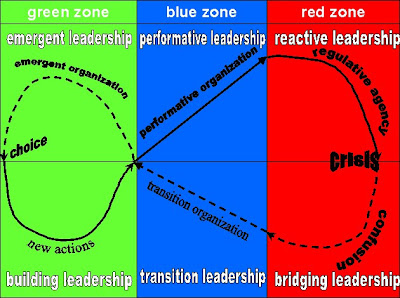
- Roxburgh and Romanuck – organisational development diagram
- leadership as process and verb, not position and noun, and the 2009 NCLS resources that let us build leadership teams and invite us into shared processes.
At times as I spoke I felt that my attempt to weave the word of mission and the ministry practice and the leadership lessons were too ambitious for an hour lecture on a Saturday evening after a long day. I wished I could have been clearer, but alas, it is too late once one is speaking! And my powerpoints were not good enough. However, there was good group interaction and some thoughtful questions and some fascinating after-ward conversations.
May God’s peace rest upon the Queensland synod.
Friday, May 21, 2010
Lament? Or Joy? Multi-cultural worship and Psalm 126 in an indigenous voice
Tonight was the opening of the Uniting Church Queensland Synod. It happens every 18 months and Queensland being a big place, people drive for hours, so it’s quite a big deal.
The night was fabulous – worship rich in respect for indigenous people and multiple cultures. Visually astute, well choreographed, musically diverse and tasteful. Check out the communion table, shaped as a boomerang, draped in the flags of those who participated.

As with pretty much all Uniting worship I attend, the Bible was read. Tonight, being special, included four readings – Psalm, another Old Testament reading, Epistle and a Gospel. (It’s interesting, by the way, to compare Uniting Bible reading practises to New Zealand Baptist Bible reading practises, both at local church level and at a Baptist Assembly level!)
The Psalm that was read was Psalm 126.
1 When the LORD restored the fortunes of we were like men who dreamed.
2 Our mouths were filled with laughter, our tongues with songs of joy. Then it was said among the nations, “The LORD has done great things for them.”
3 The LORD has done great things for us, and we are filled with joy.
4 Restore our fortunes, O LORD, like streams in the Negev.
5 Those who sow in tears
will reap with songs of joy.
6 He who goes out weeping, carrying seed to sow,
will return with songs of joy,
carrying sheaves with him.
But it was read by a local Aboriginal man. So read it again, imagining hearing the voice of an indigenous Australian.
I’ve always heard this Psalm as a Psalm of joy, of praise for Gods’ provision.
Tonight it became to feel more and more like a psalm of lament. It seems to me that very few Indigenous people in Australia can claim their fortunes are restored and they have joy in the land. A Psalm of lament?
Or a Psalm of intercession? What might it mean for a Uniting church, of predominantly Anglo-Australian’s, to actually hear an Aboriginal man read this Psalm? Might it not call us to ongoing pray and proactive protest, that indeed fortunes will be restored and songs of joy?
working from here
working on a film review of Girl with the Dragon Tattoo, and
writing topic outlines for our the re-accreditation of the Bachelor of Ministry … papers like Spirit and the World; Gift of Forgiveness; Missional leadership A and B; Mission then, mission new; Living the Biblical text in a postmodern context …
finding it hard to concentrate with a view like this …

Thursday, May 20, 2010
on speaking amid changing temperatures
Australia has great variations in temperature. Currently in Maroochydore there is an overnight low of 16 and a forecast high of 24, while in Bathurst there was an overnight low of 3 and a forecast high of 12.
This is important because I am packing for both places, first for Maroochydore, to speak to the Queensland synod, and then to Ballarat Bathurst, to speak at the Transformers conference, as part of the New South Wales synod.
It will be the 5th time in a month that I have spoken outside the Uniting College lecturing context.
- 3 days on mission, discipling, leadership at tertiary level in Sydney
- half a day on mission that’s out of the valley to youth leaders
- 2 days on mission-shaped community to lay folk from around South Australia
- and a hour lecture on mission to lay and ordained folk in Queensland
- followed by a 90 minute lecture, followed by 2 smaller facilitated workshops to ministry practioners in Sydney
To be honest, it is sort of doing my head in. Part of it is simply performance anxiety. When I was at high school, I used to skip school when it came time for the speech contests. I hated public speaking. So there’s a fair degree of anxiety flowing through me today.
Part of it is that each is different – in time and audience. Each has a slight variation in theme. Each has different issues they’d like to address and different expectations of how I might engage. The temperature is different in each room. I have a lot of things in what I call my speaking bag, different stories and paradigms and ways I have approached things. Different ways to stimulate people and gain interaction. I find it hard to pull out the same thing and just do it. Yet it has worked once and it would save me the time in trying to know what to pull out, how to start and to connect.
Part of it is my creative, restless personality, I like to keep working at things, playing with new ideas. So I simply can’t do the “canned” presentation.
I’m not sure why I am writing this, but it’s my blog and writing can clarify ….
Tuesday, May 18, 2010
Spirituality in contemporary Australian women’s fiction
Part of my current life task is to listen to Australia. In that context, an unexpected treasure is Rewriting God. Spirituality in contemporary Australian women’s fiction.
- God is a verb, rather than a noun. There is a focus on the active agency of love, healing and friendship rather than debates of gender.
- Scant attention is being paid to the solitary and distant place, like the desert, outback or the wilderness.
“Women find it possible to access the divine wherever they are, in their houses and gardens, in the company of friends and family, or in the act of creation … The way to God is through joy, creativity, and loving kindness: ‘salvation’ is communal not individual.” (278, 9)
- A recurring behaviour is a concern for other people. In this sense, the hermetic journey to the outback is seen as self-absorbed.
- Acceptance of self, of humanity, of frailness, is the first step towards God. This is in contrast to a negation of self. “[S]ervice to others is therefore rendered not as a penance but out of compassion and willingness to share onself and thus be enriched.” (279)
Love to hear feedback from the locals, about the claims of another local. In the meantime, I want to go back and re-read a younger Australian writer, Charlotte Wood, and her book The Submerged Cathedral
She builds a garden, creatively using Australian plants to transform the hollowed hull of the monastery. It’s ceaseless and heart-breakingly hard work. But in the process of contextualisation, of clearing Australian clay, she finds love, meaning and redemption.
Sunday, May 16, 2010
word of mission: a forgotten Uniting church treasure?
Over the weekend I discovered (thanks to Stephen Burns, who was a wonderful breath of fresh air in my attempts to understand the practice of mainline worship) what I think is a forgotten Uniting church treasure. In Uniting in Worship 2, the official book that guides Uniting worship, is a pattern for worship. The pattern is four-fold:
- Gathering – including welcome and prayers of praise and confession
- Word – including Scripture reading, preaching and prayers for others
- Table – communion
- Sending
The final section – Sending – is divided into a song, a benediction and this thing called “Word of mission.” This “Word of mission”, according to the book, could be a verse of Scripture, a sentence or a brief charge to the people.
I’ve never heard this, in all the Uniting services I’ve been part of. I wonder why I’ve not heard it. I wonder if it is just me, or if it’s fallen out of favour in general across the denomination. I wonder if it’s neglect says something about Uniting church life.
But what a gift, a moment when the people of God pause and prepare themselves for service in God’s world. It has all sorts of creative possibilities
– sharing in 2’s
– photos of the community which one is going to
– sounds of the world outside the church walls
– a litany of the places God is calling us to
– summing up the all that has gone before in the service in light of mission
– being recorded/journalled and then reflected on by leaders in terms of what God is saying in mission
Indeed, a forgotten treasure.
Saturday, May 15, 2010
a pentecost journal
Here’s an idea … why not every church start a Pentecost journal. This would be read every year at Pentecost. Then, after a time of silence for reflection, updates to the journal would be invited. People would name how the Spirit has been active among them in the year gone. These would be typed up, and added to the journal.
Which would be read again next year.
This would honour the Spirit as alive today, honour the Spirit as alive in history, appreciate the Spirit as diverse and creative in the life of the community, develop skills of discernment and just be plain interesting.
It is an idea that has some echoes to the Advent journals I initiated at Opawa. It emerged in my Grow and go Mission-shaped community class today. We were talking about innovation (one of the 9 National Church Life Survey indicators of a healthy church) and to make this practical, the class were introduced to a number of ways to practise creative brainstorming. In the process, as groups laughed and talked, a number of random linkages were made …
Spirited-church structures? Friends of students, teachers, creatives?
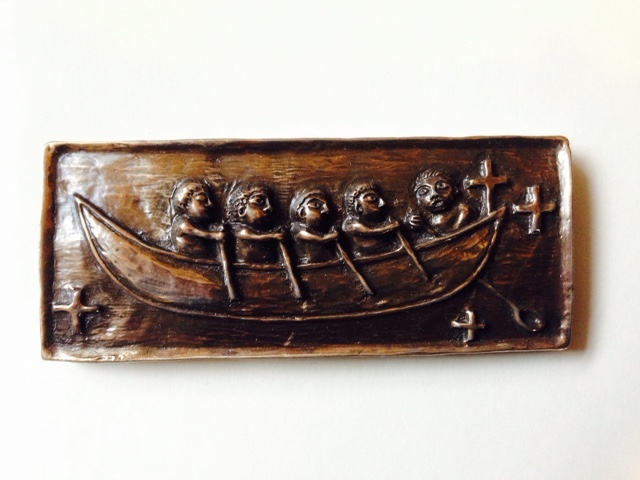
I’ve found this image a huge source of sustenance this week.

To gaze at the bent back and study the hunched shoulders,
To note the quill, a mind hard at ink,
To be reminded of the Spirit, in the form of a dove, hovering as Companion and Inspirer,
To do some research and find the story, of a man who wanted to live his life in prayer, but was dragged into administration and structures in the service of the church.
I’m tired and so are the students and so on Wednesday we started class by reflecting on those who have gone before, who have also worked hard over bent desk, hoping that in their work, the Spirit might be more fully named.
The man is Gregory and he is saint of students, teachers and creatives. He was leader of the Catholic church from 590 until his death in 604, the first of the popes to come from a monastic background, unwillingly forced from the monastic world of prayer into public church life. (especially through his first year as pope, Gregory bemoaned the burden of office and mourned the life he used to enjoy.)
Gregory was a missional church leader – most famous for sending a mission to evangelize the Anglo-Saxons of England. From Gregory we get what we know as the Gregorian chant, a system of writing down reminders of chant melodies.
Gregory is known for his administrative system of charitable relief of the poor at Rome. His philosophy was that the wealth belonged to the poor and the church was only its steward. “I have frequently charged you … to act as my representative … to relieve the poor in their distress ….”
My boss made a comment a few weeks ago, about what he called an “old-fashioned” lecturer, the type who did not write academic papers, but who worked out and expressed his theology in the service of the church, on councils and boards and writing church polity. Easy to dismiss. But it’s another whole dimension of ministry, of hard work and bent backs and seeking to see words and structures and administration and decisions be channels for God’s blessing.
Friday, May 14, 2010
mission-shaped “Grow and Go”
One of the things that appealed about becoming part of Uniting College was their intentionality in training the whole people of God. It is this weird tension where one expression of ministry is more formal than in Baptist circles, and thus has more formalised training pathways. Which then leads to a deliberate focus on all expressions of ministry.
Which means that this weekend is the annual “Grow & Go” training weekend. Training for the whole people of God. Their is a key note address on the Friday. Then nine learning streams – all day Saturday and Sunday afternoon. Shared breaks mean lots of chances for mixing and networking. People are coming from all over South Australia.
This type of thing is a pastor’s dream – every year heading off with leaders, to train and encourage and inspire them – to build shared memories – to invite potential leaders. The trip back, dreaming together with new insights, ideas, resources and inspiration. Every year, building lay capacity. Superb opportunity.
This year the theme is ‘being a mission-shaped church’. If God’s purpose of redeeming and renewing the world brought the Christian church to birth, what does it mean for mission to be at the heart of who we are and what we do as the people of God?
I’m leading one the nine streams, exploring mission-shaped community. (Others are exploring themes like mission-shaped leadership, mission-shaped community, mission-shaped worship, mission-shaped preaching, mission-shaped witness etc.)
So I am using the NCLS framework:

and will focus on the Inspirational qualities – of vision, leadership, innovation, and the Outward qualities of service, faith-sharing.
Wednesday, May 12, 2010
Ascension worship: the footprints of Jesus
I enjoyed how Ascension day chapel worship shaped up today. I always find it hard to put worship experiences into words, but for what it’s worth here are some of the pieces. The Biblical spark was the Ascension and in reflecting on the text I was struck by the idea of Ascension as the departing feet of Jesus. Real feet, now leaving.
That provided a working tactile image, footprints. And then the madly, obvious idea, to have footprints, and to invite people to stand in these footprints of Jesus. This was achieved prior by painting some barefeet, and then walking over 3 metre long strips of frostcloth. (The kids absolutely loved giving me a hand with this part!) When it dried, they looked great. Very simple. Very effective. One set of footprints were in colour.

The other set were in black.

This allowed multiple stations:
- the black footprints; the Ascension as the absence of Jesus and so the invitation to stand on the (dried) footprints and pray for ourselves and for others we know who experience God as absent.
- the colour footprints, reflecting on the impact of the footprints of Jesus, who had walked with and among the disciples. I laid, face down, beside each colour footprints, various cards from the Jesus deck (I got my deck here some years ago and it was great to get a chance to use them). So, if people chose to participate, there was a real sense of mystery about which card they would choose and thus which story of Jesus they might engage with.
The colour had another layer. I had started by offering cut up paint chips from paint charts, and the invitation for people, as they arrived, to choose a colour that symbolised their week. As part of our call to worship we shared our chips with each other. Fun, interactive, but an essential part of gathering ourselves as real people, with real stories – and of course the living “colourful” stories of Jesus continuing today.
Around this was woven the usual frame – praise, confession, Bible readings both Old Testament and New Testament, passing the peace, affirmation of faith, sermon, communion, benediction. For those interested, I’ll place the order of service below.
For me, I had quite profound encounters at both stations. The Jesus deck card I turned up was just bang on the nail in terms of my struggle to follow Jesus at the moment. So bang on the nail it was almost spooky. (more…)


 )
)