Monday, February 22, 2010
Archbishop Rowan Williams on fresh expressions of church, ministry, sacraments
There is a fascinating podcast of Archbishop Rowan Williams being interviewed about fresh expressions, especially in light of the Synod report just out regarding fresh expressions. (Hat tip Jonny and originating from a collective in Nottingham called Nomad (who seem to have a knack of interviewing some interesting people, including Tom Wright, Greg Boyd and others)).
I’m teaching a class on Church, Ministry, Sacraments in the first semester and might just use the podcast in my first lecture. Here’s is my summary of the Archbishop:
Church is people encountering Jesus, with others, in a life changing way. This happens through the baptism and communion (sacraments). This has also happened in the past, and thus we have the tradition of the church. The task of ministry includes the gift of discernment – of seeing God giving gifts to the church, both in contemporary culture and historically in the tradition – and of learning how to use these gifts – God’s gifts to the church – creatively and well. Key challenges for fresh expressions of church include giving time to listen, to appreciate the words rubbed smooth by generations that can carry us when we find life thin. Key challenges for existing churches are to appreciate new forms as real stuff, and not just an eccentric fringe.
Note how similar the ecclesiology (understanding of church) is to what the Archbishop wrote in 2004, in the Foreword to Mission-shaped Church: Church Planting and Fresh Expressions of Church in a Changing Context
‘church’ is what happens when people encounter the Risen Jesus and commit themselves to sustaining and deepening that encounter in their encounter with each other (vii)
I wonder what would happen if all Vicars pinned that wee definition to their Prayer Book?
It’s my party
Saturday was my birthday and the day was framed around a cheese and wine trail. Blessed Cheese is a local identity, producing great food, focused around local cheeses. Which they also make available in a hamper, and partner with a list of wineries who provide a wine to match the cheese.
So over about five hours, we worked our way through cheeses, seated at various local McLarenvale wineries. Slow eating. Slow driving the countryside, such a newly different landscape, with scattered gums and gaunt hills.
Cheese tasting is not necessarily the greatest thing for the kids. It is my party … but we provided for them the Birthday Boredom Buster Bag. Each got a book to read, plus a letter writing kit. So they spent time writing letters home, reading and asking the perennial question: “You having a good time Dad?”
The final stop was Samuels George, which has previously been a moment of spiritual encounter. Once again, we were late, but they were open. The wine dogs were out, just the right level of friendliness for two kids. Who also got a tour of the wine making lab. Superb views (photo from a previous visit, Oct 08):

A great day, having a good time. Cheers to life.
Saturday, February 20, 2010
Avatar film review
Each month I publish a film review, for Touchstone, which is the New Zealand Methodist magazine. Here is my review for February, on the movie Avatar. (Many more reviews, back to 2005, are here.)
“Avatar” is a blockbuster, set to sink “Titanic” as one of the highest earnings movies of all time. James Cameron, who directed “Titanic” and multiple editions of “Terminator”, is, well, back! (more…)
Friday, February 19, 2010
purchased: philosophers fingerpuppets, now wanted: theologians fingerpuppets
These little people are being ordered today:

the philosophers fingerpuppets, care of my Ministry Enhancement Allowance, in preparation for some upcoming input.
At Spirit of Wonder: imagining a church immersed in culture (part of the Adelaide Fringe Festival, more info here), I am providing two blocks of input. One is on imagination, leadership and culture, the other on the Spirit, the Bible and culture.
In a moment of mad randomness with Craig yesterday, I was talking about how imagination has a history and the need for us to find our story within that history. Craig, totally lateral thinker that he is, mentioned a shop that sold philosophers fingerpuppets. Nietzsche, Plato and Kant. Who all had things to say about imagination! Who all deserve to make an appearance at the Spirit of Wonder!
So that’s the creative spark that suddenly clicked the first session. Yes!
Which only leaves the second session – theologians fingerpuppets – like Moses and the tabernacle makers, like Deborah and Hannah, like Mary and the 70/2 anonymous in Luke 10, like Peter – who all also deserve to make an appearance at Spirit of Wonder, because they all have a lot to say about imagination and a church immersed in culture.
Thursday, February 18, 2010
the state of play: Australian film
Eric Repphun, who graduated last year with a PhD in religious studies and film (a project which I was involved in supervising), is currently writing on Australian film, specifically Balibo, Van Diemens Land and The Proposition (here). He is arguing for a growing genre of film in which he sees Australia film seeking to engage it’s past. He writes:
These two very different films hammer home something that has been increasingly clear in the past few years: Australia, as a nation, is attempting through the cinema to shed the shackles of its national ghosts, or at least bring these spectres into the full, harsh light of day. This is more than simple katharsis, it seems, bridging over into some more elemental; expiation maybe, even exorcism. Australia – or at least Australian art, as the Australian government seems to be committed to continuing its long history of criminal behaviour – is engaged in a collective exorcism. This is true, I suppose, of only those people who make these films or the people who choose to see them instead of Transformers. Perhaps this needs a further clarification, as this exorcism is largely confined to the ghosts of Australia’s European past. The long plight of the Aboriginal peoples is still largely consigned to the darkness, or is subject to well-meaning but ultimately hollow official attempts at apology. Something like Philip Noyce’s film Rabbit-Proof Fence, for all its striving nobility, simply doesn’t pack the emotional punch and the raw sense of wrongness that characterises the film-as-exorcism.
Seeing as I’m doing a paper on Sociology of Ministry in a few weeks, I’d be interested in how Australian’s respond to what Eric names and claims, as I am sure would Eric.
Wednesday, February 17, 2010
it’s all a blur really: the Taylor’s 4 weeks on
The Taylor family have been in Adelaide, Australia four weeks as of yesterday. I have been using twitter and facebook to post a variety of personal news of the short, sharp variety. But in honour of the blur that has been the last four weeks, here’s a overview.
One – It’s amazing how when you migrate, things interlock – You can’t transfer money until you have a local bank account. You can’t buy a car without local money. You can’t look for a house (easily) without a car to get you around open homes. You can’t rent without a rental record, which is difficult to have when you own your own home in New Zealand … and so the interlocking bits roll on.
Two – Adelaide as a city is caught between beach on one side, hills on the other. It means the city is squished long and skinny. A downside is transport. An upside is that there are lots of suburbs by the sea, which increases supply and reduces price. It’s probably the only city in the world we’ll be able to afford to live close to the sea ….
The upshot (blurred) is that, thankfully we have a car (Ford Fiesta). And we’ve found a place to rent in Seacliff, about three minutes walk from the beach. Ironically the street name is Kauri, which is, yes, a New Zealand native.
Our belongings were freed from customs the day we took possession, and we have so loved re-finding our stuff and starting to unpack. The girls seem to be settling well at school, each in their uniquely personal way. My new office is almost fully functional (not enough room for all my books and course notes though!) and my courses are slowly starting to take shape.
I found to my surprise when I arrived that not only was I Director of Missiology, but was also the Postgraduate Co-ordinator, and so I’ve been enjoying getting my head around the Masters of Ministry programme, which is highly focused on practical theological ministry reflection and has huge creative possibilities. I’ve also scratched out two conference paper proposals, one titled “The art of gentle space-making: responding to a de/colonizing God” and another “When non-priests pray: A conversation between Sarah Coakley and Bono Vox.” All fun.
My vegetable garden is proving very profitable – basil, rocket, spinach, parsley on demand. Lettuce, peas and broccoli coming on well.
We’re still looking for a church home, but have given ourselves till Easter to simply enjoy looking and exploring, sampling the diversity that is the Uniting church of South Australia.
Tuesday, February 16, 2010
cultivating imaginative leaders
All this talk of fresh expressions and pioneer leaders, and of wood fired emerging pizza church, raises the ongoing, nagging question for me, of how we cultivate imaginative leaders?
Here’s what I think is a perceptive diagnosis:
“We are not trained to engage. We are trained to duplicate. We are often not able to read stories and allow them to ignite our local imaginations. Instead we try to mine stories for timeless principles that can be readily applied.” (Keel, Intuitive Leadership: Embracing a Paradigm of Narrative, Metaphor, and Chaos
, Baker, 2007, 80)
It names something really important: the lack of capacity for imagination, the way that current modes of thinking work against the imaginative.
I think that like many things, leadership is both caught and taught, art and science. It is intuitive yet can be studied. It is a gift, yet can be honed.
Which still leaves the page bare, the canvas blank. How do we cultivate imaginative leaders? How do we help leaders discern the Spirit’s uniquely creative work in their own unique context.
The talk of pioneer leaders worries me.
I worry that it emerges out of pragmatism, out of decline. If so, we are more than likely to import pragmatism into pioneer training.
I worry that we might create a separate class of person, rather than simply name a charism that is perhaps not fully appreciated in our current contexts.
I worry that we might end up leaving mission to the pioneers and not to the mixed economy “ministers of the word.”
I worry that we will simply bolt a few more courses onto what is potentially a broken way of thinking, that has, and is, training people to “timeless principles.”
Sunday, February 14, 2010
wood fired pizza worship
 I was making pizza on Saturday afternoon. Homemade tomato pesto, mixed with finely cut basil and baby spinach leaves (from the newly planted “only-been-in-the-country-3-weeks-garden” of course!), topped with local sundried tomato and lots of cheese. Very simply, very yummy. (Picture does not represent the reality).
And I thought again about pizza church. Not just pizza as in, oh, we are funky because we eat pizza after worship. Which would be yummy enough.
But more like that sense of making a pizza out of what’s in the fridge. And how what’s in our fridge is simply a reflection of our lives. So why can’t that be the central image for being a worshipping community?
I mean, what it would be like for church to set up a woodfired pizza outside. Bases supplied. And the invitation for worship to be about bringing toppings from what’s in your fridge.
You could have a thanks pizza and a confession pizza and an intercession pizza.
And as each pizza is served, there’s time for a toast. And those who want can name, either by ingredient or by spoken words, what they might be bringing – their praise and their confession and their intercession. And so the pizzas are the worshipping work of the people, what’s in our lives, brought to community, shaped by the liturgical pattern of traditional worship – praise, confession, prayer.
This might not be a normal way for people to experience church, but it would be easy to run an experiment, try it for a few months, simply by working your way through say the gospel of Luke. Lots of food moments there, and so the preaching/teaching moment would involve serving the 2 fish and 5 loaves pizza, the eucharist pizza, and so on through the Gospel of Luke, using table fellowship as the metaphor. In other words, the Scriptures are embodied in the “Bible pizza”, offered to those who gather.
A simply over the top idea and I returned to the much simpler task, of calling the Taylor tribe for homemade pizza. And together we gave thanks – for a few of our favorite things – weekends and each other and the promise of a new life.
Friday, February 12, 2010
summarising Mission Shaped Church: 6 years in
Just out in Great Britian is a report researching the impact of Mission-shaped Church in England. You can download it here. At 40 pages (including appendices), it’s thorough, clear, erudite. A great piece of work.
Here’s some quotes that caught my eye, with some commentary from myself, stranded in no-mans land between Baptist and Uniting world’s.
1. The value of the notion of “mixed economy.”
Most of all, “inherited”, or traditional, understandings of what it means to be Christ’s church, and emerging fresh expressions of church are complementary aspects of a single, coherent ecclesiology. (1) The best of what we have inherited, and a rich outpouring of new creative thinking, are indeed combining in the name of the gospel. For that we thank God. (2)
It’s a fantastic metaphor and so helpful in terms of affirming and valuing what is, yet encouraging space for what is not yet. However, it does require careful attention, given what has happened.
There is a clear pattern emerging with many parish based initiatives appearing on the fringes of inherited churches … They are making the inherited church effective in mission by creating appropriate new church congregations shaped for mission (20) …. they are very valid forms of mission and have brought substantial growth to the church but are insufficient on their own to answer to the missionary task in the nation as a whole. (21)
There are fewer ‘free-standing’ fresh expressions, focused further from the inherited church and working more often with those who are non-churched. This is probably due to the greater levels of resourcing these fresh expressions tend to require. (21)
So the validity of my Opawa experience, planting new expressions as a multi-congregational model. Equally, the validity of what we tried to do at Graceway, planting a new form. And oh the resource issues we struggled with in that context. Oh the pain and energy loss we experienced trying to find a physical building to ground our mission.
2. The creation of a “pioneer stream” including selection, courses, context.
Regarding selection
Specific selection criteria should be established … Those involved in selection need to be adequately equipped to identify and affirm pioneers and mission entrepreneurs.
Regarding courses
[a]ll ministers, lay and ordained … should include a focus on cross-cultural evangelism, church planting and fresh expressions of church.” (6)
Regarding context
“curacy posts should be established where church planting skills, gifting and experience can be nurtured, developed and employed.” (7)
Wouldn’t it be great to see that type of systemic change, in which a church system has fresh expressions in which pioneers can be idenitified, mentored and then placed to be formed in leadership. I recall Al Roxburgh in 2007 summarising our Baptist “Sharpening the edge” new forms as “epiphenomenal.” In my words, a fluke of the Spirit. They happened, often driven by uniquely gifted people. While we must be so grateful for them, what was needed was a denominational system which was intentional about leadership development.
Applied to the Uniting context, I wonder how the categories of mixed economy leaders will play out. How might pioneers be identified, encouraged, mentored, trained, in ways that are mixed – best of the tradition, creative in the new.
3. Importance of lay pioneer training
A pattern should develop that provides training as part of a process of discernment-for-authorization, rather than training subsequent to discernment, or the removal of existing leaders for training elsewhere.” (7) “To turn the vision of a mixed economy church into a reality will take many lay pioneers who will be able and willing to plant fresh expressions as volunteers. The task is too great to rely solely on those who will be called, trained and appointed as ordained pioneers. (16)
This is a huge shift in thinking, but so necessary. At Opawa we were planting our “new forms” as teams, always looking for groupings of people. It was so encouraging to see what were essentially lay people grow in this capacity: Adrian learning to do lectio divina, the Soak team, Paul and Anne in their leading of espresso, the bridge builders like Annette, Hugh, Jenn. So lot’s of resonance with this.
4. The value of church “groupings”
Deaneries (geographic groupings of churches) have the potential to bring together a range of human and financial resources, to consider mission across parish boundaries, and to share prayer and encouragement. (5)
At the risk of being rude, this is where Baptists really struggle. We are so obsessed with local church, that we simply do not have this sort of grouped mission potential. When we gather (at Assembly or as associations), what coheres us is relationships (in contrast to sacraments or creeds). And because our relationships are voluntary, and because they are infrequent, there is little capacity for robust critical reflection and interaction, out of which shared mission can grow. And so we lack this shared synergy for mission.
Arriving in a Uniting context, I am wondering if “synod” can be exchanged for “deanery”? Or is it actually “networks”?
5. Resources
a [mission growth and opportunity] fund as key to the development of fresh expressions (8) … Money alone is clearly not sufficient to establish the mixed economy, but it is an extremely pivotal factor. (19)
While this is obvious, and is the logical consequence of groupings, it is then followed by some fascinating reflection on how funding is used. Shotgun or rifle, and what happens when you pull the trigger?
a plethora of small grands … tended to fund mission that was “focussed on current patterns of ministry, rather than more cutting edge, non-parochial projects.” (18)
a few projects that were “centrally discerned” … were more cutting edge, with a network focus (18)
6. Diffusion of mission-shaped vision throughout the system
“the spread of Mission-shaped Church thinking and practice” through one day courses, six evenings, a one year course, along with books, DVD’s and websites.
the impact and effectiveness of a mission-shaped diocesan strategy is directly related to the level of ownership given to the report’s recommendations by diocesan senior staff … a direct correlation between the seniority of this member of staff and the impact of the [Mission Shaped Church] report on the diocese. (13) Their [bishops] ownership has released a wave of creativity and experimentation within the church as it strives to re-shape itself in response to the call to mission.” (22)
6. Future challenges
there is still a strong bias to a neighbourhood understanding of society over network. (5)
lack of record keeping, with many dioceses have no data base of church plants and fresh expressions.
This seems to be made worse by a lack of clarity about what is a fresh expression.
“120 according to Churchwarden returns 2006, 11 according to the Fresh Expression website, 20 according to my calculation.” (20).
Is the downside of a desire to be mixed and inclusive, the reality that because anything can be fresh, then what was inherited can simply be given a “fresh label”. New paint job solves everything! When in reality, the mission requires so much deeper work, as evidenced by the following:
Ministries among profoundly unchurched people take a long time to create recognisably Christian groups – five years may just be the beginning. Such ministries do not start with worship, but with relationships, shared activity and exploration of life’s values. (27)
All this suggests that the hard work is yet to be seen. A report reflecting on 6 years, which concludes that it takes at least 5 years to see fruit amongst the unchurched.
Hats off to the UK Anglicans and I hope the work of the Spirit in their life, as seen in this report, is an imaginative stimulus to the church family I have been part of, and to the church family I am now on loan to.
And I can’t resist it – to all those using the internet to publicly jump ship on the emerging church, enjoy reading that last quote once again!
Ministries among profoundly unchurched people take a long time to create recognisably Christian groups – five years may just be the beginning. (27)
Thursday, February 11, 2010
indigenous tables and the prayerful art of gentle space-making
The phrase
gentle space-making
belongs to Sarah Coakley (from her Powers and Submissions: Spirituality, Philosophy and Gender (Challenges in Contemporary Theology), page 35. She is wrestling with what to to with the kenosis, the word found in Philipians 2 and used to discuss the vulnerability and self-emptying of Jesus.
For Coakley, Christology is “what rightly distinguishes Christian feminism from various secular versions of it” (3) and so the question she wrestles with is how to lose one’s life in order to save it, particularly in light of feminist anxiety around themes of fragility, vulnerability, self-emptying.
In other words, if I am vulnerable, won’t I then be taken advantage of? If I’m a minority, what hope is there in the notion of losing one’s life in order to find it?
Earlier in the week I blogged about the privilege of sitting with Covenanting Committee, a group set up to maintain relationships between indigenous Aboriginal people and the Uniting Church. It seemed to me that some of the same questions and anxieties were present – how, as a minority, might we find voice, be heard, be part of change, yet in ways that are distinctly Christian?
Coakley offers a number of suggestions.
Firstly, there is her approach. She is a careful, exacting reader, looking back through history to argue that the Christian history is rich and complex. Thus various notions of kenosis have existed and when rightly understood, are not in fact demanding complaince, but a strength made perfect in weakness and in a way that does not replace one form of secular power with another form of secular power.
Second, there is her conclusion, prayer. In particular, wordless prayer. The regular habit of responding to God. This is not pietism, a withdrawal, a silencing but rather “the place of the self’s transformation and expansion into God.” (36)
If anything it builds one in the courage to give prophetic voice. (35)
It’s a fascinating place to conclude: that each and any of us, no matter how marginalised, have power: are invited into a spiritual way of living, in which space is made for the other that is not us. In so doing, we let God be God.
Wednesday, February 10, 2010
partnerships and possibilities
The letter arrived. Marked “personal and confidential” (only to be blogged be me so that the whole world might read), it was to congratulate me on my status.
Senior Lecturer, Flinders University.
This possibility, and the partnership that is signals, was for me one of the intriguing dimensions of the move to Uniting College. The College is part of Adelaide College of Divinity (ACD), alongside Anglican and Catholic church, housed at Brooklyn Park. As a body, the ACD then relates to Flinders University, some 10 kilometres away. Hence the letter, approving my “status.”
It is an intriguing partnership. Flinders provides access to university libraries, human resource programs and research funding. (Together ACD and the Archaeology School have a dig in Turkey! where they are excavating Colossae!)
The partnerships raise some other intriguing possibilities. For instance,
- teaching, perhaps a course, taught at the University rather than Brooklyn Park campus, on Bible and pop culture or contemporary spiritual search
- chaplaincy linkage, in some shape or form
- research funding. For a time, the Centre for Theology, Science and Culture existed as a research centre at the ACD here at Brooklyn Park. Currently it’s just a sign on a wall and a bank account. But it’s history gives hope, of a genuine public theology, done not from a private ivory tower, but as part of the (funded) flow of university life. Perhaps linked with my research interest, around the everyday narratives of pop and contemporary culture.
Monday, February 08, 2010
indigenous tables and Sarah Coakley’s Power and Submissions
I spent today with the Covenanting Committee. Five “white’s”, five indigenous people’s and me! – the visitor! – sweating under fans on a day forecast to reach 37 degrees.
The Uniting Church has a partnership with the Congress, developed and managed by Indigenous people to provide spiritual, social and economic pathways for Australia’s First People. It is the task of the Covenanting Committee, who met four times a year, to ensure ongoing dialogue between the Uniting Church and the Congress. It was a profound privilege to sit in a church hall, surrounded by indigenous art and simply listen to contemporary struggles. Here are some notes I took:
- don’t forget that equal partnership will require similar resourcing
- the importance of oral tradition
- the systemic damage of memory loss
- the importance of places in which Aboriginal people feel comfortable to go
- “breaking of spirits” caused by ongoing injustice
- the despair at the lack of a treaty as a starting point for relationships between indigenous and colonisers
- the need for non-Aboriginal advocacy, by “white” folk, and thus a key role for the church today
- that the experience of colonisation continues in Australia today
- why can’t there be a real, dinkum, Aussie “fair go” for Aboriginal people
- the hope found in the Biblical narrative – that the earth is the Lord’s (not the coloniser’s), and the curtains/walls that separate can actuallly be turned down
- the need for voice, not just to speak once, but in shaping the process and leading to action
- the need of missional leaders – able to be pastoral, political and prophetic – in all areas – health, housing, schooling, prison, church and community development
- how does self-determination link with needing resources
- why is this Congress church so much more run-down looking than all the other Uniting church buildings I’ve been in?
Needing some processing space, I stopped for a coffee. Needing to read, I pulled out Sarah Coakley’s Powers and Submissions: Spirituality, Philosophy and Gender (Challenges in Contemporary Theology)
What is normally dense theology suddenly became alive. Does Christianity repress people, including indigenous? How might the way of Christ and the relationships of the Trinity help the repressed find voice? I’ll try to blog book notes over the next few days, but today I simply wanted to name the personal vitality present for me today in the table at which I sat and the reading I began.
Sunday, February 07, 2010
one work week in
“What will you do today,” was the question asked at the Monday morning breakfast table. New job, empty desk, new possibilities …
So what did I do?
Firstly, teaching preparation. I’m teaching four courses in 2010.
- spirit of wonder – in March there is this wonderful block-course mix of art, worship and input, shaped around topics of creativity, leadership, spirituality and mission. People can come from around Australia and take it as Masters of Ministry unit.
- sociology of ministry – a weekly class that explores the impact of contemporary culture and context for ministry today
- church, ministry, sacraments – another weekly class, applying mission to the task of being church and ministry today.
- missional church leadership – encourages innovation (both inside and outside church walls) among leaders, providing Biblical frameworks, skills and capacities. Lots of support and time to focus on one’s own context.
So, especially with sociology of ministry and church/ministry/sacraments, there is a lot of work to do getting my head around new material, particularly the Australian context and Uniting church values.
Second, leadership stuff – this is a new role, that is keyed into a College that is on a journey of change. I read the following dream statement this week:
Our Uniting Churches are hubs for mission, safe places for spiritual reflection, homes for fresh expressions of faith, learning centres for discipleship and catalysts for growth.
Sounds like Opawa and I’m keen to see this become more and more a reality for all Uniting churches, esp the first (hubs for mission) and third (fresh expressions of faith). I have lots of ideas, but a priority in these days is listening. So the first weeks are about networking, setting up ways to be out and about, listening to people around their mission challenges.
Third, speaking – there have been lots of invitations to speak, including inter-state. If it’s preaching, I have a simple reply: “Love to, but not until we’ve found a church home.” There have been lots of other invites and I’m taking them on a case by case basis.
Fourth, research and writing – this is an important part/carrot of the role. So I’ve been squirrelling myself away in the library, reading and writing. This week it was producing an abstract for the Sarah Coakley symposium, Sydney, July.
So that’s “What I’m doing with my day/week”: In some ways a similar mix to a week in New Zealand – teaching, leading, speaking – but with fewer meetings, leaving more time to research and write. And the change focus is not a church, but a denominational system of churches.
Friday, February 05, 2010
seachange, foreshore and seabed, as a theological category
Earlier in the week I blogged about seachange as a important strand in contemporary Australian identity and the wonderful article by Wendy Snook in Reimaging God and mission, edited by Ross Langmead. As I read, a number of factors were resonating for me and with me.
First, was the importance of the foreshore in Kiwi cultural identity. New Zealand is an island nation. All people that arrive in New Zealand must come by the sea. The recent foreshore and seabed issue simply highlights the importance of the sea for identity, both for Maori and Pakeha (recent developments here). For Maori it is a place of feeding. Equally, Kiwi theologian Neil Darragh writes of the impotance for Pakeha
“the beach, the sea, the sand, not so much as the holiday beaches of sun and sea, but the sand – shifting margin between solidity of land and fluidity of water, a standing-upon, walking-upon, lying-upon margin of sound and touch and taste and smell and sight.” (“The Experience of Being Pakeha,” CIT, Unpublished paper, May 1991.)
In coming to Australia, aware of the symbolic importance of the outback, I feared that this strand of identity might be lost for me. So it was such a joy to see it narrated as essential for Australia.
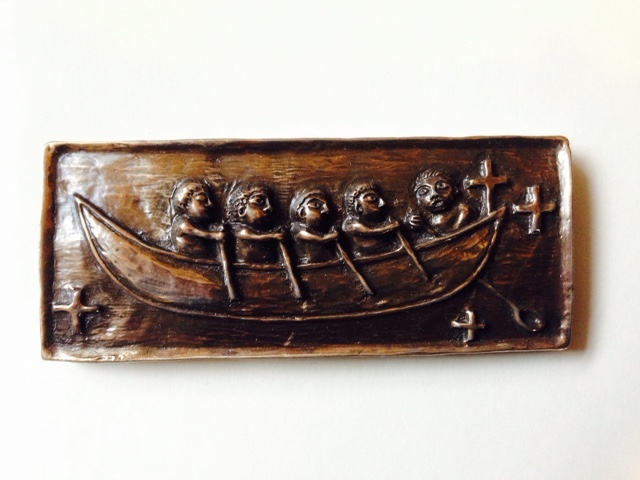
Second, it resonated with some Biblical work I’ve done around the seashore. In the midst of the foresore and seabed controversy, I began to read the gospels, wondering what Jesus did on the foreshore. What happens when we read looking for change on the beach? Here is some of what I wrote:
Sea(as-a-place-of)change is a recurring motif in the ministry of Jesus, as he engages with human identity, history and relationships. There is a dynamism at work, in which boundaries are challenged, dis-placed, and re-storied. The call narratives (Luke 5:1-11) occur on the seashore and it becomes a place of encounter, call and commitment. On the seashore, Jesus announces the Kingdom, as in the Kingdom parables in Matthew 13, which are placed “by the lake” and Jesus challenges the ethics of Pharisee encounter with anOther.
Above the seabed Jesus miraculously demonstrates his identity as Son of God. The calming of the sea (Matthew 8:23-27) illuminates Jesus as the Lord of Creation. The fear of the disciples, caught without warning in “a furious storm,” is symbolic of the fear of a land-locked nation. In response, the Son of Man turns chaos into order and bring peace by facing the storms that are part of seachange.
In John 21:1-19, the seashore again stands as a place of encounter, call and commitment. This post-resurrection narrative places the disciples doing what they do best, working the seabed, and the foreshore as a place of encounter. Jesus is on the foreshore, where he has lit a fire and is cooking some fish. One might suggest that the narrative theologically places Jesus as exerting his customary fishing rights as Lord of Creation and Chief Fisher of people.
Hence the metaphor of seachange is both a sociological reality shaping identity (Australiasian) and it’s a theological category that invites us to consider life change. It’s also an ethical category, in light of climate change.


 )
)