Saturday, January 09, 2010
atheist delusions. part 2. assessing Christian impact
Atheist Delusions: The Christian Revolution and Its Fashionable Enemies
Hart is not concerned to advocacy, (“there are numerous forms of Christian belief and practice for which I would be hard pressed to muster a kind word” (x)), merely for accuracy.
Myth: the intolerance of Christianity
- The Roman empire accepted a diversity of cults, but not a diversity of religions. “It was tolerant, that is to say, of what it found tolerable.” (118).
- Pagan cultures marked by disease, poverty, starvation, homelessness, gladiatorial spectacle, crucifixion, depravity and cruelty.
- Gnostics were “marginal, eccentric, and novel.” (135)
Why did Christianity spread across the empire and through social classes?
- Christianity welcomed both sexes and all classes. “This was, in many ways, the most radical novelty of their community: that it transcended and so, in an ultimate sense, annulled “natural” human divisions.” (158)
- Women found Christianity immensely attractive. Christianity forbade killing female babies and offered care to widows. It demanded loyalty from Christian husbands.
- Legal reforms instituted by Christian emperors included greater rights for women in divorce (Theodosius), for slaves (Justinian).
- Pagan critics were astonished at Christianity. “[O]ne finds nothing in pagan society remotely comparable in magnitude to the Christian willingness to provide continuously for persons in need, male and female, young and old, free and bound alike.” (163)
- Christian theology gave hope in a world of love, over against capricious fatalism. It gave human body dignity, a life here as well as eternal hope.
Part 1 the myths of new atheism here
Friday, January 08, 2010
atheist delusions. part 1. the myths of new atheism
Atheist Delusions: The Christian Revolution and Its Fashionable Enemies
The book is written given that for Hart: “new atheism” lacks historical insight and intellectual honesty, and comes as “attitudes masquerading as ideas, emotional commitments disguised as intellectual honesty.” (19)!!
Hart names, and then dissects, the myths of new atheism.
Myth: religion is violent
- But to be honest, the reality is that wars, bigotry and religious persecution are peculiar to humanity, not simply to monotheistic faiths.
- Christianity actually forbids violence. Should incorrect practice of a faith by it’s followers mean the faith is at fault.
- What evidence is there that secular, atheistic society would be less violent than religious societies, especially given the track record of social eugenics movement, including the Nazi movement as it’s offspring?
Myth: religion is baseless.
- Reality, for a “baseless” religion, Christianity has had an ENORMOUS impact on making world a more humane, charitable and compassionate place.
- Intellectual honesty demands that a religion be assessed on it’s actual particularities, rather than pushed into a category called ‘religion.’
- Just because the reasons for faith do not impress a skeptic does not make them irrational. “More to the point, it is bizarre for anyone to think he or she can judge the nature and credibility of another’s experiences from the outside.” (11)
Myth: that humanity has emerged from the dark ages (an age of faith) into a new age of enlightenment (an age of reason)
- Isn’t calling something the “Dark Ages” in fact an act of bigotry in it’s assumption that our times are more enlightened than other times (and other cultures?)
- In reality, the Middle Ages were marked by dynamism in many fields, like the plow, armor, horse shoe, waterwheels, wrought iron, practical inventions driven by developing scientific theory.
Myth: A golden age of Hellenistic science was killed by Christianity
- Copernicus was heir to an extended tradition of Christian scholarship.
- Science – its methods, controls and guiding principles – were birthed “within Christendom, and under the hands of believing Christians.” (63) due in large degree to the development known as the medieval Christian university.
- Galileo was supported by Archbishops and Cardinals, but refused to acknowledge that his model had flaws and was simply a hypothesis.
- Galileo appealed to Augustine and church fathers, who always saw the Bible as not providing scientific descriptions of reality.
Myth: cruelty of religious intolerance (Crusades, inquisitions, witch hunts) in Christendom
- In times of witch hunts, the church played a key role by introducing courts to channel mob hysteria.
- “[I]n lands where the authority of the church and its inquisitions were strong – especially during the high tide of witch-hunting – convictions were extremely rare.” (80) Eg. Only two convictions went to trial in Spain in all of 13th and 14th centuries.
- The fascination with witchcraft was part of a society freeing itself from authority of the church, and thus a manifestation (a fruit?) of the dawn of modernity.
- Spanish Inquisition was an office of the state, not the church. It was driven by King Ferdinand and Queen Isabella, who needed an instrument to enforce national unity. As such, the Inquisition serves an object lesson in “the inherence violence of the state.” (85).
- History shows us not a decline in church violence as the secular state gained power, but that “violence increased in proportion to the degree of sovereignty claimed by the state.” (86)
Myth: “wars of religion”
- Are in reality the first wars of the modern nation-state, with the role of establishing power of state over church.
- The crusades began as indignant response to the tales of brutality against Christian pilgrims.
- “They certainly had no basis in any Christian tradition of holy war. They [became] the last gaudy flourish of Western barbarian culture, embellished by the winsome ceremonies of chivalry.” (89)
- The wars of Christendom pale into insignificance when laid alongside the wars of the 20th century.
Part 2 here
Thursday, January 07, 2010
farewell drinks
For our non-Opawa friends, we’ll be having a few farewell drinks at Fox and Ferrett, Westfields Riccarton from 5 pm, Sunday, 17th January.
(Opawa Baptist are farewelling us from Saturday 16th, 6 pm onwards.)
Wednesday, January 06, 2010
ministry, imagination and leadership
Stephen Cherry, in Praying for England: Priestly Presence in Contemporary Culture
At such moments the canvas is blank. No-one can prepare a leader for such a moment. No book exists, no course was offered in theological education, that can prepare someone for the appropriate response to that particular moment.
After reflection, Stephen Cherry’s church decided to open their doors. The community could come and sit, or light a candle, or write a prayer of condolence. The response was not just his, as ordained minister. It included those who would offer the ministry of the cup of tea.
The moment is certainly extra-ordinary. In my 15 years of ministry, I’ve never faced a brutal murder.
But I reckon the question – will the church be doing anything to respond – is being asked, continually, daily (even if mostly subconsciously). It might be the parishioner, arriving on Sunday, who during the week has just heard news they have cancer. It might be a family facing redundancy, or the professional contemplating a job offer in another city or a festering family relationship.
It might be a more broad brush – the impact of recession, or climate change, or how to live in response to the other that is terrorist.
The canvas is blank, but surely the question is being asked, constantly, subconsciously: Will the church be doing anything to respond?
One answer is no, nothing extra. The church will simply do what is has always done. Driven by a theology of tradition or a theology of worship, the church will continue to pray and reflect. And there is value in that.
But what to do with John 3:16, the knowledge that God so loved the world. Which presumably includes the world’s questions. Or Isaiah 1, which reminds us that God detests prayer and worship as mere repetition, as acts that do not engage with justice, encourage the oppressed and speak for the fatherless.
In the face of the question – will the church be doing anything to respond? – what is required of the minister at this point is primarily imagination. Since no book has been written, since this moment is particular, since the canvas is blank, the demand is for an exercise of imagination.
Thankfully, whether the need is ordinary (the daily routines of life) or extra-ordinary (unexpected tragedy), plenty of resources to nourish the imagination do in fact exist – the guidance of the Spirit, others in the leadership team, pastoral colleagues, time for reflection, two ears that are listening, the wealth of resources present as the church in history has responded through time and space.
As a bird makes a nest, so the task is to work with what is on hand, to sift one’s resources and stitch together something, unique.
Will the church be doing anything to respond is a question not just for the minister, but also for the theological seminary. It is impossible to prepare a leader for every particular. But it is surely possible to give them confidence that they can stitch, that they do have imagination, that they have begun to use it, that they are aware of what resources they might be able to draw on.
Tuesday, January 05, 2010
suspended
On the wall hung three pictures, a Christmas gift from some years ago.
The top picture is of a moon, smiling, and a heart shaped balloon, floating.
The bottom picture is of a person, grounded, looking upward, skyward holding the balloon string.
Take away the top and bottom picture and all you have is the middle picture, which, without close inspection, is simply blue sky.
That is us, the Taylor family.
Look closely, very closely, and you might see the balloon string, tugging, tearing in the hands of our friends, family and church.
But a casual glance and there is nothing to see. The Taylors are between jobs, between schools, between countries, between what is familiar and known and what is dream and not known. It’s a unique space, in which we’re looking, hoping, trusting, wondering …
Wednesday, December 30, 2009
one day while sorting
The last two days I’ve been in my Opawa office – sorting, filing, junking – in preparation for the move to Adelaide. It’s been a bitter/sweet time; we’ve been part of some really cool stuff here at Opawa, yet we’ve also had to fight some battles and as I shredded all those notes, some of it seemed so petty.
What was fascinating was to find my initial letter of application. Dated March 2003. (I would produce it exactly, but when I turned my back, the packers packed it!)
How I sat at Opawa during Baptist Assembly in 2002 and sensed the possibilities, in creative worship, in citywide ministry and in being part of a working class area. How I was evangelical, but not conservative. How I wanted to be part of a multi-layered community, that in worship and in ministry, offered many ways for people to grow and belong.
And reading my application letter some 6.5 years later, to realise that those dreams were fulfilled. Sunday was a classic example, both folk being baptised were not in church before Opawa and acknowledged the importance of the range of evening courses and congregations in their finding of God. Deeply satisfying.
With thanks to all those who walked with us, made life so much richer and warmer in the process.
Sunday, December 27, 2009
the last Sunday: mission and church today
And so dawned my last Sunday at Opawa. An ending after six most excellent years. Emotionally it was going to be tough.
Normally the last Sunday in December is the quietest Sunday in the church year, what with the post-Christmas slump and summer holidays. But this service was to include two baptisms, three people welcomed into membership and the commissioning of one missionary. Which was a wonderful way to end.
But it also made the service very awkward to curate, especially with non-churched friends and family turning up for the baptisms. In the end I decided all I could do was acknowledge the parts of the service would mean much for some, but not all, and to ask for Christmas cheer.
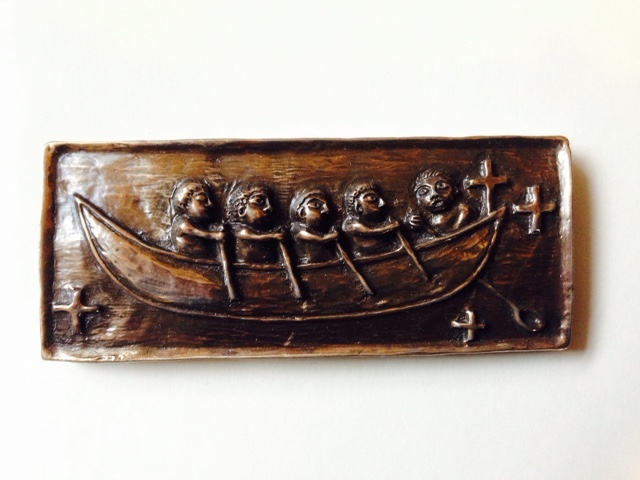
I also used boats – origami on seats as people arrived, and the invitation to write a prayer for a person they came to support, or for their own journey. And during the final song, people could come and sail them on the pool that had been made at the front.

Being my last Sunday, I wanted to remind Opawa of our journey mission. Again, not very “unchurched” friendly. But it’s not every day you conclude six years of ministry in a pretty major change project.
So for those interested, here is what I said in terms of mission, church and change. Not attractional, nor super-Christian, simply …. (more…)
Saturday, December 26, 2009
neat (liturgical) way to celebrate Christmas
From Wales, a church taking nativity outdoors, with various stations scattered around their community.
Because the Holy Trinity Church in Greenfield is closed for building works, we had a choice this year to do nothing, or to take the opportunity to do something different to mark Christmas in the community.
We wanted to give the community the opportunity to be part of the story, rather than just listening to it or sitting through a service done for them by others. Everyone had a part to play in our Living Nativity and it included the whole community because we walked the streets of the village telling the story. As well as traditional readings and carols we heard from the not-so-wise ‘wise man’ shopping for the baby Jesus, we heard the tale of the farmer, irate that the shepherd would leave his sheep and go into town, we heard from the ‘village gossips’ about Mary and Joseph running away together because of the ‘illegitimate’ child. The story, as well as Jesus, was brought down to earth this Christmas in Greenfield.
…. I believe the event showed that Christmas is not just about presents, tinsel and turkey, or even about going to church once a year, but about something which is shared out amongst the community.
Good stuff. Christmas started outdoors. Then there was the Francis of Assisi inspired first ever outdoor nativity sets. It’s such a shame to Christmas re-captured by church buildings.
Friday, December 25, 2009
the christmas eve christingle caught on fire
So I thought, being a Baptist, I’d have a crack at the Christingle idea. As Baptists can do, with our liturgical freedom to sample, make do, grab and borrow. And it being the 7pm Christmas Eve service, and built around a nativity tablaeu, the story told through carol and reading, meaning it only needed a short summary.
- I liked the orange – God so loved the world.
- I liked the orange being rotten – a knife to get rid of the gung.
- I liked the candle – the light of the world.
- I liked the toothpicks pointing in four directions – God for all nations.
- I liked the fruits on the end – that the light of the world changes us.
- But I didn’t like the red bow – the blood of Christ. It’s Christmas Eve, not Easter. It’s God with us. So the bow got switched for a nappy. (And a piece of nappy also attached to the service sheet, to be used as a tactile, participatory prayer).
So I made the Christingle and the kids were really attentive and it was great. I gave the benediction and out came the Christmas cake. Lots of people hanging around, neat sense of community, lots of positive feedback. All these Baptists have never seen anything like this before!
I’m feeling quite pleased. Until I smelt a smell. (more…)
Thursday, December 24, 2009
opawa blessings practically
There has been one more layer to our Advent blessing series. I work really hard on “layering” our mission and worship life, providing multiple ways for people to engage, see more angles. So there has been the
- Advent blessing cards
- Advent banners
- Advent prayers synced to cards
- Advent creative prayer stations
And each week there has been practical Advent Opawa blessings. Like
1. We have a missionary returning to Puerto Rico to work with the deaf community on 1st January. So one week we invited people to buy gifts for the kids she works with. We made up bookmarks that had some suggestions and some details. And during the notices, we asked if anyone wanted to give a gift to a 14 year old boy, or a 10 year old girl, etc.
2. We are holding a local community Christmas dinner, for folk in our community who would rather not eat alone. It’s more a participative, relational event than a charity dinner, in that everyone who comes is expected to sign up to do something – cook, or serve, or clean. So during the notices, we asked if anyone would like to give some new potatoes, or frozen peas, or cream, or crackers. And so those in the church who can’t come get to participate.
3. Each year on Advent 1, we make a combined church Christmas cake. At Advent 4, we cut up bits of the cake and put names and addresses of our old folk who are unable to join us for Christmas. During the notices we ask if there are people from the church who might be willing to take the cake and to pop in on Christmas Eve to say hi and remind them of Opawa’s love for them. It’s a neat, practical way of connecting the generations.
So those are Opawa blessings, that have made practical for us as a community the 4 Advent blessing cards, allowing us to participate as able and each uniquely, in our mission, home and away, inside and outside our church community.
Tuesday, December 22, 2009
kiva loans for Christmas
I’m playing with Kiva loans and Christmas and mission. (More info here).
1. At our Christmas services we often create interaction by asking who’s come the furthest, who’s up the earliest etc, who’s had the most Christmas’s. We often give out a little prize. So why not give out a Kiva gift voucher? It would splendidly capture the spirit of Christmas and would connect local with global mission.
Updated: Church manager said yes. We’ve had financial gifts flowing in all week, for us to give as appropriate. Yee ha.
2. Why not give Kiva as a Christmas gift. Imagine the kids on Christmas afternoon, huddled over the computer, deciding who they’re going to loan to, and letting them align themselves with global mission. Much more Christian use of time than trashing some toy.
3. Use Kiva to kickstart micro-finance in your community. Give out 20 lots of $25 (total $500), to people in your church. A random surprise one Sunday. Some churches ask for money, we give money! After 6 months invite them to a Kiva evening, to share what they gave to and what has happened. Use that energy to ask questions:
- Could we do micro-loans in our community?
- What questions would we need to ask first?
Send people off to do research, and bring a recommendation to your church community. Give out locally, 20 lots of “microfinance.” After 6 months, meet for yet another, but this time local, Kiva evening, to share stories and see what the next step is.
What is Kiva? Glad you asked? Use this video (and below) on Christmas morning, with your kids and at your Kiva evenings.
public kiwi mission: carols by glowstick
Some churches use public peace labyrinths. Some use controversial billboards. Some use carols, done well – high quality musicians; high quality graphics; quality networking to gain sponsorship from Auckland City Council, Vector Arena, DDB Capital; preaching; carols; prayer; offering.
= 6,000 people in attendance. For a writeup, go here.
Monday, December 21, 2009
advent blessings bannering: from process to prayer
A fabric artist, visiting from another city, was just in the auditorium admiring our banners. It’s neat to have people in the church for “creativity’s sake”. All four banners are now up, and looking fine.

(poor shot, but it gives you some idea of the height, scope and colours.) The process is pretty team-like
- Lynne did the design on publisher
- emailed it to Lawence, who as an engineer works for a firm that has a photocopier that prints to A0
- who gives the black and white banners to Carolyn and Jan, who add pastels
- who gives them to Pete, who hangs them.
Cost. $16! Plus creative time. The response has been simply excellent and it’s given some real shape and energy to our Advent.
My spiritual director challenged me to weave the four Advent blessings into the lighting of the Advent candles. So here’s version 1.
In Numbers, Old
God faces
failed Aaron, and wrestling Jacob
shines grace
ALL: Old to New, in Jesus, come
In Corinthians, New
as Spirit waters prayerless,
hard edged prisons, now new,
graced spaces
ALL: Old to New, in Jesus, come
In Jude, future
face forward
new Adam builds blushing bride
ALL: Old to New, in Jesus, come
In Luke, Mary giggles – yes
Elizabeth embraces – out of bounds no
as Jesus moves heaven to earth
ALL: Old to New, in Jesus, come
Advent blessings – four; we await the face of God in Christ
ALL: Old to New, in Jesus, we say welcome
So there we are. I suspect a totally unique approach to Advent!
Sunday, December 20, 2009
the logic of the Incarnation: Mary where’d you get your baby from
Here’s a snippet of Sunday’s sermon – in response to a bus-stop conversation last Christmas, and to the media coverage of a certain billboard put up by a church in Auckland.


 )
)