Saturday, December 19, 2009
wanted: church in Adelaide
I was driving this morning, thinking about the values that would mark the “ideal” church for the Taylor family in Adelaide. As a pastoral family, we’ve never had to “choose” a church before. We’re suddenly going to be “church shoppers.” Which is a seriously wierd experience. So what will we be looking for?
Here’s my first thoughts:
1. In a poorer area, and with an outward mission that we as a family could serve in. I really want the kids to be part of a family that serves, not just because we have been “church pastors”, but because we are Christians.
2. A community committed to growing our kids (9 and 12). This need not mean great children and youth programmes, simply a culture that is taking the growth of all ages seriously.
3. Existing worship that is thoughtful, culturally connective and whole-bodied
4. Space for the development (if necessary) of new forms of church
Am I asking too much? Is it fair to go into a church with an existing set of values? Am I just becoming a church-shopper? Are these things realistic?
And then I laughed. I suddenly realised that I know a church like this. It’s in our city, just down the road, called Opawa, the church that we are currently part of!
Thanks Opawa, for all you have done to be a GREAT place for the Taylor family. You are going to be so missed. And as we have sensed all the way through this call process: we simply have to trust that the God who has given us such great friends, family and church here in Christchurch, will do it again in a new space.
Thursday, December 17, 2009
Christmas blame: sex and the incarnation: updated
Last year, the leadup to Christmas found me in a rather bizarre bus stop conversation. The essence was a stranger telling me that Christmas was God’s fault, for not using a condom. At the time, I wondered how widespread was this rather crude notion of sexuality and the human/divine connection.
This year the conversation has returned. This time, starting not on the street, but from a church, with the following billboard going up in Auckland.

For St Matthews it is an:
ongoing effort to provoke conversation about spiritual matters … a Christmas billboard … that lampoons literalism and invites people to think again about what a miracle is. Is the Christmas miracle a male God sending forth his divine sperm, or is the miracle that God is and always has been among the poor?
Well yes, but only if you are trading on a crude notion of Incarnation as a God sleeping with a woman. It’s certainly not orthodox Christianity, in which the Creeds affirm Jesus as begotten, not made. Words designed to avoid the notion of Incarnation as literal male God sleeping with Mary. So I’m not sure what “literalism” St Matthew’s think they are lampooning. Perhaps the crude notion I encountered last year.
The Catholics are angered, claiming that “for a church to put up a poster which implied the Virgin Mary and Joseph had just had sex was disrespectful to the church.” Well there is no timeline on the poster, so it’s a silly comment. It also continues the vague disquiet that the church seems to have with sex.
I couldn’t help reflecting, as I looked at the billboard, on the fantastic annunciation art that through history the church has produced: Botticelli, Da Vinci, Caravaggio, Henry Tanner. In the 21st century is the best we can do a billboard commenting on male sexual anxiety?
It makes me glad of the Christmas journey here at Latimer Square, offering peace amid the stress, open-ended meaningful amid the tinsel.
Updated: In the last 24 hours, the billboard had paint splashed on it, and then overnight was stolen. The spokesman for St Matthews is disappointed, surprised that some people can preach love, but not act in love. Which of course demands a mirror be raised: if for St Matthews, the standard is love, how does that stack up with there self-professed motive: to “lampoon literalism” (Dictionary definition “harsh satire usually directed against an individual”). I don’t condone theft. And two wrongs don’t make a right. But me thinks it’s a bit rich for St Matthews to claim the high moral ground that is love on this one.
Wednesday, December 16, 2009
the gospel and land of promise
Some good news this morning …. another of my writings has been accepted for publication.
Back in July I presented a paper – Faithful Other or Guilty Other? a migrants reading of Genesis 28:10-18 – at an academic conference. The theme was the Gospel and the land of promise. Most of the papers looked at Biblical material in relation to the land of Israel. My paper did also, but by a somewhat meandering path. I started by reading the Jacob narrative through the lens of Aotearoa migration stories – Maori and Pakeha, Cook and Banks and Te Rangi Hiroa – which threw up some fascinating discussion around “land/s of promise.” What if “ownership” was a cultural construct? What if “promised” land was offered as already occupied land, both by animal and people?
Questions I’ve been chewing on for a number of years, and the conference was a chance to draw some threads together, put some thoughts into words. The papers were gathered. And a publisher has just said yes to making them available in written form.
So that’s a third publishable “thing” for me in this calendar year; with another 2 “things” submitted and awaiting. Plus there is a first complete draft of a potential book on faith:full family ministry, emerging from the Breathe conference I spoke at in August. All in all, it’s been a very encouraging year (for a part-time academic) writing wise. Now back to the laptop!
Monday, December 14, 2009
mission-shaped training: Grow and go weekend

It’s this type of reason that I’m looking forward to being in Adelaide. I love the mission-shaped theme, the wide range of options and the sense of a training institution intentionally resourcing the wider church. Upcoming May 14-16, 2010. For more info, go here. (And for the record, the brochure is slightly ahead of itself! I am still 2 weeks away from concluding at Opawa.)
My last Sunday at Opawa is December 27 and it looks like being quite a Sunday: including the commissioning of two sets of missionaries, a baptism and a welcoming of new members. To quote:
“I want to come into membership on the Sunday before you leave, so that you, Steve, and Lynne, leave knowing the church is in good hands!”
Sunday, December 13, 2009
Salvation as eschatology: mixing redemption, Advent, eschatology, Irenaus
The Bible text is Jude 24, 25
And now to him who can keep you on your feet, standing tall in his bright presence, fresh and celebrating—to our one God, our only Savior, through Jesus Christ, our Master, be glory, majesty, strength, and rule before all time, and now, and to the end of all time. Yes.
Which generated the following reflection: a move between salvation, Advent, eschatology and Irenaeus. Complete with wedding vows. Perhaps not your standard evangelical gospel presentation. But surely Biblical, and perhaps thoughtfully, evocatively, transformative (more…)
growing congregational capacity to engage the Bible
For those wrestling with how to deepen congregational capacity around the Bible, and who learn from others adventures, here’s what I did this morning. The Bible text was available in three formats:
– a postcard sized card, professionally printed (one of series of four “blessings”)
– as a powerpoint slide
– as a 10 metre high banner in the church (one of a set of four).

Four times during the sermon I invited a minute’s silence. Each time, I invited the congregation to read the text for themselves (whether by postcard, banner or powerpoint) and engage a different set of questions:
- first – What word or phrase strikes us? What questions does it raise?
- second – What life experiences does it connect with?
- third – How does this part fit with the rest of the Bible book?
- fourth – What other Bible verses, or Bible stories, does this bring to mind?
When appropriate (all except third time) I asked for congregational feedback, and then shared some our my thoughts, emerging from my research, reading, commentary digging during the week. I pointed out at the end that this is a model for how any of us can read the Bible – it honours the text, our life experience, literary genre and the flow of God’s big story.
I’ve blogged before (here, here, here and here) about the weakness of “one voice is the expert” and of “sharing as pooling of ignorance.” It seems to me that approaches as detailed above honour both the reservoir of knowledge that exists about original context, the diversity of life experience we all bring, the wisdom of the community and the need for all of us, publicly and privately, to be doing the hard yards of listening to God around Scripture.
Specifically what I did offered a
a) guided space for people to engage Bible for themselves
b) conversational interaction, hearing each other in community
c) shared input, from the commentaries, my life, and the history of church
d) a clear process which can then be taken and applied in other contexts.
It’s still a little bit head-based for my liking. But this is 10:30 am. After six years at Opawa, we have a variety of congregations that offer a huge range of ways to connect with God. You can art at Sidedoor, smell and feel at Soak, discuss at espresso, hymn sing, culturally connect at Grow. Bottom-line, some people still find it most helpful to sit and think with their heads. So we need “sitting and thinking” places, like 10:30 Sunday morning!
Friday, December 11, 2009
the spirit, worship, leadership. but outside the gathered?
Some random thoughts have been churning through my head. They are a mix of pastoral encounters with people in hard places, who no longer feel able to pray. And the ongoing tension of being a pastoral leader in today’s post-Christendom context, when the gathered expect my feeding, but the mission task keeps itching. And engaging (through study and reading this week) Romans 8:26, in which the Spirit prays for us.
And wondering if this prayer is embodied, takes shape in the habits of the praying community and the praying leader. As in Anunication, baptism, transfiguration, resurrection, pentecost, the Spirit finds concrete shape in human things, so does this prayer of the Spirit take shape in the prayers of the saints?
And all of this stimulated by watching U2 live in Raleigh. (Yes, yet another U2 reference on this blog. Sorry for being stuck in a moment. This time will pass!). Third song in is Mysterious ways. At the end, Bono invokes the Spirit. (See a clip here).
He literally names the one who moves us as the Spirit (3:45 “Spirit teach me, reach me), and then shifts from singular to plural (is the “we” the band or the crowd?), inviting that Spirit to come and be present (3:55 “we move with it”). And the lighting switches from being band-centric, to mirror-ball, with white light moving over the crowd (4:08). A magic moment, as for the first time the crowd are lit.
And the part of me that is not dancing and enjoying, but is paying attention wonders if this is coincidence, or if I am hearing Bono right, and seeing the light correct. Is the Spirit being invoked to be present at a rock concert, to play not just over a band member, but over all those gathered? If so, is this part of Romans 8:26, in which the Spirit is praying for the aches and pains of the gathered thousands, through the words and invitation of a singer, and underlined by a lighting director?
And if so, how to make sense – theological, liturgical, congregational – of that moment, and other moments, when the Spirit is invoked beyond the gathered church?
Many will have never make this connection I have made. Does this matter? Is this “prayer” still “for” them? Many of them will not consider themselves “Amen-ers” ready to say yes to the work of the Spirit in them. Does this matter? How is this “prayer” still “for” them? But many will go on in the concert to pray and to enact justice on behalf of the One campaign. So is this then their participation in an activity of the Spirit?
Such are the thoughts that wriggle through my head at the moment.
Thursday, December 10, 2009
bono: third way’s icon of the month
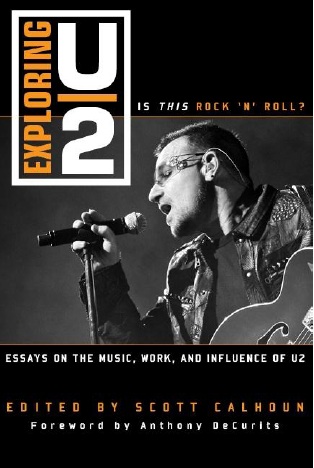
 I’ve been beating my head for the last few weeks around a couple of sentences in a chapter I’m writing: struggling to know how to express what I consider messianic pretentiousness in Bono’s claim in this Youtube video that songs can change the world.
So it was a relief to find Bono’s messianic pretentiousness captured by no less a luminary than Bruce Springsteen, who
observed, when inducting U2 into the rock and roll hall of fame that ‘every good … front man knows that before James Brown there was Jesus’. And Bono, as the Boss suggests, seems to know this better than most.
A quote as part of the December edition of Third way magazine, who have named Bono as their icon of the month. (They do an icon a month and it’s a fantastic resource for cultural studies, which I drew on for my Gospel in post-Christian class earlier this year with every student reflecting on the use and abuses of such things as – Nike, football pitch, play station, widescreen TV – in our world today.)
Which needs to be placed alongside John Drane’s incisive little book Celebrity Culture
- that our fascination with celebrities reminds us that for many humans, truth is embodied and experienced as relational and personal
- that we no longer expect our celebrities to be completely perfect. Indeed, that their pain as they struggle to be a person of value is good news, for it portrays a form of honest discipleship that is deeply Biblical.
- the contemporary human fascination with the warts and all of life, including the spiritual search, asks questions about how authentically open are most Christians in their spiritual search
And for a wonderful exposition of this theology of “celebrity culture”, see the Drane’s post on the death of celebrity Jane Goodie.
So thanks Bono, for even if your songs can’t change a world, nevertheless, in your stubbled way, you help me stumble toward my being formed in the way of Christ.
Wednesday, December 09, 2009
Dark Victory: a window onto real Australia?
while sick, I read Dark Victory
John Howard (then Prime Minister of Australia) said of the people rescued by the Tampa and sent for processing to Nauru, “We have always stood ready to take our fair share’. In the end, New Zealand took 186. Australia took one.” (page 289)
This book investigates recent Australian political history, most particular August 23-November 10, 2001. It begins with the Tampa incident, in which a boatload of refugees, seeking refugee status in Australia, were rescued by a passing cargo ship, the Tampa and then refused entry into Australia. It documents the politics, including the way John Howard and his Labour Liberal party fought, and won, an election, by merging a post 9/11 fear of terrorism with the arrival of Afghan and Iraqi people seeking refuge in Australia. It describes the military role, including towing boats back to Indonesia and the death and trauma that resulted. (The net impact was the forcing of 2390 boat people away from Australia, at a cool cost of about $500 million).
In doing so it suggests a profound racism lies at the heart of Australia, what one commentator called “dog whistle” politics, pitching a message to one group of voters that other groups do not hear. It raises some disturbing questions about the lack of hospitality in Australia, and the privileging of (white) colour.
The book is compelling written (I read it in a day, while sick), mixing personal narratives with the complex machinations of government affairs, military chains of command and media response. It is surprisingly free of editorialising, choosing instead to simply lay out the facts.
From a missiological perspective, it is interesting to see the church portrayed as prophetic in it’s critique of the government, sounding a clear call on behalf of the poor and dispossessed. This however, was what I call church “powerful” – leaders and thinkers. It left me wondering what on earth was happened at the local congregational level. What were pastors in rural churches preaching (or not preaching), during this period. (That would make a fascinating research project).
It is easy to feel a bit smug, reading this as a New Zealander, hearing our name mentioned as a country willing to make space. The cynical part of me wonders what would happen if we weren’t protected by the great red land, and if boat people were arriving on our shores? Is their “dog whistle” politics at work when Brash talks of Kiwi not iwi, or Winston Peters wants New Zealand land for New Zealand owners?
Tuesday, December 08, 2009
Christmas Journey floats in Santa Parade
The Christmas journey is up in Latimer Square, Christchurch, again this year. About 1,000 bales of hay are used to create a labyrinth, in which various stations reflecting on peace are staged. Latimer Square is a major thoroughfare in the central city, and a redlight area at night, so it’s a neat place to offer Christian spiritual practice.
To help with promotion, the Journey placed a float in the citywide Santa Parade. The sides are painted by a local community youth trust. The four towers, with Advent words are set in the four corners. The centre peace is a laminated list of names from the phone book, with Pentecost symbols, to denote the Spirit at the Anunciation.

From the rear, a grassed area is visible, on which are stuck some “stick people” (driftwood, with eyes). These are given at the start of the labyrinth and people are invited to place them at the central stable area. Over 2,500 of these stick people were given out at the Santa parade, with the hope they will bring them to the labyrinth when it opens just before Christmas.

The Christmas journey represents one of the key evolutions in “emerging church” in the last 5 years – that of large scale outdoor creative engagement. The creativity and contextuality often used to re-frame worship has now been focused on the public square, to offer spiritual practice outside the church. These types of initiative are important in keeping alive the Christmas story, in a society where the Christian story is less known. The downside is that they are extremely labour intensive and can rely on the creativity of a few. They also make problematic the relationship between individualised experience and Christian community.

Sunday, December 06, 2009
Preaching benedictions (2 Corinthians 13:14) or theology in a hard place
A few weeks ago, I blogged about my pastoral experience of finding myself locked, temporarily and unexpectedly, in a psychiatric hospital ward.
 Today’s sermon continued our Advent blessing and is a text we often hear inside the comfortable walls of the church, as a final benediction. But what does the blessing mean in the hard places. So the sermon (script to be spoken) sought to relate the Bible text to that experience. (more…)
Friday, December 04, 2009
new church website
A few weeks ago I had a day of sick leave, looking after Lynne who had lost some wisdom teeth. Given that she decided to heal by sleeping, I had a play with the Opawa website. The old one was 5 years old, so it was well broke.
Anyhow, here is the new one …. (still not perfect, but so much better than the old one that it was worth putting up even half done).
This one has new wordpress software, which enables greater sp*m control and allows us to include video. It’s in more of a magazine style, which we hope looks more appealing and allows us to better promote our congregations (in the featured section). It’s got a nice use of headings, allowing us to showcase our mission, our place, our people, our faith, our story etc.
So what do you think? What would you like to see added – from the perspective of spiritual searcher, a Christian tourist or an Opawa-ite?
first day in the new office
freshly painted
newly carpeted
clean and fresh
and in the new office, I met with people to
- plan Opawa’s first ever local community Christmas lunch and how to offer it with dignity
- brainstorm about the future of the Gathering, our local mission initiative birthed this year
- collected names in order to write thankyou cards to our voluntary leaders who serve our youth and kids (currently stands at 22 volunteers, which is pretty outstanding really)
I like that. Buildings for planning mission.
With the offices done, the builders have now started on the foyer renovations and kitchen/cafe area. In a few months, meetings could well be about
- the cafe opening to the community
- launching the Economic Development Fund encouraging local micro-business initiatives as part of community development
- providing food for “Learning days”, like Job Interview Skills; Gardening Skills; Sensemaking Faith; Budgeting; TradeMe; Culturemakers Reading Group; How to Read the Bible.
All very encouraging. Despite the Taylor’s imminent departure, all around the place I see people stepping into leadership, saying yes to a new season and preparing themselves for a new year with missionality (new word I’m coining meaning mission + intentionality).
Thursday, December 03, 2009
some days are better than others: reseaching U2
I’ve just emailed a UK music producer, John Reynolds. He is responsible for producing the chant by Sinead O’Connor, that begins the live performance of Bullet the Blue Sky on the U2 Go Home – Live from Slane Castle DVD
Since I’m researching the evolving live performances of U2, and seeking to turn a spoken 2,500 word paper into a 6,000 word book chapter, I am intrigued:
– Is Sinead singing any particular lyrics, or is she just offering a chant, perhaps as some sort of lament?
– What Sinead might have been hoping to communicate with the chant and how she felt about the way U2 incorporated it into their live performance?
– How the production process evolved, including was it initially requested by U2 or offered by Sinead?
I’ve asked for help on the atU2 forums (yep, part of research is reading fan sites!)
Some days, research is fun! (And is also an excellent excuse to keep me away from writing, which is what I am really meant to be doing).


 )
)