Monday, January 16, 2012
a prayer for the year coming
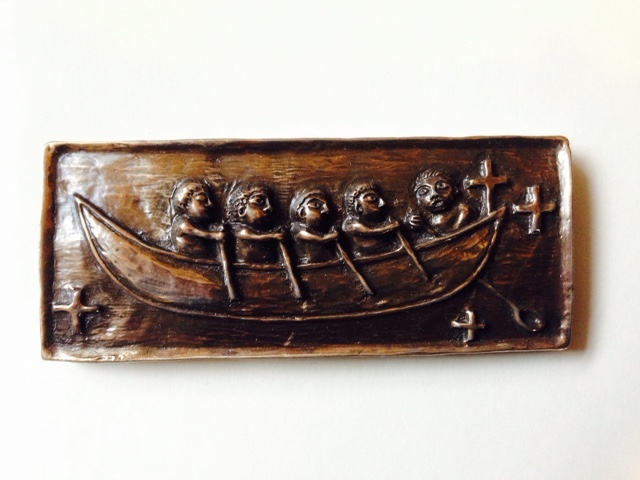
Lindisfarne Scriptorium produce A Call to Pray as a discipleship resource. It includes 13 cards, each with an artistic image, each with a prayer. They are wallet-sized, so over the summer holiday, they’ve been great to sit with at the beginning of each day. Or to place in your pocket as you go for a reflective walk.
Sunday I headed up a hill for a 2 hour walk, with the following prayer. As I walked and pondered, some questions began to emerge, which helped me as I began to pray for the year ahead.
Please God
grant us the grace
to change our hearts,
to open our minds
To ponder: What are the images of God in which you find grace?
Grant us the grace
to bless our small corner,
to encourage each other
To ponder: What is your “small corner”/refuge/sanctuary? What will bless it?
Grant us the grace
to pray for the world,
to care to much.
To ponder: How can you care too much for the world?
Grant us the grace, please Lord.
Prayer from Lindisfarne Scriptorium. Reflective questions by Steve and Kayli Taylor.
Further links:
– Photo essay of Lindisfarne here.
– Lindisfarne spiritual legacy here.
– Further discipleship resources here.
Sunday, January 15, 2012
walking the art: Brick Bay Sculpture Trail
Over the weekend I loved walking the Brick Bay Sculpture Trail – 43 sculptures from some of New Zealand’s most well known sculpturers, located outdoors, among native bush and meandering lakes. The walk takes about an hour, and involves 2 km of walking. Trees and landscape is carefully used to ensure that the environment is the canvas and it allowed a wonderful mix of walking, contemplation and discovery, all in the outdoors, allowing the visits of native wood pigeons and tui. The trail is run by a Trust, with profit being made available to assist artists with costs (because large scale sculpture is expensive).
In 2009, I was part of an academic theology conference on land. Sitting on the grass, contemplating sculpture 31 – Graham Bennett’s Position fixing – I wondered what would have happened if the academic conference had occurred not an hour down the road in a sterile lecture room, but here, with regular walks through the trail.
In 2011, the conference became a book, The Gospel and the Land of Promise: Christian Approaches to the Land of the Bible
Theology needs art. (But does art need theology?)
Saturday, January 14, 2012
the summer project
It used to look like this …

now, after fun choosing the paint, then time spent engaging in the spiritual practice of undercoating, followed by three days of exhausting painting, this is the result …

one very satisfying summer project complete. Wish all my work was this instantly transforming, this instantly satisfying.
Tuesday, January 10, 2012
holiday reading part 2
And Still the Music Plays
I have found a poem (What to remember when Waking) from Dave Whyte’s The House of Belonging
Thursday, January 05, 2012
holiday reading
In between choosing paint, preparing to paint and actually painting, there has been some (not much) time for reading.
Ford County: Stories
I’ve also been watching episodes from Rev, a BBC comedy about a vicar running a modern inner-city church, which gained BAFTA comedy award in 2011.
It was a Christmas gift, but as I watched I began to wonder if it might be useful for the Church, Ministry, Sacraments blockcourse I am co-teaching in February.
Monday, January 02, 2012
U=undercoat. working for change as a new years resolution
I’m exhausted, tired and slightly sun burnt after a day spent scrapping paint off our old wooden holiday house. It’s essential, perhaps the most important part of a much needed outdoor paint job. While choosing paint colours is exciting, it’s the hard work of preparation that makes it possible, that ensures the change of colour is longer lasting.
Like change.
New Year’s Resolutions are easy. But it’s only made possible, sustainable, durable, by the hard work of scrapping, sanding and priming.
As I think about the leadership challenges I am about to face in this new season, it was good to spend the first day of this new year scrapping and undercoating. Work became prayer, the invitation to commit myself to the spiritual practice of undercoating, the hard work of preparation – listening well, respecting the past, investing in relationships, being attentive spiritually, over-communicating, making experiments risks, building the rhythms of grace.
(This is another entry in dictionary of everyday spirituality, under the heading U is for undercoating).
Thursday, December 29, 2011
summer holidays = choosing paint colours
So the out of bounds bach (holiday home/shack) is getting a facelift, an exterior coat of paint. To be precise, an exterior coat of Rongotai, with the windows and barge boards being Reefton. Choosing colours is more fun than sanding and undercoating. Although both are more fun than ministry, because both are about instant change – you scrape, you choose – and change is immediately apparent.
What is also more interesting than sanding is the social media strategy adopted by Dulux New Zealand. Their paint range is named after New Zealand places, to which you are invited to upload your photos:
What’s your Dulux Colour of New Zealand? Where do your magical moments and fond memories come from?
To begin, simply find your special place on the map, then submit at least three photo. Simply click on the approximate area, and we’ll give you a selection of locations to choose from. You’ll also be able to browse other people’s uploads at the same time. Of course, not every location in New Zealand is in our current colour range. If you can’t find your favourite place, please let us know. We would love you to tell us what place in NZ is dear to you and what colour you think is best associated with that colour.
So that when you search under Rongotai, you get a great picture. Go look …
Friday, December 23, 2011
being consumed (at Christmas)
Being Consumed: Economics and Christian Desire
“The Eucharist tells another story about hunger and consumption.” (94).
The argument is that the Eucharist provides an alternative imagination to globalisation. It’s not just theory, because the assertion that the “church is called to be a different kind of economic space and to foster such spaces in the world” (ix) is followed by some really concrete practices
- turn our homes into sites of creative production, not just consumption (such a practical alternative perhaps to Christmas)
- donate time to those in need
- deposit in community development banks
- buy locally
- Christian business practices and
- Fair Trade
I reckon it’s a sort of Catholic equivalent of Andy Crouch’s Culture Making: Recovering Our Creative Calling
(For some of my commentary on this a great little video, see here).
Both seem to provide ways beyond the church-centric imagination that plagues so much of contemporary mission (including fresh expressions) thinking. What is more appealing about Being Consumed
Further links:
Consumerism at Christmas (part one)
Consumerism at Christmas (another here).
Thursday, December 22, 2011
a week’s work: communion in a world of hunger
Most of this week has been a writing week, preparing to speak at a conference on Post-colonial theology and religion in Melbourne later in January. My paper is titled – This is my body? A post-colonial investigation of the elements used in indigenous Australian communion practices – and over the week I’ve put together 4,800 words, which is a pretty good effort.
For those interested, here’s my introduction: (more…)
Tuesday, December 20, 2011
Advent acts of healing and redemption
The Lake (Ellesmere) on which my most re-creative space is found, was a few years ago, declared pretty well dead, a victim of chemical pollution and lack of care.
After much negotiation, the local Maori tribe has been given a greater opportunity to care for the Lake. This morning, with the air dead calm, I walked out where the River (Selwyn) meets the Lake. What was a paddock is now planted in native bush. An attractive set of wooden steps welcomes. A number of new trails toward the lake are being developed. It might be a coincidence, but the bird life seems more abundant. Black swans patrolled the river and a range of shags and seagulls fought for fish.
It struck me as being a wonderful metaphor for the work of God in the world. I have been absent, in another country. And yet creation care continues, land is being offered some space to healing and the birds rejoice. In a few days we will celebrate the birth of the One who made healing and redemption, of human and creation, a possibility in which all are invited to participate.
Romans 8:21, 23 that the creation itself will be liberated from its bondage to decay and brought into the glorious freedom of the children of God …Not only so, but we ourselves, who have the firstfruits of the Spirit, groan inwardly as we wait eagerly for our adoption as sons, the redemption of our bodies.
Monday, December 19, 2011
my most re-creative space?
This is one of my most re-creative spaces. I woke up this morning to this

and ate breakfast with the kids looking at this

It is what we call the “out of bounds bach.” The back story is that we used the author advance from my The Out of Bounds Church? book
If you ever think I’m burning out, or sense I’m losing my soul, ask me how long since I’ve been here? And how long till I plan to return?
Now we live in Australia, it’s a wonderful holiday spot, our sense of turangawaewae.
Literally tūranga (standing place), waewae (feet), it is often translated as ‘a place to stand’. Tūrangawaewae are places where we feel especially empowered and connected. They are our foundation, our place in the world, our home.
My task this week is to write from here. What joy.
Saturday, December 17, 2011
on a jet plane. tee hee
Team Taylor are on a jet plane, flying back to New Zealand for the summer. I have one more week of work, in which I hope to make significant progress on this little writing project, but with school ending for the kids on Wednesday, it’s time to reconnect with earth and people.
We are all very excited ….
Friday, December 16, 2011
indigenous dreaming
I’ve had a rich few days that included time with local indigenous Christian leaders, talking and dreaming
- about ways that Uniting Church candidates can be exposed to indigenous culture
- about whether we as staff and students at College can be taught the Lords Prayer and Words of institution at communion in the local language (Kaurna), as a way to honour the traditional owners of the land on which College exists
- about urban field trips, Saturdays in which we drive around Adelaide, hearing the stories from Colebrook, and Lartelare Park
- initially for students in my Reading Cultures class, but why not as a sort of fresh expression for new migrants
- about shared theological projects, including communion and the missiology of the Preamble.
I have left these gatherings with this urge to take off my shoes, for I feel like I’ve been walking on holy ground.
Thursday, December 15, 2011
the bias of a bowling ball as a metaphor for postmodern epistemology
 Last week included a team social. Each year we try and do something fun and different to end the year. This year we went lawn bowling. Despite some initial uncertainty, photos of the event revealed a lot of smiles on a lot of faces.
Essential to lawn bowls is the bias on the bowling ball, that one side is weighted. Which makes for great hilarity when folk get the bias wrong and the ball heads off into the next door neighbours game.
In the week following, a number of times I’ve found myself sitting with folk who have felt the need to declare their own bias. They are making an observation and as they do, point out that they have a particular perspective, a particular relationship, a particular history, that will shape their opinion.
Knowing my post-modern epistemology, I gently point out to them that there is no such thing as objective neutrality, that in fact ever person has a particular perspective, a particular relationship, a particular history, that will shape their opinion.
Like a bowling ball I have told them since last week. A bowling ball has a bias. Our task is not to think in straight, objective lines. Rather it is to be aware of our bias and weight the speed of the green (the context). Only by accurately knowing our bias will we ever get close to truth.
The bias of a bowling ball as a metaphor for postmodern epistemology. What do you reckon?


 )
)