Tuesday, April 13, 2010
saying thanks: turning practices into missional life

This is a most excellent example of helping a community give thanks. It is a church wall at Church of the Trinity Uniting, Goodwood. People are being given (paper) flowers and invited to give thanks.
Over weeks the wall is growing, an emerging symphony of colour. Over weeks what people write seems to be deepening. Over the weeks, people are commenting they are finding themselves becoming more and more intentional about looking for reasons to be thankful in their daily lives. Good stuff. (The pastor, very wisely IMHO, is photographing the wall each week, planning to make it into a movie, to play at years end.)
This became an excellent learning moment in our Missional Church Leadership class (3rd gathering of 10). We were looking at ways to listen and I was talking about appreciative inquiry, the simple practice of saying thanks, as a window into where God’s Spirit might be active. And how the simple act of naming ie saying thanks, gives people an opportunity to further participate.
And at that moment, the photo got passed around and we admired the colour and the effective, yet creative way, of helping people worship.
What intrigues me is how this simple, yet intentional, worship practice might actually be part of the church’s ongoing intentional mission life.
For example: Why not take a note of the recurring themes. Then invite all those who gave thanks over a year to a gathering. Share with them the themes. Get people in groups around questions like what surprises you? Then ask them to think about ways the community could further develop this theme ie be yet more thankful. Perhaps they are thankful for family. Get them to brainstorm ideas, ways they could focus their energy on families. Record the findings and ask if any people want to part of giving their dreams legs.
Start a second year with a second wall. See what happens as you gather people intentionally around what they have identified as important and significant.
Such, I would suggest, is the task of missional leadership:
1. Invite people into missional practices
2. Mirror back to people what is emerging as the practices are lived.
3. Gather conversations about next steps: how then shall we live?
4. Record the findings and return to 1.
It was a great class! (Even without the learning that emerged as another student talked about farm gates. But that’s for another post.)
Sunday, April 11, 2010
the use of art in growing a fresh expression: being church in a time of cultural change
Church as rugby club? Or touch team? I referred last week to this question, quoting an article by Kevin Ward, in which he explores changes in voluntary groups and ways people belong. (Kevin’s article is here, my post last week is here). As I wrote in the Sociology for Ministry lecture:
So, consider that alongside the decline in church, is a widespread decline in all voluntary associations: from Lions to labour unions, from political parties to bowling clubs.
In New Zealand in 1970’s about 400,000 people played rugby. By 1990’s it had plummeted to 100,000.
Why? Factors include authoritarian and controlling environment, rigid structures, high institutional overheads, dress code, conformist culture, lack of choice, repression of individual for sake of community.
At the same time, touch rugby, while only started in an organised sense in 1990, had by the year 2000 over 272, 000 registered participants.
Why? It is minimalist, gender inclusive. Individuals can choose their own team, while teams can choose their uniform and name. Time is limited and there is a high value on socialising and fun.
In other words, traditional structures based on long-term commitment and exclusive loyalties are less attractive than single stranded, less formal, smaller groupings.
It helped me make sense of a most stimulating Sunday afternoon I’ve just had at a Resurrection and Art seminar. It’s one of four Sunday afternoons being offered by the local Catholic Theological College, exploring Jesus passion and art; resurrection and art; Mary and art; Trinity and art.
Two hours, great visuals, a mix of history, theology and spirituality. Along with a nice afternoon tea. It was a most worthwhile afternoon.
I came away reflecting that here was an institution (Catholic Church) providing a way to play touch, resourcing people’s spirituality without requiring them to in any way be part of the institution.
What intrigues me is how this can be self-resourcing and self-starting. There were about 40 people booked, each paying $20 a session. Take out a bit for facilities (which would be unused in most churches at this time of day anyhow, the advertising (which is giving you profile even if no-one turns up), and the morning tea and you still have around 30 hours for a staff person to work up a lecture. That’s enough time to put together a pretty good talk.
(I tried to do this a number of times at Opawa, but the person I kept tried to lure to start the conversation was too booked up and I was too busy and the energy required by the Easter and Christmas Journey made other forms of creativity harder to initiate).
Do it for Easter/Pentecost. Do it again at Advent. Do it again on Waitangi Day/Australia Day, using indigenous art.
Each time, provide a set of art pieces as postcards. After a time, invite people to do more research on the artist and the theology and meet again to share their findings. Or simply to gather in a few weeks to reflect on how their artpiece as helped their journey. Slowly you are building a new community – being church in a new form in a time of cultural change.
Friday, April 09, 2010
developing change leaders: book review of chapter 1
While nearly 2000 books were recently written on leadership in an 18 month period, very few address the question:
How do we develop effective change leaders?
Such is the task attempted by business lecturers, Paul Aitken and Malcolm Higgs in their Developing Change Leaders: The principles and practices of change leadership development
(Given that church’s and church leaders are meant to be into life change, I began to flick through the book. The more I browsed, the more intrigued I was, both by the clarity of the material, and by the extensive reading and practical case studies the author’s draw on. Thinking this might be a good resource, I opened my wallet.)
Aitken and Higgs use a key image, that of “sense-making” to argue that the challenge is not to find some yet to be discovered new golden bullet. Rather the challenge is to make sense of what we know. In chapter one, this focuses on the impact of organisational culture on leadership.
“In broad terms, our framing of effective leadership has shifted notably from the ‘Heroic’, leader-centric viewpoint to a more ‘Engaging’ one which focuses on working with followers to address the leadership of organizational challenges … In today’s complex environment, an approach to leadership which is more ‘Engaging’ appears to offer some useful pointers to more sustainable success.” (13-14, 20).
They suggest leadership is a triangle, made up of thinking, doing and being.
- thinking is about a range of intelligences – evaluating, decision-making, planning.
- doing is about the skills and competencies to envision, engage, enable, inquire, develop.
- being is about authenticity, integrity, will, self-belief and self-awareness.
They then suggest the same triangle for the organisation, in which
- thinking is in fact strategy
- doing is policies and practices
- being is culture, the social glue and the way things are done around here
This introduces the challenges of effective change. Research shows very clear links between an organisations culture and it’s performance. Other research shows that leaders have a strong impact on an organisation’s culture. This sets up chapter 2, which describes the challenges involved in implementing change.
Wednesday, April 07, 2010
being church in a time of cultural change
Flat out preparing for a class on changes in religion in Australia. Amid all the sociological theories and depression over declining numbers, the work by Kevin Ward back in 2002 stood out.
“One of the great points of hope for the church is that sociologists suggest we are moving away from an era of rampant individualism into a new communitarian era .. one in which people bring a strong sense of individuality and will therefore be marked by a high degree of diversity and variety … We urgently need to finds forms of church life that resemble a community of touch teams much more than they resemble the local rugby club … If we are willing not only to give the freedom for this kind of evolution to occur, but also to provide resources to foster it, we may find not only a form of church life that actually engages with and incarnates the gospel into the culture in which we are placed, but also, surprisingly, one that more resembles in essence the church we find in the pages of the New Testament.”
Probably the last thing exhausted ministers might want to read this side of Easter. But it does provide a window on the appearances of Jesus after the resurrection, that sense of impermanence and willingness to meet Thomas in a different way than Mary, in a different way than Peter.
Monday, March 29, 2010
implementing change and the potential of “Migration” days
Thunderbird (which I use for email) has a new software upgrade, planned for mid-April. I know this because they have just announced Migration Day, a 24 hour period when volunteers will provide real-time support to users via a chat room.
Now that’s a simple, yet stunning approach to change management isn’t it?
You know that change is disruptive. You know that people have different timestyles and lifestyles. You know that most people don’t like change. You know that change will be messy. To be honest, you do want to manage that change by encouraging people to kick tires and iron out kinks.
So why not give some time to the actual process of implementation.
A Migration day does this, signaling change, making time for it, providing expert help in it, building community around it.
I can think of so many ways a church or teaching place could use this concept
- a migration morning when you are introducing a new powerpoint system and the main tech people hang around with great morning tea and people who have been, or who might be interested, are invited to pop in
- an community open week if a church has a new building project to display. Community given free coffee cards and volunteers to show them around the building, explaining what has happened and how it could effect them, or people they might know.
- a change in a degree system, so a day in which people can gather to talk about teaching implications, tutoring demands, administrative implications.
Change is disruptive. I’ve seen lots of creative ways put into managing the the decision-making process. But there’s also the actual execution which takes time and effects morale. Migration days could be one highly effective change strategy in this regard.
Friday, March 26, 2010
just do it: since when was formation easy anyway?
The whole missional thing is both simple and complex. As seen in this great quote from prodigal kiwi. The post starts by talking about the reality that formation takes time. It’s work. And then applies that to missional life. Which is not missional conversation. Talks cheap. Formation requires an investment.
We can attend all the workshops, training sessions etc, but if we don’t or can’t make the commitments to the practices of being missional, including gathering with people, listening in ones context, neighbourliness, change management and transition (I established congregations), missional learning, creativity etc, etc, then nothing will come of our good intentions.
Thursday, February 25, 2010
images of church in society: Why we need salt not exodus
Exodus is a powerful and repeated Biblical motif. For Israel, and for many oppressed people’s through time, it has defined a profound liberation from bondage and a life of service in response to a God who led through perils to a new land.
But spatially, Exodus relies on a “going out.” The people are to leave behind what is bad.
 Contrast the metaphor of exodus with the metaphor of salt and leaven, which work only by staying within. Salt needs meat, leaven needs dough and so the metaphor acts spatially, in a startlingly different way than Exodus. Rather than leave in order to become God’s community, we become God’s community from within, by digging in and staying put, by infiltration, rather than by separation and removal.
Marianne Sawicki suggests that this metaphor, of salt and leaven, was actually the dominant metaphor for the very early church.
“Jesus’ first followers knew that there was no escape, no place to get away from the civil war and personal evils confronting them. They had to figure out how to live in a landscape compromised by colonial oppressions. They would seek and find God’s kingdom precisely in the midst of that.” (Marianne Sawicki, Crossing Galilee: Architectures of Contact in the Occupied Land of Jesus
, 155)
She describes this as a “stealth operation” that looks for the Kingdom of God in the midst of (Roman) oppression. “It presumes that imperial structures will remain intact so that they can be infiltrated. This is a resistance that exploits the empire; it does not defeat, neutralize, kill, or escape from its host.” (162) She draws both on the parables and on the missionary text that is Luke 10, in which the disciples “indigenize themselves by attaching to the family that employs them.” (163)
This is a pattern of cultural immersion. It’s deliberate.
It’s also a pattern of cultural resistance. Salt not only preserves, it also corrodes. In other words using the metaphor of salt and leaven to understand ourselves as the church, allows “the gospel to be both corrosive and preservative like salt … to be infectious, expansive and profane like leaven.” (155) As a metaphor it still encourages the church as a contrast community, refusing to bless the culture.
Sawicki suggests that perhaps the church today – globalized, enmeshed in consumerism – might find the salt and leaven metaphor a most useful stance in relation to our world:
The kingdom of God is not free-standing. It has to be sought in the middle of something else … [it] can take the form of small-scale refusals to comply with the alleged inevitability of the pomps and glamours of middle-class life … the commuting lifestyle; so-called “life insurance” and retirement funds; careerism; the “soccer mom” syndrome and the overscheduling of adolescent activities; fast food; fashionable clothing … (174, 175)
It strikes me as a fantastically practical, deeply Biblical way for Christians to see ourselves in the world today.

Monday, February 22, 2010
Archbishop Rowan Williams on fresh expressions of church, ministry, sacraments
There is a fascinating podcast of Archbishop Rowan Williams being interviewed about fresh expressions, especially in light of the Synod report just out regarding fresh expressions. (Hat tip Jonny and originating from a collective in Nottingham called Nomad (who seem to have a knack of interviewing some interesting people, including Tom Wright, Greg Boyd and others)).
I’m teaching a class on Church, Ministry, Sacraments in the first semester and might just use the podcast in my first lecture. Here’s is my summary of the Archbishop:
Church is people encountering Jesus, with others, in a life changing way. This happens through the baptism and communion (sacraments). This has also happened in the past, and thus we have the tradition of the church. The task of ministry includes the gift of discernment – of seeing God giving gifts to the church, both in contemporary culture and historically in the tradition – and of learning how to use these gifts – God’s gifts to the church – creatively and well. Key challenges for fresh expressions of church include giving time to listen, to appreciate the words rubbed smooth by generations that can carry us when we find life thin. Key challenges for existing churches are to appreciate new forms as real stuff, and not just an eccentric fringe.
Note how similar the ecclesiology (understanding of church) is to what the Archbishop wrote in 2004, in the Foreword to Mission-shaped Church: Church Planting and Fresh Expressions of Church in a Changing Context
‘church’ is what happens when people encounter the Risen Jesus and commit themselves to sustaining and deepening that encounter in their encounter with each other (vii)
I wonder what would happen if all Vicars pinned that wee definition to their Prayer Book?
Friday, February 12, 2010
summarising Mission Shaped Church: 6 years in
Just out in Great Britian is a report researching the impact of Mission-shaped Church in England. You can download it here. At 40 pages (including appendices), it’s thorough, clear, erudite. A great piece of work.
Here’s some quotes that caught my eye, with some commentary from myself, stranded in no-mans land between Baptist and Uniting world’s.
1. The value of the notion of “mixed economy.”
Most of all, “inherited”, or traditional, understandings of what it means to be Christ’s church, and emerging fresh expressions of church are complementary aspects of a single, coherent ecclesiology. (1) The best of what we have inherited, and a rich outpouring of new creative thinking, are indeed combining in the name of the gospel. For that we thank God. (2)
It’s a fantastic metaphor and so helpful in terms of affirming and valuing what is, yet encouraging space for what is not yet. However, it does require careful attention, given what has happened.
There is a clear pattern emerging with many parish based initiatives appearing on the fringes of inherited churches … They are making the inherited church effective in mission by creating appropriate new church congregations shaped for mission (20) …. they are very valid forms of mission and have brought substantial growth to the church but are insufficient on their own to answer to the missionary task in the nation as a whole. (21)
There are fewer ‘free-standing’ fresh expressions, focused further from the inherited church and working more often with those who are non-churched. This is probably due to the greater levels of resourcing these fresh expressions tend to require. (21)
So the validity of my Opawa experience, planting new expressions as a multi-congregational model. Equally, the validity of what we tried to do at Graceway, planting a new form. And oh the resource issues we struggled with in that context. Oh the pain and energy loss we experienced trying to find a physical building to ground our mission.
2. The creation of a “pioneer stream” including selection, courses, context.
Regarding selection
Specific selection criteria should be established … Those involved in selection need to be adequately equipped to identify and affirm pioneers and mission entrepreneurs.
Regarding courses
[a]ll ministers, lay and ordained … should include a focus on cross-cultural evangelism, church planting and fresh expressions of church.” (6)
Regarding context
“curacy posts should be established where church planting skills, gifting and experience can be nurtured, developed and employed.” (7)
Wouldn’t it be great to see that type of systemic change, in which a church system has fresh expressions in which pioneers can be idenitified, mentored and then placed to be formed in leadership. I recall Al Roxburgh in 2007 summarising our Baptist “Sharpening the edge” new forms as “epiphenomenal.” In my words, a fluke of the Spirit. They happened, often driven by uniquely gifted people. While we must be so grateful for them, what was needed was a denominational system which was intentional about leadership development.
Applied to the Uniting context, I wonder how the categories of mixed economy leaders will play out. How might pioneers be identified, encouraged, mentored, trained, in ways that are mixed – best of the tradition, creative in the new.
3. Importance of lay pioneer training
A pattern should develop that provides training as part of a process of discernment-for-authorization, rather than training subsequent to discernment, or the removal of existing leaders for training elsewhere.” (7) “To turn the vision of a mixed economy church into a reality will take many lay pioneers who will be able and willing to plant fresh expressions as volunteers. The task is too great to rely solely on those who will be called, trained and appointed as ordained pioneers. (16)
This is a huge shift in thinking, but so necessary. At Opawa we were planting our “new forms” as teams, always looking for groupings of people. It was so encouraging to see what were essentially lay people grow in this capacity: Adrian learning to do lectio divina, the Soak team, Paul and Anne in their leading of espresso, the bridge builders like Annette, Hugh, Jenn. So lot’s of resonance with this.
4. The value of church “groupings”
Deaneries (geographic groupings of churches) have the potential to bring together a range of human and financial resources, to consider mission across parish boundaries, and to share prayer and encouragement. (5)
At the risk of being rude, this is where Baptists really struggle. We are so obsessed with local church, that we simply do not have this sort of grouped mission potential. When we gather (at Assembly or as associations), what coheres us is relationships (in contrast to sacraments or creeds). And because our relationships are voluntary, and because they are infrequent, there is little capacity for robust critical reflection and interaction, out of which shared mission can grow. And so we lack this shared synergy for mission.
Arriving in a Uniting context, I am wondering if “synod” can be exchanged for “deanery”? Or is it actually “networks”?
5. Resources
a [mission growth and opportunity] fund as key to the development of fresh expressions (8) … Money alone is clearly not sufficient to establish the mixed economy, but it is an extremely pivotal factor. (19)
While this is obvious, and is the logical consequence of groupings, it is then followed by some fascinating reflection on how funding is used. Shotgun or rifle, and what happens when you pull the trigger?
a plethora of small grands … tended to fund mission that was “focussed on current patterns of ministry, rather than more cutting edge, non-parochial projects.” (18)
a few projects that were “centrally discerned” … were more cutting edge, with a network focus (18)
6. Diffusion of mission-shaped vision throughout the system
“the spread of Mission-shaped Church thinking and practice” through one day courses, six evenings, a one year course, along with books, DVD’s and websites.
the impact and effectiveness of a mission-shaped diocesan strategy is directly related to the level of ownership given to the report’s recommendations by diocesan senior staff … a direct correlation between the seniority of this member of staff and the impact of the [Mission Shaped Church] report on the diocese. (13) Their [bishops] ownership has released a wave of creativity and experimentation within the church as it strives to re-shape itself in response to the call to mission.” (22)
6. Future challenges
there is still a strong bias to a neighbourhood understanding of society over network. (5)
lack of record keeping, with many dioceses have no data base of church plants and fresh expressions.
This seems to be made worse by a lack of clarity about what is a fresh expression.
“120 according to Churchwarden returns 2006, 11 according to the Fresh Expression website, 20 according to my calculation.” (20).
Is the downside of a desire to be mixed and inclusive, the reality that because anything can be fresh, then what was inherited can simply be given a “fresh label”. New paint job solves everything! When in reality, the mission requires so much deeper work, as evidenced by the following:
Ministries among profoundly unchurched people take a long time to create recognisably Christian groups – five years may just be the beginning. Such ministries do not start with worship, but with relationships, shared activity and exploration of life’s values. (27)
All this suggests that the hard work is yet to be seen. A report reflecting on 6 years, which concludes that it takes at least 5 years to see fruit amongst the unchurched.
Hats off to the UK Anglicans and I hope the work of the Spirit in their life, as seen in this report, is an imaginative stimulus to the church family I have been part of, and to the church family I am now on loan to.
And I can’t resist it – to all those using the internet to publicly jump ship on the emerging church, enjoy reading that last quote once again!
Ministries among profoundly unchurched people take a long time to create recognisably Christian groups – five years may just be the beginning. (27)
Sunday, December 27, 2009
the last Sunday: mission and church today
And so dawned my last Sunday at Opawa. An ending after six most excellent years. Emotionally it was going to be tough.
Normally the last Sunday in December is the quietest Sunday in the church year, what with the post-Christmas slump and summer holidays. But this service was to include two baptisms, three people welcomed into membership and the commissioning of one missionary. Which was a wonderful way to end.
But it also made the service very awkward to curate, especially with non-churched friends and family turning up for the baptisms. In the end I decided all I could do was acknowledge the parts of the service would mean much for some, but not all, and to ask for Christmas cheer.
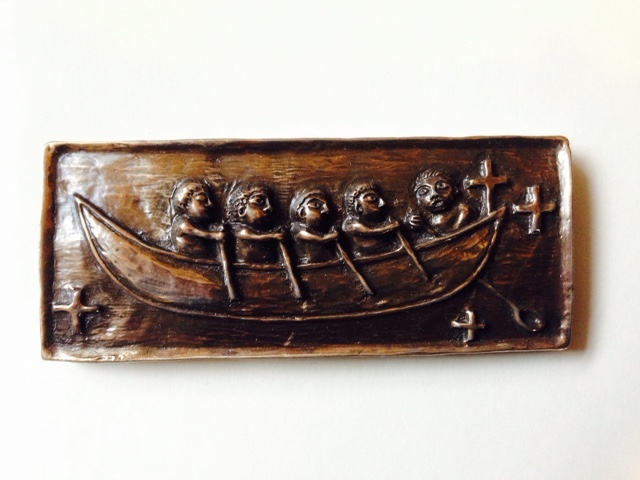
I also used boats – origami on seats as people arrived, and the invitation to write a prayer for a person they came to support, or for their own journey. And during the final song, people could come and sail them on the pool that had been made at the front.

Being my last Sunday, I wanted to remind Opawa of our journey mission. Again, not very “unchurched” friendly. But it’s not every day you conclude six years of ministry in a pretty major change project.
So for those interested, here is what I said in terms of mission, church and change. Not attractional, nor super-Christian, simply …. (more…)
Tuesday, December 01, 2009
advent blessings as spirituality to go
Following on from some excellent feedback on some advent creative prayer stations, here are four more, that could easily be home-based, during the week Advent activities. Again they sync with our Advent 2009 theme of blessings.
ADVENT ONE: Choose white candle. Mark 24 notches in it. On a piece of paper, or in your journal, write the names of 24 people or places you want God to bless this Advent. Burn one segment a day.
ADVENT TWO:Each day this week, take a can of food out of your pantry. Read the labels. Consider who made it. What will Christmas be like for them? This Advent, what might it mean for you to join with Christians who pray the Lord’s Prayer: “Give us this day our daily bread.”
ADVENT THREE: Make a list of your enemies. It might be someone who has hurt you and it still gets to you. It might be someone in the Christian community you disagree with, or a political opponent or someone you feel ripped you off. Place their names carefully in a blessing bowl, as you do imagining that you are letting them go by placing them in God’s hands.
ADVENT FOUR: Take some time to consider joy this week. Start by finding some bubbles. (If you don’t know, ask a child). Use the bubbles to pray. What words describe their shape, their colour, their flight? Blow these prayers on yourself. Blow them on the places you sleep and eat. Blow them on your pets. Be bold and blow them down your street.
Wednesday, November 11, 2009
Sharing faith across cultures
A reality of our times is that we live in a pluralistic world. This has been incredibly important in sharpening how we think about other faiths. We live between two (unhelpful IMHO) poles: silence, in which a person is too scared to share the sacred story of God’s work in their lives and hostility, in which the way a person shares is rude, intolerant and antagonistic.
These poles apply to all faiths. I sat in a taxi a few weeks ago in Australia. When I mentioned I was a church minister, for the next 40 minutes the taxi driver lectured me on his faith. He was struggling with the two poles, not wanting to be silent, but in his monologue, ending up rude and intolerant.
Richard Sudworth is a CMS missionary, working in a Muslim majority part of the (English) city of Birmingham. He is part of a Christian-Muslim Forum launched their “10 Commandments of Mission”, offered as a conversation starter in an attempt to establishing honest and workable relations between faiths that allows for freedom of conscience.
Here are their 10 commandments of Mission.
1. We bear witness to, and proclaim our faith not only through words but through our attitudes, actions and lifestyles.
2. We cannot convert people, only God can do that. In our language and methods we should recognise that people’s choice of faith is primarily a matter between themselves and God.
3. Sharing our faith should never be coercive; this is especially important when working with children, young people and vulnerable adults. Everyone should have the choice to accept or reject the message we proclaim and we will accept people’s choices without resentment.
4. Whilst we might care for people in need or who are facing personal crises, we should never manipulate these situations in order to gain a convert.
5. An invitation to convert should never be linked with financial, material or other inducements. It should be a decision of the heart and mind alone.
6. We will speak of our faith without demeaning or ridiculing the faiths of others.
7. We will speak clearly and honestly about our faith, even when that is uncomfortable or controversial.
8. We will be honest about our motivations for activities and we will inform people when events will include the sharing of faith.
9. Whilst recognising that either community will naturally rejoice with and support those who have chosen to join them, we will be sensitive to the loss that others may feel.
10. Whilst we may feel hurt when someone we know and love chooses to leave our faith, we will respect their decision and will not force them to stay or harass them afterwards
Now, I want to place this alongside Luke 10:1-12. Jesus sends disciples out in mission. They are not to be quiet. Rather they enter the culture with the instruction to speak “peace.” This fits with (1) and (7). It also is an endorsement of (8), in that it names faith clearly.
If peace is returned, then the disciples are to dwell at table, eating and drinking what is placed before them. This seems to me to fit with (4) and (5). The disciple is placed as a receiver of hospitality, depend on the culture. As such, they must be willing to do (6), to find ways to name the Kingdom in ways congruent with table fellowship. It also allows due care (9), to occur in a natural and relational way.
If our message is rejected, the disciples are to leave. Mission is not coercive and does not overstay it’s welcome. It retreats when it is not wanted. Reading Luke 10:12 can sound judgemental, but when placed alongside Luke 9:51-56, it suggests a willingness to let go in gracious humility. This fits with (3). It is also essential to (10).
Essential to Luke 10:1-12 is the fact that the disciples are sent ahead of Jesus, yet reliant on the work of the Spirit in order for hospitality to be enacted. This fits with (2).
Or, in the words of An Introduction to the Study of Luke-Acts

“From this description of mission ‘strategy’ we could not possibly draw the notion of domination in any way.” (89) and “It is a mystery how this sense of the text could have escaped colonialist-minded missionaries. The idea of imposing a Christian culture on a receiving culture is foreign to this text.” (90)
People used to being in control, at the centre of a culture and a conversation (whether Christian or Muslim) will not find this easy. However, our Biblical story, the narrative of Luke 10:1-12, offers us resources. So “Lukan/Biblical” applause to Richard Sudworth and the Christian-Muslim forum for finding a creative way beyond those two poles of silence and hostility.
Wednesday, October 21, 2009
emerging adults and emerging church
Christianity Today has a feature “Lost in Transition“, exploring emerging adult research and a new book, Souls in Transition: The Religious and Spiritual Lives of Emerging Adults, by sociologist Christian Smith
The missiologist in me wants to be asking if churches in Australasia (having watched today this TV program regarding the future of Sydney Anglicanism) currently strong in young adult ministry are actually only more likely to be targetting/reinforcing belief among say the Traditionalist.
Here were some quotes that struck me: Firstly in response to the question: Do emerging adults like the emergent church?
The bottom-line answer is yes. Emergent churches are on to something that seems to connect better with this wave of young people … Where it exists, your average emerging adult would find it more intriguing and more engaging than a traditional approach. But I would caution that emerging adults are smart about when they are being marketed to. So if the emergent church doesn’t offer something genuinely different from what emerging adults have too much of already, they’re not going to give it two seconds of attention.
Second, the essential role of parents in faith development.
The most important factor is parents. For better or worse, parents are tremendously important in shaping their children’s faith trajectories.
Third, the need for churches and leadership with creativity and imagination!
To connect with emerging adults is going to take more creativity and initiative than I see at the moment.
Friday, September 25, 2009
mission as climate change
My half day with the South Australian Baptists went well. Good questions, engaged group, good energy. I essentially talked about the Opawa story and the changes the church has been through, framed with a context of mission and change. I felt like it was my best attempt yet at telling the Opawa story in terms of frameworks of mission and change and this was most probably because I test drove two new frameworks.
Firstly, the concept of micro-meso-macro climates. It is a term I learned in my initial horticulture degree, which I have since taken and applied to mission and change. The idea in horticulture is that a fence, or some shade cloth can change the micro-climate of an environment. So can a set of hills or a river (meso-climate). So can a mountain range (macro-climate). In sum, the environment of a place is affected by all three aspects – micro-meso-macro.
 So, in terms of church, I asked each person to think about their “micro” climate ie the 5 blocks around their church. We then listed those on the white board and instantly, visually, we could see very different and diverse climates are at work. They then told me, as the outsider, about the “meso” climate of Adelaide city, before I told them about the macro-climate that is the post-… West. In sum, the task of being leaders today is affected by all three aspects – micro-meso-macro. And so the wise leader sets about understanding all three climates as they embark on the change and mission journey.
I suspect that setting out this framework thus meant that as I told the Opawa story, they were hearing the story sensitized not just to the challenge of post-… mission, but also able to do the translation work because Opawa has a unique 5 block “micro” climate, in terms of the history of the church in the area, and the demographic of our community.
Second, I used a change diagram from Leading Congregational Change : A Practical Guide for the Transformational Journey
What I find helpful is this: that it says – yes, we have to understand the sociological dynamics of change. Equally, such processes must be accompanied by a set of spiritual practices through which our Christlike character is shone, and based on a clear theology of change. It is an integration of best practice, Christ-like spirituality and Christian understandings of who is God and who are humans? All of which then provided a helpful framework by which to unpack the Opawa story.
All in all, an enjoyable half day, followed by a most stimulating lunch with the state-wide leadership team. How do we develop new leaders? What is the place of creativity in leadership? Can it be taught, or is it a gift? How on earth does a missional theology of missio Dei shift from head to hand, from theory to practice? A most stimulating day.


 )
)