Saturday, June 19, 2010
Fresh expressions formalised in South Australia: updated
Exciting weekend here in South Australia, with the Uniting Church Synod (council of all Uniting churches in South Australia), voting to accept a number of resolutions including the following:
- develop Fresh Expressions and Church Plants throughout South Australia
- develop a network/community of Pioneer Ministers
- ask the Uniting College (of which I am a part) to take the lead in developing training for Pioneer Ministry, both for lay people and for those wanting to live out their ordination as Pioneer Ministers
(Updated: full resolutions here)
So there we are – a church denomination making Fresh expressions a priority, and formally charging it’s training arm to train pioneer leaders.
It dovetails beautifully with the fact that as a Uniting College staff, we’ve been putting in hours of work in the last few months into developing a unique pathway by which to train pioneer leaders. This will be as part of our new B.Min degree programme. If our application is successful it will mean we are offering two training paths. One path will be a more conventional mission and ministry degree.
The other path will also offer a B.Min degree, but with a focus on innovation and pioneering. It will offer learning by doing, in situ in a fresh expression, observational intensives so people can broaden their vision and practice of ministry, expect mentoring – both individual and in community – along with integration through study in areas of leadership, mission, Bible and Christian discipleship. So if you sense God calling you to train as a fresh expressions pioneer leader, we at Uniting College just may be able to help you.
All quite exciting.
Wednesday, June 16, 2010
faith outback: planting rural fresh expressions

The feature story in the Australian Outback magazine (June 2010) is titled Faith:Belief in the bush. It’s pretty hefty – 22 pages – and explores how people have coped with the adversity of recent drought. There’s an appeal to a faith rooted in land and that is sensitive to indigenous issues. And all as the lead article in a commercial magazine. Secular Australia? Really?
There’s some challenges to theology.
For rural Australia to succeed and grow we need people who are prepared to take risks and try different approaches. Faith can be a huge driver for change. Equally it can be a form of avoidance. There are some who put all their faith in God or industry leaders to fix the problems. Having faith in yourself, your family and your community means accepting that you are accountable. Cheryl Philips.
There’s a nice nod to fresh expressions – rural style – including the rise of lay ministry, discussion groups and home churches.
For rural people, having their lives enriched spiritually through their relationships with others is where it’s at. If that leads to going to church, then that’s an added benefit. The church now wants to be a legitimate working part of the community. Ross Neville, Uniting church rural consultant.
A few weekends ago I taught at a lay training event called Grow and Go. My topic was Mission-shaped community. To break up the monotony of Steve Taylor talking for 8 hours, each person was given an overhead projector acetate. Each acetate had the following headings:
- A new insight:
- A new idea and/or resource:
- An inspirational story:
And I spread a whole lot of resources around the table – short articles, booklets, a few computers with websites to browse. The group had 30 minutes to browse, read and fill in the acetate if they found a new insight, idea or story. And then we had a great reporting back session – various ones sharing with the group a resource they had discovered. The most popular resource were those I dug out on rural ministry. Like the Grove Books – a veritable treasure trove – for example some of these. Rural ministry in Australia dying? Really?
Tuesday, June 15, 2010
developing change leaders book review – Ch 5 Building a Change Leadership Culture
A book review of Paul Aitken and Malcolm Higgs, Developing Change Leaders: The principles and practices of change leadership development
“we need to depersonalise and decentre the leadership concept, so that we begin to perceive leadership as a co-operative or collective enterprise.” (93-93, quoting Bate, 1994, 242).
This is a crucial chapter, providing a framework by which to develop change leaders. This chapter explores the shift from “I” to “we”; from individual change managers to “leadership culture.” It calls for a “walk the talk” in which leaders make clear the links between what they do and their underlying values. “Whilst heroes can carry the day in times of crisis, building a sustainable culture of innovation, excellence and achievement requires a collective and distributed, as opposed to individualised and hierarchical, leadership mind-set and approach.” (103)
Research into “leadership culture” is rare, with a lack of clarity about how values of individual leaders translate into action. How to influence a culture? There are many options, including directing attention to priorities, reacting to crisis, creating formal statements, telling stories, symbolic acts, design of work facilities and processes, rewards and sanctions, methods of decision-making. But which to use and when? They suggest a mix of the following (112):
- role model the future, every day and in every way
- foster understanding of changed expectations and their purposes
- find and develop the ‘new way’ values, capabilities and behaviours
- reinforce future state with formal and informal culture signals
This includes some practical steps
- appreciate that change is complex. It must be embedded in behaviours and run across the organisation, not top-down
- make modelling a priority
- build in feedback loops (this is critical including “experimental, case study and real life observation of leadership” (114)
- build team by creating an open table in which to discuss the real values of the organisation
- creating a culture development plan
- identifying key behaviours that have the best chance of making a difference
- seeking out and developing change leaders and followers who represent your future
The more I read this book, the more impressed I am. The mix of research, concise summaries, diagrams and practical examples is appealing. The use of a strong values basis makes it much more likely to transfer to religious contexts. I suspect it will provide a fascinating way to discuss leadership development ie training of Christian ministers.
Tuesday, June 08, 2010
resourcing missional church
I concluded my missional church leadership class yesterday with the following ….
MISSIONAL COMMUNITY…SIMPLE from jeff maguire on Vimeo.
It’s from the website saying it simply, (hat tip Bosco Peters), who have the goal of tackling “new topics, concepts, or ideas that need to be explained simply.”
The class chewed their pens for a minute or two. And then came the money question: How did Jesus resource the 70/72 to be missional community? Great integration, the student taking the video clip to theology, in particular the missional theology embedded in Luke 10:1-12, Jesus sending disciples out in missional community. (Sermon on Luke 10:1-12 here if you want some more framing).
It is simply too good a question to answer immediately. Sure I’ve got some ideas, and some practical examples from 6 years at Opawa. But some questions need to sit. So instead I suggested it become our homework question. 200 word responses over the next 10 days please and I’ll collate them for next time we meet.
Want to be part of the fun? Got some cyber ideas for my class? 200 word maximum in the comments please: How did Jesus resource the 70/72 to be missional community
Wednesday, May 26, 2010
developing change leaders book review – Ch 4 A Values Dialogue for Change Leaders
A book review of Paul Aitken and Malcolm Higgs, Developing Change Leaders: The principles and practices of change leadership development
The chapter starts by marshalling a wide range of evidence for the importance of values in change leadership. “The management focus for the first part of the twenty-first century will be the management of meaning through the demonstration of values in management behaviour.” (62) The authors urge that selection of change agents include values, as well as experience and competencies.
They suggest a diversity of values are at work and offer some categories (77-81) by which a leader can assess their organisation and how their individual values might mesh with that of their organisation. (Anyone like to locate their church, and their leadership training, in relation to the grid?)
- Clan. Family type organisation, (often seen in Japanese companies). Key word is collaboration. Values commitment, communication, development. Leader type = facilitator, mentor, team builder.
- Hierarchy. Key word is control. Values coordinator, monitor, organizer. Leader type = efficiency, timeliness, consistency.
- Market. Key word is compete. Values hard-driver, competitor, producer. Leader type = market-share, goal achievement, profitability.
- Adhocracy. Key word is create. Values innovation, transformation, agility. Leader type = entreprenuer, innovator, visionary.
And the implications for change leaders? “leaders have to learn to communicate purpose and direction with a whole culture made up of different personal values, concentrating on shaping informal organizational life (emphasis mine). We might call this ‘strategy by the coffee machine’, consisting of dialogue about what we are told we should be doing, what are leaders are actually doing and how we feel about joining them to make change happen.” (82) “Effective change leaders must continually check what their heart, head and hands communicate.” (83)
Sunday, May 23, 2010
where does the hope come from? words of mission in mission
Today is a transition day – flying from Maroochydore to Bathurst via Sydney; from Queensland Synod lecture to working for with New South Wales ELM centre (lay ministry training); from one-off talk to two days of rolling conversation around the theme of transformers.
Last night I talked with the Queensland Synod about a word of mission. (Update: summary and even audio are here).

It’s a (neglected?) part of Uniting church worship and I used it as a framework to explore my ministry experience with Opawa Baptist. What were the words of mission in our change process? What did we do in actual ministry practice as a result of those words of mission? What were the leadership understandings that helped our journey?
So I looked at
- the Pentecost story and the word of mission in Acts 2:6 people hearing “in their own language and how that helped shape our multi-congregational model.
- and the Parable of the sower (I used a children’s book, Bodge plants a seed, by friend Simon Smith as a encouragement to lead by nuturing green shoots
- and the story of Mary and Elizabeth, as a word of mission to Elizabeth’s to speak words of courage and life to the new things of God in our midst and for the church to be open to the unexpected innovation from Mary’s
And I reflected on the leadership understandings
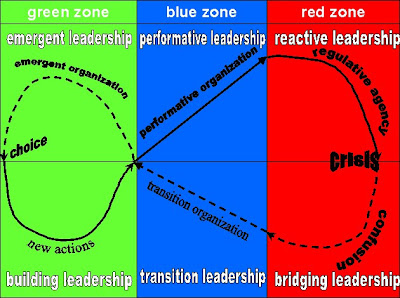
- Roxburgh and Romanuck – organisational development diagram
- leadership as process and verb, not position and noun, and the 2009 NCLS resources that let us build leadership teams and invite us into shared processes.
At times as I spoke I felt that my attempt to weave the word of mission and the ministry practice and the leadership lessons were too ambitious for an hour lecture on a Saturday evening after a long day. I wished I could have been clearer, but alas, it is too late once one is speaking! And my powerpoints were not good enough. However, there was good group interaction and some thoughtful questions and some fascinating after-ward conversations.
May God’s peace rest upon the Queensland synod.
Friday, May 14, 2010
mission-shaped “Grow and Go”
One of the things that appealed about becoming part of Uniting College was their intentionality in training the whole people of God. It is this weird tension where one expression of ministry is more formal than in Baptist circles, and thus has more formalised training pathways. Which then leads to a deliberate focus on all expressions of ministry.
Which means that this weekend is the annual “Grow & Go” training weekend. Training for the whole people of God. Their is a key note address on the Friday. Then nine learning streams – all day Saturday and Sunday afternoon. Shared breaks mean lots of chances for mixing and networking. People are coming from all over South Australia.
This type of thing is a pastor’s dream – every year heading off with leaders, to train and encourage and inspire them – to build shared memories – to invite potential leaders. The trip back, dreaming together with new insights, ideas, resources and inspiration. Every year, building lay capacity. Superb opportunity.
This year the theme is ‘being a mission-shaped church’. If God’s purpose of redeeming and renewing the world brought the Christian church to birth, what does it mean for mission to be at the heart of who we are and what we do as the people of God?
I’m leading one the nine streams, exploring mission-shaped community. (Others are exploring themes like mission-shaped leadership, mission-shaped community, mission-shaped worship, mission-shaped preaching, mission-shaped witness etc.)
So I am using the NCLS framework:

and will focus on the Inspirational qualities – of vision, leadership, innovation, and the Outward qualities of service, faith-sharing.
Friday, May 07, 2010
mission that’s out of the valley 4: grounded in a local church community
(Last post in this series I promise. For the introduction go here, for the motivation go here for the material go here.)
5%.
Last week I blogged the fact that according to 2006 National Church Life Survey data, only 5% of Uniting churches had offered significant training at a congregational level for lay people in evangelism.
5%.
That’s not many. Which got me thinking about my ministry. You know, the old “reality” check – was I a leader in a community practising what I was/is preaching? So I shuffled through the following dates ….
2004 – Evangelism as process – I preached 2 sermons on the topic of evangelism. A good deal of energy resulted. A church community forum was held and as a result a number of new community contact initiatives were launched – including Koru, a youth programme and a family film night.
2005 and 2006 – Opawa’s energetic Evangelism Ministry leader, Hugh, used a video series to offer training in faith sharing. This happened once in the church foyer and a second time in a local home group
2007 – God at work – a 3 week course on “Where is God on Monday?” run by (then) Anglican ministry candidate, Nigel Wright, all the way from UK. About 25 Opawa folk participated, reflecting on being salt and light in all of life. As a result a God at work group formed and met regularly, keeping each other accountable in this area of faith-sharing mission.
2008 – Biblical pictures of witness – A four week preaching series that explored the themes of
- being a mate – sharing with friends
- having a yarn – announcing the good news
- crossing the ditch – incarnational mission
followed by Wednesday evening discussion evenings. (For more, see here.)
2009 – Mission collectives, including the living collective. This meet four times a year, led by a lay person, in their workplace, (See here for an overview and here for an example of a night). It sought to offer encouragement, resource, prayer, ideas in terms of faith sharing.
Why blog this?
First, it’s a list of dates that I found mighty encouraging, because it shows a regular, year by year commitment, to encouraging and resourcing faith sharing.
Second, it illustrates one way to look at leadership, not as a linear process, but as a spiral, rotating around certain themes. Hopefully not a rut! but a spiral, building on what has gone before, learning from the past, recircling to allow new people to join, unavailable people to check in.
Third, it’s just one embodied example of what encouraging in faith-sharing can look like in a local community context.
Fourth, I hope it might spark you to think about what has happened in your context. Let’s share our ideas. What things have you seen done, or been part of, that would be ways to get beyond that 5%?
Tuesday, May 04, 2010
mission that’s out of the valley 3: evangelism as mission
- being a mate – sharing with friends
- having a yarn – announcing the good news
- crossing the ditch – incarnational mission
(These are highly Aussie phrases and they came to mind while reading Darren Cronshaw’s most excellent Credible Witnesses, Companions, Prophets, Hosts and Other Australian Mission Models, Urban Neighbours of Hope, 2006, and that give shape to the most useful Picturing Christian Witness: New Testament Images of Disciples in Mission
Being a mate – sharing with friends
Look at how people find Jesus in John 1. It’s through friends – Andrew, Philip – who simply invite people to “see.” So mission that’s out of the valley starts with inviting people to see lives changed. It’s not words, but seeing lives changed.
And so a discussion question: How were you evangelised? How do you feel about that now? A chance to remind ourselves that overwhelming the gospel is transmitted through relationships. Equally a chance to share negative stories and so detox ourselves from
Having a yarn – announcing the good news
The book of Acts is interesting, for a third of the content is public speeches. There are 20 speeches in total and grouped together, give us a window into how the early church had a yarn/announced the good news.
An extremely useful exercise can be to place them alongside each other. Take Peter in Acts 2, Paul and Barnabas in Acts 14, Paul in Acts 17. Look at what resources they use in announcing, consider their punchline and analyse the response.
What do we learn? That there is no one way to announce the good news. The content changes, the resources used range from Scripture to creation to contemporary culture.
In other words, having a yarn is not about dropping a body of content on someone, it’s about starting with what makes sense in their world. This for me is where the gates of the cross becomes so useful.
For discussion: Does any gate make sense of how you find God? Or do you need another, 11th gate? Share that with the person beside you.
On Saturday a great burst of noise arose, as people shared how God found them. And I had great joy in giving them feedback: I see a whole bunch of people announcing the good news, in ways uniquely appropriate.
Crossing the ditch – incarnational mission
When I read the Zaccheus story I realise that mission happens in Zaccheus house. It is so easy to get caught up in thinking that mission is about people coming to us and our (church) space.
Mission as crossing the ditch is about going to Zaccheus home. Hang out with Zaccheus mates. We form a church at Zaccheus place, not our place. This changes the way be a mate – We join Zaccheus youth group. This changes the way we announce the good news – we start with what God is doing in Zaccheus world.
And if you want a contemporary example, check out the work of Richard Passmore, working with young people outside the church. (Hat tip Jonny Baker). He depicts mission as crossing the ditch in 5 stages:
- A Contacting Community – Through detached youth work
- A Growing Community- Through ongoing contact and residential
- A Connecting Community – Through undertaking a rite of passage committing to journey together
- An Exploring Community – Through connecting stories and life
- An Ecclesial Community – Through living together with a missionary DNA
And for a powerful example of announcing the good news in this context, check out his story of Abs and Flow. It’s a superb example of post-Christendom, Western, contextualisation.
My next post is about how this works in an ordinary congregation ..
For earlier posts in this series on mission that’s out of they valley, go here
Friday, April 30, 2010
mission that’s out of the valley (1 of 4)
Updated: for what I said –
1) in relation to mission motivation, go here,
2) in relation to faith sharing, go here,
3) in relation to practice at an ordinary church, go here.
I’m speaking to youth leaders from around Adelaide tomorrow, at a training day called Out of the valley. I was asked to speak about mission and as I’ve been reflecting, I want to focus on the sharing of faith. More evangelism, but still a subset of mission. I hope to do a number of things
- free people from a 1 size fits all understanding of faith sharing
- help people grasp more of God’s story
- help people find their own unique story within God’s story.
(Update: according to 2006 National Church Life Survey data, the denomination least likely to have offered significant training at a congregational level for lay people in evangelism is .. yep, you guessed it, the Uniting Church! Only 5% of congregations in the last 2 years said they had offered congregational training in evangelism.)
Below is one of the tools I’ve just been working on. It offers 10 different ways people might understand the gospel. It’s based on Understanding the Atonement for the Mission of the Church
What I hope it does is help people find an echo of their story and a way to link their unique story with a Biblical frame. I’ll let you know how it goes, but if you have time, I’d love to know which statement which might describe your experience. (For me it was, and is, the peace gate). If none do, can you sum that in a few sentences. (more…)
Wednesday, April 21, 2010
developing change leaders book review – Ch 3 What does it take to lead?
A book review of Paul Aitken and Malcolm Higgs, Developing Change Leaders: The principles and practices of change leadership development
Chapter three explores what is required to lead change effectively.
One helpful insight is the fact that they need to be able to operate both on the church and in the church, to both performing public skills (ensuring existing functions like preaching, pastoring and organisation) and backstaging (engaging support, working with resistance, influencing the future).
Key phrases keep appearing – “deal with ambiguity” (44), “deal with ambiguity, paradoxes and dilemnas” (45), “facilitative and engaging practices” (55)
The danger lights, especially in regard to some existing church change process, are there if we want to pay attention:
“Might not the continual search for the hero-leader be a critical factor in itself, diverting attention away from building institutions that by their very nature, continually adapt and reinvent themselves, with leadership coming from many people and many places and not just from the top. (45 citing Senge 2002, 64)
When, oh when will the church get over the search for the one dynamic, command/control type leader. When will it realise that their is no magic bullet, that leaders need “not follow a set or common approach to the overall change implementation process.” (49) Instead: “It is only by learning new things about ourselves, our relationships with others and discovering new ways of seeing reality that we can start to implement new [business] practices” (49)
Research of 84 leaders shows “that effective change leadership requires the leaders to have a high level of Emotional Intelligence.” (50)
Over 100 change leadership stories (when, on when might the church collect 100 change stories and use them as one of the data sets for reflecting on leadership. Could we be part of this with the Master of Ministry), showed three broad groups of behaviour, and a subset of behaviours:
- Shaping behaviour – lead by example, expect hard work and enthusiasm, personally persuasive, expecting accountability.
- Framing change – working with others to create vision and direction, explaining, educating and communicating on need for change, giving freedom for innovation within broad frameworks, changing how things get done as well as what gets done
- Creating capacity – developing the skills of others in implementing change, offer feedback and coaching, working across the organisation at all levels, ensure adaptation of reproducible systems.
The change stories indicate that while directive type leaders focus on the first, shaping behavior, this actually negatively reduces the likelihood of change. Yep reduces! By contrast, it is the last two – framing change and creating capacity – that bring long term change.
This data was reduced to four core change leadership principles:
- attractor – creates energy for change by connecting with others emotionally to embody the future, creates compelling story, weaves it to make sense of the life of the organisation, seeks good of the organisation above their own, able to adapt their leadership
- edge and tension – amplifies disturbance by telling truth, is constant in tough times, challenges assumptions, stretches people, grows talented people
- creates a container – holds the tension around the change by managing expectations, faces conflict, encourages, creates safe space to take risks, seeks alignment of resources
- transforming space – creates movement by showing commitment, is vulnerable in a way that frees people to new possibilities, breaks existing patterns and challenges systems.
I’ve just spent 3 days and over 20 hours with 15 students. The topic was change and the leadership question sat with me all week. How to develop these people? How to best use the time? Was this the best use of my time? Should instead have been researching change stories? offering ongoing and longterm coaching with a few leaders?
The next chapters might answer these question, as they will turn to explore how to develop change leaders.
Saturday, April 17, 2010
developing change leaders book review of chapter 2
A book review of Paul Aitken and Malcolm Higgs, Developing Change Leaders: The principles and practices of change leadership development
Chapter 2 The Challenge of change
This chapter explores the challenge of change. It provides a helpful diagram, linking change to what looks like a grief cycle – shock, anger, resistance, acceptance, hope. As with grief, people need time.
This includes noting the potential of resistance:
“Whilst resistance is generally perceived as being a negative within a change process, it is important to consider that resistance can be an indicator that change is having an impact. Furthermore, it surfaces the key issues and concerns which need to be addressed in order to ensure the effective implementation in the long run. Finally, resistance can play a positive role in surfacing challenge and insights which can prove beneficial in achieving the change goals or indeed discovering more appropriate ones.” (31)
Of course, to respond to resistance in this way, and be able to surface such positive possibilities for a change process requires a fairly unique skillset, far removed from “Well, this is what we have decided.”
It also depends on the approach to change, of which 5 are noted:
- Directive: the leader’s right to impose change, which has the disadvantage of breeding strong resentment
- Expert: generally applied to more technical problems, in which a specialist team leads
- Negotiating: accepts that those involved in the change have the right to a say in how the changes are made. It takes longer, but equally is more likely to last longer
- Educative: changing people’s hearts and minds. Again, takes longer but is more likely to last
- Participative: while driven by leaders, all views are considered as change occurs. Again, takes longer but has far greater by in.
They note the shift from linear and programmatic notions, to emergent notions of change, characterised by the appreciation of the entire system, the acceptance that change can start anywhere (and the larger the system, the more likely that large changes begin at the edge), leaders as facilitators instead of drivers of change.
They then analyse over 100 change stories to conclude that change was successful when:
- it was understood as complex
- processes were used that genuinely involve people
- change leaders have the skills to involve people.
Friday, April 16, 2010
re-framing the prodigal in regard to fresh expressions and established church
Ben Edson has re-written the parable of the Prodigal son/Waiting Father/Faithful son/absent prodigal daughter (choose your title with care, because each character opens up a different interpretive lens).
There was a mother who had two sons. The youngest one said to his mother, mother thanks for the years that you’ve looked after me, thanks for all that you’ve give me, but I think that you’ve got it wrong. I’m going to take all that I have inherited from you and go off to country foreign to you and experiment.
After being away for sometime the younger son started to recognise that he had been foolish and needed the love and support of the mother. He decided to go home back to the mother. He would say to her: I am sorry that I left you, your resources are so diverse, I miss you and I want to be part of your family.
The first part is here. The conclusion, offering 3 alternative endings
- the institutional church’s slow grinding to death of innovation
- the arrogance of fresh expressions
- an embrace between margin and centre
is here. It’s a wonderful example of re-framing and re-creating, and a fascinating use of Scripture.
Initially I loved it, the creativity, the multiplicity of endings. But now I’m not at all sure. When I have the words to name my unease, I’ll try to complete this post by explaining why … (more…)
Thursday, April 15, 2010
fresh expressions regenerate discussion
re-generate is a series of pub conversations, begun in the creative mind of Craig Mitchell, providing an interactive space around the meal table for those wanting to be involved in being church that is thriving and connected to the culture. (I’ve been the speaker at a couple here in Adelaide, then hosted another with Jonny Baker in March).
There was another on Monday night, not with a speaker, but an open invitation to any Adelaide locals who have begun to create or lead a fresh expression, those who have an urge to do so, and those who have an interest in this movement to come and share their experiences and dreams.
About 20 people gathered. Over food we shared what had drawn us to the table. As the night evolved it seemed there were two groups of people: those looking for ideas or stimulus for their life of their congregation; and those already engaged who want to wrestle with issues like funding, sustainability, the journey to faith, developing leaders, etc.
The upshot was enthusiasm to begin a series of regular pub conversations based around participant questions (people add their questions to a bowl from which we could draw a topic for the following gathering – wonder who suggested that idea :)).
The next one is planned for early June (details coming) and will focus on two issues
– how to fund a fresh expression
– how to sustain a fresh expression
The hope is that it’s not just Uniting church and perhaps the fact that it’s question based from those who gather will help to include other denominations.
It was an exciting night to be part of!


 )
)