Tuesday, February 21, 2012
msm Adelaide final “report” in video format
Mission shaped ministry Adelaide. 40 folk from three denominations gathering over five months to reflect on mission and spirituality today. How did it go?
Well, we asked participants that very question on the last night and here’s the result: a final “report” not in words, but in video.
Also wondering if this might serve to promote mission shaped ministry throughout Australia – it’s a first being with Australian rather than British accents :).
Big thanks to Stephen Daughtry who gave his time to shoot and edit.
Monday, February 20, 2012
a Perth artists describing of mission?
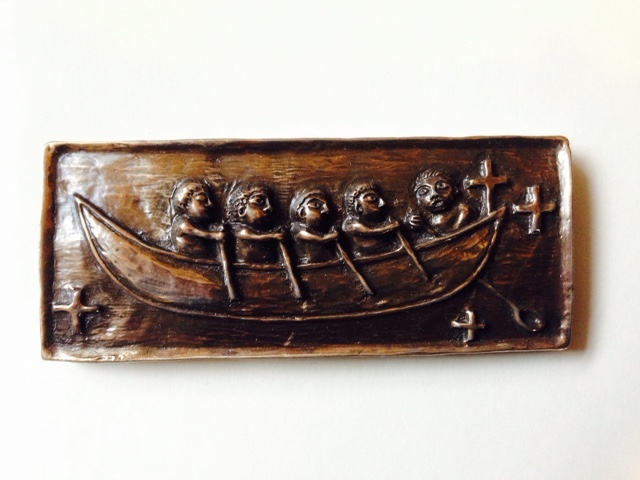
 This wooden plate was a gift from the folk in Perth, a thanks for my input. It is made by artist Tony Docherty, who works with native Western Australian timber. Here is part of the artists statement:
“To transform this salvaged or discarded material into practical objects or pieces to please the eye and lift the spirit is my passion and joy.”
Isn’t that mission?
That we as individuals and as communities are called to attend to what is discarded. We can’t transform. Nor can we grow. But we can be part of processes that help draw forth the natural beauty, the God-placed grain that is in all human life (Genesis 1).
In so doing, we find joy. Thus mission is so much more than an act of obedience. It is an invitation to joy, to being part of God’s transforming processes in the world.
Thursday, February 02, 2012
a day’s retreat with Uniting world
Today I am spending the day with Uniting World, who are the overseas mission arm of the Uniting Church of Australia. My task is to input into the 19 staff, who have gathered on retreat. (It means a long day, as they are meeting in Sydney, so a 5 am start, back in Adelaide by 7 pm).
I think I will frame my time with them around two questions.
First, what do we do with the word “mission”? I will tell a couple of stories that might be a window into the current mission state of the Uniting Church. One will reflect on how church folk are shaped today by their previous experience of mission, the other on our tendency to reduce mission. I hope that will provoke some discussion on how we frame, imagine and talk mission today.
Second, I will ask them about the Uniting Church Preamble, and what is the missiology embedded in it, and what that might mean.
I also have some global mission stories, which I have prepared as takeaway postcards, along with some recent non-Western mission thinking, which perhaps I might salt through the conversation.
I am not at all sure what and who I will find, and my brief has been fairly vague. So I’m feeling a tad nervous, but am praying that some connection points get made and that we all leave a little richer.
Wednesday, February 01, 2012
Is it time to change the word “mission”
Let me give one story. Last year I worked for a year with a local church. This involved meeting 4 times with their leaders, preaching once, designing for them some Lenten listening-in-mission exercises and facilitating two forums.
In other words, quite some time.
As the year ended, I asked for an informal catchup, a chance to reflect on the year and what had worked, and what had not.
During the conversation, one of those present suddenly exploded. “I have no time for this black arm band stuff,” he announced. And out poured a long passionate speech, about how busy he was, about how much he prized good relationships with his neighbours, about how there was no way he was going to tell them they needed saving, about how talking to them about god in the hope of getting them church to grow was a sick motivation for being a good neighbour. It was a passionate, articulate speech.
Given that I had preached on mission, I asked him if that was the type of mission he had heard me articulated. When I preached, I had used Luke 10:1-12.
- Who is God? the Sender.
- Where is God? in 3 places. First in the church, second in the towns and villages of our communities.
- What is God up to? seeking relationships, speaking peace and in the seeing of lives changed.
I thought I had done my level, preaching best to offer a contemporary understanding of mission – God is at work in the world and we are invited to participate. Here’s an excerpt from the sermon:
So mission doesn’t starts with us. Not our bright idea. Not something we do because we need a few more people to join our church. It’s simply because God is sending God. Who chooses all types of ordinary, everyday people.
So mission doesn’t starts with us. Not our bright idea. Not something we do because we need a few more people to join our church. It’s simply because God is sending God. Who chooses all types of ordinary, everyday people.
But the stereotypes, the previous bad experiences, seemed to loom to large for what I said to be heard.
Hence my question: Is it time to change the word “mission.” Do we keep trying to redeem the word? Or is it so damaged, that we need to find a new word, a new language?
Thursday, January 26, 2012
a white dove on Australia Day
As I walked outside today, Australia Day, I encountered a white dove. (Australia has over 20 types of pigeons and doves. It looked like a Pied Imperial Pigeon, but they are meant to be in the north of the country). I stopped, hoping it might come closer. Slowly it walked toward me, head cocked. It got to within a feet. I could see it’s dark eye, carefully studying me. Slowly it circled in front of me, and then slowly walked off.
It felt profound. Christianity has a long history of paying attention to animals. In Matthew 6, Jesus invites his disciples to learn from flowers and birds. Saint Cuthbert had many God encounters through animals (For more, see St. Cuthbert and the Animals’
Today, this dove offered me trust, responding to my newness, my largeness, my stepping into their world, with an open curiousity about who I might be and how I might respond.
It spoke of how I would like people to treat, and be treated. That we would greet what is new and different with a simple curiousity, a coming closer to know more.
Yesterday, a speaker at the Storyweaving conference stated that “Australia is a country of strangers.” It is so easy when we encounter what is strange to laugh, giggle, spot the difference, seek to make them like us.
The white dove, today, on Australia Day, offered me another way of being in the world, in which we respond to what is new with a trusting curiousity.
(This is another entry in dictionary of everyday spirituality, under the heading W is for white doves).
Tuesday, January 24, 2012
the diversity of story weaving

The Story Weaving conference is one of the most diverse spaces I’ve been in. Of the 130 delegates, over 40 are indigenous. In the two days to date I’ve listened to research on indigenous theology from Canada, Samoa, Solomon Islands, India, Aotearoa New Zealand, while other streams have included work from Fiji, Philipines, Indonesia. I’ve shared meals with folk from PNG and the indigenous communities of Taiwan and built and renewed connections with various Uniting church leaders, including Congress folk from Tasmania.
The weaving metaphor has been great – we’re each unique and together, as we dialogue and engage, we find a fresh pattern. They even had folk actually weaving late this afternoon.
It’s been a really challenging time, so much stretch and stimulus. It’s a reminder of how much energy there is in the research scene in Australia and around the world. It has made me reflect on my childhood, the marginality of growing up a minority person in PNG and what it has meant to move countries in the last few years.
I’m not sure I’ve had the time to come (I’m meant to be teaching a 2 week intensive in early February), but I’m glad I have.
Wednesday, January 18, 2012
needed: 13 mission legends for mission trading cards
Who would be your top 13 mission legends?
One of my tasks in the next month is to write a distance topic – Equipping in Culturally Appropriate Mission – to help lay leaders of local churches engage in mission. It is my experience that one very helpful way to engage people in mission is to tell stories of people past. Something happens when the story is told of Brendan the Navigator, or of Alexandre de Rhodes pioneer leadership in Vietnam in the 1600s. It provides a glimpse of a way of life that values pioneering and risk and it seems to fire people’s imaginations.
So I thought it would be fun to make up some mission trading cards to give to each student. This would involve finding a helpful cartoonist to draw a picture on the front, provide some key data on the back, along with a further written resource. It would be tactile. It would be fun. Students could play with them. Or even compare cards with each other (give everyone 12, not 13), leading to them swapping them with each other if they want.
But first, I need to identify some “mission legends.” Who are they for you? Who are the people in history who challenge and inspire the way you do mission? In an ideal world I would like 13 legends, including 3 from Australia. They would also embrace the breadth of mission – including proclaiming, discipling, serving, enacting justice and social transformation.
(I did a similar thing last year, when I designed a distance topic on Jesus, and AKMA very kindly let me use his Theologian trading cards and the feedback has been very positive. In fact, it allowed one of the best moments of intuitive teaching I did in 2011, when, as a group of students articulated their “Jesus” questions, I was able to give each of them a different theologian trading card, saying “Oh, you should meet (x), they had a similar question to you and you might find them really helpful.”)
Thursday, December 22, 2011
a week’s work: communion in a world of hunger
Most of this week has been a writing week, preparing to speak at a conference on Post-colonial theology and religion in Melbourne later in January. My paper is titled – This is my body? A post-colonial investigation of the elements used in indigenous Australian communion practices – and over the week I’ve put together 4,800 words, which is a pretty good effort.
For those interested, here’s my introduction: (more…)
Friday, December 16, 2011
indigenous dreaming
I’ve had a rich few days that included time with local indigenous Christian leaders, talking and dreaming
- about ways that Uniting Church candidates can be exposed to indigenous culture
- about whether we as staff and students at College can be taught the Lords Prayer and Words of institution at communion in the local language (Kaurna), as a way to honour the traditional owners of the land on which College exists
- about urban field trips, Saturdays in which we drive around Adelaide, hearing the stories from Colebrook, and Lartelare Park
- initially for students in my Reading Cultures class, but why not as a sort of fresh expression for new migrants
- about shared theological projects, including communion and the missiology of the Preamble.
I have left these gatherings with this urge to take off my shoes, for I feel like I’ve been walking on holy ground.
Tuesday, December 06, 2011
public theology indigenous style: Rev Dr Djiniyini Gondarra
“You put it on the spoon and then you put it in my mouth. Like a baby”
You stole everything from us and then you say to us, live like a white man, think like a white man … You are setting the rules for my children.
Where is my liberty? Where is my people liberty?
Rev Dr Djiniyini Gondarra is a Uniting Church minister. Here he is addressing the Australian Labour Party national conference, responding to the ‘second Intervention’ otherwise known as ‘Stronger Futures in the NT’, a new Commonwealth Government initiative which will maintain key powers introduced through the NT Intervention. This message was screened in Sydney on Saturday December 3.
Friday, December 02, 2011
current Australian attitudes toward religion and Christianity
There is a great resource just out, exploring attitudes toward religion and Christianity in 21st century Australia. It emerges from Olive Tree media and is based on focus groups and a national survey of 1,094 Australians.
Almost half of Australians consider themselves open to religious change
Key obstacles are not around belief, but around behaviour (like abuse, hypocrisy, judging attitudes). For example, some 76% consider themselves repelled by church abuse.
There is a high quality, attractively presented four page summary here here, while the entire report, 32 pages, can be purchased from here.
It’s a resource I will be using it in my Reading Cultures class, and will be weaving the data into mission shaped ministry.
Thursday, December 01, 2011
mission shaped ministry Adelaide calls it a dawn
Endings became beginnings, as the Adelaide mission shaped ministry course concluded last night.

The evening began in celebration, with food and sparking wine. Around tables folk looked back, reflecting on what the course had meant. They looked forward, reflecting on first next steps and what ongoing relational connections they wanted:
- coaching
- learning networks
- regular reunions
The evening concluded with worship, a thanks for all we had experienced and then a commissioning into the dawn that is God’s new possibilities.

Spontaneously the lights were turned out and the leaders thanked. Each lit candle represented a person from the course, better equipped to be light in their communities. Each unlit candle represented the potential of future courses, (Semester 2, 2012) to ignite more lights into the community. A new dawn.
Throughout the night we shot video, interviewing folk about what the course meant to them, hoping to create an Aussie accented mission shaped ministry promotion. The camera person commented how they were blown away by what people shared and the sort of life changes they were speaking of, which was really neat to hear.
Wednesday, November 16, 2011
capacity building and mission shaped ministry
Building capacity is a cute business term. But it’s also a helpful way to think about leadership and your organisation.
Practically, on Friday and Saturday, there is capacity building in relation to the mission shaped ministry course here in Australia, as we look to multiply trainers and thus multiple the course throughout Australia, ie “build capacity”.
The back story. In November last year, a group of strangers gathered. Hosted by Uniting College, the conversation was about ways to transplant the mission shaped ministry course from UK to Australia as a way of raising the mission temperature.
A result was the decision to pilot two courses in 2011, one in Adelaide, another in Canberra. The UK like to train those who want to teach. But we, being down under and upside down folk, asked if rather than be trained at the start, we could be trained at the end! This could have 3 advantages. First, it would enable us to learn by doing, with the trainers able to evaluate our pilot, what we were actually doing, rather than what we could do. Second, it would likely give us more space to contextualise, to feel our way toward what an Australian expression of mission shaped ministry would look like. Third, it might aid in capacity building as we could offer the training not just to those involved in the two pilots, but throughout Australia and on the back of the buzz from running the two pilots.
This is happening. mission shaped ministry train the trainers is running Friday and Saturday, again hosted by Uniting College. We have 33 folk who have registered, from every State in Australia. Which opens the possibility of courses happening in every state in the next few years, along with a distance option for rural folk.
Here is the program.
Friday
9:15-9:30 am Opening meditation – Tracey Gracey
9:30 am -10:45 am The story so far: introducing the msm course (John Drane)
Coffee etc
11:15 am-1 pm A sample unit: A02, The Mixed Economy (Olive Fleming Drane)
Lunch (1-1:45 pm), followed by outdoor worship walk (1:45 pm-2:15 pm)
2:15 pm – 3:30 pm Practicalities & processes 1: structures and content
(John Drane)
4:00 pm – 5:15 pm Practicalities & processes 2: environment and ambience (Olive Fleming Drane).
5:30 pm Happy hour and pizza dinner. Followed by optional evening session. Discussions on pilot course so far, and Australia wide future of msm course.
Saturday
9:15 am – 9:30 am Opening worship – Eloise Scherer
9:30 am -11:00 am A sample unit: A08, What is the Church? (John Drane)
11:30 am-1 pm Where do we go from here?
, with concluding worship Ruthmary Bond
It has been a lot of work and organisation and it’s hard to believe that 12 months after an initial discussion, we’ve got these levels of interest and potential capacity and the potential for mission training throughout Australia.
PS. For Adelaide readers, John and Olive Fleming Drane are offering other input on Thursday 17th (details here).
Sunday, November 13, 2011
sacred urban spaces: Lartelare Park, Port Adelaide
Sacred spaces lie all around us. Part of today included finding and exploring a local urban sacred space, Lartelare Park in Port Adelaide. Named after an indigenous woman, Lartelare, who was born on the banks of the Port River, in a time of change, in which her local habitat, a mangrove swamp rich in sea food and bird life, would be threatened by white arrival.
Lartelare worked for a local white fella, then was evicted from the land of her birth in 1889, in order for the construction of a sugar refinery. For many years, her great-great granddaughter, Aunty Veronica Brodie, worked to share Lartelare’s story with the Port Adelaide community and seek the return of the land to its rightful indigenous owners.
Which has happened, in the shape of Lartelare Park. We walked among stone paths and past native coastal vegetation to find five large honey coloured rocks. Cleft in two, each was a cultural site. Each portrayed a different element of indigenous life, including housing, middens (rubbish dumps), tools and significant animals like the Black Swan. It was an artful mix of shrub and heritage, a reminder of history that lives and the rich deposit that was indigenous (Kaurna) culture and heritage.
It seems a small gesture in a sea of urban regeneration. Amid newly modern apartments blocks, costing over $2billion of developer money, all the original owner gets is a small garden.
Yet theologian Philip Sheldrake, in his book, Spaces for the Sacred: Place, Memory, and Identity
Sheldrake goes on to argue that for Christianity, the Incarnation of Jesus impels us to consider the layers of identity, relationships and memory. Which meant that today became an invitation to enter Incarnation. To enact intercession. To remember. To honour the fight for a just naming of the past. To reflect on what I value. To recall how important history needs to be today. To ponder the possibility of taking a Reading Cultures fieldtrip in 2012.


 )
)