Sunday, April 03, 2011
Aha, there’s a storyteller: Daniel Lanois, Brandon Flowers and a ministry of imagination
 Daniel Lanois is a record producer and musician. His CV includes working with Bob Dylan, Neil Young, Peter Gabriel, Emmylou Harris, Willie Nelson, Brian Eno and U2. Quite a list! Three of the albums he produced have gone on to win the Grammy Award for Album of the Year. Quite an achievement! Soul Mining: A Musical Life
Here is his reflection on deciding to work with Brandon Flowers (formerly with The Killers) on his 2010 solo album, Flamingo.
I can hear Brandon’s influences, and that’s okay by me; we all got into this because we fell in love with already existing works. The part of me that looks for the original turns a blind eye to the influences and a good eye to the imagination of this young man. Aha, he’s a storyteller. There is it is, the never-ending frontier – storytelling. Life experience lives beyond the medium. (208)
It’s a lovely insight into how different generations might work together, Lanois born in 1951, Flowers born 1981. It’s a fascinating insight into the music industry and the valuing of originality. It’s a reminder for those of us who work in the religious and spiritual world, that yes we need to have our influences, our traditions and our authors. But lets not lose our good eye for imagination and the valuing of life experience.
Isn’t that the biggest challenge for teaching and for ministry formation – to cultivate imagination in the midst of the sifting of life experience?

Monday, March 28, 2011
taking work home: a basket of books

It turned out to be both a stimulating, yet slightly sad weekend. I was due to preach at a local church on Sunday evening. The working week – Monday to Friday – were pretty demanding, and I got very little preparation done.
So by Friday afternoon I had a choice. I could pull an old one out of the hat. After 15 years I do have a few sermons hanging around on the hard drive!
But. But.
I find it really hard to do something I’ve done before. First, because I’m by nature creative. What has been done is now a moment in history. I change. The world changes. Second, the longer I hang in Uniting Church circles, the more I realise just how diverse this church is. As a communicator, you search for connection points. And what connects in one context – young adults in urban Adelaide, won’t connect with families in a seaside suburb and won’t connect with a gathering of leaders from the more justice orientated wing of the church. (My last 3 speaking things).
Plus I had a few thoughts rattling around in my head. And a hunch – that my “few thoughts” might actually serve at least four purposes – the Sunday sermon, a keynote address in May, a theology conference paper I’m kicking around for August. Plus I reckon the “few thoughts” are actually pushing mission and ministry in some pretty unique areas, this is a potential book.
And it would be helpful to start the process by test driving the thoughts with and among the people of God. This is my theology of ministry – that our thinking emerges from among God’s people cf cooked up solo in an academic office.
Hence the photo – the basket of books – mostly commentaries to be precise, plus a few books on the psychology of the New Testament. Which led to a weekend reading and reflecting. Which I enjoy – creating something connective that relates to the mission of God is a life-giving. But also demanding. And not much fun for the rest of the Taylor family.
Now in saying this, I realise that at this moment I am just like many (all?) lay folk in the church. They too work during the week, often in demanding jobs. And so their involvement upfront on Sunday is fitted around evenings and weekends and involves a cost to their leisure and their families time.
I don’t know how to process all these tensions. I’m simply marking it here as a note to self. And as a reminder that I find myself back to work on a Monday feeling like I need a weekend! (But also with confirmation that “my few thoughts” do actually connect in public and seem to offer a fresh and challenging way of connecting with God’s mission.)
Wednesday, March 09, 2011
emerging responses to For the Parish, chapter 5 – flight from tradition
“For the Parish”, by Andrew Davison and Alison Milbank, is an extended critique of fresh expressions. Always good to listen to the critics, so I am engaging the book, chapter by chapter. The Introduction is here, Chapter one is here, Chapter two is here. Chapter 3 is here. Chapter four is here, including a lengthy and very helpful set of comments
These posts seem to be getting longer and longer. My excuse is that I do want to take seriously the questions being raised!
This chapter offers an extended reflection on the relationship between faith and tradition. It begins with the assertion that the Anglican church originates with an priority of common prayer. Thomas Cramner “producing a prayer book for all to use, not through a common confession.” (98) So For the Parish take issue with Fresh expressions practically, ethically, theologically and grammatically.
Practically, if you have diversity as encouraged by Fresh Expressions, does this not make it hard when people shift.
“The person who has come to faith through a ‘skateboarding church’ or a ‘greetings-card-making church’ is very unlikely to find anything on offer in a new locality that even approaches what will have been his or her only experience of church life up to now.” (99-100)
Ethically, Fresh Expressions seems to value novelty, and to value novelty is simply a middle-class luxury.
“Only those who are rich in this world’s goods are likely to side with ….[the] … postmodern thinker, who looks forward to a future that is like the present ‘only with more options’.” (102)
Theologically, faith is a given gift. “It is notable that every Fresh Expression starts with what is chosen, wheras the inherited church is more likely to start with what is given.” (102-3) Thus For the Parish frames tradition as something that comes to us “from beyond ourselves.” (103) In so doing, the the tradition gives us an “exteriority” (103) with which to judge ourselves, a breadth and depth that is both “wide-ranging and specific.” (105)
Grammatically, For the Parish is concerned about the loss of “the” in the language of Fresh Expressions. They offer examples including phrases like “faith” rather than “the Faith” and “Fresh expressions of church” rather than “Fresh expressions of the Church.” Apparently this makes the church into an abstracted idea, rather than the inheritance of the past. This is a “flight from locality, temporality and particularity.” (117).
The chapter offers one extended example – the use of compline. It is worth pondering in relation to tradition. (more…)
Sunday, February 20, 2011
church and mission: a highly constructive ongoing blog comment discussion
“The story of Acts is the story of a community inspired to make a continual series of creative experiments by the Pentecost Spirit.” (Joe Fison, Fire Upon the Earth, 79.)
I’m involved in one of the most satisfying and stimulating blog conversations I’ve had in quite a while – in relation to my ongoing book review of For the Parish. The conversation has become a probing exploration of church and mission as it relates to Fresh Expressions.
I know that in general blog commenting is way down compared with a few years ago. I realise that there is a blog rule of thumb that the life of a blog post lasts three days. So I wanted to simply note this ongoing conversation, thank God for the value of blogs and provide a note of appreciation for Tony Hunt and his wisdom, grace, thoughtfulness.
Saturday, February 19, 2011
a history of reading: reflections for a faith linked to a book
I’ve been enjoying Alberto Manguel’s A History of Reading
It’s an important book, given the importance of a book – the Bible – for Christianity and given that one of the gifts that mission work gave to many indigenous cultures was the ability to read and write. (Yep, there are some very real curses that mission gave, but honesty means we need to face the both the good and bad of our past.)
Here are some of the best quotes. First, a concluding comment on the complexity of reading, specifically the relationship between the book, the moment of reading that book, and how we remember that moment of reading.
A text read and remembered becomes, in that redemptive rereading, like the frozen lake in the poem I memorized so long ago – as solid as land and capable of supporting the reader’s crossing, and yet, at the same time, its only existence is the mind, as precarious and fleeting as if its letters were written on water. (65)
Second, a gem on how even in postmodern thought, not all readings need be treated as equally valid.
If, in reading, there is no such thing as “the last word”, then no authority could impose a correct reading on us. With time we realized that some readings were better than others – more informed, more lucid, more challenging, more plausible, more disturbing. (86).
I love that last word – more disturbing. It’s one of reasons I keep reading the Bible – it’s a most profoundly disturbing book, that has the ability to keep blindsiding my simple attitudes to life.
And here is one of the relationship between writer and reader.
The primordial relationship between writer and reader presents a wonderful paradox: in creating the role of the reader, the writer also decrees the writer’s death, since in order for a text to be finished the writer must withdraw, cease to exist. While the writer remains present, the text remains incomplete. Only when the writer relinquishes the text, does the text come into existence. (179)
As I read it, I couldn’t help but think of Galatians 2:20, and the fact that life only comes through death. Someone asked me last night why I had yet written a second book. Part of the answer lies in the slow process by which things need to die in me, the writer, before life becomes possible in the reader.
Tuesday, February 15, 2011
emerging responses to For the Parish, chapter 4 – segregation
“For the Parish”, by Andrew Davison and Alison Milbank, is an extended critique of fresh expressions. Always good to listen to the critics, so I am engaging the book, chapter by chapter. The Introduction is here, Chapter one is here, Chapter two is here. Chapter 3 is here.
There is much that I applaud in this chapter (The Flight to Segregation). This includes the call for conversion to be radical, the call for reconciliation to be made present in local faith communities, the call for a faith that challenges politics and ethics. There is an even-handed and thorough discussion of the Homogenous Unit Principle (that people are more likely to find faith if they don’t have to cross cultural boundaries).
I think that Fresh expressions would do well to keep some of the quotes from this chapter for ongoing evaluation. For example
- Bad examples of church practice need “not doom everyone to reproduce these patterns.” (80).
- “Expressions of the Fall in late modernity are particularly nasty.” (page 84, footnote 29)
- “There is almost no sense (in Fresh Expressions) that the Church might take a political stand against the errors and tragedies of contemporary society, not least in offering practical resistance through its forms of life.” (91)
It is easy to take the best of what you fancy and the worst of what you dislike. I’ve seen it done often in emerging/fresh expressions circles. However I suspect it’s also being done in this book. This chapter suggests that one particular facet of the parish church is that it is a “mixed economy ” (64) For Davison and Milbank, this is linked theology, linked to “a message of reconciliation, forgiveness and peace.” (64) Apparently, “The parishes of the inherited church are heterogenous communities.” (64)
Well, try telling that to my kids, for whom their experience of a mixed economy means continuing to do church the way another generation likes it done. Or tell that to a migrant struggling with English, for whom their experience of a mixed economy means doing church in English.
I remember once a 90 year old churchgoer telling me that the kids were being too noisy in church. Their turn (to sit quietly like the adults), would come later. For now, they should be somewhere else.
This simply assumes the church does not yet belong to “the little ones.” It’s about privilege fused with power. For Davison and Milbank, “the cultural interests of church members [in a parish] can be valued without having to structure an entire church around them.” (77)
So let’s reverse this. Imagine the “parish” offers messy worship. Or sings to drum and bass. Now imagine telling a visiting baby boomer that their cultural interests can be valued without having the drum and base music and chatter of kids needing to change! Because this is a “heterogenous” church.
So what to do with church next Sunday? Establish something new for the visiting aging babyboomer. Which Davison and Milbank consider “a recipe for segregated congregations.” (65) Or continue the status quo (in which the boomers like it or lump it, because in essence this church is in fact already segregated)?
Or does not Acts 15 give us some way forward? A dominant power group lays down it’s need for assimilation, and instead sends some pioneers to encourage what is new, requesting only a willingness to grow in a shared commitment to mission and justice.
Davison and Milbank might charge that this runs the danger of being seen as choice, a bowing to consumer culture. But isn’t it surely part of the Spirit’s work in the early church? Consider these two verses from the same Bible book In 1 Corinthians 1:10 I appeal to you, brothers and sisters, in the name of our Lord Jesus Christ, that all of you agree with one another in what you say and that there be no divisions among you, but that you be perfectly united in mind and thought. Place it against 1 Corinthians 9:20 To the Jews I became like a Jew, to win the Jews.
Do you start with mission-as-contextualisation ie 1 Corinthians 9? Or mission-as-reconciliation ie 1 Corinthians 1? If you start with either, it seems to me that you need to see them not as the endpoint, but as the start of a life-long spiral toward justice and transformation.
Further:
(I have written elsewhere about the place of social justice and the poor in Fresh Expressions)
Tuesday, February 08, 2011
emerging responses to For the Parish, chapter 3 – mission and church
“For the Parish”, by Andrew Davison and Alison Milbank, is an extended critique of fresh expressions. Always good to listen to the critics, so I am engaging the book, chapter by chapter. The Introduction is here, Chapter one is here, Chapter two is here.
Before we plunge into round (chapter) 3 of For the Parish vs Fresh Expressions it is worth gaining an overview. Chapter 3 is a crucial chapter, which in a nutshell, battles over the relationship between church, worship and mission. Did Christus propter ecclesiam venit (Christ come for the sake of the Church)? Or the world?
Before I explore this chapter, I wanted to gain an overview of current debates on the relationship between church and mission. I turned to the The Routledge Companion to the Christian Church
Collins offers some history. First a history in which mission has been understood, based on Matthew 28:19-20, as going. By implication, mission becomes a task performed elsewhere. Second, a history in which the context of Christendom, which meant that “conversion and salvation, church and mission became inextricably bound together.” (624).
Collins urges the “understanding of the world church today [be] rooted in the experiences of the colonial and post-colonial periods of the nineteenth and twentieth centuries” (623). He then links six themes – salvation, partnership, missio Dei, relationality, inculturation and pluralism – in dialogue with major church councils like Vatican 2 and World Council of Churches. His conclusion is that to be church is to be sent, to participate in God’s mission in the world. “Ideas of ‘mission’ in terms of conversion and recruitment to church membership need to be re-evaluated in the light of God’s cosmic mission: ‘that God may be all in all.” (633, drawing on 1 Cor 15:28)
This overview of global trends in thinking about church and mission, gives us some way to understand For the Parish. The book makes no reference to trends in world Christianity, nor to the conciliar councils. Instead the authors draw on European theologians like John Robinson, Sergei Bulgakov, Henri Lubac. They acknowledge the place of the Kingdom in the Gospels, but choose to place priority on the Pauline epistles to argue that “the goal of salvation … might even be said to be all church.” (48) They conclude that to suggest mission is a proper ultimate goal is “the ultimate heresy within the contemporary Church of England.” (54)
Heresy. A strong word indeed.
They critique Fresh Expressions for having
the fervour of devotees casting around for increasingly precious things to offer up to mission. The favoured sacrifices are the practices and traditions of the inherited church. To mission, every and any treasure must be sacrificed. (For the Parish, 54)
This chapter opens up a crucial, crucial debate. What is the relationship between church and mission? Does church exist for mission? Or for worship? It seems to me, given the overview provided in The Routledge Companion to the Christian Church
Whether Fresh Expressions is doing any better is an equally valid question, which will occupy us in Chapter Four. But first, back to the piles of paper on my desk.
Tuesday, January 25, 2011
emerging responses to For the Parish. A Critique of Fresh Expressions, chapter 2
For the Parish, by Andrew Davison and Alison Milbank, is an extended critique of fresh expressions. Always good to listen to the critics, so I am engaging the book, chapter by chapter. The Introduction is here, Chapter one is here
Chapter two – Theology and mediation
This chapter introduces a second theological concept, that of “mediation.” This is (dictionary) defined by Davison and Milbank as actions that bring about a gift. They chart a number of implications for Christian faith
- “the messenger becomes the message; we receive the gift of being gifts to ourselves” (30)
- the priority of the sacraments as “the chief material means by which we are united to Christ (31)
- “God works through our actions, words and communities because he is the active, speaking, communal God, whose image we bear.” (33)
- God is “revealing himself in [human] language” (36)
- the goal is the divine redemption of human culture
Having dedicated 11 pages to defining mediation, the chapter then finishes with three paragraphs in relation to Fresh expressions, which are accused of lacking this theology. However, no concrete evidence (eg quotes or examples) is provided to back up such accusations.
One way to examine a work is to look at the sources being used. So this chapter affirms culture, as it needs to by advocating a theology of mediation. So does it practice what it preaches ie use cultural sources? If so, what? This chapter does draw on culture, citing poet David Jones (35), Elizabeth Bishop (36), and an opera by Rossini (38). I will be keeping an eye on this as the book develops, but my initial observation is that this book is privileging certain forms of culture – it is quoting poetry but not pop music, opera but not film. In doing so, it might well reveal an exclusive, limiting understanding of what it is to be human and of what cultures can be part of mediation.
As with chapter one, I am again left confused with the fact that the themes being argued here are also being used in the Fresh Expressions discussion. When I teach on “alternative/emerging worship, I use themes of Creation, Incarnation, Redemption, Ascension to argue for the priority of embodiment and thus the use of culture in worship. Pete Ward has written an book titled Participation And Mediation: A Practical Theology for the Liquid Church
Wednesday, January 19, 2011
a emerging response to For the Parish. A Critique of Fresh Expressions, chapter one
For the Parish, by Andrew Davison and Alison Milbank, is an extended critique of fresh expressions. Always good to listen to the critics, so I am engaging the book, chapter by chapter. The Introduction is here.
Chapter one – The Union of Form of content
This chapter argues that Fresh expressions separate form (practices) and content (message, purpose, identity). The authors argue that such a separation is passe (so 19th century!), because “In the Church … the message is in the form.” (9) They offer some charity “Any particular Fresh Expression may well embody one aspect of the Church’s life and mission extremely well.” (9) However the belief is that a parish, because it has a deep rooted commitment in people and place (ie doesn’t separate form from content) is more likely to have the resources to adapt and minister across the breadth of human living.
The argument about the inseparability of form from content is grouped in three sections.
First, they draw on Ludwig Wittengstein, a 20th century philosopher, who argued that language is thoroughly communal. “Our existence is a shared existence and it becomes intelligible only through distinctive, shared ways of life.” (12) The implications for Christianity include the ordinary, everyday practices and disciplines of the Church as the place where faith is embodied.
Their concern is that Fresh expressions “do not appreciate how much the practices of the inherited church offer for mission and discipleship. They discount the forms of the inherited church without appreciating their potency for bringing the Faith to bear upon our time and space.” (17)
(I’ve heard this argument used to justify fresh expressions, especially in the seeking of a more communal hermeneutic, for example Ben Edson, “An exploration into the missiology of the Emerging Church in the UK through the narrative of Sanctus1” and Guest and Taylor “The Post-Evanglical Emerging Church: Inovations in New Zealand and the UK”, both in the International Journal for the Study of the Christian Church, 6, 1, 2006)
Second, they draw on post-liberal theology, for example George Lindbeck and his use of the “cultural-linguistic” turn to urge the essential coherence between religious statements and community life. (And so again, content can no longer be separated from form).
“The meaning of the Christian faith is found in the forms of the Christian church. It is in the forms of the Christian church … any root and branh ‘re-expression’ of the Church, in new practices and forms of life, involves and equally thoroughgoing re-configuration of what the Church believes.” (23-4).
Their concern is that separating form from content, faith from culture, leaves fresh expressions appealing “to an abstract and cultureless deposit of the Faith that is is be enculturated here and now.” (23) Thus fresh expressions are bypassing the tradition, the form and content of the church through history.
(Again, I’ve heard this argument used to justify fresh expressions, especially in the turn toward spiritual practices.)
A third major section is that of the rise of a theology which stresses how mysterious God is. This demands a humility in our talking of God, an awareness of the limitations of human language. It requires us to “stress another sort of knowledge through art and ritual, shared stories, and shared forms of life.” (26)
(Again, I’ve heard this argument used to justify fresh expressions, especially in the turn toward art, ritual, story and community).
I have five responses to this chapter. (more…)
Friday, January 07, 2011
summer holiday reading
The Associate: A Novel
Replenishing the Earth
Psalm 119
Playing God by Glenn Colquhoun. Glenn is a New Zealand doctor and writes high quality poems about the practise of medicine. Full of warmth and empathy, they show the human side of doctoring amid car accidents, meningitis and death. God is a recurring dialog partner, including a set of poems with titles like Creation, Communion and Performing Miracles.
Words carefully chosen, edited by Siobhan Harvey. 15 leading New Zealand interviewers interview 15 of New Zealands outstanding writers and poets. Each interview becomes a delightful probing of the patterns by which people create, with some revealing insights into the diversity of the writing craft. Some writers I want to read more of, some I want to read less of. Charlotte Grimshaw in particular comes across as immensely opinionated and strong-willed, quite different to the delightful short stories that she has created in the likes of Opportunity.
Thursday, November 11, 2010
Christmas crafting with Mary: another entry in the dictionary for everyday spirituality
I continue to find enormous enrichment from Rowan Williams Advent reflections, Ponder These Things: Praying With Icons of the Virgin
Mary, one legend says, was brought up in the Temple precincts; and, like the other young ladies living in this rather strange boarding school, she was occupied for a lot of her time in weaving the veil of the sanctuary. When they drew lots, she was assigned the weaving of the purple and the scarlet thread, and was sent home to Nazareth to spin. She takes up the scarlet wool; pauses to go to the well for water and is greeted by the Gabriel as she goes. But she sees no one and returns, anxious and flustered, to the spinning wheel. This time, she takes up the purple – and Gabriel stands before her and announces her future. (60)
While this is creative re-imagination, it does encourage a creative, crafted approach to Christmas and Christian spirituality. It is an invitation to craft, to hand-make Christmas cards, to paint an icon, to bake some Christmas muffins. And in these very acts of domesticity, to expect that encounter with God and an invitation to bear new life, that spirituality can be woven into the fabric of our ordinary lives, that discernment of God’s threads in our life need not be instant, but can be slowly unravelled.
(I’m also adding this to the A-Z dictionary of everyday spirituality. In this case C is for crafts. For more on domestic spirituality, especially in regard to gender, see here.)
Tuesday, October 26, 2010
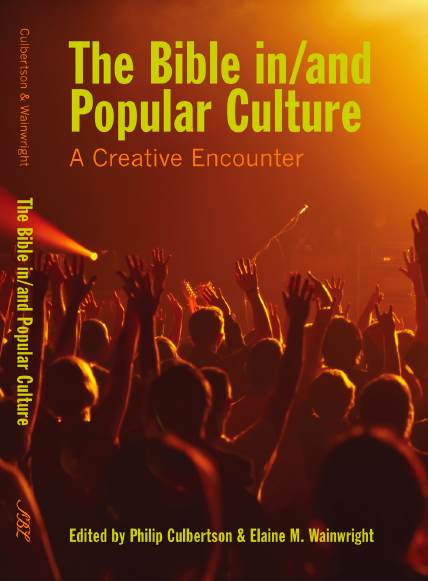
new book release: Bible in/and Popular culture: a creative encounter
 I have a book chapter in a new release, out this month. Titled The Bible in/and Popular culture: a creative encounter, it is an exploration of how the Bible reads pop.culture – and how pop.culture reads the Bible. (Available for purchase on Amazon
A lot of writing has done on the Bible and film. This book charts a different path and focuses on areas including the Bible and other popular media like hip-hop, graphic novels, animated TV cartoons, apocalyptic fantasy. Mine is a chapter on Bro-town, an animated TV cartoon, set in Pacifica urban culture. The title is “Reading “pop-wise”: the very fine art of “making do” when reading the Bible in bro’Town.”
Updated: By request, here is the full list of contributors
Introduction by Elaine M. WainwrightSome Novel Remarks about Popular Culture and Religion: Salman Rushdie and the Adaptation of Sacred Texts by Michael J. Gilmour
Red Dirt God: Divine Silence and the Search for Transcendent Beauty in the Music of Emmylou Harris by Mark McEntire
“Here, There, and Everywhere”: Images of Jesus in American Popular Culture by Dan W. Clanton Jr.
’Tis a Pity She’s (Still) a Whore: Popular Music’s Ambivalent Resistance to the Reclamation of Mary Magdalene by Philip Culbertson
Spittin’, Cursin’, and Outin’: Hip-Hop Apocalypse in the Imperial Necropolis by Jim Perkinson
The Bible and Reggae: Liberation or Subjugation? by Noel Leo ErskineHelp Me Make It through the Night”: Narrating Class and Country Music in the Theology of Paul by Tex Sample
Jesus of the Moon: Nick Cave’s Christology by Roland Boer
Prophetic Voices in Graphic Novels: The “Comic and Tragic Vision” of Apocalyptic Rhetoric in Kingdom Come and Watchmen by Terry Ray Clark
Reading “Pop-Wise”: The Very Fine Art of “Making Do” When Reading the Bible in bro’Town by Steve Taylor
Daemons and Angels: The End of the World According to Philip Pullman by Tina Pippin
Close Encounters: The Bible as Pre-Text in Popular Culture by Laura Copier, Jaap Kooijman, and Caroline Vander Stichele
Pop Scripture: Creating Small Spaces for Social Change by Erin Runions
Personally, career-wise, I am pretty stoked. The publisher is the Society of Biblical Literature, which is the oldest (1880) and largest (8,500 members) international scholarly organization in the field of biblical studies, so it’s neat that first, they are publishing in this area and second, for me to have work published in such a place.
NB 1. One of the talks I gave at Spurgeons College in September drew on this.
NB 2. For a description of my method and some of the resources I used, go here.
Thursday, October 21, 2010
too blunt? the mirror held by early church preaching
I have a column over on the kiwimadepreaching website. Here’s my introduction:
Is the phrase “Biblical preaching” simply too blunt? I began to wonder this as I gazed into the preaching mirror held by the early church.
With over forty years of missionary service in Africa, David Dunn-Wilson has made a study of the sermons of the early church. In his book, A Mirror for the Church
(Eerdmans, 2005) David points out how sermon change – in style, in subject – as the needs of congregations and contexts change.
The chapter headings tell the story.
I then explore categories of missionary preachers, apologist preachers, mystic preachers, theological preachers, homiletical preachers. For the full article, or to make a comment, head on over
Tuesday, September 21, 2010
loving eric: a contemporary theology of hospitality
An unexpected bonus of visiting the Tate Modern was re-finding the work of Shaun Tan. Si Smith, of 40 fame, first put me onto Shaun, by sending me The Red Tree. It was beautiful, hand illustrated with a lovely, unfolding short story.
While at Tate, I noticed another Shaun Tate, Eric. Delightful size. Once again beautifully illustrated. And the story, again lovely and unfolding. I am not going to summarise it in any way, because it would ruin it. Simply to say that it offers a fascinating theology of hospitality; what it means to give as a tourist and receive as a host.
It worked for me at so many levels – tourist in England, alien in Australia, missiologist talking often about hospitality your place and mine!


 )
)