Thursday, June 07, 2007
missional church and missional agencies part 2
Hi. I’m on the run, needing to be in the lecture room in a few hours, all made worse by my flight from Rotorua to Christchurch being cancelled. I hope to post some further reflections, but in the meantime, the following worked really well.
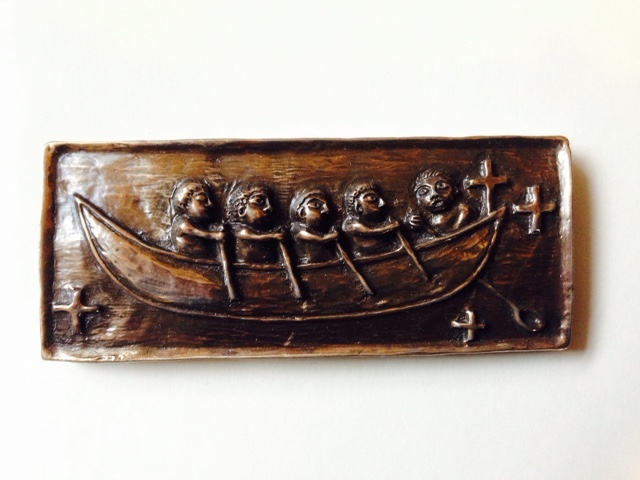
As part of my presentation I wanted to engage with Scripture. So my partner made up 4 postcards with the words: “I am learning that mission is ….”. The first postcard had to be written at Luke 10:4; the second postcard at Luke 10:7; the third at Acts 10:23; the fourth at Acts 10:47. I got people in groups around each postcard. (The postcards are here)
It seemed to work really well in terms of helping people enter the text and think about mission. Which of course sets up The Question: so where is the mission agency in Luke 10 and Acts 10?
And at that point, there was a quiet silence in the room, because the answer is …
Wednesday, June 06, 2007
missional church and missional agencies
Further to my post last week, today I am off to Rotorua to talk to about 100 gathered Kiwi mission agencies about how they might relate to missional church.
I have arranged my thoughts as such:
1. Define missional church
2.Define missional agency
3. Biblical understanding of missional church
4. A possible future
– Agency as myspace
– Agency as abbott
– Agency as global worship resourcer
I have really appreciated the comments and discussion by people on the blog and just wish I had more time, as I don’t feel I’ve read enough to do the invitation and topic justice. If you are really keen, here are my slides: download file (650K)
Sunday, April 15, 2007
An inconvenient truth?
EARTH DAY: 22 April, 3pm-5.30pm
Opawa Baptist Church
Reflections on the science, theology and personal responsibility of climate change
* For anyone who saw Al Gore’s movie and was challenged or has questions
* For anyone who hasn’t yet seen the movie
* For those who want to know how they can better care for our earth
* For people who don’t think we need to care for the earth, but are willing to have their view challenged
With special guests:
Prof Geoffrey Savage (Lincoln University), Rev Dr Steve Taylor (BCNZ)
3-4.40pm Movie showing of “An inconvenient truth”
4.45-5.15pm Questions including:
How credible are Al Gore’s claims? Is global warming a given? How about the hole in the ozone? How do the CO2 calculations work (2.5 kg of CO2 seems a lot from 1 litre of petrol)? How concerned should I be to reduce my carbon footprint? As Christians should we care? Are we going to inherit a new heaven and a new earth? Therefore shouldn’t we feel free to trash the old one? Does God love the physical world, or only the “souls” that inhabit it? What does Colossians 1:15-17 mean for us as Christians as we consider climate change?
5.15-5.30 Questions from the floor (if time)
Concluding with Sustainable Living information packs.
Thursday, October 19, 2006
journalling the emerging church journey
 The kitchen is “an experiment in community.” Their experimental journey is being recorded here. I’ve shared a number of coffees and listened as this experiment has taken shape over the last year.
Earlier this year, round New Year, I posted a series of emerging church postcards05; a visual record, along with some words about birth, values, music and mission, of emerging churches around the world. I wanted to make the visual point that the emerging church is wider than Emergent church US. I also wanted to name the life of the emerging church not as books and speakers but as God’s Spirit at work in the real life stories and everyday struggles of mission and worship stories of emerging church communities. (The complete series is here). I am planning to repeat this series at the end of this year.
And it is exciting to think that throughout this year, groups like the kitchen have become to take shape – to wonder concretely what it might mean to embody the life of Christ in our world – an experiment – a risk – just like the birth of that Christ baby so many years ago.
Thursday, July 06, 2006
emerging AD:missions 7
 a series of posts called emerging AD:missions; reflecting on the emerging church in light of mission thinking.
MISSION IN THE BALKANS: Readings in World Mission, page 12-14.
The context is the 8th century, the place is the Balkans and the people group are Muslim. St Cyril learns Slavic, turns this oral language into a written language and then translates the Bible.
Missionary issue one: The Church in Rome responds by accusing Cyril of selling out to the culture. Oh how familiar. Some 1200 years later, the context is global and the people group are postmodern, and the emerging church in a missionary mode is often accused of selling out to the culture.
Cyril responds to his critics by quoting from Psalm 150:6; “Let everything that has breath praise the Lord” and by celebrating that “the sun of justice [has] diffused the holy Christian faith throughout the earth.” Amen. The emerging church continues in the contextual missionary spirit of Cyril. May we have the grace to respond Biblically and prophetically to our critics. May we continue to be part of the diffusion of Christian faith throughout our globe.
Missionary issue two: Slavic Muslims want to follow the Christ. Cyril offers 1 day of catechical instruction, immediate baptism, followed by thorough education. Cyril recognises that Christian faith requires formation. Which leaves me wondering where formation occurs in the emerging church. We are often criticised for being soft on doctrine. How true is this criticism? In what ways are we paying close attention to the forming of disciples?
I am futher intrigued by Cyril’s decision to baptise early and form later. This is in striking contrast to authors like Stuart Murray in Post-Christendom and Robert Webber in Ancient-Future Faith who call for extended catechesis before baptism in our contemporary world. So, does the order of baptism and formation matter in any way?
……..
This post ends the first section of readings; titled Early and Eastern Church. I have initiated a dialogue between mission history and the emerging church. Topics covered include culture | context | rhythm | focus | worship and formation | heresy. For an more detailed introduction to emerging AD:missions, go here. For all the posts in this series go here.
Saturday, June 17, 2006
emerging AD:missions 6
a series of posts called emerging AD:missions; reflecting on the emerging church in light of mission thinking.
MISSION TO SLAVS: Readings in World Mission, page 11-12.
The Nestorians worked as missionaries in China in the 6th century, talking, contextualising Jesus. Yet they were dismissed as heretics in the 2nd century. So this is mission for the edge to the edge. If you were forced from the church, would you put your energy into angry defense or pioneering mission?
The emerging church is an edge movement. It seems we are increasingly dismissed as heretics. In response, where will we put our energy? Into protest and defense and anger?
The Nestorians offer a fascinating approach. In the face of accusations of heresy, why not go wandering the edges of our world, offering God’s grace and love. No one, no matter how judgemental, can stop us doing that.
For an introduction to emerging AD:missions, go here.
For all the posts in this series go here.
Thursday, May 18, 2006
emerging AD:missions 5
a series of posts called emerging AD:missions; reflecting on the emerging church in light of mission thinking.
MASS CONVERSIONS: Readings in World Mission, page 9-10.
In this reading we gain insight into baptism in missionary settings. Firstly, ramp up the worship by using the senses. “The church was resplendent with banners, flickering candles and the scent of wax and incense, so that those present believed that they partook of the savor of heaven.” No, not multi-sensory or alt.worship, but baptism in the 5th century. Using all the senses in worship is nothing new. It’s just that the church became captive to the culture and let modernity strip us of our senses.
Secondly, practice catechesis. In a missionary context, instruction was placed before baptism. This year at Opawa we’ve ramped up our catechesis, and used the ancient creedal formulation – do you follow Jesus, do you repent of your sin, do you renounce evil – as the basis for our baptismal instruction.
Thirdly, mission as less than ideal. But this reading leaves a sour taste in my mouth. Conversion comes because the king prayed to God for victory in battle. So, how many people died? How to reconcile “Blessed are the peacemakers” with this missionary narrative?
Perhaps the lesson is that faith is not found in ideals, but between rocks and hard places. Is this where the emerging church is located, in the hard places of people’s lives? Are we messy and provisional? Or are we stuck with our theories of postmodernity, youth spirituality and imaginary conversations with Neo?
For an introduction to emerging AD:missions, go here.
For all the posts in this series go here.
Tuesday, May 16, 2006
emerging AD:missions 4
a series of posts called emerging AD:missions; reflecting on the emerging church in light of mission thinking.
MONASTICISM: THE MISSIONARY IDEAL: Athanasius on Anthony, Readings in World Mission, page 8-9.
“While he lived in the desserts as a hermit, [Anthony the monk] was able to move in and out of contact with people. In certain periods, he served almost as a spiritual director for others.”
We glimpse a a fascinating mix of radical monk yet settled pastoral care; a life of prayer that interfaced with real people ministry. We see a Christian counselling other Christians who are attracted to him. Hold on. In a missions text! Why is a monk, who encourages visiting monks, a mission text? Why is attraction, people visiting you, deemed missional?
Perhaps because history has deemed that, with hindsight, the radical monastic exploration of new forms of spirituality preserved Christianity. Such is the wisdom of history.
What will history make of the emerging church? For all our missional talk, what will history write of us and our exploration of new forms of spirituality? Will we be deemed to have been a salt preservative in the grand sway of missio dei?
What comforts me is that such questions are none of my business. I doubt Anthony considered them. He just took risks, practiced prayer, loved God and people.
For an introduction to emerging AD:missions, go here.
For all the posts in this series go here.
Wednesday, May 03, 2006
emerging AD:missions 3
a series of posts called emerging AD:missions; reflecting on the emerging church in light of mission thinking.
ITINERANT EVANGELISTS: Eusebius of Caesarea, Readings in World Mission, page 7-8.
So, how did early Christianity, birthed into a pluralistic and multi-cultural world, become, in the space of several centuries, the dominant world religion? Firstly, becase of a lifestyle of influence (emerging AD:missions 1 post). Secondly, for Eusebius of Caesarea, the use of evangelistic pilgrimage. Following the example of Jesus, the wandering rural peasant, Eusebius describes people in the early church; “entering upon long journeys … As soon as they had only laid the foundations of the faith in some foreign land they appointed others … but they themselves went on to other lands and peoples with the grace and co-operation of God.”
And now we live in the 21st century. Evangelistic pilgrimage has to overcome the practical realities that include a world of mortgages, individual households and visa and entry requirements. Equally, we face a globalised society, an information age and an internet culture. Every day we can participate in a global wander through blogs and cyber-sites. Today it is both easier and harder to wander.
I ponder the mission challenge that might lie in the rhythm of these early wanderers – a speaking and a walking; a scattering and a gathering; a communal hospitality and an individual journey. How to discern and follow this rhythm in our lives and in our communities? Eusebius honours both those who plant and those who pastor. At times the emerging conversation seems far more monochrome and settled than Eusebius’s missiology.
For an introduction to emerging AD:missions, go here.
For all the posts in this series go here.
Sunday, April 30, 2006
emerging AD:missions 2
a series of posts called emerging AD:missions; reflecting on the emerging church in light of mission thinking.
DIVINE TRUTH THROUGH PHILOSOPHY: Clement of Alexandria, Readings in World Mission, page 5-7.
While Jesus was a wandering rural peasant, it did not take long for Christianity to become an urban faith.
Alexandria was a city of 1 million people noted for it’s intellectual life. The very presence of the writings of Clement remind me that an emerging church can Incarnate faith in philosophers cafes of our urban centres. How?
Clement experiences the philosophy that is his contemporary cultural world as gift. Contemporary culture is “preparation paving the way for him who is perfected in Christ.”
How willing is the emerging church to watch film, listen to pop culture, dialogue with postmodern philosophers, and so (like Clement) find a seedbed for Christianity to grow? What are the skills, environments and narratives needed for this initial contemporary cultural dialogue to be perfected in Christ, in whom is hidden all the treasures and wisdom.
For an introduction to emerging AD:missions, go here.
For all the posts in this series go here.
Saturday, April 29, 2006
emerging AD:missions introduction
I am beginning a series of posts called emerging AD:missions; reflecting on the emerging church in light of mission thinking. I will be using the book, Readings in World Mission, by Norman Thomas (sadly out of print). It is a companion to David Bosch’s Transforming Mission
I have been stimulated to do this by Don Carson. In his book Becoming conversant with the emerging church (ie some books of Steve Chalke and Brian McLaren)
For the archive of all the posts; go here.
emerging AD:missions 1
a series of posts called emerging AD:missions; reflecting on the emerging church in light of mission thinking.
EXEMPLARY CHRISTIANS: Letter to Diogentes, Readings in World Mission, page 5.
So, how did early Christianity, birthed into a pluralistic and multi-cultural world, become in the space of several centuries the dominant world religion? The answer, for Diogentes, is a lifestyle of influence. “They do not live in cities of their own; they do not use a peculiar form of speech; they do not follow an eccentric manner of life.” Reading Diogentes, I am struck by the fact that residents are not alien.
A marginalised faith can never retreat. Rather, mission is influence through lifestyle. This early emerging church was in-culture. Emerging churches are encouraged to be in-culture.
For an introduction to emerging AD:missions, go here.
For all the posts in this series go here.


 )
)