Sunday, November 03, 2013
the changing landscape of agencies and mission
David Bosch is one of the worlds finest thinkers on mission. His Transforming Mission: Paradigm Shifts in Theology of Mission
- Primitive Christianity
- Patristic Period;
- Reformation;
- Enlightenment;
- and Ecumenical (or postmodern)
Bosch argues that as a paradigm changed, mission changed. In changing times, the mission of the church took different shape. His argument is strengthened by the research he does, asking what Scriptures were being quoted in these paradigms to motivate mission. He argues that each paradigm was shaped by a different dominant Biblical text.
- Primitive Christianity – the letters of the New Testament
- Patristic Period – John 3:16 in the patristic Period; the love of God, seen in the sending of Jesus, is extended by God’s messengers
- Reformation – a shift from Luke 14:23 in the Middle Ages; compel them to come in! to Romans 1:16; God’s rightliving means grace and mercy, not punishment
- Enlightenment -the Great Commission (Matthew 28:18-20)
With regard to the ecumenical/postmodern, Bosch suggests the immense challenges of our contemporary world are signs of a transition into a new period. This has huge implications for churches thinking about mission today. There is widespread agreement that culturally we are going through another paradigm shift. The world of today is vastly different from the world of 40 years ago. So any discussion of church and mission today needs to keep stepping back, keep watching the paradigms.
Stanley Skreslet (Comprehending Mission: The Questions, Methods, Themes, Problems, and prospects of Missiology

- Primitive Christianity – the radical communal compassionate care for the sick
- Patristic Period – the monastery
- Reformation – religious orders
- Enlightenment – the voluntary society, based on the shareholder model, by which lay people became voluntary participants. And the institution, the large scale constructing of schools and hospitals, which offered care and cure.
Which of course, raises the question, what might be the modes for the ecumenical/postmodern period. Skreslet argues for the NGO – the Non-government organisation. He cites examples like Greenpeace and Amnesty International. These offer a physical presence, based on a extensive networks and clear, instant lines of communication. These NGO’s harness public opinion, building pressure to bring about change. They thus offer a very different model for mission.
Over the last few days, I’ve been part of debates about the changing landscape of agencies and mission. All the time, I kept wondering if these debates are part of the same worldwide questions about the forms of mission into a new ecumenical/postmodern paradigm. Bosch writes:
“The transition from one paradigm to another is not abrupt … This produces a kind of theological schizophrenia, which we just have to put up with while at the same time groping our way toward greater clarity … The point is simply that the Christian church in general and the Christian mission in particular are today confronted with issues they have never even dreamt of and which are crying out for responses that are both relevant to the times and in harmony with the essence of the Christian faith …. The point I am making is simply that, quite literally, we live in a world fundamentally different … The contemporary world challenges us to practice a “transformational hermeneutics”, a theological response which transforms us first before we involve ourselves in mission to the world.” (Bosch, Transforming Mission: Paradigm Shifts in Theology of Mission
What will it look like to see the shape of the church and mission formed by NGO models? To prioritise smaller bodies, with a premium put on their ability to be nimble, to cultivate networks and communication? Skreslet notes a number of advantages of the NGO paradigm: “a new model of mission would also have its own distinctive organizational structure” (“Networking, Civil Society and the NGO: A New Model for Ecumenical Mission,” Missiology 25 (1997): 307-319, p. 310). These can apply globally, to international mission. They can also apply locally, to how a local church might operate in their community. Networking as a mode of action contrasts with the worst parts of colonial mission. It encourages behaviours that are flexible, egalitarian and wholistic in orientation. They allow multiple partnerships, at local, regional, national, global levels.
Thursday, June 13, 2013
missional readings of Scripture: widow of Zarephath
The missional conversation expects us to read the Bible with missional eyes. That means we pay attention to the edges. We read texts asking – who are the marginal people, what are the marginal places? That then allows us to focus on encounters – the interactions between edges and centres, outsiders and insiders, powerless and powerful.
Take for example, 1 Kings 17, the story of the encounter of the widow of Zarephath with Elijah.
There is a geographic edge. As a consequence of the drought, Elijah heads to Sidon: 1 Kings 17:7-8: “Some time later the brook dried up because there had been no rain in the land. 8 Then the word of the LORD came to [Elijah]: 9 “Go at once to Zarephath of Sidon and stay there.”
Sidon is a town mentioned in the previous chapter: 1 Kings 16:30: “Ahab …. married Jezebel daughter of [the] king of [Sidonians] and began to serve Baal and worship him.” So Elijah, God’s agent, heads to Sidon. To the place where Jezebel, the Kings wife was born, to the place where Baal worship is strong and thriving. This is a fascinating response to encountering a diverse belief system. You go to it.
Second, the people on the edge. Elijah finds a woman gathering sticks. To quote from a Bible commentary: There were many widows in [Elijah’s] Isreal and the surrounding areas because of war and famine. Traditional family and village systems of support for widows had broken down since the king … had started buying up the land and corrupting village leaders. Prices for oil were high because they were chief export crops. This widow could not afford them anymore.
They talk in the news media about needing to find the human interest story. Well here in 1 Kings is the human interest story. YHWH, the God of the Old Testament, has a human interest in widows.
Third, the interaction. Having gone to the edge, in place and person, we can now consider this story from the viewpoint of the widow. From this perspective, she is a most extraordinary example of hospitality and faith. She offers her last to a stranger. She says yes to a prophet, no matter how illogical. This is discovered in the “Baal” worshipping town. A redeeming God will always be found in the places the centre considers unlikely!
Finally, this text offers an insight regarding community empowerment. I am fascinated by the way that Elijah doesn’t give her a handout. Instead he empowers her. Invites her to simply give what she’s got. One book noted that “The key [to 1 Kings 17] is that [Elijah] does not do the miracle for [the widow] [Instead he] enables her to do it for herself.” Here’s a way to work with the poor, in ways that do not leave them victims, but invited to use what they have got – the twigs they can collect, their flour and oil.
This is a missional reading. The people of God are encouraged to journey to the places complicit with economic oppression. In this places, they are to concentrate of human interest. They are invited to look for God’s prior activity in those places, to seek those who already have the capacity for extraordinary faith.
Tuesday, June 11, 2013
ageist mission?
On Friday, I ducked away to a seaside cafe to do some writing (another 1,000 words on the Sustainability and mission project).
As I took a break, I looked at those around me in the cafe. At one table was a grandmother, struggling with two lively pre-schoolers. At another was a group of friends, grey-haired, sharing travel plans. At yet another was a similar group, obviously regular weekly gatherings.
The day prior, I’d been part of a presentation of NCLS data on the Uniting Church in South Australia. The average age is 62. That Friday morning, I’d found parking at this seaside suburb outside a local Uniting Church. It is a church I’ve been a few times, to find myself surrounded by a good number of elderly folk.
Cause for concern?
Not if you consider the demography of those surrounding me in the cafe. Surely a denomination of retirees is superbly placed to incarnate the Gospel among grandmother struggling to babysit, retirees planning a worthwhile future and searching for relationships.
Fresh expressions can, frankly be ageist. It can assume that the new, young, hip are the future. Well, the young and hip will struggle to meet those seated around me on Friday.
It reminds me of the claim by Mark Lau-Branson, that Pentecost is for the geriatric.
Friday, May 31, 2013
model missionaries: Centurion in Luke 7
During team devotions yesterday, we explored the lectionary reading for the week – Luke 7:1-10.
The Bible text is placed in an envelope and before we read it, we try and piece together what we can recall. This engages us a group. It builds curiousity. It provokes questions.
Then we read it aloud together and ask each other: What surprised us? This often exposes our blindspots, makes us aware of the bits we have historically skipped over.
Finally we ask each other: What might this text mean for us as a College? What might this text mean for us, individually?
Yesterday, the discussion wandered into the cultural layers at work in this text. And then how different cultures have different attitudes to authority. Which led us to wonder if the centurion was a model cross-cultural missionary. He loves where he is planted (v.5). He has obviously built strong relationships (v. 3). He has partnered in community building (v.5). He knows how the culture works (v.6).
A centurion, a Gentile, as an example of mission! A lovely challenge for us to ponder, as we as a College think about what it means to train disciples in mission.
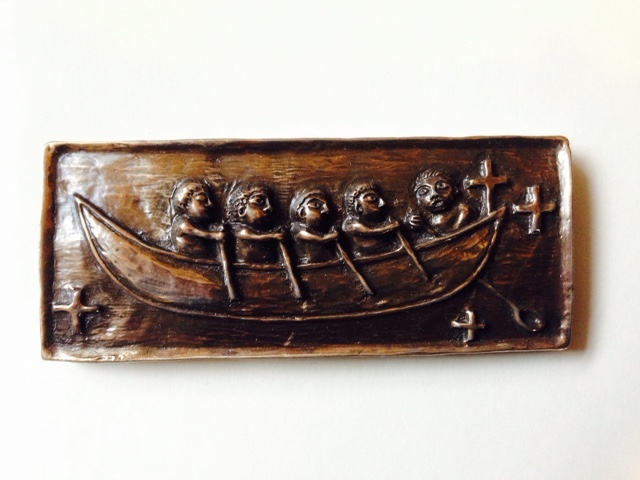
Creationary: a space to be creative with the lectionary (in this case, visual images on themes of pilgrimage). For more resources go here.
Tuesday, May 28, 2013
Go Danica, Go Pilgrim, Go indigenous immersion
Sunday was Reconciliation Sunday here in Australia. A week to focus on partnership with indigenous people and communities.
Earlier this year, Uniting College partnered with one of our local churches, Pilgrim Uniting, to begin Walking on Country – a long weekend immersed in a local indigenous community, supported by pre-readings and post-trip debrief. This was part of a non-formal teaching plan to ensure our ministry candidates and their families (optional) experience cross cultural immersion among Australia’s indigenous peoples.
Sunday was a fitting time for this new venture to connect back with the local partner church. Danica Patselis (student at Uniting College, currently in a Period of Discernment and married to a candidate) spoke, reflecting on what the experience meant to her. As she later emailed me –
Thanks for prioritizing this trip for the formation of ministers. Nick and I were both renewed and transformed in our thinking and actions from our time with Uncle Tom and Aunty Denise. We are hoping to take a group from Hope Valley to the Congress church to begin conversations, worship together, and learn from the vibrant spirituality of these peoples. But we’re taking small steps as we want it to be long-term action not reactive.
As part of the service, as Principal, I offered a greeting (which I emailed sitting on a Melbourne motel floor)
Uniting College have been delighted to partner with Pilgrim Uniting in the Walking on Country initiative. It has been life changing for some participants. It has enabled ongoing conversations about the Preamble, justice, partnership across cultures. It has both broadened, yet humbled, our understandings of mission and ministry. We hope its the start of an annual event and an ongoing partnership both with Pilgrim and local indigenous communities. Maori culture has a proverb “He tangata, he tangata , he tangata” – the people, the people, the people. That was our experience with you and at Camp Coorong. A Pentecost gift to cherish – Principal Steve Taylor
Thursday, May 09, 2013
Pilgrimage spirituality interaction
Darren Wright, who so long ago did a very thorough blog review of my Out of Bounds Church book, is interacting with my recent Old Testament festival spirituality talk.
to be honest the idea of seeing our liturgical year being split into 6ish gatherings connected to festivals (we already naturally celebrate 3 festivals in christmas, easter and harvest) sounded like a beautiful and sustainable idea for many people at the conference. People seemed so attracted to the idea of festivals that the other ways of exploring community, spirituality and faith seemed overlooked by many of the group, so with that in mind I thought I’d like to explore each of the categories leaving Festivals to the last.
He is taking each of the categories I introduced – temple, festival, pilgrimage, table, sacred site – starting with pilgrimage.
He explores rural life, driving, weekly bike club rides that exist in almost every town, a driving holiday, transporting cattle/stock along the stock trails, harvesting and sowing (where in Australia one sits alone on a huge machine for days on end). Even geocaching.
Pilgrimage as practice opens up the possibility of seeing the tractor as a space for liturgical & ritual practices, the car/vehicle as one drives between Hillston and Sydney as a space for faith and connection. The task for us now is to develop ideas that help the spiritual practice of pilgrimage develop and professional travellers ways to engage with the region they’re driving through in deep spiritual reflection.
It’s a creative piece of work.
Monday, May 06, 2013
missional communion
An introduction to communion that I shared today, working with our candidates, faculty and visiting ministers, gathered around the topic of self-care.
There is a story of some ministers gathering. Much like us today, to wrestle with ministry. In the question time, a question is raised. A person aware of their world, concerned about the church. How can we bring people to the altar?
The response is made. Is the question how do we bring people to the altar? Or is the question, how do we bring the altar to people?
An important reminder as we gather. It is not that we come to communion, but that in communion God comes to us. In this we are invited to participate in God’s mission.
Yes, it is about our care. In communion God feeds us, centres us, re-values us around grace and redemption.
But it is more than that. It is also about care for the church. In communion God feeds the church, centres the church, re-values the church around grace and redemption.
But it is more than that. It is also about care for the world. In communion God wants to feed the world, wants to centre the world, wants to re-value the world around grace and redemption.
And so we pray; Spirit, fall on us, that these elements of bread and wine may be for us a participation in your life, love and mission, your bringing the altar to people.
Friday, May 03, 2013
Festival spirituality stories: Spin and Fibre Festival
I’m starting a research project, wanting to collect stories of Festival spirituality. It is an extension of a brief idea I sketched in my The Out of Bounds Church?: Learning to Create a Community of Faith in a Culture of Change (emergentYS)
Festival spirituality (working definition): an occasional period of community gathering for celebration, in which Christians intentionally participate, seeking to make the shalom of God more visible.
This Festival spirituality story – Spin and Fibre Festival comes from Frontier News, May 2013, 8-10. It relates to the 35th Bothwell International Highland Spin In and Fibre Festival, a biennial event held in Tasmania and comes from an interview with Rev Meg Evans, Patrol Minister, Midlands, Tasmania.
Held every two years, Meg is the unofficial chaplain for the festival, which was started by a group of Uniting Church women who were spinning wool to raise funds to restore the church tower. Bothwell is one of the smaller communities in the Patrol located in the Central Highlands, 70 km northwest of Hobart. It has a long history in Merino wool production and the festival remains a huge event for both local and international visitors showcasing crafts and skills associated with superfine wool.
“On the Friday, we shear a sheep for the fleece, and then we hold a ‘Blessing of the Fleece.’ The wool is given out to people to spin during the weekend. On the Sunday I hold a service in the school gym, surrounded by all this wonderful creativity. It is just a great community celebration.”
“People come and tell me how much they enjoy it. I think the fact that the Church is there speaks to people.”
Some interesting things to note
- gift – the involvement of the church begins with “Blessing”. This suggests a thankfulness. What is blessed (the Fleece) is then given away to participants
- risk – This clearly involves risk, that the gift might not be “unwrapped,” might not be utilised. Or it might be “wrapped” in a way contrary to the values of the giver.
- theology of creation – the connection to wool, as the product of local industry, as the lifeblood of what this community, this land, produces. A celebration both of the gift of wool, but also of the creative gifts that surround wool – “crafts and skills associated with superfine wool.”
- being church as spun (interwoven) presence, first in being close enough to the land to be aan initiating participant, second in being a worshipping presence through the festival, both from the initial blessing through to the service, third in the theology of Meg, “the fact that the Church is there speaks to people.” The church began this event, but was willing to give it away. The church is willing to be one of many participants, many strands, in the fibre of this event. It does not need to own it nor control it.
So this Festival spirituality is mission as chaplain, celebrating creation, with particular attention to presence, participation, gift and risk.
Questions for discussion
- I wonder what things might be worth celebrating in your community – what gifts of “creation” and “creativity” you could bless?
- I wonder how you might take risks and invite people to participate in these gifts?
- What might an authentic presence look like? Think about this both from your perspective as a church and from the perspective of visitors and locals.
Monday, April 22, 2013
In sure and certain hope
Andrew Dutney, President of the Uniting Church, dropped in on my Sustainability and the mission of God presentation at the Australian Association of Mission Studies (Adelaide chapter) today, when I presented some of my findings from research into UK fresh expressions ten years on.
Andrew offers a fascinating followup reflection, pondering further some of my ruminations around the implications for a church that seeks to live in response to an Easter story of death and resurrection.
One of the interesting things [Steve] found is that there’s about a 50% attrition rate in the Fresh Expressions he’s followed over the last decade. He checked this against other writers’ lists of innovative faith communities like that and found a similar “death” rate.
But he also found significant signs of new life – resurrection even – associated with those short-lived churches. Individual participants report being transformed by the experience and prepared to offer significant leadership in mission after the demise of the Fresh Expression they were part of. Other faith communities – both established congregations and other Fresh Expressions have learned from the experience and example of the community that has wound up. And many of those communities have left behind “products” generated in their years of vitality – art, liturgical resources, training modules etc.
So, Steve told us, that 50% attrition rate doesn’t mean that half of the Fresh Expressions initiated weren’t worth the effort. Not at all. They are integral to the dynamic of the church’s discernment of and participation in the life of the Holy Spirit in the world. They too embody the One Holy Catholic and Apostolic movement.
You’d think a movement oriented around the death and resurrection of Jesus would get that intuitively.
Andrew then moves from fresh expressions to ponder the implications for inherited expressions, particularly churches facing death. It’s really interesting. More here
Tuesday, April 09, 2013
Festival spirituality, mission and ministry
I’m speaking tomorrow at the National Uniting Church Rural Ministry Conference, at Barmera, which is about 3 hours drive north of Adelaide, in the Riverlands.
My topic is festival spirituality. It’s a significant development of some ideas I sketched in my The Out of Bounds Church?: Learning to Create a Community of Faith in a Culture of Change
Here’s my conclusion.
I have wanted to engage with two problems. First, the perception of Christianity as urban, a move which can downplay the vitality of rural ministry. Second, the perception of church as building, geographic and Vicar led.
I have deployed the Old Testament to suggest different modes of gathering, around sacred sites, on pilgrimage, in festivals, around tables. I would suggest these are more congruent with the needs of rural folk, in current patterns of belonging, in ways of participation and the existence already of festivals.
Finally, two examples have been provided, which show current examples of rural churches embracing these new/old forms. My suggestion is that these patterns are more likely to be life-giving for a rural church. Rather than a weekly habit, they provide ways to participate in the rhythm of a community, to embrace sense of place and to offer spirituality for the road trips so integral to rural life.
It should be a fun day.
Wednesday, March 13, 2013
Gender matters: in church structures
Today I’ve been writing (Sustainability and fresh expressions book project) on the history of mission in Great Britain. What has the God of mission been up to in the past? How might that help us analyse the current and dream of a future?
More specifically, I’ve been writing about the voluntary missionary society, a significant and important gift, from Great Britain, to the world. William Carey, often called the father of modern mission, in his hugely influential An Enquiry into the Obligations of Christians to Use Means, argued not only for mission, but also for a new structure for mission. Drawing from the world of commerce, the trading company and the way it, through seeking shareholders, created participation and enabled action, Carey wondered:
Suppose a company of serious Christians, ministers and private persons, were to form themselves into a society, and make a number of rules respecting the regulation of the plan, and the persons who are to be employed as missionaries, the means of defraying the expense, etc etc
Missiologist Andrew Walls considers this of huge significance, a revolutionary re-structuring of the church in light of mission. He also notes a number of outcomes, including gender matters, the way it allowed women’s giftedness. Walls argues that voluntary societies
assisting [the church’s] declericalization, giving new scope for women’s energies and gifts and adding an international dimension which hardly any of the churches, growing as they did within a national framework, had any means of expressing. After the age of the voluntary society, the Western Church could never be the same again. Andrew Walls, “Missionary societies and the Fortunate Subversion of the Church.”
Often church structures impede women, as so eloquently attested in Maggi Dawn’s recent book. But sometimes (albiet probably unintentionally), they allow the body of Christ to experience “new scope for women’s energies and gifts.” In other words, to more fully be the body.
Yeah for church restructuring!
Tuesday, March 12, 2013
persuasion: a fine art in mission
You are invited to read this while listening to some wonderful Kiwi music, a song called Persuasion, by Tim Finn.
As part of my sabbatical, I’m reading through Paul’s letter, Philippians. I like to bury myself in a Bible book, to read it in one whole go, then segment by segment, a number of times, over a number of months. It becomes for me a sort of recalibration, a reminder of priorities.
Once I’ve engaged Scripture, as a whole, and in segments, I then augment it with a commentary, which adds depth and original context. So over the last few days, I’ve begun reading Ben Witherington’s, Paul’s Letter to the Philippians: A Socio-Rhetorical Commentary
He argues for Paul’s use of rhetoric, that in a rhetoric-saturated culture, one in which the “vast majority of people were either producers or eager consumers of rhetoric,” (page 24) that Paul deliberately learns, then uses, this culture way of arguing.
So for example, a feature of Philippians is the absence of Old Testament bible verses. Paul is writing to a highly Romanised culture and in that world, he uses different ways to persuade, including the widely practiced communication art called rhetoric, the art of discourse, the study of how to engage head and heart, skillfully, with spoken words.
Why? Because of mission.
“One cannot command people to believe the gospel but must persuade them … [ever after conversion] … Paul knew that it continued to be better to persuade than to command one’s converts … The objections and the mental and emotional obstacles in the minds and hearts of the listeners had to be answered and removed.” (Ben Witherington, Paul’s Letter to the Philippians: A Socio-Rhetorical Commentary
We live in a culture that uses different forms. Not rhetoric, but digital storytelling, art and social media. So, mission in the way of Paul includes giving up on commanding belief, and being willing to not only learn, but also use, the fine arts of persuasion.
As Tim Finn sings,
I will always be a man
that’s open to persuasion
Tuesday, February 26, 2013
Comprehending mission – chapter 4 – Theology mission, culture


Chapter one, on the who and why of the study of mission, is here. Chapter two, on trends in the Bible in regard to mission, is here. Chapter three part a looked at mission history, the evolution through time, the shifting resources that shaped how the church understood itself. Chapter three part b, on the history of mission today is here.
Chapter four – Theology, Mission, Culture
“Within the realm of missiology, culture becomes a primary conversation partner.” (69)
This includes communication across cultures, agencies of social change, the complex formation of innovation and new contextual projects. (This makes so much sense of my interests and why I find myself reading from change management to social innovation, to indigenous and popular culture.)
The chapter begins with theology, in particular current research on salvation and ecclesiology. This includes the shift to see mission as an aspect of God rather than as a function of the church. It also includes the recent search for a more developed pneumatology, the place of the Spirit of God.
A second section explores the growing importance of social sciences (again this makes sense of my methods, using ethnography and interviews, plus my interest in the ecclesiology and ethnography project). Mission played an active role in the development of ethnography and anthropology. The 1910 World Missionary Conference pleaded that sociology be included as one of five necessary subjects for all candidates in mission training. (It certainly is at Uniting College, where we teach Reading cultures/Sociology for ministry, as a core introductory topic).
“Not fully appreciated, perhaps, is the way in which sustained research on culture has served to keep missiology closely connected to everyday life, which lessens the risk that its theological concerns will be treated only in the abstract.” (95)
A third section explores gospel and culture, the quite deliberate participation in both arenas at the same time. “The doctrine of the incarnation has also been taken as an invitation to think deeply about human culture as the particular sphere within which Christian outreach necessarily takes place.” (86) There is a rich coverage of the development of research in contextualisation and intercultural theology.
“Writing about fifteen years ago, Lamin Sanneh perceived that Western theology was just about the last discipline in the modern university to show serious interest in missionary experience.” (94)
However, in recent years, writings from Timothy Gorringe Furthering Humanity: A Theology of Culture


Thursday, February 14, 2013
the ending of innovation: last fresh expressions interview
Today marks the last interview of the UK alt.worship research phase. It will be interview number 20. The interviews can be grouped in three categories.
Innovation in groups (alt.worship groups ten years on). The selection is not random but simply based on groups that I interviewed back in 2001 as part of my PhD research. They thus provide a window into sustainability.
- Host
- Sanctuary
- Bigger Picture
- Foundations (Resonance)
- Moot (Epicentre)
- Grace
- Club culture Project
- Visions (Transcendence)
Innovation in denominations as Fresh Expressions. During the ten years, a key change in the UK landscape has been the advent of Fresh Expressions. It has introduced new words, including pioneer, mixed economy, Bishops Mission Orders. These interviews analyse the environment in which the innovation occurred and explore the leadership practices and insights that lay behind the change.
- Dr Rowan Williams
- Bishop Steve Croft
- Bishop Stephen Cottrell (today, last one)
- Andrew Roberts
Innovation in training. Intrinsic to the formation of new communities is leadership. These interviews analyse the changes that have, and have not occurred, in recognised training systems, in light of the Fresh Expressions initiative.
- Trinity College
- Ridley Pioneer training
- CMS Pioneer Training
- St Mellitus
- John and Olive Drane
Together, these interviews provide a variety of perspectives on mission, leadership and change in the church in the United Kingdom. In cafes, Colleges and churches, bishops courts and Master lodges, I have been gifted some wonderful honesty and insight.
I’m still pondering a frame by which to analyse the data. My instinct is to turn to mission, and especially mission history. This could involve placing Fresh Expressions alongside other mission initiatives in history. Three possibilities spring to mind – the Celtic mission from Ireland to England; the modern mission movement through the voluntary organisations that began with William Carey and the birth of Methodist, which served as a renewal movement in denominational structures.


 )
)