Thursday, June 17, 2010
leading from your strengths. gift or curse?
What if you are really good at something. You have a passion for it and over time you invest in it. You develop skills and you become good at it.
Really good.
But over time you begin to wonder if there are some potential downsides to your gift.
Some people tell you they could never do what you do. That your gift leaves them feeling somehow inadequate and so they close down.
Still others begin to place you on a pedestal. In your presence they become less forthcoming with their opinions.
Still others ask what happens when you leave, with the assumption that somehow you are invaluable, that things should continue with, or without you.
Such reactions, observed as I watch people respond to creative people, leave me wondering. What do gifted people do with their strengths? Should Da Vinci have used his gifts less? Or differently? How much of how a creative person is perceived and processed is their responsibility? What is involved in the shift from creative individuals to creative communities?
Tuesday, June 15, 2010
developing change leaders book review – Ch 5 Building a Change Leadership Culture
A book review of Paul Aitken and Malcolm Higgs, Developing Change Leaders: The principles and practices of change leadership development
“we need to depersonalise and decentre the leadership concept, so that we begin to perceive leadership as a co-operative or collective enterprise.” (93-93, quoting Bate, 1994, 242).
This is a crucial chapter, providing a framework by which to develop change leaders. This chapter explores the shift from “I” to “we”; from individual change managers to “leadership culture.” It calls for a “walk the talk” in which leaders make clear the links between what they do and their underlying values. “Whilst heroes can carry the day in times of crisis, building a sustainable culture of innovation, excellence and achievement requires a collective and distributed, as opposed to individualised and hierarchical, leadership mind-set and approach.” (103)
Research into “leadership culture” is rare, with a lack of clarity about how values of individual leaders translate into action. How to influence a culture? There are many options, including directing attention to priorities, reacting to crisis, creating formal statements, telling stories, symbolic acts, design of work facilities and processes, rewards and sanctions, methods of decision-making. But which to use and when? They suggest a mix of the following (112):
- role model the future, every day and in every way
- foster understanding of changed expectations and their purposes
- find and develop the ‘new way’ values, capabilities and behaviours
- reinforce future state with formal and informal culture signals
This includes some practical steps
- appreciate that change is complex. It must be embedded in behaviours and run across the organisation, not top-down
- make modelling a priority
- build in feedback loops (this is critical including “experimental, case study and real life observation of leadership” (114)
- build team by creating an open table in which to discuss the real values of the organisation
- creating a culture development plan
- identifying key behaviours that have the best chance of making a difference
- seeking out and developing change leaders and followers who represent your future
The more I read this book, the more impressed I am. The mix of research, concise summaries, diagrams and practical examples is appealing. The use of a strong values basis makes it much more likely to transfer to religious contexts. I suspect it will provide a fascinating way to discuss leadership development ie training of Christian ministers.
Wednesday, May 26, 2010
developing change leaders book review – Ch 4 A Values Dialogue for Change Leaders
A book review of Paul Aitken and Malcolm Higgs, Developing Change Leaders: The principles and practices of change leadership development
The chapter starts by marshalling a wide range of evidence for the importance of values in change leadership. “The management focus for the first part of the twenty-first century will be the management of meaning through the demonstration of values in management behaviour.” (62) The authors urge that selection of change agents include values, as well as experience and competencies.
They suggest a diversity of values are at work and offer some categories (77-81) by which a leader can assess their organisation and how their individual values might mesh with that of their organisation. (Anyone like to locate their church, and their leadership training, in relation to the grid?)
- Clan. Family type organisation, (often seen in Japanese companies). Key word is collaboration. Values commitment, communication, development. Leader type = facilitator, mentor, team builder.
- Hierarchy. Key word is control. Values coordinator, monitor, organizer. Leader type = efficiency, timeliness, consistency.
- Market. Key word is compete. Values hard-driver, competitor, producer. Leader type = market-share, goal achievement, profitability.
- Adhocracy. Key word is create. Values innovation, transformation, agility. Leader type = entreprenuer, innovator, visionary.
And the implications for change leaders? “leaders have to learn to communicate purpose and direction with a whole culture made up of different personal values, concentrating on shaping informal organizational life (emphasis mine). We might call this ‘strategy by the coffee machine’, consisting of dialogue about what we are told we should be doing, what are leaders are actually doing and how we feel about joining them to make change happen.” (82) “Effective change leaders must continually check what their heart, head and hands communicate.” (83)
Sunday, May 23, 2010
where does the hope come from? words of mission in mission
Today is a transition day – flying from Maroochydore to Bathurst via Sydney; from Queensland Synod lecture to working for with New South Wales ELM centre (lay ministry training); from one-off talk to two days of rolling conversation around the theme of transformers.
Last night I talked with the Queensland Synod about a word of mission. (Update: summary and even audio are here).

It’s a (neglected?) part of Uniting church worship and I used it as a framework to explore my ministry experience with Opawa Baptist. What were the words of mission in our change process? What did we do in actual ministry practice as a result of those words of mission? What were the leadership understandings that helped our journey?
So I looked at
- the Pentecost story and the word of mission in Acts 2:6 people hearing “in their own language and how that helped shape our multi-congregational model.
- and the Parable of the sower (I used a children’s book, Bodge plants a seed, by friend Simon Smith as a encouragement to lead by nuturing green shoots
- and the story of Mary and Elizabeth, as a word of mission to Elizabeth’s to speak words of courage and life to the new things of God in our midst and for the church to be open to the unexpected innovation from Mary’s
And I reflected on the leadership understandings
- Roxburgh and Romanuck – organisational development diagram
- leadership as process and verb, not position and noun, and the 2009 NCLS resources that let us build leadership teams and invite us into shared processes.
At times as I spoke I felt that my attempt to weave the word of mission and the ministry practice and the leadership lessons were too ambitious for an hour lecture on a Saturday evening after a long day. I wished I could have been clearer, but alas, it is too late once one is speaking! And my powerpoints were not good enough. However, there was good group interaction and some thoughtful questions and some fascinating after-ward conversations.
May God’s peace rest upon the Queensland synod.
Wednesday, April 28, 2010
future Adelaide: a leadership dreaming process
One of the big tasks recently for me has been working toward the facilitating of a dreaming time in regard to mission and the future of the Uniting Church. It is part a 360 review – looking forward, backward and sideways, in relation to one of the mission experiment undertaken by the Uniting Church Synod of South Australia.
I was asked to conduct the looking forward part. So I invited about 15-20 people to join me around the big picture question of how can the missional temperature of the church in South Australia be raised. This type of thing requires energy, so food was provided, along with a range of inputs.
Another input was to try to get us to step forward. I reckon you can dream in 2 ways. One is start from now and think forward. Another is to jump forward and then start to think backward. Both have advantages and disadvantages. Given that in this context, we are deeply involved in the now, I decided we could try jumping forward.
So I asked my partner in contribute her research skills in preparing a scenario, looking at Adelaide and the Uniting church in 7 years time. She prepared a two page summary sheet (here), and also found this video.
So this was the start of our time together. Over food, in groups of 4, people discussed the future:
- what strikes you?
- what could contribute to a different imagination?
- what might be missing or lacking from this scenario?
I’ll blog the rest of the process on Friday. First, a few days for you to use the resources for yourself. Let me know what you come up with!
Wednesday, April 21, 2010
developing change leaders book review – Ch 3 What does it take to lead?
A book review of Paul Aitken and Malcolm Higgs, Developing Change Leaders: The principles and practices of change leadership development
Chapter three explores what is required to lead change effectively.
One helpful insight is the fact that they need to be able to operate both on the church and in the church, to both performing public skills (ensuring existing functions like preaching, pastoring and organisation) and backstaging (engaging support, working with resistance, influencing the future).
Key phrases keep appearing – “deal with ambiguity” (44), “deal with ambiguity, paradoxes and dilemnas” (45), “facilitative and engaging practices” (55)
The danger lights, especially in regard to some existing church change process, are there if we want to pay attention:
“Might not the continual search for the hero-leader be a critical factor in itself, diverting attention away from building institutions that by their very nature, continually adapt and reinvent themselves, with leadership coming from many people and many places and not just from the top. (45 citing Senge 2002, 64)
When, oh when will the church get over the search for the one dynamic, command/control type leader. When will it realise that their is no magic bullet, that leaders need “not follow a set or common approach to the overall change implementation process.” (49) Instead: “It is only by learning new things about ourselves, our relationships with others and discovering new ways of seeing reality that we can start to implement new [business] practices” (49)
Research of 84 leaders shows “that effective change leadership requires the leaders to have a high level of Emotional Intelligence.” (50)
Over 100 change leadership stories (when, on when might the church collect 100 change stories and use them as one of the data sets for reflecting on leadership. Could we be part of this with the Master of Ministry), showed three broad groups of behaviour, and a subset of behaviours:
- Shaping behaviour – lead by example, expect hard work and enthusiasm, personally persuasive, expecting accountability.
- Framing change – working with others to create vision and direction, explaining, educating and communicating on need for change, giving freedom for innovation within broad frameworks, changing how things get done as well as what gets done
- Creating capacity – developing the skills of others in implementing change, offer feedback and coaching, working across the organisation at all levels, ensure adaptation of reproducible systems.
The change stories indicate that while directive type leaders focus on the first, shaping behavior, this actually negatively reduces the likelihood of change. Yep reduces! By contrast, it is the last two – framing change and creating capacity – that bring long term change.
This data was reduced to four core change leadership principles:
- attractor – creates energy for change by connecting with others emotionally to embody the future, creates compelling story, weaves it to make sense of the life of the organisation, seeks good of the organisation above their own, able to adapt their leadership
- edge and tension – amplifies disturbance by telling truth, is constant in tough times, challenges assumptions, stretches people, grows talented people
- creates a container – holds the tension around the change by managing expectations, faces conflict, encourages, creates safe space to take risks, seeks alignment of resources
- transforming space – creates movement by showing commitment, is vulnerable in a way that frees people to new possibilities, breaks existing patterns and challenges systems.
I’ve just spent 3 days and over 20 hours with 15 students. The topic was change and the leadership question sat with me all week. How to develop these people? How to best use the time? Was this the best use of my time? Should instead have been researching change stories? offering ongoing and longterm coaching with a few leaders?
The next chapters might answer these question, as they will turn to explore how to develop change leaders.
Saturday, April 17, 2010
developing change leaders book review of chapter 2
A book review of Paul Aitken and Malcolm Higgs, Developing Change Leaders: The principles and practices of change leadership development
Chapter 2 The Challenge of change
This chapter explores the challenge of change. It provides a helpful diagram, linking change to what looks like a grief cycle – shock, anger, resistance, acceptance, hope. As with grief, people need time.
This includes noting the potential of resistance:
“Whilst resistance is generally perceived as being a negative within a change process, it is important to consider that resistance can be an indicator that change is having an impact. Furthermore, it surfaces the key issues and concerns which need to be addressed in order to ensure the effective implementation in the long run. Finally, resistance can play a positive role in surfacing challenge and insights which can prove beneficial in achieving the change goals or indeed discovering more appropriate ones.” (31)
Of course, to respond to resistance in this way, and be able to surface such positive possibilities for a change process requires a fairly unique skillset, far removed from “Well, this is what we have decided.”
It also depends on the approach to change, of which 5 are noted:
- Directive: the leader’s right to impose change, which has the disadvantage of breeding strong resentment
- Expert: generally applied to more technical problems, in which a specialist team leads
- Negotiating: accepts that those involved in the change have the right to a say in how the changes are made. It takes longer, but equally is more likely to last longer
- Educative: changing people’s hearts and minds. Again, takes longer but is more likely to last
- Participative: while driven by leaders, all views are considered as change occurs. Again, takes longer but has far greater by in.
They note the shift from linear and programmatic notions, to emergent notions of change, characterised by the appreciation of the entire system, the acceptance that change can start anywhere (and the larger the system, the more likely that large changes begin at the edge), leaders as facilitators instead of drivers of change.
They then analyse over 100 change stories to conclude that change was successful when:
- it was understood as complex
- processes were used that genuinely involve people
- change leaders have the skills to involve people.
Tuesday, April 13, 2010
saying thanks: turning practices into missional life

This is a most excellent example of helping a community give thanks. It is a church wall at Church of the Trinity Uniting, Goodwood. People are being given (paper) flowers and invited to give thanks.
Over weeks the wall is growing, an emerging symphony of colour. Over weeks what people write seems to be deepening. Over the weeks, people are commenting they are finding themselves becoming more and more intentional about looking for reasons to be thankful in their daily lives. Good stuff. (The pastor, very wisely IMHO, is photographing the wall each week, planning to make it into a movie, to play at years end.)
This became an excellent learning moment in our Missional Church Leadership class (3rd gathering of 10). We were looking at ways to listen and I was talking about appreciative inquiry, the simple practice of saying thanks, as a window into where God’s Spirit might be active. And how the simple act of naming ie saying thanks, gives people an opportunity to further participate.
And at that moment, the photo got passed around and we admired the colour and the effective, yet creative way, of helping people worship.
What intrigues me is how this simple, yet intentional, worship practice might actually be part of the church’s ongoing intentional mission life.
For example: Why not take a note of the recurring themes. Then invite all those who gave thanks over a year to a gathering. Share with them the themes. Get people in groups around questions like what surprises you? Then ask them to think about ways the community could further develop this theme ie be yet more thankful. Perhaps they are thankful for family. Get them to brainstorm ideas, ways they could focus their energy on families. Record the findings and ask if any people want to part of giving their dreams legs.
Start a second year with a second wall. See what happens as you gather people intentionally around what they have identified as important and significant.
Such, I would suggest, is the task of missional leadership:
1. Invite people into missional practices
2. Mirror back to people what is emerging as the practices are lived.
3. Gather conversations about next steps: how then shall we live?
4. Record the findings and return to 1.
It was a great class! (Even without the learning that emerged as another student talked about farm gates. But that’s for another post.)
Friday, April 09, 2010
developing change leaders: book review of chapter 1
While nearly 2000 books were recently written on leadership in an 18 month period, very few address the question:
How do we develop effective change leaders?
Such is the task attempted by business lecturers, Paul Aitken and Malcolm Higgs in their Developing Change Leaders: The principles and practices of change leadership development
(Given that church’s and church leaders are meant to be into life change, I began to flick through the book. The more I browsed, the more intrigued I was, both by the clarity of the material, and by the extensive reading and practical case studies the author’s draw on. Thinking this might be a good resource, I opened my wallet.)
Aitken and Higgs use a key image, that of “sense-making” to argue that the challenge is not to find some yet to be discovered new golden bullet. Rather the challenge is to make sense of what we know. In chapter one, this focuses on the impact of organisational culture on leadership.
“In broad terms, our framing of effective leadership has shifted notably from the ‘Heroic’, leader-centric viewpoint to a more ‘Engaging’ one which focuses on working with followers to address the leadership of organizational challenges … In today’s complex environment, an approach to leadership which is more ‘Engaging’ appears to offer some useful pointers to more sustainable success.” (13-14, 20).
They suggest leadership is a triangle, made up of thinking, doing and being.
- thinking is about a range of intelligences – evaluating, decision-making, planning.
- doing is about the skills and competencies to envision, engage, enable, inquire, develop.
- being is about authenticity, integrity, will, self-belief and self-awareness.
They then suggest the same triangle for the organisation, in which
- thinking is in fact strategy
- doing is policies and practices
- being is culture, the social glue and the way things are done around here
This introduces the challenges of effective change. Research shows very clear links between an organisations culture and it’s performance. Other research shows that leaders have a strong impact on an organisation’s culture. This sets up chapter 2, which describes the challenges involved in implementing change.
Monday, March 15, 2010
here’s my current definition of leadership
I’m reading a great set of participant responses to the first set of Missional Church Leadership readings – thoughtful, honest, passionate, astute. I’m responding personally to each one and I just wrote the following:
leadership is being deeply aware of the gap between what is, and what is not yet, and having the courage to attend to the gap.
What do you think? Resonate with your experience?
Tuesday, February 16, 2010
cultivating imaginative leaders
All this talk of fresh expressions and pioneer leaders, and of wood fired emerging pizza church, raises the ongoing, nagging question for me, of how we cultivate imaginative leaders?
Here’s what I think is a perceptive diagnosis:
“We are not trained to engage. We are trained to duplicate. We are often not able to read stories and allow them to ignite our local imaginations. Instead we try to mine stories for timeless principles that can be readily applied.” (Keel, Intuitive Leadership: Embracing a Paradigm of Narrative, Metaphor, and Chaos
, Baker, 2007, 80)
It names something really important: the lack of capacity for imagination, the way that current modes of thinking work against the imaginative.
I think that like many things, leadership is both caught and taught, art and science. It is intuitive yet can be studied. It is a gift, yet can be honed.
Which still leaves the page bare, the canvas blank. How do we cultivate imaginative leaders? How do we help leaders discern the Spirit’s uniquely creative work in their own unique context.
The talk of pioneer leaders worries me.
I worry that it emerges out of pragmatism, out of decline. If so, we are more than likely to import pragmatism into pioneer training.
I worry that we might create a separate class of person, rather than simply name a charism that is perhaps not fully appreciated in our current contexts.
I worry that we might end up leaving mission to the pioneers and not to the mixed economy “ministers of the word.”
I worry that we will simply bolt a few more courses onto what is potentially a broken way of thinking, that has, and is, training people to “timeless principles.”
Wednesday, January 06, 2010
ministry, imagination and leadership
Stephen Cherry, in Praying for England: Priestly Presence in Contemporary Culture
At such moments the canvas is blank. No-one can prepare a leader for such a moment. No book exists, no course was offered in theological education, that can prepare someone for the appropriate response to that particular moment.
After reflection, Stephen Cherry’s church decided to open their doors. The community could come and sit, or light a candle, or write a prayer of condolence. The response was not just his, as ordained minister. It included those who would offer the ministry of the cup of tea.
The moment is certainly extra-ordinary. In my 15 years of ministry, I’ve never faced a brutal murder.
But I reckon the question – will the church be doing anything to respond – is being asked, continually, daily (even if mostly subconsciously). It might be the parishioner, arriving on Sunday, who during the week has just heard news they have cancer. It might be a family facing redundancy, or the professional contemplating a job offer in another city or a festering family relationship.
It might be a more broad brush – the impact of recession, or climate change, or how to live in response to the other that is terrorist.
The canvas is blank, but surely the question is being asked, constantly, subconsciously: Will the church be doing anything to respond?
One answer is no, nothing extra. The church will simply do what is has always done. Driven by a theology of tradition or a theology of worship, the church will continue to pray and reflect. And there is value in that.
But what to do with John 3:16, the knowledge that God so loved the world. Which presumably includes the world’s questions. Or Isaiah 1, which reminds us that God detests prayer and worship as mere repetition, as acts that do not engage with justice, encourage the oppressed and speak for the fatherless.
In the face of the question – will the church be doing anything to respond? – what is required of the minister at this point is primarily imagination. Since no book has been written, since this moment is particular, since the canvas is blank, the demand is for an exercise of imagination.
Thankfully, whether the need is ordinary (the daily routines of life) or extra-ordinary (unexpected tragedy), plenty of resources to nourish the imagination do in fact exist – the guidance of the Spirit, others in the leadership team, pastoral colleagues, time for reflection, two ears that are listening, the wealth of resources present as the church in history has responded through time and space.
As a bird makes a nest, so the task is to work with what is on hand, to sift one’s resources and stitch together something, unique.
Will the church be doing anything to respond is a question not just for the minister, but also for the theological seminary. It is impossible to prepare a leader for every particular. But it is surely possible to give them confidence that they can stitch, that they do have imagination, that they have begun to use it, that they are aware of what resources they might be able to draw on.
Friday, September 25, 2009
mission as climate change
My half day with the South Australian Baptists went well. Good questions, engaged group, good energy. I essentially talked about the Opawa story and the changes the church has been through, framed with a context of mission and change. I felt like it was my best attempt yet at telling the Opawa story in terms of frameworks of mission and change and this was most probably because I test drove two new frameworks.
Firstly, the concept of micro-meso-macro climates. It is a term I learned in my initial horticulture degree, which I have since taken and applied to mission and change. The idea in horticulture is that a fence, or some shade cloth can change the micro-climate of an environment. So can a set of hills or a river (meso-climate). So can a mountain range (macro-climate). In sum, the environment of a place is affected by all three aspects – micro-meso-macro.
 So, in terms of church, I asked each person to think about their “micro” climate ie the 5 blocks around their church. We then listed those on the white board and instantly, visually, we could see very different and diverse climates are at work. They then told me, as the outsider, about the “meso” climate of Adelaide city, before I told them about the macro-climate that is the post-… West. In sum, the task of being leaders today is affected by all three aspects – micro-meso-macro. And so the wise leader sets about understanding all three climates as they embark on the change and mission journey.
I suspect that setting out this framework thus meant that as I told the Opawa story, they were hearing the story sensitized not just to the challenge of post-… mission, but also able to do the translation work because Opawa has a unique 5 block “micro” climate, in terms of the history of the church in the area, and the demographic of our community.
Second, I used a change diagram from Leading Congregational Change : A Practical Guide for the Transformational Journey
What I find helpful is this: that it says – yes, we have to understand the sociological dynamics of change. Equally, such processes must be accompanied by a set of spiritual practices through which our Christlike character is shone, and based on a clear theology of change. It is an integration of best practice, Christ-like spirituality and Christian understandings of who is God and who are humans? All of which then provided a helpful framework by which to unpack the Opawa story.
All in all, an enjoyable half day, followed by a most stimulating lunch with the state-wide leadership team. How do we develop new leaders? What is the place of creativity in leadership? Can it be taught, or is it a gift? How on earth does a missional theology of missio Dei shift from head to hand, from theory to practice? A most stimulating day.
Wednesday, September 23, 2009
pioneers and pastors – part 3 – an alternative lens
This is part 3 of a series of posts about how the relationship between pioneer and pastor might actually be held in creative tension rather than poles part. In an initial post, I focused on individual leadership practices, in a second post I expressed concern about the use of pioneer and pastor on our understanding of congregation. In this post I offer a lens which I have found useful.
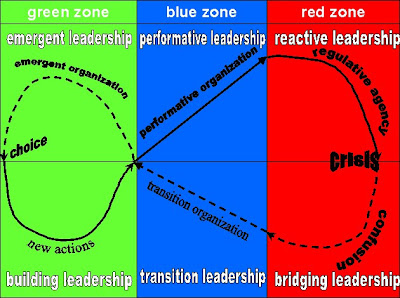
Roxburgh and Romanuk (Christendom thinking to missional imagination, unpublished work, p26) use a three zone model to model life-cycle of a local church:

The Three Zone Model … visualizes the organizational cultures congregations and denominations form at various periods in their lives. It represents a dynamic of continuous change in organizational culture relative to the external environment. Church systems living in the discontinuous change now characterize Western societies will be continually shifting through these zones
This can be applied to a human life: babies and teenagers grow like crazy; but tend to get a haircut and real job and settle into more settled life patterns; which is followed by retirement. This can be applied to organisations – they grow in an adhoc, experimental, tentative way; they need to settle into more structured patterns; and will eventually face their need to die well. At each stage an organisation can resist the lifecyle, and choose to enter into destructive patterns.
Note that:
• life cycle process are normal. We should expect cycles of life, death and resurrection.
• change in any particular movement needs to be understood as part of a series of phases and not simply looked at in isolation
• all zones are valid and essential. For example, red zone leadership is a needed, required, natural part of the rhythm of organisational life.
• the diagram can help to identify what type of leadership is required in an organisation and to move to the next stage of the life cycle
• classical “seminary” training is often shaped by the blue zone or the red zone. Most church systems breed managers and encourage chaplains.
• different congregations and groupings in a organisation can be at different stages. At one time you can have parts that are being planted, flourishing or dying.
So this provides another way of thinking about pioneers. They thrive in the green zone. Leave them too long and they keep creating chaos. Partner them with “blue zone” people, and more settled and sustainable, managed patterns are likely to emerge. I suspect that this tension is what underlay Mark’s original post.
What then to do with pioneers as the organisation goes more blue zone? Send them off? That is one way, although it is hard on the pioneer and the organisation. Another way is to encourage the pioneer to develop another green zone within the organisation. However this might have practical issues, in regard to resources. It also requires re-definition, both by the leader and their community. Managing expectations is such a key part of leadership and these type of shifts are complex.
But it does NOT (IMHO) provide a way of thinking about pastors. We need to be pastoral in green and blue and red zones. In saying this, I am defining pastoral not as a title, but as a way of being – of walking alongside.
Part 1 leadership practices here;
Part 2 community here.


 )
)