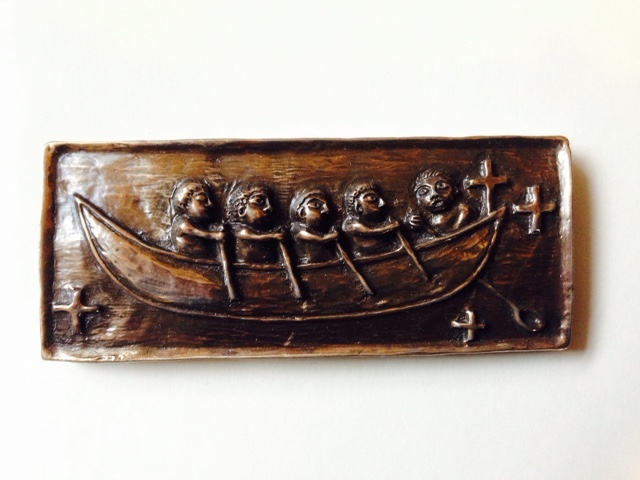
Wednesday, November 09, 2011
seminaries as missional orders planting missional communities
it is unethical to send gifted, idealistic, and high-potential young leaders into intractable, dysfunctional congregations that will grind them up, disillusion them, and damage them for life
So suggests Brian Mclaren in a recent article on the future of seminaries. He argues that seminaries are doing a great job of providing a robust intellectual environment, ecumenical diversity, are soul-friendly and engaged missionally and offer a rich communal life.
I was talking to colleagues about this very issue over the weekend, expressing concern about the places that talented young ministers can end up in churches that have a slogan:
an unchanging church seeking an unchanging world
Brian offers a simple suggestion: “turn towards the development of new faith communities.”
What a grand suggestion. I would frame it as seminaries forming themselves as missional orders planting missional communities. And it is where, I think, we at Uniting College are structured to head with the Pioneer stream of our Bachelor of Ministry: a degree based on a student spending their time hands on entrepreneurial ie actually planting something – whether congregation or justice project or art collective and around that experience being formed as a leader and in relation to the wisdom of the church in the past.
In the article, Brian acknowledges that this is not for everyone and again, I agree. My response is to suggest that rather than individualised field work, the seminary select some “mission sites.” These would be diverse in context and in partnership with local churches. Seminary lecturers would be expected to be embedded in these projects, offering their talents in relation to these missional sites. One could be in a poorer suburb, another in a new build area, another in a pocket of sub-cultures. (For those reading this in Adelaide, I am actually thinking of specific sites 🙂
Students would select a mission site, thus finding themselves in clusters of learning through planting focused on a mission sites. The clusters and the sites would allow for a diversity of giftings to be explored, for some to develop mercy, others to plot radical justice, others to nurture being pastoral, others speaking evangelistically. By clustering they are being formed in ministry as team from the start. As a cohort of people, students will enter and exit, around a stable core of people. Gathering at College will be shaped by the issues of these contexts, the College will be praying for these sites (think contextual pictures around the College walls). Over time, new faith communities develop. Seminaries as missional orders planting missional communities.
Anyone else up for such ride?
Monday, November 07, 2011
the never ending list: leading in change
I really like this idea, found on the walls of our local IKEA.


Basically, they are advertising the improvements, they as an organisation have made. While it is part of their marketing, I think it contains some really interesting possibilities that could be easily adapted by any group
- start an open ended list titled “the never ending list.”
- keep a record of all the projects that could improve your team/group/community/church/business
- every now and again, decide as a team/group/community/church/business to pause from life as usual. Shut the door, turn off the phones, ditch a few meetings, stop a church service – whatever you need to do to unplug.
- instead gather as a group and invite folk to choose from “the never ending list.” Anything. With anyone they want. Some folk will want to work alone, others in groups. Some will want to work with those they know, others with someone new.
- use the time you have put aside from (3) to make progress on the idea
- meet at the end to share with each other what you’ve done, over food and drink. Cross of any completed projects. Add any new possibilities thrown up. Celebrate progress. Laugh.
I think it would provide satisfaction, promote teamwork, ensure improvements, all in ways that were sustainable, fun and communal.
Further posts:
For a related practical post on leading and change, see migration days.
Sunday, November 06, 2011
burning bush (Exodus 3 and 4), mission, call, creativity and Advent
I’ve been sitting for the last few months with the call of Moses in Exodus 3 and 4. A few months ago I heard it told well as a children’s story and really hit me. First, mission and the importance of beginning with our ears on. Second, call and what it means for me to respond to God’s call by simply giving my “staff” – my gifts, talents, experiences.
Over the weekend, as a way of trying to dwell further on the text, I googled burning bush icons. (I’m just about to finish an icon (another pioneer Jesus), so I’m beginning to feel my way toward my next icon project.) I could only find about four and one, was most intriguing. It is titled the Theotokos of the Unburnt Bush. (More here)

Mary is surrounded by the flames. She literally sits in the middle of the burning bush, while Jesus sits in the middle of Mary! I like how small Moses is, off and to the side, and the little angels up top, doing their spiritual play!
Textually, much of Jesus in the Gospels, especially in Matthew, is framed as the new Moses, leading a new Exodus. Thus visually, a burning bush icon that references Jesus is very Biblically astute.
What struck me was how visually it connects for me with that superb Advent icon, the Theotokos Orans icon.

Toward the end of last year, leading into Advent, I spent much time reflecting on the Orans icon and the implications for mission, church and pioneer leadership (here and here).
So there is something intuitive here for me, about the need to take of shoes for we stand on holy ground, about the mission of Moses as a forerunner of the mission of Jesus, about refinement, about possibilities.
Yes, I think I know what my next icon might be!
Monday, October 31, 2011
the white spaces in leader formation
Imagine a page. On it are black marks that make up words.
On it are also white spaces – the edges of the paper and the gaps between words.
Easy to overlook, yet essential for legibility, for clarity, for ease of reading.
Often when we talk formation, we concentrate on the back marks – the topics, the books, the content that needs to be internalised.
But what about the white spaces? If faith is caught much more than taught then what does it mean to cultivate the white spaces of leader formation, to be deliberate and intentional not just about developing and assessing the progress of black space internalisation, but white space formation?
The whites spaces include many things. For me, the list starts with things like mentoring, worship, spiritual practices. What would you add?
In what ways have you seen good practice in regard to the white spaces in leader formation – both in your own life and as you engage with others?
And how might we tend to the white spaces in a dispersed culture, when the academy is no longer monastic or the student’s sole community, but is one of multiple communities they are part of? How does we encourage God and the student’s work across what is in fact multiple white spaces?
Sunday, October 30, 2011
a visual vision for mission
This image became prayer for me today.

It was from an item of clothing at Pumpkin Patch. It got me thinking about a quote from Mike Frost, via Tim Hein at the mission shaped ministry course on Wednesday night
If you want to change the church more than you want to change the world, you’re NOT YET MISSIONAL.
And some things clicked for me in terms of leadership development. I’ve struggled historically with the concept of training leaders for the church. That’s because it’s often been presented as a vision to change the church.
Which is, as Mike rightly notes, is simply not missional. I need to keep hold of the vision of leading a church to build the city, rather than building the church itself. That’s what missional church leadership is all about.
For another vision for mission, see here.
Monday, August 29, 2011
leading in a mission: moses style
Sitting in church yesterday, I heard a particularly good storytelling of the call of Moses. I began to appreciate a number of important insights in regard to leading in mission.
First, the call begins with the cry of a people. So leading begins with listening, to the cries of those in pain. This is a care for another, a motivation to serve born out of desire to serve. And in the Moses story, the listening is quite specific, the cries of an oppressed Israelite people at a particular time in history. Good leading involves that depth, knowing what are the cries of our community, at a particular time. (For a specific way to do this, see some ideas I have produced here and here and here).
Second, Moses was invited to give what he had, his staff, his hand. In other words, to share what he had. This could be viewed thought the lens of asset-based community development, or appreciative inquiry, that Moses builds on what he has, on what he knows, rather than on what he does not have, or does not know. All people, all churches, all groups, have something in their hand, have gifts and insights and important ways of being. Leading in mission starts with being willing to offer that.
Third, it assumes our feelings of inadequacy. I find this wonderfully liberating. I often feel overwhelmed by what lies around me and deeply aware of my own limitations. So did Moses. Yet God called in and with those limitations.
So, leading in mission – Moses style
- listen deeply, specifically
- assume we start with limitations and liabilities
- simply give what we’ve got
I can almost feel a sermon coming on! 🙂 Which might be important, given that I am speaking Tuesday night at a Uniting Church Community network!
Thursday, July 07, 2011
pioneer night for a pioneer course in a pioneer country: launch of mission shaped ministry Adelaide
Last night was a good night. The wind was wild and the rain heavy. But the room felt warm and alive.
A pilot of the mission shaped ministry (msm) course kicks off in Adelaide July 27. A partnership between Anglican, Lutheran and Uniting churches, it will run over 14 weeks and one weekend.
Last night Dave Male, Director of the Centre for Pioneer Ministry, at Ridley College, Cambridge was in town. It seemed an opportunity to good to miss, a chance both to hear from him and to offer some information about mission shaped ministry.
About 40 folk showed up, which was pretty exciting for a wet and wild winter’s night. A representative from each of the 3 partner churches offered prayer and input. This included a ringing endorsement from Archbishop Jeffrey Driver, who hoped that when Anglican history is written, the most important thing about the year 2011 will be the successful launch of the mission shaped ministry course. Dave Male shared about the impact of msm in the UK and it’s importance in cultivating a missional climate. I shared some of the story of how the course came to be in Australia and spoke about the shape of the programme. (For those interested, my notes are below the fold).
Some time for questions. And then we prayed together. Across denominations. A living ecumenism, gathered around the task of mission.
Please join us. Please do pause at this point
… and pray with us … and for God’s ongoing purposes in Adelaide and Australia.
Wednesday, June 29, 2011
Why engage a leadership 360 process in Christian ministry?
Yesterday I blogged about a new Masters intensive, Leadership 360. As Sandy Jones spoke today, on why do 360? I took the following notes …
- Overcomes isolation. A common complaint from ministers is about a sense of is isolation in ministry. They get so little feedback and when they do, it’s often complaints. What they have found is that a Leadership 360 opens up constructive feedback loops. You get some perspective on your strengths and impact you are having on people.
- Eavesdropping into expectations. The leadership 360 has involved working with 100s of leaders. A recurring surprise is the fact that the 360 tool offers not just a window into a leaders own personal leadership. It also offers a window into the expectations that people have, or yearning for, in leadership. This is really helpful, as it allows insight and discovery of more about the community of faith you are part of and what might be significant for this group of people.
- Celebration. Invariably the 360 allows a chance to celebrate God’s grace through a person’s leadership. This is key, to take the feedback as a chance to honour before God what people are thankfulness for about your ministry.
- Assumes team. No leader can be great at everything. A 360 makes that obvious.
- Exploration of perception. The tool is not designed to describe what a great leader looks like, but interact with perceptions of those who engage with you in ministry.
- Invitation to journey. The process provides a space for journeying. It includes coach working with you to help a person process and plan. It mixes personal reflection mixed with coaching.
- Education. Doing the 360 can have an educative role for congregations. It helps folk realise the breadth of being in ministry. This can often cause them to want to better support and train. Which returns us to point one – it works against isolation in ministry
Wednesday, May 25, 2011
leading and fresh expressions
I’m back from a rich and thought-provoking time with the Anglican clergy of South Australia. Throat a bit sore and grateful for all those who prayed. One of their requests – to reflect on leadership and fresh expressions – involved me reworking some previous work, plus developing some entirely new material. Time consuming, but quite rich personally. It involved reflecting on the leaders who had helped shape my understandings of leadership in fresh expression
- Mary who births – hands open to God and eyes open to the world
- Elizabeth who blesses in Luke 1:39-45
- The unnamed in Luke 10 who speak peace and dwell at tables
- Paul in Athens who looks for unknown Gods
I explored the postures toward culture and the habits at work. This included some contemporary leadership and change insights, including appreciative inquiry and Roxburgh’s three zone model. Plus some stories, via God Next door and my Opawa experiences.
We ended by praying for each other (the person next to us), aware that we are all uniquely gifted, we are all uniquely called to keep growing as disciples and thus (for this group) as leaders and ministers.
It seemed to be helpful – as someone commented “You took what was beyond us and made us feel like we could be part of it.”
Tuesday, April 12, 2011
finding your theological rut
1. How do you do theology?
2. How does your church do theology?
These are the questions by which we concluded our (post-graduate Master/Doctor of Ministry) Program Seminar yesterday. The post-graduate Master/Doctor of Ministry can only be taken by folk in ministry and by folk doing it part=time. In other words, folk a few years into ministry. And I have this hunch that after a few years in ministry, a few years beyond formal training, it’s easy to settle into a rut.
Recent events in Australia and in the world – floods, fires, earthquakes, nuclear fear – make important the genre of lament. So that was focus of the class. We explored lament – in contemporary culture like U2 and Sound relief concerts, at nuclear disarmament protest marches and in the Biblical tradition.
Then at the very end we introduced the work of John O’Malley, Four Cultures of the West
- the prophetic culture that proclaims the need for radical change in the structures of society (represented by, for example, Jeremiah, Martin Luther, and Martin Luther King, Jr.)
- the philosophical culture that seeks to understand those structures (Aristotle, Aquinas, the modern university)
- the poetic culture that addresses fundamental human issues and works for the common good of society (Cicero, Erasmus, and Eleanor Roosevelt);
- and the performance culture that celebrates the mystery of the human condition (Phidias, Michelangelo, Balanchine).
We invited people to look in the mirror. To think about the latest tragedy they had encountered in ministry and to identity the main way they had responded. Did they engage in prophetic action, or want to think through the issues, or seek poetry or metaphor by which to name the suffering, or the liturgy they might have written? To group together with like-minded people.
And then to consider if that is a repeated pattern. Are we simply going to where we feel most comfortable? Where does the community we serve tend to go? Are they in a comfortable pattern? What might it look like for us to engage in a way of doing theology that is more unfamiliar to us, or to our community?
Because it’s easy to get in a rut. And part of our growth as leaders come as we push ourselves into different spaces and places.
Tuesday, March 15, 2011
What reaches young adults? 3 free giveways
I’ve just had an essay, titled “What reaches young adults?”, published in Australian Leadership. It was a commissioned piece and the entire edition is focused around generational mission, including pieces by Fuzz Kitto and Heidi Harding.
 Subscription is $68 (Australian); $78 NZ for 6 editions per year from Mediacom (go here for e-version). As author, I got a few free copies, which I thought I would offer as a freebie. I will send a copy of Australian Leadership to the first 3 people to comment on blog and provide a one paragraph biography of the person who was most influential in your young adult spiritual formation!
The article took a snapshot of a number of “young adult spirituality” moments in 2010 – from Blake Prize to Father Bob. Given that I was writing for a more mainline church context, I was particularly pleased with my concluding paragraphs.
If you have 0 young adults, then pray for them. Regularly use your prayers of intercession to pray for young adults. But choose your words carefully. Given the emerging trend of popular culture, you will need to find words to bless, rather than critique, their spiritual search.
If you have 1 young adult, then offer a traveling companion. Place this offer on the front of your weekly newsletter. Ask people in your church to become as curious as Father Bob, to ask a young adult to take you to the Blake Prize or the Big Day Out. Not to speak, but to listen. The aim is not to make Jesus relevant, but instead, to simply share, only when asked, your story of how your God-experience has daily legs.
If you have 5 young adults, ask to join them in a shared project. One example could be some shared, mutual action, a giving of legs to faith. Perhaps cleaning up a local stream. In other words, gather not around belief, nor around worship, but around mission action. (More examples can be found at the www.morepraxis.org.au, a ministry of the Uniting church in Victoria.)
Another example could be a conversation, similar in shape to espresso, one of the young adult congregations I helped plant. It began by inviting young adults to write down their questions about life and faith. These were thrown into a bowl. Together, some guidelines by which a culture of irreverent questions might flourish were agreed and discussion began. As one voice among many, the need for faith to grow by including irreverence was encouraged.
If you have 20 or more young adults, then you have a gift. Something to be shared not just with yourself, but with the wider body of Christ. Your task includes inviting them to put legs on 1 Corinthians 12:22 “those parts of the body that seem to be weaker are indispensable.” And how to partner with neighbouring churches who have fewer young adults than you.
Free to first 3 blog commenters to describe the person who most influenced them as a young adult!
Wednesday, March 09, 2011
gender, ministry and church on International Womens Day
It’s the centenary of International Womens Day. In honour of this significant occasion, I want to point to two historic posts on my blog.
The first is a more Biblical reflection on women and apostolic leadership, which explores one of my favourite missional leaders, a women called Joanna (Luke 8:3).
The second is a podcast interview (it’s one of my very first, so it’s not great quality) in which I interview Jenny McIntosh about women and the emerging church. She reflects on the struggles of women to have voice and explores some possible reasons. Is it about the way the Bible is used? Is it about 50/50 representation? Is it about the way gender’s know, relate and include – and so we need not just an emerging church, but an emerging change of culture?
Tuesday, March 08, 2011
a little pause to celebrate: the missional masters begins
Yesterday was for me a bit of milestone, which at the risk of being self-indulgent, I am pausing to mark.
Yesterday the Missional Masters cohort began and for 2.5 hours, I sat with a group of church leaders. Together we wrestled with Luke 10 and found ourselves both encouraged and challenged by the expression of mission. We began a conversation with Graham Ward, Cultural Transformation and Religious Practice
In August last year I was flying to Tasmania to work with their Synod. At 30,000 feet my brain started to do some free wheeling. For a number of years, Uniting College has been offering a Masters in Ministry. It is an exceptionally well-designed course, offering collegiality, flexibility and a practical theology focus.
At the same time, I have, for the past five years, taught a one-year course on Missional Leadership. Generally by the end, students feel like they are just starting. I don’t think this is because I am a poor teacher. Rather, I think it is a reflection on the long haul nature of being missional in leadership. The course needed more time, more years – not so much in lecturing from the expert, but more in accountable, collegial relationships.
At 30,000 feet I began to wonder what it would look like to apply this existing degree to the challenge of developing missional leaders in context.
- To shape the existing thesis into an action/research journal documenting missional innovation
- To shape the existing entry level papers on research design into a focus on action research
- To shape the existing theological reflection paper into a leadership evaluation process
- To shape the existing colloquim into a cohort specifically focusing on supporting each other in missional change
- To shape the existing Guided readings into a shared experience of reading mission texts together.
The last five months have involved moving this through academic processes, writing some thought pieces on the methodology (here and here and here and here), recruiting participants, seeking inputers.
Yesterday the work became a reality. I had hoped for 5 to 8 (adventurous) participants in first year, and then to add 4 to 5 each year after, which over a part-time 4 year degree, builds nicely toward a cohort of around 15 to 20.
Well, we began yesterday with 4 folk and expect another 3 more joining mid year, so looking on track. (This should include 1 in NZ, 2 in Queensland, 2 in rural South Australia, so certainly the distance thing seeming to be helpful.)
At the same time, numbers in our existing Masters/Doctor of Ministry have increased, an overall doubling of our enrolments, with over 30 folk involved in study. (That still leaves the PhD programme, of which we at Uniting College are involved in supervision of more than 10 candidates). The existing part of the programme began last week, and also started exceptionally well, a group of students reflecting on images of God in relation to disability and depression. Grounded, thoughtful and honest.
Hence the little, slightly self-indulgent, pause. Yesterday was a moment to celebrate.
Wednesday, March 02, 2011
Why are mainline churches in decline? could it be theology?
In my last post I engaged the question of why mainline churches are in decline (full post is here). I pointed to a blog comment which suggested the answer was because the church had lost touch with culture.
This is supported by a number of sociologists of religion, who point to the fact that many voluntary groups, not just the church, are in decline as they lose touch with cultural change. As I wrote last year in a post on being church in a time of cultural change (and drawing on some work by Kevin Ward:
So, consider that alongside the decline in church, is a widespread decline in all voluntary associations: from Lions to labour unions, from political parties to bowling clubs.
In New Zealand in 1970’s about 400,000 people played rugby. By 1990’s it had plummeted to 100,000.
Why? Factors include authoritarian and controlling environment, rigid structures, high institutional overheads, dress code, conformist culture, lack of choice, repression of individual for sake of community.
At the same time, touch rugby, while only started in an organised sense in 1990, had by the year 2000 over 272, 000 registered participants.
Why? It is minimalist, gender inclusive. Individuals can choose their own team, while teams can choose their uniform and name. Time is limited and there is a high value on socialising and fun.
In other words, traditional structures based on long-term commitment and exclusive loyalties are less attractive than single stranded, less formal, smaller groupings.
But another answer to the question of mainline church decline is to point to theology. This comes in two directions.
First, some see the mainline church as liberal. So the church just needs to get beliefs right around notions of conversion, gospel, etc.
Second, some see the mainline church as conservative. This was summed up delightfully in a conversation I had during the week. After I presented on Fresh expressions I was asked if surely a person needed to give up on belief in an interventionist God in order to be part of a fresh expression. My conversation partner wondered if there was a need for a fresh expression not only of church, but of theology. This was defined as moving away from historic notions of a three tier universe and God as an intervenor in people’s lives. In other words, the mainline church is in decline because of theology – it’s too conservatively old-fashioned.


 )
)