Wednesday, November 12, 2014
intensive week: campus comparisons
It is intensive week at Uniting College, with three intensives running in two different geographic locations.
In Adelaide, Theology and Practice of Chaplaincy is being taught by Rev Dr Trevor Whitney. It has attracted folk from around the country, including Frontier Services Patrol Ministers, some of whom have driven for ten hours to be part of the intensive. Their 4wd vehicles sit, large and proud, in our carpark, a physical reminder of a national church.
In Adelaide there is also Formation for Christian ministry, being co-taught by Dr Pete and Sue Kaldor. They’ve joined us from Sydney for the week. That class also includes folk from inter-state, Ministers whom we at Uniting College have trained and now sent nationally, returning for ongoing training as part of their post-ordination training.
In Gold Coast, there is Theology of Jesus, being taught by myself. It is another step in the partnership between New Life Uniting, Robina, and Uniting College Adelaide. According to the Gold Coast locals, there are around 530,000 people who live on the Gold Coast. There are no theological Colleges, apart from a few Pentecostal churches that run in-house offerings. There is also a lack of distance providers in Queensland. The result is a group of the most enthusiastic students I’ve ever had, so grateful for the chance to learn and grow.
Without wanting to create a rivalry! the fact is that Gold Coast campus is far better equipped than the Adelaide campus! Check out this view … some students working on a group project.

This is just the start. New life have a vision for offering ministry training throughout the Gold Coast. To make that happen they are outfitting a newly built area as a lecture room, are planning a dedicated student cafe area and have a medium term plan to build a dedicated set of lecturer offices. It’s a privilege as part of Uniting College to partner with them in their dreams.
Sunday, November 09, 2014
teaching the “flipped” open table of Jesus
My Semester 2, Jesus Christ topic, came to an end this week. It ended as it began, with food. Every week for 13 weeks, soup has been offered. For two of the classes, the entire lesson was done around food. One week, as we talked about the open table of Jesus and the final week, as we reflected on our experiences together. In doing so, a very different dynamic has emerged among us. We have become community, shared being human, laughed, shared soup recipes.

The dynamic around soup had reinforced another change in class – a change in teaching methodology. I introduced flipped learning. Class readings and lecture notes were placed online and students were invited (expected) to come to class prepared to engage in activities together.
In order to encourage this, I provided two learning moments. First, a discussion around what type of individual behaviours would enhance our class learning as a group? This generated an informal set of expectations among us. Second, an introduction to how people learn. I offered Bloom’s taxonomy and suggested that the traditional lecture tended to keep class time focused on knowledge and comprehension (bottom half of the circle). However if reading was done prior, this would mean our class time together could be used to focus on analysis, synthesis and evaluation (top half of the circle). In order to help this, every class offered a choice of activities. Students could choose to check their comprehension, or to work with classmates in an activity of their choosing – analysis, synthesis or evaluation.

The result has been a vastly different learning environment. The class has been pushed in new ways and I’ve learnt a lot as a teacher.
To help us process the semester as we gathered the final time, I suggested reflection around three colours. Green, a moment of growth that had occurred in the class. Red, an emotion we wanted to express. White, any thing else we wanted to share.
It had been an extraordinary class. Alongside the flipped learning, we’ve also had to process tragedy. During the semester, a student in the class unexpectedly died. Healthy one week, fully participating, fully engaged. Then during the week, they suffered an out of the blue heart attack.
So the class has had to process this sudden gap. In some ways the soup and flipped learning have made the gap larger. We’d become more human, known each other in ways more vulnerable and real. Twenty heads facing a talking head lecturer would not have formed these levels of community. Equally, have formed community, we experienced greater pain. But because we were a community, we drew strength from each other, found a group ready to listen and pray.
Such is the “flipped” and open table of Jesus. More engaged. Perhaps even more painful. Yet more vulnerable, more supportive, more human, more prayerful.
Thursday, November 06, 2014
too busy not to listen
As the Semester ends at Uniting College there is the usual tiredness, mixed with piles (and piles) of marking. At times of busyness, the need to make time to listen is even more important. In fact, listening is one of the most important things a leader can offer their community. We have two ears but only one tongue for a reason. Hence the following invite, being sent out to our students in the next few days. It is an invite to be listened to ….
Greetings,
It has been a year of significant change for students at 34 Lipsett Terrace, Brooklyn Park. Whether you are studying for a Flinders University or Adelaide College of Divinity award, there have been changes – with new technologies, with the library, in ecumenical relationships.
As the year ends, Janet Buchan (Executive Officer, ACD) and Steve Taylor (Principal, Uniting College), would like to spend some time listening to students. Whether you are undergraduate or postgraduate, part-time or full-time, we would like to hear from you.
What is working well? What could work better?
We will offer you pizza. We will guide you through a process of clarifying and refining the good and the bad.
We make three commitments
- We will provide you with pizza if you RSVP
- We will listen
- We will make what emerges a priority for us into 2015.
Date: Wednesday, November 19, 5:30 pm-7:15 pm, student common room. RSVP by Monday, November 17, to lynda dot leitner at flinders dot edu dot au
Hoping to see you
Janet Buchan and Steve Taylor
Wednesday, November 05, 2014
Boyhood: a theological film review
Monthly I publish a film review for Touchstone (the New Zealand Methodist magazine). Stretching back to 2005, some 85 plus films later, here is the review for November 2014, of Boyhood.
Boyhood
A film review by Steve Taylor
“The good news is that you’re feeling stuff.”
Father to son in Boyhood
We have either all had one or observed one.
I refer to boyhood: that process by which a child grows into an adult. “Boyhood” the movie follows Mason from age five to eighteen. Through his eyes we experience broken marriages, domestic violence, bullying and various male rites of passage deemed essential to contemporary Western cultural life. We face the pain and potential of becoming adult.
“Boyhood” was twelve years in the making, twelve short stories, each written over the shooting period. It was collaboratively, director and actors together shaping the narrative direction.
Director Richard Linklater is known for movies including “Before Sunrise,” “Before Sunset,” “Before Midnight.” Each of the three “Before” movies focused on one twenty-four hour period.
Each explored generational rites, earning Linklater a reputation as the definitive cinematic capturer of 20-something contemporary culture, a visual Douglas Coupland.
In “Boyhood,” that one day becomes thirteen years. Academics call it longitudinal studies, repeated observations of the same variables over long periods of time. They also call it particularity, in which the focus on the singularity makes accessible what is universal. It’s impossible to watch “Boyhood” without thinking of your own becoming of age.
Each of the “Before” trilogy also features Ethan Hawke, who in “Boyhood” faces his own need to grow, from 20-something to father of Mason (Ellar Coltrane) and his older sister, Samantha (Lorelei Linklater). She is also Linklater’s daughter. After the first three years of filming, she wanted out, asking her director father to find a way to kill her “Boyhood” character.
If Linklater is master of the capture of contemporary culture, then what are we seeing as we look in the “Boyhood” mirror? Reflected back are images of developing technology, the seduction of education, the corrosive power of alcohol, the potential of parents no matter life’s circumstances.
The theological notes are intriguing. Good news, a phrase rendered cliché and clunky by so many Christian churches, becomes in “Boyhood” the appreciation “that you’re feeling stuff.” It sets up the final scene in which Mason asks if we seize the moment? Or do the moments seize us? Hence good news becomes feeling the experiences of the now.
It is an intriguing attempt at theology, given that growth over time, grasped through a sense of unfolding memory lies at the movie’s core. This is best depicted by Mason and Samantha’s mother (Patricia Arquette), as she faces the adulthood of her children.
“This is the worst day of my life. I knew this day would come, except why is it happening now? First I get married, have kids, end up with two ex-husbands, go back to school, get my degree, get my masters, send both my kids off to college. What’s next? My own funeral?”
For her to experience the now is news more bad than good. Which perhaps is the real message of “Boyhood.” That growing up is for adults.
Rev Dr Steve Taylor is Principal at the Uniting College for Leadership and Theology, Adelaide. He writes widely in areas of theology and popular culture, including regularly at www.emergentkiwi.org.nz.
Sunday, November 02, 2014
looking up
I love the creativity by which spaces are changed. Here is a wonderful example from our recent holiday in Turkey. The interior of a large room, and from the ceiling had been hung bright yellow coloured rings.

Walking inside, we noted a change of colour, from yellow to green, along with a change of shape. It seemed invitation, pointing toward another room.

They had even placed a swing inside. Which sure enough, you were allowed to play on. I watched a young child head straight for the swing, and another young couple enjoy some fun together.

It changed the entire look and feel of the place, from large and stark, to playfully invitational. I have no idea why (not being fluent in Turkish) but it was a memorable and striking way to invite us to “look up.” It created interaction, built conversation with strangers (Wow, what is it?) and offered a set of memories that walked with us into our week.
A church could use their “looking up” to change with the colours of the church year, to hang angels at Advent, to create more intimate surroundings in winter. For a positive, practical, example, Cityside Baptist in Auckland were superb. They had strung wire across their auditorium and this allowed them to attach spots, but also to provide a range of creative offerings – flowers, poppies at Anzac Day.
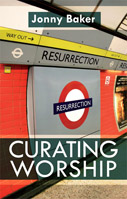
Up is as much of a space to be curated as the front. (For more on curating and worship; see Jonny Baker, Curating Worship

Friday, October 31, 2014
The complexity of authenticity in religious innovation: “alternative worship” and its appropriation as Fresh Expressions
There is a Cultures of Authenticity Symposium in Adelaide, 28 November, 2014. Here’s the brief
Authenticity pervades contemporary culture. This symposium provides a unique opportunity to investigate the significance of authenticity in regards to self, culture and society across key areas of social life from ethics, spirituality, work and intimacy to new media, tourism, health and environment.
The invite is to scholars to submit papers assessing the role of authenticity in late-modern life and its real-world applications and consequences. Full papers will be published in the journal M/C. It seemed a good opportunity to take my research on fresh expressions into a wider conversation, so last night I submitted an abstract:
The complexity of authenticity in religious innovation: “alternative worship” and its appropriation as Fresh Expressions
This paper will explore the formational potential of authenticity in late-modern cultures, with particular attention to unintended consequent complexities as authenticity is appropriated by contemporary religious innovations.
Recently within Western Protestantism a range of new approaches to church and worship has developed. Ethnographic research into these religious communities (called “alternative worship”) shows that authenticity was a generative word, used by these community to define themselves as marginal and thus to justify innovation.
However these acts of self-location, so essential for innovation and identity, were complexified when appropriated by the mainstream. This occurred first as mainstream religious communities sought to implement selected liturgical innovations generated by these “alternative worship” groups. Secondly, an organisation structure (called Fresh Expressions) was formed by appropriating the innovation. However the generative energy was not around marginality but rather on the renewal of existing institutional life.
These complexities can be theorised using the work of Sarah Thornton (Club Cultures: Music, Media, and Subcultural Capital (Music Culture)
This suggests that authenticity plays a complex role in identity formation in a branded world.
Thursday, October 30, 2014
the power of the Preamble
In recent years, the Uniting Church in Australia has added a ‘Preamble’ to its Constitution. Emerging from discussion with indigenous folk (UAICC -Uniting Aboriginal and Islander Christian Congress) it provides an account of the role of the church in Australian (settlement/invasion) and makes some declarations of the Indigenous experience of God.
For instance, here is paragraph 3:
“The First Peoples had already encountered the Creator God before the arrival of the colonisers; the Spirit was already in the land revealing God to the people through law, custom and ceremony. The same love and grace that was fully and finally revealed in Jesus Christ sustained the First Peoples and gave them particular insights into God’s ways.”
Yesterday our Christology class had the second in our indigenous women’s Christology series. We had the privilege of hearing Eseta Meneilly, a Uniting Church minister from Victoria, share how she connects Christ and her culture (Fijian).
She began her lecture by noting the power of the Preamble. How when she read the Preamble, she began to wonder. If the First Peoples of this Australian land had already encountered God, then did the same apply to her Fijian people’s experience? As she pondered this question, she remembered something from her school days. Long forgotten in her journey, a piece of her cultural history.
She shared this cultural history with the class and together we began to see a deeply Incarnational movement by the Christ, to be present in a (Fijian) cultural worldview. We decided that yes, indeed, here was a “particular” insight into God’s ways.
As part of the indigenous women’s Christology project we have videod the lecture by Eseta and a researcher will work with Eseta to see if we can provide a written account. The hope is that this will be added to other indigenous Christology accounts and a student resource might emerge, that can place indigenous theologies alongside the weight of currently published Western Christologies.
But as these efforts to make more visible these rich Christologies continue, I am struck today by the power of the Preamble. I am grateful for the courage of those who dreamed it, wrote it, advocated for it. I’m intrigued by the potential of a written document to bring change, including theological and missiological change. I’m challenged by people, like Eseta, who have taken the Preamble seriously. I’m eager to hear and see what might continue to be produced in the year’s ahead.
Monday, October 27, 2014
sticky innovation: making change concrete
Making change stick. It’s one of the challenges of innovation. Finding ways to embed change in the life of your organisation and your systems, so that change lives on. Last week I saw this happen in two different ways, by ritualising and by double-dipping.
First, by ritualising. Last year as our annual Presbytery and Synod approached, I was in a group discussing a separate issue, of how to name a change in our candidate process. Uniting Church ministerial training guidelines, passed in 1997, reviewed and affirmed in 2007, call for a Third Phase of Ministerial Education. It is intended to be period of sustained and intentional mentoring and support for newly ordained ministers during the first three years of ministry practice. In South Australia, this partnership happens through Formation Panels. Nine times in Phase two, five times in Phase three, a group of experienced ministers meet with those in Phase 3, to provide support in transition, to advise in managing time, developing an appropriate work-life balance and doing all those firsts – wedding, funeral, baptism, Easter, AGM, conflict!
Deep relationships form. Then suddenly, the minister has moved to Phase 4. How to honour this change? At the same time, another group I was part of was planning the annual Recognition of Ministry service, in which retiring ministers are thanked and blessed. Why not weave a new ritual into that evening? Why not ask all those transitioning into Phase 4 to stand? Why not celebrate this expression of growth? Why not ask the retiring ministers to bless them?
This week the annual Presbytery and Synod approached again. The order of service from last year was found and the email arrived. “Steve, last year we did something. Can you remember what it was, because it needs to be done again.” And so ritualising, weaving a growth moment, with prayer, into a worship service, had “stuck.”
Second, double-dipping. In May, we introduced a change into our Adelaide College of Divinity graduation service. As each graduand came forward, they were briefly introduced. A few sentences that told where they had come from, what they had studied and where they were going to. This involved a prior brainstorm regarding what we as Faculty knew of the student, followed by a phone call to ensure the student was happy with what would be said. A bit of work. But the feedback was overwhelming. Students felt personalised, the audience felt connected.
Last week, we faced the annual government reporting. It includes a graduate survey, to capture employability. We all grinned. No need do that research, because we already have that data. Sure enough, every single graduation introduction, had the employment data we needed. Double dipping. Using one piece of work twice. It makes the change likely to “stick” because of the value of double dipping.
Making change stick is harder that starting change. But ritualising and double-dipping are all practices which make change concrete.
Friday, October 24, 2014
the teaching challenge: theology
I wrote this recently, in response to a Flinders University request to explain why I teach, and how this applies in how I teach theology. (It is a few paragraphs by way of contextual introduction in what was a 5,500 word paper about evidence-based research I’m doing into the impact of flipped learning on the student experience).
Theology students are more likely to be part-time and mature in age. This presents a range of challenges including managing significant diversity within the classroom and working with a range of anxieties as mature age students return to study.
Theology is often closely tied with personally held beliefs. Some students are studying for a vocational role in their religious communities, while others study for interest. This presents some unique learning challenges. Students are being invited to engage critically with beliefs that at times they, or the communities to which they belong, are highly invested in.
In response, I seek to be a learner-centred educator. I believe that each student comes with a unique finger print and deserves space and processes to connect their existing life experience with the subject matter. People learn best when safe space is created, so a classroom of respect and appreciation of diversity is essential. Thinking aloud must be allowed.
Wednesday, October 22, 2014
singing a new song
The lectionary Psalm for the day has twice, in the last six days, begun with the words “Sing a new song.” I used it to begin our team meeting community time last week. What new things are we seeing, that we need to “sing” in thanks to God? It opened up a rich and celebrative conversation.
Reading the words again today, it struck me that singing has different dimensions. It can be aural, the audible lifting of voice. The singing can be recorded and thus the the audible lifting of voice can be shared. The singing can also be written down as sheet music, and thus others can perform the new song for themselves. In so doing, the performance can then change, as new harmonies are added, as different speeds or mixes are incorporated. Each are ways to “sing a new song,” each allow different layers of reach, influence and release.
I used this notion of “singing a new song” to reflect back over what God has been doing in and around me in recent weeks.
First, the “singing” of the indigenous womens’ Christology project. This was aural in class last week. But through strategic use of funding, there is the hope it can be recorded. The hope is that in “singing” this indigenous song, that different contexts are freed to sing their own unique harmonies, to find confidence in their own “performance” of Jesus.
Second, the “singing” of the urban gardens presentation I did at the Urban Life together conference. This was sung on Saturday, to a group of conference participants. The conference hopes to produce a book, and so my aural “song” might well end up “recorded.” (If I can find the time).
In the meantime, some of what I said was “recorded” in bits on my website. It’s one of the reasons I blog – to sing a new song, and in a different “recorded” way than book based “recording.” During the conference, a stray conversation with another conference participant offered another “mix.” Again, I recorded this by blogging it, linking community development, missiology and urban development. In turn, it attracted some wonderful comments, which linked with flipped learning and it helped me make connections to another “mix”.
Aural, recorded, performed: the many ways that we can sing a new song.
Tuesday, October 21, 2014
life to the full: Boyhood and wellbeing
Over the weekend, I watched Boyhood, the coming of age movie by Richard Linklater. It’s outstanding, following Mason from age five to eighteen. Through his eyes we experience broken marriages, domestic violence, bullying and various male rites of passage deemed essential to contemporary Western cultural life. We face the pain and potential of becoming adult.
Over the weekend, I noted that a school in Western Australia were advertising a new position – Director for the Centre for Boys’ Health and Well-being. It is a new role, to inform the school and wider community through guest speakers, research and publication of best practice and next practice related to the health and well-being of boys of school age. It builds on the Centre for Ethics and the Centre for Pedagogy.
It seems to me to be a new way of the church (in this case it is an Anglican school) doing public theology. Here is a group talking wellbeing (which can be framed as John 10:1 – life to the full).
I loved the meshing of input, research and communicate. I love that it’s research linked closely to actual communities, in this case to school and parents. I love that it’s such a practical response to Boyhood.
Sunday, October 19, 2014
flipping good neighbours in community engagement
I was researching a community ministry this week, interviewing about a community garden planted on a rooftop, four stories high in inner-city Sydney. (It was part of my work on Urban gardens for the Urban Life together conference).
In telling the story of the community garden, the comment was made that in beginning the garden, they didn’t how to garden. As a result they reached out to local gardeners. Similarly, in establishing bee hives as part of the garden, they didn’t know how to keep bees. Again, they had to reach out to local book keepers.
It struck me as a fascinating approach to take to community development. Start with what you don’t know.
Later in the interview, I returned to tease this out further. “It sounds like your lack of knowledge was a gift. It involved the community to shape the environment.”
Absolutely was the animated reply. Start with what you don’t know and you ensure very different relationships with your community.
In Luke 10:5-8, Jesus instructs the disciples in mission.
‘When you enter a house, first say, “Peace to this house.” If someone who promotes peace is there, your peace will rest on them; if not, it will return to you. Stay there, eating and drinking whatever they give you, for the worker deserves his wages. Do not move around from house to house. ‘When you enter a town and are welcomed, eat what is offered to you.
What if Luke 10 is picking up on the same approach? Jesus sends the disciples with nothing (Luke 10:4), with no food for the night. When they approach the community, they approach with vulnerability, with a lack. In doing so, they invite a different set of relationships. Specifically, the person of peace, the one who opens the door, is being invited to become a good neighbour. The community is being invited to be generous, to be hospitable, to participate in partnership.
This is a risky strategy. It might not work, leaving the disciples hungry. Or it might come across as manipulative. (I think this is addressed by the offer of peace in verse 5 – see an earlier post on Sharing faith across cultures).
But it does totally flip the traditional understanding of being a good neighbour. What if the task of the church in mission is not to be a good neighbour? Rather what if it is to act in ways that enable our community to be good neighbours? What sort of relationships of mutuality and partnership might emerge?
It would be as practical as starting community ministry in the areas in which we lack some knowledge.
Thursday, October 16, 2014
Urban Gardening
At 4 pm I shut myself in my office, with the challenge of writing at least one, if not two academic papers for the Urban life together mission conference in Melbourne this weekend. It looks a fantastic event, encouraging mission reflection among grassroots practitioners.
I wanted to explore the potential of urban gardens for the mission of the church. A few hours work and I have some 2,800 words ready to go. I’ve woven together two film reviews, some of my research into local stories of inner-city urban churches doing garden mission, spiritual practices of composting, a consideration of the shady side of spirituality, some Maori proverbs, interaction with a range of Bible texts in God’s garden, gratitude for the wisdom from Julian of Norwich and Fred Bahnson’s Soil and Sacrament: A Spiritual Memoir of Food and Faith
Here’s my introduction:
Some gardens are planted in straight lines. They are orderly and linear. Other gardens are planted higgelty pickelty, random and inter-connected. Some academic presentations are planted in straight lines. They are orderly and linear. This presentation is neither straight nor linear. Rather it is random and in the higgelty pickelty you are invited to make the inter-connections with your urban context ….
Which leaves the powerpoint, but there is always the early morning flight over.
Wednesday, October 15, 2014
indigenous women’s Christologies project
The indigenous women’s Christologies project began tonight. It began with an indigenous Adnyamathanha woman, Aunty Denise, speaking at our theology class, talking about how she does Christology. It was an extraordinary performance, with an hour of what was essentially an extremely sophisticated hermeneutic, laced through with stories of how the oral stories of culture help her address “Who is Jesus for her.” So the Jesus theology class got an outstanding example of contextual theology. The evening was open to the public and it was great to have a few visitors join us, and catch a glimpse of the edges that contemporary theology at Uniting College is currently exploring.
A second evening will occur on October 22, when Eseta Meneilly will join us, offering an indigenous Fijian Christology.
Around this speaking, two further processes are at work. The talk was being recorded, for future reference. In addition a researcher was in the room, listening and recording. The aim is the production of a written and video resource study guide, which in conversation with the presenters can be used more widely – by other classes and by other theologians.
I introduced the lecture today with the following:
“This breakthrough that occurred in early Christianity via dialogue with the different cosmologies is an important precedent and model for the conversations that should take place today between cosmology and Christology.”
Now change three words (worldviews and cultures).
“This breakthrough that occurred in early Christianity via dialogue with the different [worldviews and cultures] is an important precedent and model for the conversations that should take place today between [worldviews and cultures] and Christology.”
In hearing the theology of another, their conversation between their local worldview and a Christology, it helps us begin to form and refine our “model.”
So the class are now processing three questions
– How does Aunty Denise do theology?
– Who is Jesus for Aunty Denise?
– What can I and my community learn for how we do theology?


 )
)