Thursday, September 09, 2010
tricky theology question from a 10 year old
A delightfully agile 10 year old threw me this question last week.
How do you know that God is the most powerful one? What if there was someone more powerful, but they have been keeping that hidden?
I’d be grateful for any insights, ponderings and musings from you, my intelligent readers.
Wednesday, September 08, 2010
So what was the shape of your ministry today?
Was the question as I walked in the door. It’s been a rich day. So pour yourself (and me) a drink and let’s talk.
1. I presented my findings in review of a fresh expression. It’s been a fascinating experiment – an attempt to build an online community. I was invited to be the “missiologist-in-residence” as it were, which was an enormous privilege. There is not much written on this, so it has been such fun linking fresh expressions thinking with online website tools. I ended up writing about 2,500 words. So it has the makings of an article at some point.
2. I got to talk to someone about their “restless” heart and to discuss their journey toward ministry. A potential pioneer leader IMHO.
3. I got to help align a student research masters with a supervisor. It’s sort of a form of discipleship. Someone wants to do some thinking, some serious thinking, about what it means for them to love God and neighbour. And I get to help them align some people in ways that will maximise that learning. Huge privilege.
4. I got to meet with one of my PhD students. She’s just beginning a fascinating journey, wanting to explore how to help marginal voices, particularly speakers of English as a second language, do theology without imposing Western ideas on them. Stimulating.
5. I got to write up some of my own research. Again fascinating – to listen to some recorded interviews with pioneer leaders (of the alt.worship variety) and attempt to reflect on their stories missiologically. I’m developing a hunch and here it is: that “fresh expressions of church” is fundamentally an unhelpful phrase in a mission sense. I’m still working on my logic to support this hunch. But I am loving the reading, reflecting, probing.
Cheers. Thanks for listening.
Tuesday, September 07, 2010
creationary: lost coins, lost sheep
A creationary: a space to be creative with the lectionary. For more resources go here.
With the lectionary text for Sunday being Luke 15:1-10 or Luke 15:1-32, here are some resources I’ve used previously, buried in my blog archives, that might be useful.
First, here is a missional pondering on Luke 15, in which I tease out some of the potentially unhelpful mission and ministry images that might be at play.
Then Jesus told them this parable: “Suppose one of you has a hundred sheep and loses one of them. Doesn’t she leave the ninety-nine in the open country and go after the lost sheep until she finds it? And when she finds it, she joyfully sits down. Then she calls the friends and neighbors of the lost sheep together. And as this moment, as a new missional congregation is planted, the shepherd and existing congregation burst out ‘Rejoice; the lost sheep is found.’ I tell you that in the same way there will be more rejoicing in heaven over one sinner who repents than over ninety-nine righteous persons who do not need to repent.
Second, a gender in ministry reflection emerging from the lost coin parable on Jesus as the good woman. Here’s an excerpt:
Luke 15:1-7 presents Jesus as like a good shepherd, searching for a lost sheep. Luke 15:8-10 presents Jesus as like a good woman, searching for a lost coin. The church has been very happy to tell me about the first, Jesus as good shepherd. But why has the church been strangely silent about the second, Jesus as a good woman? As Kenneth Bailey, Finding the Lost, notes, Jesus is remarkable for the way he affirms both women and men as “full and equal participants in the kingdom of God.” Surely this pairing has something to say about women in ministry.
Third, some potential worship stations.
Sheep station – with a metal fencing and gate, and the invitation to
Look: at the fence and the gates.
Act: by sitting inside the sheep pen.
Reflect: How would you feel if you were ninety-nine? Pray for us at Opawa, and for what your feelings mean for the future of the church.
Art station – an invitation to
Look: at the art image, Woman Sweeping, by Jean Vuillard; which portrays God as an ordinary house-keeper in everyday life.
Reflect: on the following poem
I was passionate,
filled with longing,
I searched
far and wide
But the day
that the Truthful One
found me,
I was at home.
by Lal DedCoin station: – with a whole lot of coins scattered around
Act: by holding a coin. On one side of the coin is a name of a child in our community. Pray that they will be found.
The other side of the coin is blank. It might be your name. What does it mean for you to know that God, like the woman, searching is for you? It might be someone you know. You might want to pray for them by writing their name (permanent marker supplied).
Whatever you do, take the coin with you into your week.
For more go here.
Finally, for those who need a bit of a light relief, here is the true story of what happened one Sunday in worship (ending with a reflection on leadership). Like all good Kiwi stories, it started with a sheep. (more…)
Sunday, September 05, 2010
being church in an earthquake zone
Given that only a few months ago, I was pastoring in Christchurch, my thoughts in the last 24 hours have revolved around wondered what I’d do if I was pastoring, being church in the midst of such destruction.
My current thoughts (and I’m at distance, so might be way of beam) revolve around creating some sort of communal drop-in point for at least the next 7 days. Open the foyer from 9 am-3 pm. Provide hot soup. Set up some breadmakers and get a lovely warm, home smell into the place. Since schools are being closed, set up an area for kids to play, with a range of games. My hunch is that people will want ways to be together, to share, laugh, cry. So tables with food allow that to happen naturally.
Some people might want a more focused listening ear, so I’d set up some “sharing couches” and have some designated “listeners” who would simply be there to listen. I’d tell them to keep an ear out for those who might need more focused help, 50+ after shocks and counting might led to trauma for some.
I’d set up a range of prayer stations, that would allow people to engage with God. Words are hard to find in the midst of shock, so I’d focus on simple, tactile ways to pray.
“Oh help” station – with candles and sand trays to lit in memory of things that are lost, broken, damaged, missing. Simply helping people name the grief and the shock.
“Whew, that was close” station – post-it notes or clothes line prayers (string and some pegs), in which people could give thanks for what they still have – life, food, neighbours, friends, a professional Civil Defence … and so on. Simply helping people pay attention to moments of grace.
“Seeking beauty” station – a sort of craft table, in which people could make something of beauty. For some this would be facile. For others, it’s a part of being human and it can be a way of helping people focus beyond themselves. I’d make it communal and expect that lots of healing chat would happen.
“Where is God” station – a thinking station. Often at times like this God’s name get’s used in some pretty naive ways. Quietly ignored for years while the good times roll, yet suddenly named in the midst of devastation. In all sorts of ways – judgement for sin or suddenly micro-manager of the world. At this station, I’d probably put up some prayers prayed by those who throughout history have experienced tragedy. Perhaps blow them up big ie A2 size, with pens, and expect people to engage in response. Some examples might be Psalms of lament of which there is a huge range. Without checking them all for suitability:
- some Community Psalms of lament include 12, 44, 58, 60, 74, 79, 80, 83, 85, 89, 90, 94, 123, 126, 129; while
- some Individual Psalms of lament include 3, 4, 5, 7, 9-10, 13, 14, 17, 22, 25, 26, 27, 28, 31, 36, 39, 40:12-17, 41, 42-43, 52*, 53, 54, 55, 56, 57, 59, 61, 64, 70, 71, 77, 86, 89, 120, 139, 141, 142. Yes, heaps, because unexpected tragedy and pain is part of being human.
- here is a sermon I preached, using one particular Psalm (69), after the Mangatepopo River tragedy plus some words and liturgical ideas we used at the time
- a pile of other prayers in disaster are here (textweek.com),
I’m not sure whether I’d have a station in relation to giving aid – whether practical or financial. My hunch is that at least for the first few days, the most important thing is simply space to pray and most of all, ways to naturally be together, eat together, laugh together. But again, I’m miles away, so might be really out of touch.
Saturday, September 04, 2010
my home’s a state of emergency

Update 2: candle lit today in prayer. It’s really hard to be so far from home on days like today.
Update 3: one of my former teaching colleagues, Richard Neville has had his home destroyed.
Christchurch, the Taylor family home, has been hit by a major 7.1 earthquake. Biggest earthquake in New Zealand since 1931. No reports of death, but extensive building damage. Initial estimates are of $2 billion in damage. Photos here, some of which make it look like a war zone. The city is without water and sewage. Quite sad to think that of one’s own city. We’re still trying to check the state of various things, including family, friends, neighbours and property we own. Opawa Baptist pastors have been ringing through the church phone directory checking on everyone in the church. The church has suffered some interior damage, with lights broken. (Update 1: sounds like our house is OK. Still not sure about our holiday home.)
Friday, September 03, 2010
a “surface” book: hipster Christianity
I don’t like doing book reviews. It takes time to read a book, sit with a book, contemplate a book. So books I get sent to review tend to find their way to my pile of good intentions.
But I’ve just got my copy of Hipster Christianity. When Church and Cool collide by Brett McCracken and it demands a different approach.
Here is a whole book dedicated to people’s outward appearances. It visits a few churches and counts the goatees and the screeens. So in honour of a book glossing over people’s surfaces, I’ll give this book a quick surface read and review.
Here is a book that judges people, and churches, based on their outward appearances! If they look hip, then they might have sold out to culture! Really. What is culture? Oh, it’s the surface appearance, what people wear and look like. Really. I couldn’t find a single reference to any meaningful cultural theorist. Sigh! Check again through the bibliography. No, hardly a writer from outside the surface of US Christianity.
As I leafed it, the Bible story that came to mind was Samuel’s anointing of David and that gorgeous refrain “People look at the outward appearance, but the LORD looks at the heart.” This is a book that looks at the outward appearance.
I know I really should look more deeply at this book. But to do so would seem a betrayal of it’s essential method: that you judge a person and a church by their cover.
Wednesday, September 01, 2010
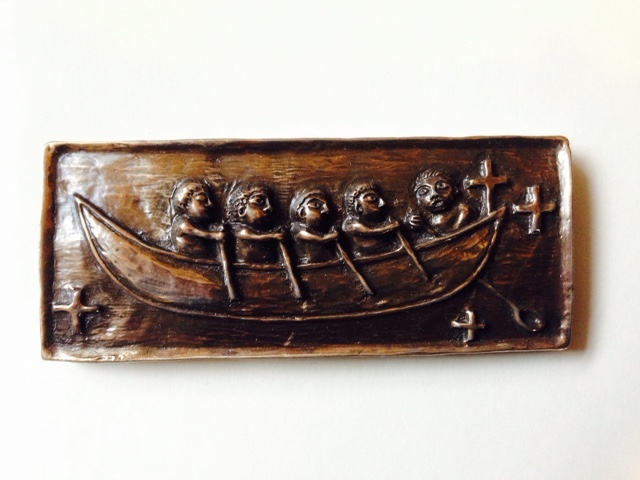
little boat blown across the mighty Tasman sea
College worship today was framed around Jeremiah 18 and God the potter. We were offered a piece of play dough and invited to play as the service progressed. What was formed was laid on the communion table as an act of response, and then could be taken with us post-Benediction.
Here is my ponderings (thanks Sarah) …

… my little boat, blown by the wind of God’s Spirit. Echoes of Brendan the navigator, green the colour of this season in the church year that of growth in ordinary time. The backdrop a gift I gave myself a few years ago, that I have with me whenever I speak, as an evocation of grace and possibilities and God’s future.
Are we dinosaurs? churches in Western culture
On Friday I’ve been asked to speak with the South Australian Heads of Churches. The topic I’ve been given, for 90 minutes, is the question: Are we dinosaurs? with particular focus on the future of the church. It’s a pretty significant opportunity and my colleagues have been teasing me about the need to dig out my tie and suit!
I thought it might be helpful for the leaders if as part of the presentation (one of three parts), I sought to summarise the range of approaches being advocated. So here’s a first crack at this, in which I am playing with the dinosaur theme. What do you think? Is it a helpful framework? What approaches might I be missing?
a) Theologies of extinction
These in many ways assume that the dinosaur will die. That is accepted and is legitimised through theological reflection. An example might be Atheist Delusions: The Christian Revolution and Its Fashionable Enemies
b) Go back: good old days theologies
These encourage a looking back in time. It might be the good old days of the 1950’s. Or it might be the early church, say pre-Constantine or in the book of Acts. It might be a moment of liturgy, for example the Radical Orthodoxy movement and the Tridentine mass. They often trade on a fairly romantic notion.
c) Climate changers and Culture-makers
These include words like “Fresh expressions” and “Missional Church.” They point to a changing climate and encourage the church to adapt. Often they have a missionary view of history. One way to categorise them is in terms of theology and missiology. So much of the Emergent church conversation in the US is a call for a new theology, while much of the fresh expressions conversation is a call for a new missiology.
Tuesday, August 31, 2010
rolling our story with God’s story: Biblical story cubes

Storycubes has got all sorts of church and worship possibilities. The instructions are simple:
Roll the Cubes. Begin with ‘Once upon a time’ and tell a story that links together all 9 face-up images and spark your imagination.
The possibilities are endless.
- throw them and invite people to weave some of the symbols into their story.
- throw them and invite people to weave some of the symbols into a Biblical story.
- Play a what happened next, using the symbols to storytell an Acts 29, or a Mark 17 ie the chapters after the chapters that are written.
- You could make your own cube, for example an angel for the gospel of Matthew, lion for Mark, the ox for Luke, the eagle for John. Then throw the gospel cube plus the nine and invite people to think of, and then share, a story from the gospel that uses that symbol.
- Or your own cube that has an angel, a mountaintop, a forest. Use these to invite personal/group sharing – a mountain top moment ie when you were at your best, a dark forest moment ie when you were at your most scared, an angel moment ie when something happened you couldn’t explain.
Why? It invites creativity and imagination and humanity around the weave of God in our lives and the Biblical story.
I think I might just buy one for the upcoming National Biblical Storytelling gathering here in Adelaide (Sept 24-25). It would be a fun addition to my workshop, helping people tell their story and God’s story.
Monday, August 30, 2010
evaluating fresh expression birth narratives
In a few weeks I’m due to head to the UK, to take part in the Evaluating fresh expressions research consultation in Durham.
Which means some preparation! Back in 2001, as part of my PhD study, I interviewed various UK folk in regard to the alt.worship movement. Questions like
- outline your involvement
- in what ways do you see contemporary culture influencing you
- how accessible is (should) worship be
- how would you describe the place of mission and faith contextualisation
I ended up attending 10 UK alt.worship services, interviewing 17 people/groups (early pioneers like Late, Late Service, Visions, Dave Tomlinson) and talking to 9 more. It was fascinating stuff, but in the end my PhD simply got too big, and so I had to leave all of this research behind.
Now some 10 years later, I’m wondering if this stuff might be useful. So I have begun to dig out the tapes. I’ve heard the scrape of coffee machines in London cafes, footsteps echoing through church halls in Hackney and tea being poured in Northern England. Sure, 2001 is so last century. But I’ve found some great quotes:
“One of the things we learnt was that you need quite a lot of determination and quite a lot of encouragement if you want to be given the space to do something new within the church.”
“The very fact [evangelicalism] has been formed by the book speaks volumes about the kind of cultural baggage evanglicalism has.”
And some great questions being raised: What does sustainability look like and who’se responsibility is it? Does it matter if new forms are not longer with us? Is “surviving as Christians and living faith authentically within late-twentieth century London” less missional than “being a compassionate local presence working for peace and justice within the community”?
Whether I have the time to turn all this primary data into a research presentation I’m not sure. Whether I have the time to construct a thesis that can honour these voices, connect with the Fresh Expressions literature that began to emerge 5 years later and still say something helpful remains to be seen.
But today I feel like I’ve been at table with some real heroes, some outstandingly creative, missional pioneers.
Saturday, August 28, 2010
art and faith Australian style: the window that is the Blake prize
This is a fascinating resource: the Blake Prize, exploring the religious and spiritual in art.
The Blake Prize is one of the more prestigious art prizes in Australia. Since 1951 the Blake Society has been awarding a prize for works of art that explore the subject of religious awareness and spirituality.
Here are all the art entries for 2009, and here are the art finalists. Then the catalogue of winners is here, stretching back to 1978. There were over a 1,000 entries in 2009! That’s a lot.
The 2009 winner was artist Angelica Mesiti for a silent video work entitled [Rapture (silent anthem)].
(silent video! edited – 40 seconds of a 10 minute original)
Filmed from a concealed position beneath the stage at a rock concert, it caught the judges eye for its beauty, emotional intensity and technical virtuosity. “An enigmatic work that operates on many levels, Rapture depicts the joy of being alive while also hinting at the darker aspects of religious emotion.”
I find it fascinating because it is art acknowledging the place of pop.culture. First in medium – video winning an art competition (See the Sydney Morning Herald byline: How videos killed the painting stars). Second in theme (crowds at a rock concert) in religion and spirituality. While there is some Christian thinking in this area, it still remains a bit of a challenge to us in our churches and theological colleges!
Anyhow, I will be using this in my Sociology for ministry paper. And perhaps in the future as an introduction to my attempts to sketch a pneumatology for pop.culture. And there is a journal article in this, using the finalists in the competition over the year, to explore the development, or not, of religious and spiritual in Australian culture.
Friday, August 27, 2010
fresh expressions adelaide vision day: putting legs on the local
Key words: dreamers and sponsors, wonderers and strategists
Key sense: taste
Key question: How can fresh expressions emerge within and alongside local congregations, agencies, schools ?
Had an excellent 90 minutes planning a (1st ever?) local Adelaide Fresh Expressions vision day with the Synod Fresh Expressions Core team. Put a ring around November 27, 11-3:30 pm, Christ Church Uniting, Wayville. Having had a swag of outside input on Fresh expressions, this day is ideal for local communities thinking about putting local legs on local fresh expressions.
Programme (draft):
11-12 pm – Introducing Fresh expressions: Who, What, Where, Why, How – Steve Taylor. Being Uniting, being emerging? a CMS team
12-1 pm – Local lunch – people are invited to bring local produce to share
1-2 pm – Putting legs on the local – interviews with three diverse local fresh expressions. A rural story, an art story, a justice story (TBC). Exploring how dreamers and sponsors work in life-giving partnerships.
2-3 pm – Conversational workshop – share challenges and opportunities in conversation either with local dreamers or local sponsors.
3-3:30 pm- Space with candlelight reflections community.
Thursday, August 26, 2010
the ethics of living At home
My recent thinking about hospitality and mission, food and faith has also been finding itself shaped by Bill Bryson’s At Home: A Short History of Private Life

“Houses aren’t refuges from history. They are where history ends up.”
Which links so superbly with hospitality as mission and the banquet meals in Luke 14. Faith becomes domestic. Christianity sits at table. It’s just profoundly challenging, yet profoundly empowering to realise that how we live, what we eat and who we eat with is Kingdom living, a world loving way of being. Or in the words of says Silvija Davidson, chair of Slow Food UK.
“The world food crisis is making people think differently about what’s on their plates,”
To be practical, like this sort of list from the slow food movement: (more…)
Wednesday, August 25, 2010
party meals with Jesus
Sitting with Luke 14 over the last few days has reminded me of a creationary-type resource that is offered in my The Out of Bounds Church?: Learning to Create a Community of Faith in a Culture of Change
Levi’s banquet (Luke 5) :: bean and meat casserole
Disciples eating corn (Luke 6) :: corn, roasted, and served with mustard-infused butter.
Son of man, eating and drinking (Luke 7) :: stuffed quail
Feeding 5000 (Luke 9) :: fish fried in dill
Parable of Rich Fool (Luke 12) :: deep fried locust in minted yogurt dip
Parable of Great banquet (Luke 14) :: Jewish vintage
Zaccheus’ house (Luke 19) :: roasted chick peas
Last Supper (Luke 22) :: baking Jewish bread
Emmaus Road (Luke 24) :: leeks sauteed in saffron
It is sort of playful, but also quite serious! Christianity is a domestic faith.


 )
)