Friday, April 02, 2010
easter 2010
The Taylor family are all really excited. Moving from pastor at Opawa to teaching at Uniting college means that Easter 2010 marks my first Easter break in 16 years. It’s also the first Easter break the girls will have ever had with me.
Which means a totally new Easter rhythm for us. We’re heading away to a seaside town called Robe. We’ll relax and explore – ancient caves at Narocoorte, wineries in Coonwara, the distinctly Australian saint that is Mary Mackillop. After a very exhausting first term with so many changes, we are so looking forward to catching our breath together.
A second part of the totally new Easter rhythm is that we get to go to Easter services as a receiver, not a giver. When you’re a pastor, the blessing is in the chance to work with the Jesus story in the week leading up to Easter, to wrestle with the texts in preparation. This week it has been SO nice to gather not knowing what the creativity will be, to simply be participants in the story.
We went to what was a very rich Tenebrae service at the girls school on Sunday evening. It featured the readings and extinguishing of candles. It also included a range of choir items, that were crafted into a wonderful re-appropriation of the Christian sung tradition. Plus there was an excellent use of space and some thoughtful prayers. Big clap to the chaplaincy and musical teams at Westminster.
On Thursday, we went to an alternative worship gathering at Wayville, an offering from a new church community called the Esther project. Environment thoughtfully crafted, words chosen well, senses full engaged, space to sit with the Biblical story. Openended and rich.
On Sunday we’ll look to gather with a local rural community somewhere around Robe. This Easter 2010 we’ll end up engaging with just as many church services as if we were a pastoral family, but in a new and rich way.
Thursday, April 01, 2010
opawa’s multiple congregations
New video just out, introducing Opawa (my previous ministry context); one church in multiple congregations.
Opawa Baptist Church Intro from opawa mac on Vimeo.
communion as community storytelling
Craig Mitchell offered what I found a wonderfully helpful communion at chapel here on Wednesday.
Often the words leading into communion are said by the person at the front and run the danger of becoming a potentially lengthy monologue. Instead, on Wednesday, leading into communion, the communion leader asked questions of those gathered. Questions like
Why have we gathered here?
What story shall we live?
Where did this story begin?
Whose story is this?
Why then should we speak of this story?
Tell me what he said and did
Let’s celebrate the way that grace has shaped our lives, I invite you to say aloud a prayer of thanks
What is our prayer on this day?
The responses (scripted) were provided by those gathered. In so doing, the people told of the redemptive story, proclaimed the words of Institution, welcomed the Spirit, joined with the crowd of witnesses.
It felt so much more like the work of the people. It reminded me of the Jewish Passover tradition in which learning happens on a question and answer basis. Thus faith formation is placed within the context of home and food and inter-generational relationships. Doing this in Holy Week added yet another layer, for it was on Maundy Thursday that Jesus gathered his disciples for the last time in a Passover type meal.
So thanks Craig, for offering simultaneously a fresh, yet deeply traditional approach to communion.
Tuesday, March 30, 2010
emerging from? emerging to? nature religions
A few weeks ago I attended the commissioning of chaplains at Flinders University. I couldn’t resist the opportunity to get out of my office, to support a friend and to hear the Vice chancellor speaking on the place of chaplaincy in the university strategic plan.
Oasis includes chaplains for a range of groups including Uniting, Lutheran, Jewish, Hindu, Muslim, Buddhist and Pagan.
Seeing the pagan chaplain being welcomed, made me think of the Australian census results and the fact that between 1996 and 2001, people associated with nature religions (for example Wicca and paganism) grew 140%. While numerically that figure totalled fewer than 25,000 people, that still pretty good growth by anyone’s standards!
Phil Hughes makes the following comment on the data:
“Many of the people who have moved into the nature religions are people who wish to protest against what they have seen as the restrictiveness of Christianity.” (Philip J Hughes, “Religious Trends in Australia,” in Reimagining God and Mission: Perspectives from Australia, 28)
Really?
One of the criticisms made of the emerging church is that they are a protest movement, a reaction to something. Hughes essentially places nature religions in the same category – a protest against a patriarchal, nature hating expression of faith.
Really? Is Hughes right? Is that what others are finding in their dialogue with, or experience among, those converting to nature religions?
Monday, March 29, 2010
implementing change and the potential of “Migration” days
Thunderbird (which I use for email) has a new software upgrade, planned for mid-April. I know this because they have just announced Migration Day, a 24 hour period when volunteers will provide real-time support to users via a chat room.
Now that’s a simple, yet stunning approach to change management isn’t it?
You know that change is disruptive. You know that people have different timestyles and lifestyles. You know that most people don’t like change. You know that change will be messy. To be honest, you do want to manage that change by encouraging people to kick tires and iron out kinks.
So why not give some time to the actual process of implementation.
A Migration day does this, signaling change, making time for it, providing expert help in it, building community around it.
I can think of so many ways a church or teaching place could use this concept
- a migration morning when you are introducing a new powerpoint system and the main tech people hang around with great morning tea and people who have been, or who might be interested, are invited to pop in
- an community open week if a church has a new building project to display. Community given free coffee cards and volunteers to show them around the building, explaining what has happened and how it could effect them, or people they might know.
- a change in a degree system, so a day in which people can gather to talk about teaching implications, tutoring demands, administrative implications.
Change is disruptive. I’ve seen lots of creative ways put into managing the the decision-making process. But there’s also the actual execution which takes time and effects morale. Migration days could be one highly effective change strategy in this regard.
Friday, March 26, 2010
course planning: what skills to work across cultures?
We are in the midst of reworking the Bachelor for Ministry here at Uniting College. Our goal is to
Develop effective leaders for a healthy, missional church.
So yesterday I was meeting with some leaders from a cross-cultural mission organisation. Together we were reflecting on migration patterns, and the influx of world to Australian shores. Take Sydney, which would be a city in decline if it wasn’t for overseas migration.
So, having just emerged from a planning meeting in regard to changes in the B.Min (which are pretty exciting IMHO) I decided to do some market research. I asked them:
what skills are needed in order to work across cultures here in Australia?
What would you say if I asked you that question?
Posted by steve at 11:22 AM
a pretty radical (8th century) image of church
I’m teaching a paper this semester called Church, Ministry, Sacraments. In approaching the paper, I’ve wanted to dispel the idea that when we think of church, we simply draw a line from Jerusalem to Rome to Europe. The reality is that for the first 1,000 years of the life of church, Christianity was a global faith, covering three continents – Asia, Europe and Africa. This gives a dynamism and diversity that offers a very different approach to church.
“In the West, attention centred … on the clergy … ecclesiological discussion in our time nearly always centres on, or degenerates into, disputes about clergy and bishops, the result being that the question of the nature or being of the Church is rarely allowed to come into view.” Gunton in On being the church, 49.
A really helpful resource for me has been Readings in World Mission


Anyhow, this is church, for Bishop Timothy, of the Syriac church, in the 8th century, living in a pluralist world and asked to debate his faith with the caliph al-Mahdi, the leader of the Muslim world at that time:
we are all of us as in a dark house in the middle of the night. If at night and in a dark house, a precious pearl happens to fall in the midst of people, and all become aware of its existence, every one would strive to pick up the pearl, which will not fall to the lot of all but to the lot of one only, while one will get hold of the pearl itself, another one of a piece of glass, a third one of a stone or of a bit of earth, but every one will be happy and proud that he is the real possessor of the pearl. When, however, night and darkness disappear, and light and day arise, then every one of those people who had believed that they had the pearl, would extend and stretch their hand towards the light, which alone can show what everyone has in hand. The one who possesses the pearl will rejoice and be happy and pleased with it, while those who had in hand pieces of glass and bits of stone only will weep and be sad, and will sigh and shed tears.
Which is a pretty radical position for what was at the time, a major Christian leader to take. For Timothy, the pearl is true faith and it had fallen to earth and each faith believed it alone had possession. All humans can do – Christian, Islamic (today atheist?) is offer their evidence for believing, or disbelieving, that they have the real pearl. But the final truth can not be known on this side of reality.
Was he selling out? Or was he modeling a humility which should actually be at the heart of Christian witness?

just do it: since when was formation easy anyway?
The whole missional thing is both simple and complex. As seen in this great quote from prodigal kiwi. The post starts by talking about the reality that formation takes time. It’s work. And then applies that to missional life. Which is not missional conversation. Talks cheap. Formation requires an investment.
We can attend all the workshops, training sessions etc, but if we don’t or can’t make the commitments to the practices of being missional, including gathering with people, listening in ones context, neighbourliness, change management and transition (I established congregations), missional learning, creativity etc, etc, then nothing will come of our good intentions.
Thursday, March 25, 2010
can we talk?
We’ve been without phone since we arrived in Australia nearly 2 months ago and the saga looks set to continue.
We came with cellphones, brought during an earlier visit, so that initially took the pressure off. We added to that a wireless roaming plug-in, and that managed to get us through the initial search for car and house.
Once established in a house, with a 12 month rental, we began to look at phone companies.
We were recommended a wireless provider, but warned of a potential 3 week delay. They looked good initially, but after multiple to and froing (it’s not easy to organise phone without a phone), and toward the end of the 3 weeks, told us that our local exchange was overloaded, so they couldn’t help us.
So we turned to Optus, who prepared to send us out the required hardware. Which never arrived, because apparently the intermediary company we were going through (Direct Connect) required some information from us to complete a credit check, but never contacted us, so we duly failed the check.
By now it’s been weeks and we’re feeling quite cut off, especially from friends and family back in New Zealand.
So we look at yet more wireless providers. Many advertise and for a fee, will check whether there is room on the exchange for us to plug in. Yeah right, a fee to be told they can’t help!
So we’re now back looking at a landline connection. Which means back talking with the owner of the house, because the existing wires have been ripped out of their sockets and so the connection fee looks like going up.
It all feels so hard. And so tiring.
Tuesday, March 23, 2010
Kiwi made preaching: stories can be a sermon’s best friend
There’s a new blog, focused on preaching, which has been quietly growing over the last months, steadily adding some great content. It’s focused on preaching;
- a team of 25 contributors posting short weekly articles
- a range of resources
- an ‘images that speak’ feature with photos that speak
Yep, it’s “Kiwi-made”, but perhaps even little Kiwi’s might have something to contribute to discussion around preaching today. I’m one of the weekly contributors and my recent contribution: Stories can be a sermon’s best friend has just gone up. So click on over, or simply click here to read what I wrote: (more…)
Saturday, March 20, 2010
sizzling sausages at the State elections
It’s State election day here in South Australia. Unlike New Zealand, voting is compulsory (but only for Australian citizens).
That’s not the only difference between Australia and New Zealand. Party placards are still up all around town even while people vote. And outside all voting booths various party promoters are allowed to stand, hawking their party. (If people really do make a decision between a party promoter and the ballot box, it certainly doesn’t say much for a carefully considered democratic process!)
I was asked to help at the nearest polling both, which is also the hall of the local Uniting church. Not in the name of politics, but because each election (state and federal), the church throws a sausage sizzle, as a fundraiser. All monies go outside the local church, to School chaplaincy and an orphanage in Thailand. So it was a neat way to be useful and serve.
Plus it was a good chance to cast an eye over the community. Seacliff is a slowly gentrifying beach side suburb. So the suburb is a real mix: of wealth more likely to be younger, of long term residents more likely to be older, of some rental accommodation, more likely to house a mix of migrants and the mentally challenged. It’s a fascinating suburb.
The local newspaper was also out and about, sniffing for news. Our sausages lured them over. Asked for my opinion on the fate of the election, I announced that all exiting voters seemed happy with their choice. And that my name, if they wanted to quote me, was Spin Doctor.
I also got photographed for the same newspaper. This was to be an action shot, so that involved me cooking sausages. I’m a vegetarian, which raised an interesting ethical question. But a local Green party promoter was also tucking in, so we shared a guilty grin.
If you’re from Adelaide, look for my mug in the Sunday mail.
Friday, March 19, 2010
vestments. any emerging theology? other than bling the bish?
Plea for help from a student: they are doing a paper on worship and specific research on vestments. (Apparently, they are popular in Uniting Churches in other parts of Australia, but not as much here in South Australia. I’ve certainly not seen them in my church-seeking travels as yet.) The student has an interest in the emerging church and so popped in wondering if there has been any recent emerging theologising in this area?
They kept stressing the word “theologise”. They think this should be more than just a personal – will I, won’t I – bling the bish – type issue; they want to make a decision based on theology, not on personal preferences.
Anyone of my readers know of any good thinking around vestments, worship and emerging cultures?
(There’s theology in the video actually:
- vestments to increase “mystery”
- incarnational inclusivity – what to wear “to enter God’s house” and do vestments work towards, or away from, new cultural forms of dress
- “bless, bless” and what human agency can be involved in enacting blessing)
u2 chapter accepted for publication
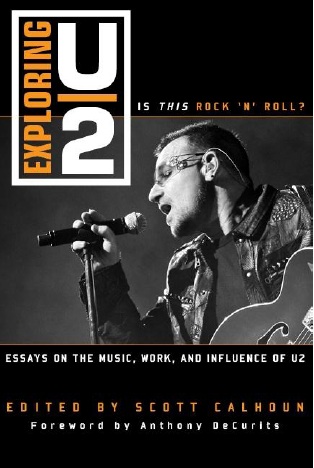
News overnight that my U2 conference paper – Sampling and reframing: the evolving live concert performances of “Bullet the Blue Sky” – has been accepted for publication. Date and publisher still to be clarified, but with over 40 papers being submitted for a book of about 15 chapters, I’m stoked.
It’s also my first foray into the arts and music world outside the church, so the whole process – having the chance to present a paper and now have that accepted for publication, is a pretty big tick in terms of what I do and teach (the paper began life as a casestudy in a lecture in my Living the text in a postmodern context.”
Here is the “abstract”:
“Bullet the Blue Sky” is the fourth track on U2’s 1987 album, The Joshua Tree. The song was originally written as a commentary on a highly particularized context, the involvement of the United States military in Central America during the 1980’s. Over time, this highly particularized political context has changed, yet the song has continued to be performed by U2.
Using commercially available concert footage, this chapter will explore the changes and development in the song’s performance, over a twenty year period, with a particular focus on concerts in Paris (1987), Slane Castle (2001) and Chicago (2005).
Following one song over an extended period allows an exploration of how a band can reframe and re-perform their music as the context and culture shifts. (Hint, hint, what churches are seeking to do every Sunday in relation to Bible and church tradition! Ed)
The theoretical frameworks of narrative mapping and analyzing popular culture using the metaphor of sampling will be employed. Narrative mapping allows complex data to be analyzed in real time, as it unfolds, while sampling involves the collage-like re-appropriating of already existing elements in the pursuit of creativity.
Naming these samples, including song snippets, video and theatrical performances, and how they work in relationship to the audience, demonstrates a complex renegotiation of the meaning of “Bullet the Blue Sky” and shows how “sampling” a song might address new contextual and political issues. The application of installation art theory offers insights into the public negotiation of communal memory and provides another window by which to appreciate U2’s live concert performances. (Hint, hint, creativity in the context of gathered worship! Ed)
Thursday, March 18, 2010
creating class learning communities
As a summer reading treat, I brought myself a book on adult learning (Learner-Centered Teaching: Five Key Changes to Practice
- power
- content
- the teacher
- the student
- evaluation
While studies show the only 5% of university class time actually does involve student participation,
Learner-centred teachers connect students and resources. They design activities and assignments that engage learners. They facilitate learning in individual and collective contexts. Their vast experience models for novice learners how difficult material can be accessed, explored and understood. (Weimer, Learner-Centered Teaching: Five Key Changes to Practice
Based on the book, I’m trying some new things with my classes. One involves inviting the class to work in groups, including designing their own assessment. Here’s what I suggested for one assessment:
Course outline: The mark will be allocated based on the overall group project and each person’s individual contribution. With regard to individual contribution, each person will also be asked to assess both themselves and their group members. During the second week the class will design the assessment which will then be used with regard both to lecturer and peer-assessment. For those who wonder why, it seems an appropriate ethical response to the theological notion of the church as the body on Christ, in which each member is unique and has a unique contribution.
In order to facilitate this, I conducted the following process:
- Class invited to list 5 things they would expect of themselves or others in doing a group project
- Share in pairs to gain confidence
- Share with class. If people felt their criteria was already on the whiteboard, then people could feel free to fold.
- I then wrote up the outcomes, grouping them under similar headings and checking for “assessibility” ie could a student use this as a grading criteria.
- This was take back to the class. If we agree, I will provide this as a grading sheet.
So here is what the class suggested as their criteria for assessing each other in relation to their group work.
As individuals
- Regular meetings
- Participate equally, willing and consistently in research phase
- Willing to fold for the group
- Contribute not hog the discussion
- Openness to listen
- Affirm and encourage – including body language positive and respectful
- Work toward group cohesiveness
- Presentation is clear, enthusiasm and kept to time, as planned
- Participate equally and consistently in presentation
As a whole group, a desire to be
- fun, spontaneous
- creative
- develop clear communication roles in both group and in presentation
- develop a group that worked toward a participation around unique abilities
It’s a fascinating list. I commented to them, first, that if they managed to achieve half the list, it would be a great group. And second, that if they took those attitudes into their future, I’d love to work with them in ministry. The class is called “Church, Ministry, Sacraments” and my sense is that in inviting them to design their own assessment, they have in turn invited each other into some ways of being that actually put flesh on the images of church as a body of Christ. In other words, the class has shifted from information to formation.


 )
)