Thursday, February 16, 2006
going to bible college will destroy your faith

I lead a devotion at Bible College today. The slogan; “Going to bible college will destroy your faith” was written on the whiteboard as students came in. It’s been said to me many times and I reflected on how funny the statement is when you think about it; is faith that brittle; which lecturer will do it; do they organise it, take turns, play tag?
Asking the question; “Does bible college destroy your faith,” I turned to Pauls autobiography in Galatians 1:13-18.
Wednesday, February 15, 2006
DJing gospel and culture video interview
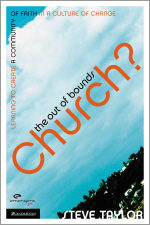
In postcard 8 of my out of bounds church? book I explore the relationship between gospel and culture. Rather than present either/or opposites of wholesale withdrawal or wholesale assimilation, I use the image of DJ to explore how, in a fragmented and postmodern world, we engage in multiple responses to culture; of protest and subversion and affirmation. I think it’s some of the most creative thinking in the book.
Anyhow, late in 2004 (when the book manuscript was with the printer) I spoke at a ecumenical conference (national youth ministries of the Anglican, Catholic, Methodist and Presbyterian Churches in Aotearoa New Zealand); the big E. The theme was gospel and culture and they asked me to exploration the interaction between global and local. It was a chance to earth the DJ image in terms of ministry and young people and globalisation. It is a more “well-cooked” version of Postcard 8, including a social justice reflection. It’s now a chapter in a book; titled “Culture – Yeah Right.”
(Buy the book, by contacting Jacky Sewell, 3/89 Michael’s Ave, Ellerslie, Auckland. Cost – Book $20, DVD $45 or both for $60. P&P $5 in NZ, $10 Aust and Sth Pacific, $20 rest of the world.)
They also interviewed me, and this is now an online QT video (11 MB). So if you want to see my “summary” or get the 10 minute summary, download here.

This post is repeated in my out of bounds church? book blog.
Tuesday, February 14, 2006
smells like the kingdom
Jim’s story: Jim (name changed) knocked on the church door at 1 pm, asking to use the phone. New flat, phone not working, big bond, paid by cheque and it’s waiting for the bank to clear. Jim works the phone, rearranging appointments because cash is tight and the gas tank is in the red.
Then he’s asking if social service agencies in general do petrol? Not as a policy, I say. It’s too easy to swap petrol vouchers to feed addictions.
As Jim makes to leave, he says he’s free in the afternoons and if we want any volunteer help, to let him know. My gut says he’s genuine.
So I asked Jim if he wanted to work for his petrol. Work for 2 hours and we’d give him petrol vouchers for half a tank of gas. There’s dignity for him and benefit for us. I pair him up with our caretaker and so there’s relational mission. It sort of smells like the Kingdom.
Rob’s story: 9 hours later, Rob (name unknown), knocks on the church door. It’s 10 pm. Espresso church is just winding up in the foyer and the Sunday music group are practising in the auditorium.
Rob announces he loves Baptists and loves the faces of happy people. He asks what is happening. Rob’s breath indicates high levels of alcohol consumption. My gut says Rob wants an audience and I’m not sure we are in the entertainment business. I’m about to leave to relieve the babysitter and I don’t want Rob walking into the church, drunk, potentially pretending I let him in. In my friendlist voice I tell Rob we are finishing. Rob heads into the night.
One stranger gets work. Another stranger gets the friendlist farewell I can manage. What does the hospitality of Jesus mean? I’m not sure which, or both, smell more like the Kingdom.
Saturday, February 11, 2006
emerging church in australia
There is a superb exploration of emerging church in Australia in the latest (Summer 2006) Zadok magazine.
 Highlights for me where;
Stephen Said’s historical narrative around the emerging church in Australia;
Barb Daws, who discerns the links between emerging church values and new ways of education and learning;
Matthew Stone’s plea for a missiological understanding of New Age spiritual search to be entwined with expressions of emerging church;
Dan McCredden’s answering the question; “Can an existing denominational church be emerging?”
Anne Wilkinson-Hayes plea that ‘new missional churches’ seek a more authentic, gospel-centred approach to living our the faith in our society today. (For those interested, there’s an interview with Ann here (scroll down to bottom of page 2) as part of research for my out of bounds church? book) which also interleaves with the question of denominations and emerging church.)
Plus there’s a nice review of my book, both by Dan McCreeden and Darren Cronshaw, who has written an introductory reading guide to the emerging church phenomenon, covering 50 books, a number of internet links and blogs.
If Zadok is any guide, there is a rich breadth in the emerging church conversation in Australia. The edition would sit as a more popular companion to the International Journal For the Study of the Christian Church;
 .
.
my dad
My dad had a fall in the bathroom last night. His legs just stopped working and he collapsed. He’s in hospital while they do tests. He was diagnosed with multiple sclerosis (degeneration of nerves) about 8 years ago. This might be a flareup and he might regain movement. Or not. Or it might be something else. We don’t know. He’s 66.
All kids just expect their Dad’s legs to move. I’m just a kid and this is just my dad.
Friday, February 10, 2006
formed by scripture
Excerpt from a letter I sent to our church staff as we started a new year together.
I would like to see us deepen our sense of shared spirituality. I would like to make two suggestions in this regard.
1 We make a commitment to read the same Scriptures together in our individual devotional practice. This is of course optional, but it would be quite nice to know that we are all (literally!) on the same page as it were in terms of our individual formation through the Scriptures. I am not sure what you currently use and I am loath to dictate something to you that is perhaps alien.
However to do this we would need a common starting point. I personally like to engage the Bible rather than someones thoughts about the Bible. So rather than use a devotional guide I use the Church Lectionary reading, which offers the option of 4 readings for each day Psalm, Gospel, Epistle and Old Testament. I always use a Psalm; and usually the Gospel (every now and again, if I need a break or feel challenged by a difficult bit of Scripture, I also read the Epistle or Old Testament.) So I am being bold enough to include a Lectionary Reading guide that could form the basis of an individual yet collective reading.
(If we settle into a shared pattern like this, we could also
a) inform the church what we were doing this and invite them to join us if they want.
b) begin to use the Psalm of the Sunday regularly in our church services,
2 I would also like to suggest a fortnightly Friday gathering over morning tea for 30 minutes (10:30-11:00) to share Scripture corporately. I would suggest the following regular pattern.
a) Reading aloud the Scripture (we could use the lectionary reading for that day):
b) Individually reflect on the following: Key word or phrase; What is it saying in context?; What is God saying to us?; What am I saying to God?
c) Share our reflections together:
This would not require anyone to prepare a devotional, yet would allow us together to be formed by the Scriptures. I really want this sense that together we are standing accountable, not to a persons devotion, but to the Scriptures.
Update: Excellent further discussion by Nigel Wright here, where he offers the possibility of gathering around not only text, but music or image. Which is probably what we were doing with our Advent Art postcards in December; everyone in the church was given a postcard with an art image, ritual and Scripture. So this offered individual nourishment, and then in the services we invited artisticly inclined people to speak to the art, and a musician to play a piece of music.
Wednesday, February 08, 2006
the emerging church in 2005: a visual summary
What does the emerging church look like? More specifically, what does the emerging church look like in 2005?
 And they say a picture is worth a 1,000 words. So, why not gather a visual date stamp? Why not invite an emerging church to send a picture of their life? Collected together, they could offer a visual narrative of a year of life lived.
Thus Postcards05 germinated. I posted the concept on my blog in mid-December and invited anyone who wanted to send a postcard. I worked up a generic template, hoping for visual continuity. I never got my wished for postcards from France and Serbia. But I did get fifteen postcards from 8 countries; Ireland, England (5), Australia (2), Canada (2), New Zealand (2), Germany, Malaysia and Denmark (and had email conversations with people in Japan and South America).
Today I printed out all 15 postcards and wondered if there were some repeated echoes.
Monday, February 06, 2006
Contemporary Waitangi Day worship
Today in New Zealand is Waitangi Day, which acknowledges the signing of the Treaty of Waitangi between Maori and the Queen of England’s representatives in 1840.
So Sunday’s worship needed some connection between such themes and the gospel. For me I wanted to capture welcome, what it means to be inclusive and hospitable and how one might live justly as a guest in another land.
So as everyone arrived on Sunday they were given a photo of a person of different ethnic origin, currently living in New Zealand. (Images had been sourced in relation to here and printed black and white on 5 cm square paper.) After an opening song, we read together a montage of Scriptures (based on a selection I found in an old Baptist hymn book) which named the reconciling work of Jesus. I had hung a line of string across the front of the church. As a response to the welcoming and reconciling power of this gospel, people were invited to paper clip their photo onto the string. I played Welcome home DVD, from the Available Light album , by Dave Dobbyn, as people streamed forward. Quite simple, yet a really nice mix of participation, gospel and contemporary cultural connection.
Once we had finished, I prayed a brief prayer confessing our human ability to be selfish and hold onto gifts, praying that people coming to New Zealand would experience welcome and that our actions as a church would always demonstrate the hospitality of the gospels.
By chance, it was the first Sunday of the month, in which Opawa has historically celebrated communion and welcomed new members. It was visually powerful to celebrate communion and reconciliation in bread and cup against a backdrop of a “line” of photos. We were also welcoming a Korean family into church membership and that added a further layer of poignancy to themes of gospel welcome and hospitality.
Updated: For those who requested the Scriptures, here’s a the DJ-ed list (without references)
Sunday, February 05, 2006
theology of blogging
Some thoughts in process.
This blog is gift. As hobby it emerges from surplus; my time, creativity, thought and skill. A gift always costs. Every minute I blog is one less for family or for sipping a pinot.
Gift need not cost the recipient, but it costs the giver. Indeed if it has not cost, it is not gift but work.
It is the choice of a giver to give a gift. This means that consumerism is not necessarily theft of a surplus.
However, a consumer of a gift might note that while given freely, surplus is neither endless nor unlimited. By definition, for a surplus to remain a surplus requires replenishment. Such replenishment is uniquely contextual, dependant on the individual and their unique personality and makeup.
It might be financial,and so the chance to trade in Adense for the replenishment offering by a pinot or a new CD; it might be a comment that offers a new perspective; it might the encouragement of a story returned when an idea or resource has morphed into life; it might be a link or another blog offering creative resource; it might be a relational connection made, a network accessed; it might be hits on a traffic counter.
Method and mode of surplus replenishment may change over time.
Sustainability will depend on the sustainable replenishment and thus the ability to match gift, surplus and appropriately renumerated replenishment.
Saturday, February 04, 2006
is blogging worth it?
Over my January holidays I contemplated shutting down this blog. I had started emergentkiwi to experiment with on-line community. In the early days of this blog (back in 2002-3) it felt like there was a lot of community; lots of comments, through which I learnt heaps.
Over the last year, it felt less and less like a community space. Visitor numbers tracked up, but the sense of interaction on-blog and through e-mail declined. At times I wondered if this was now a consumer space, rather than a community space. Did I need to change the way I posted in some way? It takes time and money to run a blog. I have always resisted the idea of advertising as alien to a “community” sight. But if more and more visitors are just consuming, why not?

Two weeks into my January holiday a parcel arrived, posted from the UK. With a card; thanking me for the blog and noting that I had made a post asking for input regarding spiritual practices that might help a cafe. Near 100 people had visited the post. Four had commented. I had found that depressing.
And a book, titled Church Cafes. Explored and Celebrated. (Order here). A really interesting survey of 100’s of cafes around UK.
So I’m back blogging for another season. I’m still concerned about the balance between community and consumerism and still pondering the time and effort of a blog. But I’m feeling a little less “consumed.” Thanks J. (you know who you are).
Friday, February 03, 2006
I found 9000 dollars today
This week has been budget preparation week at the church. Among other things we’ve taken on an extra staff person to work (among other things) among youth in the community and all week I’ve worked with others trying to balance budgets.
All week this voice has gone; “You’re a pastor. You have more important things to do. You’re busy. You should be writing a sermon.” All week I’ve kept saying, no.
“No. I refuse to accept the sacred/secular divide. I refuse to believe that there are “spiritual” things that are more important than “earthly” things.” Besides, this is about growing and developing people and resourcing for mission. Besides, I’m good at this. I can be sharp.”
Today the wrestle bore fruit. I spotted the fact that the spreadsheet was using a hidden formula that based this year’s offerings on last year’s projected budget, rather last year’s real budget. Last year we projected a 10% rise in offerings. We actually got a 14% rise. The difference is $9000, a budget that could balance, a mission that could happen. A nice end to a week of deeply embodied spirituality.
Thursday, February 02, 2006
Old Testament emerging mission
In December I was e-interviewed about my out of bounds church? book. I was asked to comment on an absence of interest in the Hebrew Scriptures in the conversations around missional churches and to what extent can the Hebrew Scriptures offer new models to the Church that is emerging.
In the interview I noted that a dominant mission model in the emerging church is the going to forming new communities of faith. This is often based on contrasting attractional forms of church with incarnational forms of church. I mentioned a article by Walter Brueggemann as a great example of careful Bible reading that goes beyond 2 binary opposites of mission as attraction vs mission as incarnation. A number of people have since emailed asking for the full reference: Walter A. Brueggemann, “The Bible and Mission.” Missiology 10, 1989, 397-412.
 Steve, before you dash off-line, could you summarise the article? Can perhaps could you apply it to emerging church? Well, part of the article includes 4 different ways in which mission is at work in the Old Testament.
I Kings 4 is a subtle critique of the use of God to legitimate actions. This would mean that Americans who blogged against the Iraqi War are performing mission in the style of 1 Kings 4.
Dueteronomy 19 is the working for legislative reform to enact Gods justice. This would legitimate something like protest4 as Biblical mission even if it never “incarnates” a new faith community.
1 Samuel 2 offers the power of imagination to offer a new vision of society. This would legitimate the art of alternative worship as Biblical mission in its potential to offer a radical re-dreaming of Christianity enculturated.
Hosea 2 offers the belief that in a fragmented world, God can intervene in love. A Blue Christmas service offering hope of Gods love would thus be an expression of mission in the style of Hosea.
And for those who want more detail on the Biblical texts, here are my Church and Society (University of Auckland) 2003 Course lecture notes..
Wednesday, February 01, 2006
do you renounce cultural evil?
Ever a provactive thinker, Mike Treston gifted me a phrase today; “cultural exorcism.” Reflecting on the place of confirmation in a post-Christendom culture, he wrote; “I think this is what is missing, excorcism was always apart of the catechesis rites of the anicent church, a cultural excorcism could be very impotant now also.” Link
To which I commented on his blog:
I really like the phrase “cultural exorcism.” That is very good. When I baptise people I ask them 3 questions as they enter the pool – do you follow Jesus, do you repent, do you renounce evil?
I have been pondering tying those questions to a more in-depth catachetical programme. That phrase “renouncing cultural evil” suddenly gives great scope for exploration of consumerism, social justice, living simply. Thanks heaps for the phrase Mike.

For more on what I actually do in terms of re-imagining baptism as ancient future:
mission health conversation
Looks like I’ll be in Dunedin Thursday 9th March as part of Mission Health Conversation (Baptist Union gig).
4:00 – 5:30 Telling the Opawa story as part of a panel.
5:30 – 6:30 meal
6:30 – 7:45 4 Options; 1 of which is me on “Thinking missionally”
7:45 – 8:00 coffee/tea
8:00 – 9:15 4 Options repeated.
It’s a great topic, that will force me to articulate not only the Opawa story but the underlying missiology and theology.
Venue: Valley Baptist.


 )
)