Thursday, September 08, 2011
tell show be. a useful way to intro evangelism?
Evangelism. Generally a word that freaks people out. Both Christians and non. So here’s an interesting resource from the Methodist church in UK.
TELL.SHOW.BE. is an invitation to rethink evangelism, to dispel the myths that hinder many and to challenge our understanding of what it means to pass on the good news.
It’s designed to be accessible, multilingual and free, inspiring us to tell somebody, show somebody and be somebody.
Video runs for under 2 mins. What do you think?
TELL.SHOW.BE. – English from Tell.Show.Be on Vimeo.
Friday, September 02, 2011
out of the closet? or just the closest I’ll ever be to Barthian?
I’ve just had a short piece published on Share, a UK fresh expressions website. Titled “Welcome home? Hospitality as mission”, (a cut down piece from something I wrote here last year), I explore how often the church hears hospitality as welcoming people who come to us. I start with a New Zealand singer, Dave Dobbyn, move to Jesus and then to fresh expressions. I conclude with a mission question
“I wonder what it means for the church to see itself as homeless rather than home-owner? To forget practising welcome and instead go looking for welcome? To make ourselves reliant on people to make space for us?”
Which, as I reflected today, might actually make me a closet Barthian. I’ve never read all of Barth, but am informed that it was he who describes the Father’s sending of the Son into the world as “The Way of the Son Into the Far Country.” (Church Dogmatics Vol IV 1 and 2). Just as the prodigal son traveled off into “the far country” (Luke 15:13), so in Jesus, the Son takes the same journey (While the Son of God, in contrast to the Prodigal Son, carries out this journey in total obedience, this journey into the far country is radical, risky, excessive and prodigal.
So there we are. Am I a closet Barthian? Or simply a missiologist coming close?
Anyhow, head on overand see what you think of the piece. Or go here, for another – David Fitch – angle on the whole Incarnation-mission thing.
Wednesday, August 31, 2011
making links through Fresh expressions
Here is some notes from the talk I have gave last night, titled Making Links Through Fresh Expressions. And a concluding prayer, using this advertisement, which sort of really went off!!
Introduction (2 mins)
Moses and burning bush. It has a lot to say in terms of our topic – making links through F ex.
First, mission begins with listens – Exodus 3:7 “I have heard them crying because of their slave drivers …. “ Mission begins with this compassion for hurting people.
Second, Moses is asked to give what he’s got – “what is in your hand.” (Exodus 4:2) All he’s got is his stick. And a diseased hand. And a tongue that feels to thick. And that’s what God starts with. Pretty simple way to think about mission. It’s as is as simple as giving what’s in our hands. We’ve all got something.
For all of us, it’s our God story – our lives have been changed. As it says in Basis of Union – Para 3 – say it to the person beside you … you are “the beginning of a new creation, of a new humanity. God in Christ has given to all people in the Church the Holy Spirit as a pledge and foretaste of that coming reconciliation and renewal
And our community charism. That each of us are in a church that has a particular set of gifts and possibilities.
So Making links – starts with us paying attention to the cries. And being willing to simply give what we’ve got.
I want to approach tonight under 4 headings
- linking through listening
- linking in (because despite tonight being about fresh expressions, many of you are in established churches and not yet ready to think about fresh expressions)
- linking out (focused on fresh expressions)
- linking in posture
I plan to talk for about 35 mins and then give you some time to chose 1 of those 4 headings and “do something”, ie to resource yourself practically. (more…)
Tuesday, August 30, 2011
a practical “linking in” mission resource?
Tonight I’m speaking to about 60 folk from the Community Outreach Mission Network, which is a grouping within the Uniting Church of South Australia. The topic they have given me is
“Making links in mission.”
It has given me the chance to develop some ideas I’ve been pondering. In particular, how to help churches conduct a mission audit of their life. I worked with a church recently who became aware of needs in their community but in the end decided they were simply too busy.
So the tool is a way of inviting us first to reflect on what exactly we are busy about. Who is our life for?
And second, to think strategically about how we do our mission. If we have limited resources, then how are those resources being deployed? Anyhow, here it is “Linking in” resource and I’d love some feedback on how useful you find in reflecting missionally on your church life?
Thursday, August 11, 2011
missional values

This was a (home designed) “brand” on a sweat top being worn at mission-shaped ministry course last night. And what are the missional values embedded in the words?
Eden’s bean. Serving God. Drinking Coffee. Since Day three.
It was another great night. Lindsay Cullen, from the Canberra team, was with us, sharing on the topic of missional values. I think he enjoyed having a 2nd go (having taught this topic in Canberra last weekend) and we certainly enjoyed a new face, some external input and outside encouragement.
Thursday, June 02, 2011
being practically useful to a church in mission
On Wednesday I was part of a group in which it was stated a number of times that some of my input had been practical, useful, to a church in mission. The reference was to a session I did in September 2010, to a group of church leaders, titled Inspiration outside our walls: Being church in the city. In the talk I explored three church:city questions and then offered ten practical mission possibilities to city churches. I mention in simply because if one person found it useful back then, others might find it useful now – (here).
Tuesday, May 10, 2011
a playful and public faith? a favourite urban mission resource
This is one of my favourite resources for mission, particularly in urban contexts.
I love the way it started with just a few folk, with a passion. And yet the way it grew. Simply by the use of social media and capturing the imagination of other groups. Not to reproduce, but to be individually them.
I love the way it spotlights an issue, without being illegal, aggressive or obnoxious. I love the words “playful” and “public.”
Why can’t more urban churches do this? Esp in warmer, outdoor Aussie climates? Plant an easter garden outside, serve coffee and give out easter eggs after Resurrection Sunday. Blow bubbles and create homemade wind chimes at Pentecost. Share a banquet table for an occasional community.
Simply take your belief and passion outdoors in ways that are “playful” and “public.”
Saturday, April 16, 2011
local church in mission. starts practically here
These represent the next step in a local church practical mission project I’m involved in – postcards – given out to the church this Sunday. The front, including google map of the community,

And on the back, four questions to consider, with plenty of blank space to write responses

Back in January I conducted a seminar, in which I suggested that in our contemporary world, a theology of mission must begin with two ears. To make that practical, I suggested a range of exercises
- Listening project one – some growth questions to ask selected individuals
- Listening project two – observation walks around the community
- Listening project three – visual observation of the community, involving creating photo exhibits
- Listening project four – some Appreciative inquiry questions
(for more see here).
The church decided to make this part of their Lenten process. People were encouraged to choose one exercise and, with joy, seek to put it into practice leading up to Easter. During Lent, when the church gathered, stories were told, including a number of folk putting their listening project 3, the visual observation, up on the screen during worship courtesy of PPT. Very cool.
So with Easter approaching, it’s time for the next step. The postcards are intended to help with the bottom nature of this project. This is not about a select group or the leaders, but the whole church who’ve been invited into mission with their ears. Now it’s the whole church, any and all, given a postcard and invited to record what happened.
These will be collated up and hopefully, at Pentecost, the results will be shared. And the question asked: given what we, all, have heard, how then might we need to act?
In working on this over the week, I realised that this is yet another example of church resourcing both scattered and gathered.

I’ve blogged about this a number of times over the last month, the need for church practically in how it shapes it life to be affirming God at work when the church gathers and God at work when the church scatters
This is a 4th example, in which the postcards affirm the church as both scattered, any and all engaged in practical listening, and gathered, being collected, collated, gathered as next steps in mission.
Monday, April 04, 2011
can mission be embedded into the worship DNA? a worship treat
Scattered and gathered, outward and inward, sending and receiving, mission and worship – I have been pondering the relationships for the last few weeks.
- I had a general introduction – can mission be embedded into the worship DNA – here.
- I had a followup – a possible worship pattern – here.
Today in chapel we trialled a very practical beginning. We began outdoors (scattered). We invited people to use their outside environment as the starting point for reflection. For 10 minutes, to wander. And in particular to consider
- bitumen – what has been hard?
- sky – where have we found joy?
- windows – who, what, have we walked past?
- grass – what of God’s breath in creation have we missed?
We gave out a card as an aid (very simple, used an apple Pages business template and just rolled text and picture in).

And then we gathered to continue in worship – to hear Scripture, to have communion, to pray for God’s world, before being benedicted back into the places of bitumen, sky, windows and grass.
I loved seeing people wander, reflecting on God in our scatteredness and then having that woven into our gathering. So there you are, some thinking about mission and worship, a possible worship pattern and now here, a practical worship treat that might encourage and inspire you to do better.
Do let me know how you improve it 🙂
Friday, April 01, 2011
mission in digital frontiers: a learning day with Andrew Jones
delighted to announce this –
mission in digital frontiers: a learning day with Andrew Jones
Thursday 28 April 1:30pm – 3:00pm Pioneering lessons
Pioneering is hard work and Andrew Jones has been doing it, and seeing it, for over 20 years. This session offers some wisdom on sustainability, dealing with difficulty and building creative partnerships. It is by invite only, by simply asking for the pioneer password. The aim is to encourage folk with a pioneering heart and is jointly hosted by Mission Resourcing Network and Uniting College.
3:45 – 5:15 pm Social media as fresh expression of mission
The digital world is a fast moving frontier. This session with explore the potential of blogs, Facebook, Twitter for congregations and communities in mission. The content will cover getting started, strategies for effective network and the shape of mission theology for a digital world. The aim of this session is to both upskill and encourage local churches to think about their use of the internet.
7-8:30 pm Social media and justice-making in God’s mission
This session will explore the relationship between social media and justice-making. Can the use of social media be an outworking of “Your Kingdom Come”? If so, how? The session will share stories from around the globe mixed with theological reflection. The aim is to explore the potential and pitfalls that face those surfing the digital frontier.
 Andrew Jones aka Tall skinny Kiwi travels the world with his family in a 4×4 truck. They seek to see the world that God loves, to eat unusual food {but not too unusual} and to help change the world by telling stories, throwing parties, making friends and giving gifts. Andrew is interested in spirituality and religion as it collides with new media and the emerging culture.
Details: April 28 2011
Venue: Uniting College
Cost: $20 per session or $30 for two.
Here’s a publicity brochure, which doubles as a registration from – low res here, high res here – feel free to post in your church, email it onto your friends.
Wednesday, March 30, 2011
mission made practical
This is a practical mission story. As a Taylor family, we were all pretty upset about the Feb 22 Christchurch earthquake.
In our feelings of sadness, one of the family had an idea. What about having a casuals day at school? What about asking if the whole school could swap uniforms for casual clothes, complete with a gold coin donation to help with earthquake relief in Christchurch?
A feeling. That needed a bit of courage. First an email to the school leadership – explaining the idea and making the request.
Then more courage. Because of the request – would you explain your idea to the class and seek to win their support?
And then the response, permission for the school to have a casuals day. With money raised going to Christchurch. And all the kids forming a sign on the playing fields – CHRISTCHURCH.
Which happened last week.
A feeling of sadness. Made practical with courage. A child providing caring and practical leadership in mission.
For more in mission made practical in a quakezone, go here.
Tuesday, March 29, 2011
Give us this day our daily bread: a just theology of food? part 2
Last week I began to sketch a just theology of food. I offered a short quiz:
- True or false: Wealthy suburbs are more likely to have fast-food outlets than poor ones.
- True or false: Healthy food is more expensive than fast food.
- True or false: 77% of Australians eat together as a family five times a week
- True or false: In Australia, more women are head chefs that men
- True or false: On a daily basis, women spend more than twice as long as men on food preparation and clean up.
- True or false: The biggest global killer is a disease called New World syndrome
(Answers, for those interested are at the bottom of this post).
My contention is this – that when Christians pray Give us this day our daily bread, we must pay attention to think about who cooks, who cleans, who eats what, and with who.
In the class I offered two resources. First, a story from Rebecca Huntley’s (Eating Between the Lines
The second is the book by John Koenig, Soul Banquets: How Meals Become Mission in the Local Congregation
“we have seriously undervalued our church meals, both ritual and informal, as opportunities for mission … to realize this potential, we, like the disciples on the road to Emmaus, must have our eyes opened by the transforming presence of Christ at our tables.”
He provides a checklist on what it means for meals to become mission:
- This is serving graciously with human contact. Koenig cites the example of one the busiest church food kitchen in New York, in which each volunteer is expected to find ways to encourage eye contact and genuine conversation.
- This is setting tables, serving food, eating in patterns and places that speak of God’s abundance and creativity.
- This is encouraging role reversals by finding ways for all, helper and hungry, to contribute through a diversity of gifts.
- This is committing to a long-term, intentional project, a willingness to eat together a lot, because in that eating good things will happen.
Give us this day our daily bread is an invitation for all those who pray that prayer to consider what and how they eat. And it opens to door to a whole new way of being in mission – around tables, among strangers, with justice, generosity and humanity. Such is a just theology of food in the Kingdom of God.
Wednesday, March 23, 2011
can mission be embedded into the worship DNA? a 2nd proposal
This is a further post on the topic: can mission be embedded into the worship DNA? a proposal.
In an ideal world, worship moves as a spiral between gathered and scattered, scattered and gathered.
I imagine two circles. Some worship I experience is simply gathered – you go round and round in a circle with no evidence that life outside Sunday, outside the church building exists. Some worship I experience as simply scattered – the call to live in the world, as individual salt and light, with no connection to the people of God gathered. What I suggest is that the two circles – gathered and scattered – overlap, with a continuous flow.
Whether you start with gathered, and then are sent into the world to be the hands and feet of Jesus, or whether you find yourself the hands and feet of Jesus and return to share those stories with the community of God, the hope is a rhythm in which the people of God gather to scatter, scatter to gather.
In my first proposal I sketched a way that over time, over a month, a community might structure itself to embody this flow between gathered and scattered.
In this second proposal, I suggest a way this could happen weekly. This is based on deciding that the places we are salt and light are the primary places in which we are Christian. In other words, to be Christian is to be scattered.
Then, when we gather, we want the stories of us being in scattered in mission, of us being the hands and feet of Jesus, to shape our gathered worship.
The suggestion is that we use the standard pattern of worship
- Call to worship
- Thanksgiving
- Confession
- Word – hearing
- Word – engaging
- Communion
- Prayers for the world
- Benediction
and invite the focus to be on the community sharing stories that are arising from our scatteredness. In other words – what have we seen that makes us thankful? what have we experienced that sends us to confession? what in our scattered context makes the Word alive among us? what from the newspapers is causing us to pray?
When people gather, worship moves through this regular pattern. People simply share the stories. This could be impromptu, or it could be decided prior, or it could be a mix of both. Some sort of shared words could be used to nest individual stories in the work of the worshipping community. For example, after each thanks story is shared, then everyone together says – Thanks be to God. Or words from the Lectionary Psalm are read together after stories for confession have been shared.
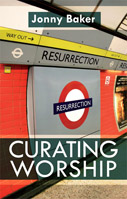
It will probably mean less of a need for a worship leader as song leader (although songs could still be sung) and more of a need for worship leader as curator – a person to welcome, enact the call to worship, offer the benedict, who make sure enviroment works, and to link, where necessary between the segments. (Mark Pierson’s The Art of Curating Worship: Reshaping the Role of Worship Leader
This second proposal is using the established gathered worship liturgy of the church, but is making the focus of gathered worship the stories from the scattered lives-in-mission. It is refusing to let worship be about gathering, nor letting scattering have no communal resourcing. Rather it is “lightening” existing gathered worship by orientating it around the stories of the people of God in life.

Sunday, March 20, 2011
can mission be embedded into the worship DNA? a proposal
Updated: For a second proposal, see can mission be embedded into the worship DNA? a 2nd proposal.
Updated: to be clear, I’d not for a moment suggesting this for a whole existing congregation. Best way to kill an idea is to expect everyone to agree! With this, I’m wanting to suggest an experiment, to invite a number of folk to try for a set period of time and then to sit back and reflect on the implications.
Here is the logic of some current thinking.
1. Faith is caught, not taught. Thus the Christianity we are offering is focused on worship, not on mission. The energy for being Christian today (what folk see, what people are paid for) is concentrated on the invitation to gather and to worship, not to scatter in God’s sending name.
2. This makes mission the extra, the stuff we do after the benediction and outside the worship service.
3. Mission is a multi-faceted way of being God’s hand and feet in the world. It includes the individual relationships we have with those beyond the community of faith. It also must include corporate acts in which the people of God together are the body of Christ.
4. We live in a time poor society. This means that some prioritisation must happen. Current Western church attendance patterns include more and more folk attending fortnightly. In other words, weekly is hard enough, let alone saying to folk – to be part of us weekly involves both gathered worship and mission.
5. Churches when they gather do some mission. This involves pray for others. It also involves giving financially. However if we are honest, most of this giving is funneled into more worship, not into mission.
6. Further, it takes levels of skills I rarely see to integrate mission into all of gathered worship – thanks, hearing the Word, confession, communion. The Uniting church worship recommends the worship includes a Word of Mission, but one is more likely to see a Kiwi than find this wonderful treasure.
So how can we embed mission into the DNA of the worshipping life of the church? Since this blog has many purposes, one of which includes trying out ideas, flying kites, here’s a suggestion, that we offer the following pattern for church.
Week one – gather together to give thanks, name sin, engage the Jesus story, hold the world before God ie gathered worship.
Week two – scatter – each is encouraged in this week to simply connect with friends and family who are not yet Christian, to pursue individual redemptive relationships.
Week three – gather – a simple gathered worship service focused around communion, storytelling of the Jesus story and prayer for relationships.
Week four – gather but only in order to do a combined mission project. People come together to plant trees, feed the homeless, advocate for justice, plan community events.
In this pattern, all the important facets of gathered worship are present, albiet monthly, rather than weekly. What is changed is that mission – both individual and corporate – is now embedded into the rhythm of the gathered communion.
I would have resisted such a pattern 10 years ago, when I use to argue vehemently for regular weekly patterns. My thinking 10 years ago was that those on the fringe, or visitors, might not be able to connect with this changing pattern. And so they might turn up to find the church “in mission”, which would be cool, but also pretty inhospitable. But 10 years ago was before we had cell phones, websites, social media. These now allow a whole range of ways for people to keep connected with the life of a community.
So what do you think? Would such a project allow the life of a church to be more aligned around the important impulses of worship and mission, gathering and sending? What might be lost?


 )
)