Monday, May 06, 2013
missional communion
An introduction to communion that I shared today, working with our candidates, faculty and visiting ministers, gathered around the topic of self-care.
There is a story of some ministers gathering. Much like us today, to wrestle with ministry. In the question time, a question is raised. A person aware of their world, concerned about the church. How can we bring people to the altar?
The response is made. Is the question how do we bring people to the altar? Or is the question, how do we bring the altar to people?
An important reminder as we gather. It is not that we come to communion, but that in communion God comes to us. In this we are invited to participate in God’s mission.
Yes, it is about our care. In communion God feeds us, centres us, re-values us around grace and redemption.
But it is more than that. It is also about care for the church. In communion God feeds the church, centres the church, re-values the church around grace and redemption.
But it is more than that. It is also about care for the world. In communion God wants to feed the world, wants to centre the world, wants to re-value the world around grace and redemption.
And so we pray; Spirit, fall on us, that these elements of bread and wine may be for us a participation in your life, love and mission, your bringing the altar to people.
Sunday, May 05, 2013
original of the species
for my kids
One of the optional events at the U2 conference in Cleveland included a discussion of U2’s music by Rev Kurt Wiesner, an Episcopal priest and U2 fan. He took a reader response approach, that a song can mean more than it’s original, authorial intent. On that basis he showed the video, noted that it was written by Bono for the daughter of a friend. He then asked a number of questions that generated a rich discussion. These included a key phrase, what might the song be saying about growing up, what if the voice of the singer was God talking to us?
Friday, May 03, 2013
Festival spirituality stories: Spin and Fibre Festival
I’m starting a research project, wanting to collect stories of Festival spirituality. It is an extension of a brief idea I sketched in my The Out of Bounds Church?: Learning to Create a Community of Faith in a Culture of Change (emergentYS)
Festival spirituality (working definition): an occasional period of community gathering for celebration, in which Christians intentionally participate, seeking to make the shalom of God more visible.
This Festival spirituality story – Spin and Fibre Festival comes from Frontier News, May 2013, 8-10. It relates to the 35th Bothwell International Highland Spin In and Fibre Festival, a biennial event held in Tasmania and comes from an interview with Rev Meg Evans, Patrol Minister, Midlands, Tasmania.
Held every two years, Meg is the unofficial chaplain for the festival, which was started by a group of Uniting Church women who were spinning wool to raise funds to restore the church tower. Bothwell is one of the smaller communities in the Patrol located in the Central Highlands, 70 km northwest of Hobart. It has a long history in Merino wool production and the festival remains a huge event for both local and international visitors showcasing crafts and skills associated with superfine wool.
“On the Friday, we shear a sheep for the fleece, and then we hold a ‘Blessing of the Fleece.’ The wool is given out to people to spin during the weekend. On the Sunday I hold a service in the school gym, surrounded by all this wonderful creativity. It is just a great community celebration.”
“People come and tell me how much they enjoy it. I think the fact that the Church is there speaks to people.”
Some interesting things to note
- gift – the involvement of the church begins with “Blessing”. This suggests a thankfulness. What is blessed (the Fleece) is then given away to participants
- risk – This clearly involves risk, that the gift might not be “unwrapped,” might not be utilised. Or it might be “wrapped” in a way contrary to the values of the giver.
- theology of creation – the connection to wool, as the product of local industry, as the lifeblood of what this community, this land, produces. A celebration both of the gift of wool, but also of the creative gifts that surround wool – “crafts and skills associated with superfine wool.”
- being church as spun (interwoven) presence, first in being close enough to the land to be aan initiating participant, second in being a worshipping presence through the festival, both from the initial blessing through to the service, third in the theology of Meg, “the fact that the Church is there speaks to people.” The church began this event, but was willing to give it away. The church is willing to be one of many participants, many strands, in the fibre of this event. It does not need to own it nor control it.
So this Festival spirituality is mission as chaplain, celebrating creation, with particular attention to presence, participation, gift and risk.
Questions for discussion
- I wonder what things might be worth celebrating in your community – what gifts of “creation” and “creativity” you could bless?
- I wonder how you might take risks and invite people to participate in these gifts?
- What might an authentic presence look like? Think about this both from your perspective as a church and from the perspective of visitors and locals.
Wednesday, May 01, 2013
Pop culture, Steve Averill, U2 and the Incarnation
Steve Averill, Senior Art Director at AMP Visual, was one of the keynote speakers at the recent U2 conference. He was introduced as speaking on what it means to turn sound into a vision. It was an important statement, a reminder that music is so much more than sound.
Steve Averill has designed nearly all of U2’s album covers. Many have won industry awards. He structured his talk around album covers, working his way through the U2 album sleeves he has designed. As he discussed colours, font styles, images and influences, you became aware of how much thought, care and imagination go into what we hold, the CD cover, what we wear, the concert T-shirt, what we see, the branding on the U2 publicity.
He noted the quirky eccentricities of the covers – that Bono wanted Bible verses on the cover of All you can’t leave behind, and so they added them in via the airport gate signs, that the picture used on No line on the Horizon was by artist Hiroshi Sugimoto. He was not willing for their to be any branding on his art. The solution was to etch branding onto the plastic CD sleeve.
He showed us the album covers that were influential, the album sleeves the band own, they listen to, they like – The Ramones, The Beatles.
Dr Jason Hanley, who holds a Ph.D. in Musicology, introduced and interviewed Steve Averill. He began by noting that rock and roll is a material culture. When you look at it, when you research it, when discuss it, you are learning about yourself, about your world, about your culture.
This should make sense to Christian theologians. The Incarnation, God coming in human body, is an honouring of the human body, of the senses, of what we see, feel and touch. Pop culture should thus be an easy and obvious area of theological research, both as an exercise in Incarnation, and as a way of helping us see ourselves, our culture, our world.
Monday, April 29, 2013
Head and heart: a U2 conference review
I will remember this U2 conference for the way it brought together both head and heart.
It began for me with Natalie Baker’s fan film and the stories from fans of how U2’s music helped them avoid suicide and assist their healing from childhood sex abuse. Suddenly U2 was more than entertainment and the conference more than academic. It was inviting us into deep places.
It quickly went deeper, with Bill Carter sharing about his engagement with U2 in the Zooropa tour. His stories, of persuading Serbians to drive past sniper alley in order to share, via ZooTv, their story of living through the bombing of their city, took us even deeper, into the humanity that can emerge amongst inhumanity.
Finally, the presentation by Steve Averill was a further reminder that music is so much more than music. His sharing about the development of U2’s albums documented the visual and tactile side of music – the album and CD cover, the merchandising. It was a reminder that music is about communication, the colours and photos carefully selected to try and capture the essence of the music.
There were more many other highlights but for me, I will remember the head and heart being invited to be whole bodied.
Perhaps it was the jet lag. Flying overseas is always a disorientating experience, so perhaps the way my body responded was to seek another heartbeat.
Perhaps it was the venue, more compact, which encouraged more interaction and engagement.
But I suspect there was more going on, an important corrective for the work “academic”, which can easily hide behind footnote and theory, and in doing, so walk past the beating heart and whole body.
Thanks to all those who made the head and heart possible, especially the Calhoun’s.
For those interested, a brief summary of my contribution to the conference is here. And here is my review of the first, 2009, U2 conference.
Sunday, April 28, 2013
Let us in the sound. My U2 conference paper
Some really positive, engaged, thoughtful response to my U2 conference paper this morning.
My argument is that U2 concerts act as corporate memory makers. I used as a theoretical conversation partner Paul Connerton’s How Societies Remember
- Concert-rical repetition, an adaptation of Connerton
- Verbal repetition, in which I looked at the different between album lyrics and live performance, using the U22 album. This data generated a corporate memory making around remembering the local, remembering the concert history and remembering people past.
- Gestural repetition, in which I looked at Bono’s gestures, drawing on photos of live performance in From the Ground Up, the official photobook of the U2 360 tour.
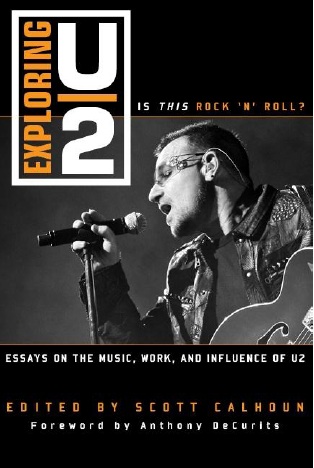
All of which seemed to generate, as I said, some really rich conversation. So it looks like it has the legs to turn into a publication, either in Journal of Religion and Popular Culture or in the book that is intended from this conference, and which will accompany Exploring U2, the book that emerged from the first conference.
Thursday, April 25, 2013
Let me in the sound of U2 conference
The last few days of my sabbatical and I’m heading Stateside, to attend the U2 conference.
I’ll collect my T-shirt.

I’ll present my paper – on which there has been quite some to-ing and fro-ing. It has taken a bit of detour as I wrote it, and is now focused on how U2 act as corporate memory makers, through analysis of U2’s live performance, including Bono’s physical performance gestures.
I’ll check out the conference and enjoy the input including Steve Averill, U2’s designer and Bill Carter, the journalist who provided U2’s links with Sarajevo during the dark days of the Bosnian war, plus the other academic papers.
And I’ll return, flying back Sunday. A very short trip stateside.
The last U2 conference (which was the first and also had a T-shirt!), was a whole lot of fun, so expecting the same.
Wednesday, April 24, 2013
Gender matters: Startups with women more likely to succeed
Here’s another one in the gender matters series.
Startups with Female Directors Have Better Chance of Survival. Newly incorporated companies with one female director have a 27% lower risk of becoming insolvent than comparable firms with all-male boards, says a team led by Nick Wilson of Leeds University Business School in the UK. The effect decreases as the number of female directors rises, suggesting that what matters is diversity rather than the specific number of women on the board. Past research shows that groups with greater gender diversity generate more-innovative thinking in problem solving.
Source – this piece of research in International Small Business Journal.
For more on gender matters
- my emerging church research does gender matter in faith development?
- women’s faith development is in alienation, through awakenings, by relationality
- What do Lo-ruhamah in Hosea 1, Namaan’s wife’s slave girl in 2 Kings 5, the slave girl in Philippi in Acts 16, Jarius daughter in the Gospels have in common?
- do women lead differently?
Monday, April 22, 2013
In sure and certain hope
Andrew Dutney, President of the Uniting Church, dropped in on my Sustainability and the mission of God presentation at the Australian Association of Mission Studies (Adelaide chapter) today, when I presented some of my findings from research into UK fresh expressions ten years on.
Andrew offers a fascinating followup reflection, pondering further some of my ruminations around the implications for a church that seeks to live in response to an Easter story of death and resurrection.
One of the interesting things [Steve] found is that there’s about a 50% attrition rate in the Fresh Expressions he’s followed over the last decade. He checked this against other writers’ lists of innovative faith communities like that and found a similar “death” rate.
But he also found significant signs of new life – resurrection even – associated with those short-lived churches. Individual participants report being transformed by the experience and prepared to offer significant leadership in mission after the demise of the Fresh Expression they were part of. Other faith communities – both established congregations and other Fresh Expressions have learned from the experience and example of the community that has wound up. And many of those communities have left behind “products” generated in their years of vitality – art, liturgical resources, training modules etc.
So, Steve told us, that 50% attrition rate doesn’t mean that half of the Fresh Expressions initiated weren’t worth the effort. Not at all. They are integral to the dynamic of the church’s discernment of and participation in the life of the Holy Spirit in the world. They too embody the One Holy Catholic and Apostolic movement.
You’d think a movement oriented around the death and resurrection of Jesus would get that intuitively.
Andrew then moves from fresh expressions to ponder the implications for inherited expressions, particularly churches facing death. It’s really interesting. More here
Sunday, April 21, 2013
the challenges in fresh expressions: a counter spirituality
“For the essence of modernity is economic development, the vast transformation of society precipitated by the emergence of the capitalist world market. And capital accumulation … requires the constant revolutionising of production, the ceaseless transformation of the innovative into the obsolescent.” (Paul Connerton, How Societies Remember (Themes in the Social Sciences)
I wandered my garden over the weekend.
Recently planted broccoli seeds are up, tiny leaves seeking light. The blessing of something planted days ago, which in time will yield nourishment for the Taylor table.
The leaves of kale, seedlings planted some two months ago, now stand proud, nourishment now for the Taylor table. The blessing of something planted months ago.
Some autumn bulbs have suddenly flowered. A dash of crimson, fragile and beautiful, has emerged from what was dry. The blessing of something planted years ago.
Pioneers like to plant. I noted last week the challenge of fresh expressions. How much of fresh expressions is simply the church entering into “the constant revolutionising of production, the ceaseless transformation of the innovative”? What does it mean talk fresh and emerging in a culture that plans obsolence, privileging the new in a relentless search of the next fashion trend?
Yet such analysis ignores a significant dimension of the practice of fresh expression. I’m talking about the emerging trend of recapturing the ancient, when what is new is in fact a deliberate reaching for what is old.
Doug Gay captures this superbly in his book, Remixing The Church: Towards an Emerging Ecclesiology.
This move stands at odds with Connerton’s analysis – of “the constant revolutionising of production, the ceaseless transformation of the innovative into the obsolescent.” (Paul Connerton, How Societies Remember (Themes in the Social Sciences)
(Although it could still be a problematic manifestation of postmodern consumer culture – for more on this see my discussion of the ethics of sampling in my The Out of Bounds Church?: Learning to Create a Community of Faith in a Culture of Change
Which returns me to my garden. The bulbs are an ancient planting, the kale an earlier planting, the broccoli recent. They involve multiple moments of planting. They rely on more than one pioneer.
This is one posture by which pioneers might respond to the spirituality of our age. We will cultivate crops recent and ancient. We will consider as important the seeds that yield instant results as the seeds that might take months to grow. We will plant in expectation of seasons with rain and without. We will partner with other pioneers, honour their historic acts of grace, deliberately plant things we know that we will never harvest, glad that another will enjoy our fruit.
Such is God’s economy.
Thursday, April 18, 2013
consensus and decisionmaking
The Uniting church seeks to work by consensus. It relies on a lot of people working very hard, willing to listen deeply, and skillful chairing, to help the process. When it is found, especially in larger groupings, it is a joy to behold.
So here’s a really interesting counter view, from Michael Stiassny, at the Institute of Directors annual conference in New Zealand yesterday.
consensus allowed directors to hide from making tough decisions. “I think it is time we toughened up. We need to be stronger and share our views.” …. passionate people needed clear boundaries … boards and chief executives needed to have full and frank discussions … “If the chair and CEO are holding hands – how on earth are the board going to have a frank discussion?”
I’m not saying I like all the corporate language. Nor am I saying I agree. But it’s worth a read and to consider if at times, consensus leads to poorer decisionmaking and less truth telling in an organisation. Full article here.
Wednesday, April 17, 2013
talking sustainability and mission
A cancelled appointment, combined with a decision to start early, has meant a valuable few hours in a cafe working on my
Sustainability and the mission of God: a case study of fresh (and failed) expression
presentation for the upcoming South Australian Mission Studies Network Gathering.
It’s a chance for me to present some of my sabbatical data, to be accountable for the gift of time I get given, plus an ongoing chance to process the resultant book project. Today involved trying to extract some clarity from what is currently 32,000 words, spread across 11 chapters.
Here are the six headings/highlights which I hope to address.
1. Defining mission and fresh expressions
2. Describing fresh expressions today
Hearing from the House of Lords. Seeing the impact of fresh expressions in three Dioceses
3. Discerning Rowan’s theo-ecclesio-missi-ology
The impact of Rowan Williams doing theology, being church, practising leadership on the evolution of fresh expressions and the development of Fresh Expressions.
4. Tracing Fresh Expressions
Eleven key leadership strengths supplied by one Bishop, one Archbishop, one funding body, one book, one DVD. Note – eleven, but not twelve!
5. Learning Ten years on
The stories of ten new forms of community and the four ecclesial layers that emerge when fresh becomes failed, yet failed becomes fresh
6. Four insights for sustainability and mission
- the power of top down and bottom up
- the place of the whole body in mission
- the potential of buildings when mission trumps worship
- sustainability in a divine economy
The event is open to all mission-minded individuals, including scholars, reflective practitioners and teachers.
Monday 22nd April @ 12.30 pm (until 2:00 pm) in S1, Adelaide College of Divinity, 34 Lipsett Terrace, Brooklyn Park, SA. BYO Lunch but Tea and Coffee provided. To RSVP by Friday 19th April or want further information, then contact David Turnbull on 8373 8775 or dturnbull at adelaide dot tabor dot edu dot au
Monday, April 15, 2013
the fraility of Follow me
The Bible reading for Sunday, from John 21, got me thinking about aging. It is Jesus encounter with Peter after the resurrection and it is interesting the way discipleship looks both backward and forward.
Backward, to Peter’s denial, as three times Jesus questions Peter’s loyalty.
Forward, as Jesus looks to Peter’s future.
“Very truly, I tell you, when you were younger, you used to fasten your own belt and to go wherever you wished. But when you grow old, you will stretch out your hands, and someone else will fasten a belt around you and take you where you do not wish to go.” John 21:18
This is often taken by commentators to refer to how Peter will die. But it is a fairly standard description of aging. The reading occurred in a church service in which an elderly minister, with significant health concerns, was presiding over what might in fact be their last ever time to lead communion.
Hence my connection with the aging dimension of the text, the inevitably of time in which all of us no longer be able to dress ourselves and rely on others to walk us.
What left me pondering was how the call to discipleship in the text, both forward and backward, is the same: “Follow me.” Whether to previous denial or to a less than mobile future, God invites us into discipleship.
We live in a society that prioritises youth. I like that Jesus calls folk, no matter their age, to discipleship. I see this as encouraging, a reminder that we’re invited into God’s purposes no matter our faculties, that God does not put people on the shelf as their bodies waste.
All this has echoes with a book on my beside table, John Swinton’s Dementia: Living in the Memories of God
Which is exactly what is happening in John 21. Peter has been frail, in denial. Peter will be frail, in the future. Both are held by God in Jesus, in the practicalities of food, in the warmth of fire, in the invitation to discipleship no matter one’s age and stage.
Friday, April 12, 2013
the challenges in fresh expressions
“For the essence of modernity is economic development, the vast transformation of society precipitated by the emergence of the capitalist world market. And capital accumulation … requires the constant revolutionising of production, the ceaseless transformation of the innovative into the obsolescent.” (Paul Connerton, How Societies Remember (Themes in the Social Sciences)
This raises the question – how much of fresh expressions is simply a reflection of capitalism? Are new forms of church simply a reflection of a cultural privileging of the search for the next new thing? Are we replacing the ever changing fashion hunt for clothes, gadgets, machines, neighbourhoods, with the fashion hunt for churches, spiritual experiences, worship ideas?
This, in a nutshell is a significant challenge to fresh expressions. We are all deeply enmeshed in this cycle, this economy. Our culture has deep and powerful subterranean currents that push us to prize innovation, the new.
As my family joke to each other as something new distracts us in the shops: “Oh, shiny.”
In our pursuit of mission, we need a depth of cultural analysis, an ability to more clearly recognise the deep and powerful subterranean currents that carry us as individuals and communities. The cultural tools to do this can be found in the world of mission, which has 2,000 years of experience in reading cultures.
We also need a theological understanding of gospel and culture, and awareness of the multiple postures by which the church in history has engaged with the deeper currents of culture. Mission history is a rich resource for such insights, for again, it has 2,000 years of seeking to find the Spirit in the outworking of cultures.
As we have these conversations, we can begin to frame a divine economy, a way of seeing our past, the places we walk, the people we engage that is neither free market capitalist nor historic rural idyll.
Armed with cultural awareness, mission insights and a theology of God, we might then begin to work toward a richer theology and missiology of fresh expressions.


 )
)