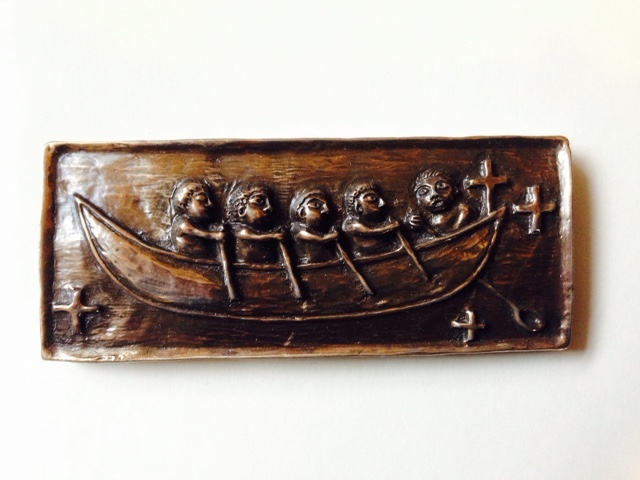
Monday, January 14, 2013
A prayer for writers (for me)
Having returned from holiday over this weekend, my main task for the next 12 weeks is to write. (I have some research to do, but that takes second place behind my hope of completing a book – on sustainability in emerging and fresh expressions.) I face the 12 weeks with mixed feelings. It’s been 7 years since my first book
Writing is such an individual experience. It feels so egotistical, this individual pursuit to be heard. Why might my words be worthy of being read? Why, in a world of so many books, should I pollute with yet more information?
There are a whole lot of academic pressures at work – to publish, to get the right press, to be recognised. Again, a complex set of emotions and motives to sift.
So this morning I found some phrases from Philippians 1:9 helpful.
“And this is my prayer:”
“love” – and so to write out of love for God, church, people and world
“knowledge” – and so to write respectful of the tradition, of those who’ve gone before and my contemporary colleagues in scholarship, all the while conscious of the intuitions and feelings that are learnings within myself
“depth of insight” – to write something that might, through God’s mercy, shine some light on the yet simply complex and complexly simple task of being a disciple in this contemporary world.
And so, to writing I will go …
Saturday, January 12, 2013
Art and creativity as acts in community
Walking art galleries. Something I’ve done a lot of in recent days. There is a pattern. Payment. Coat removal. The signs – no flash, no backpacks. The rooms patrolled. Pictures framed. Ropes to divide, cameras to watch.
But it turns out such an approach to art is cultural. At least according to A History of the World in 100 Objects
Of the 100 objects that are the focus of the book, number 39 is a painting from China. Called the Admonitions Scroll, dated around AD 400, it introduces a very, very different way of understanding art appreciation.
“each imperial ruler has left their mark on (the art piece), in the form of a stamp carefully placed in the blank spaces around the paintings … Some of the previous owners have also added their own comments to the scroll. This brings a kind of pleasure you can never find looking at European painting: the sense that you are now joining a community of discerning art lovers who have cherished this painting over centuries.” (A History of the World in 100 Objects
So this is another approach to art. You make it with interactive borders, a white space for viewers to engage. In doing so, you allow, expect even, participation. All very different from the wonderful solo artist who produces solo art works. Instead we have a work for community.
Which sounds like an early form of blogging to me, that deliberate attempt, at least for those who allow comments (!) to encourage participation, to expect work to be modified and affirmed.
There is one caveat. In the case of Object 39, the participating community is elitist, in this case the emperors. In contrast, any can blog and any can comment.
Still, the challenge remains. Who is art and creativity for?
(This links with the work of Thomas Struth – which I’ve blogged about here) and his exploration of how people engage galleries and museums, and how museums and galleries actually control people.)
Friday, January 11, 2013
Middle-aged Cathedrals as cultural mirrors
In order to help me process Europe, and its accompanying museums, galleries and cathedrals, I’ve been reading A History of the World in 100 Objects
Object number 20 was the statue of Ramesses II. I read it the day we visited the Cathedral at Cologne. Described as an Everest among cathedrals, it is one of the largest in the world in floor area. I must confess to having a rather allergic reaction to cathedrals. I struggle with the fusion with military conquest, with the way God is imaged as remote, so inaccessible in the height of roof and distant altar.
So what does this have to do with the Statue of Ramses II?
This serenely smiling sculpture is not the creation of an individual artist, but the achievement of a whole society – the result of a huge, complex process of engineering and logistics – in many ways much closer to building a motorway than making a work of art.
So a cathedral is much more than a reflection of God and church. It’s also about society. How a town can show off their organisation and culture, their ability to plan, resource, be a team.
It’s also a way for artists to participate. I mean, there were no galleries back then. So you can have your work locked up in kings collections. Or brought by wealthy benefactors. All remove your work from the public. Or participate in cathedrals, thus engaging the public.
In other words, I need to understand cathedrals within their cultural context. And to appreciate how they flow within a society, in community rather than through an individual “God and me” lens. They are mirrors not just off the church, but of the whole of society.
Wednesday, January 09, 2013
the year that was – 2012
It’s always interesting to look back over the blog as one way of reflecting on the 2012 year past. The most interesting thing for me is the decline in blogging that began in July, coinciding with becoming Principal. I was posting 25 times a month prior and 19 times a month after. Given that I blog as a way of reflecting aloud, it is an interesting development.
So, posts from 2012 that I like, that give some sense of the year gone
- the sacramentalism of house renovations
- we lift up our livers
- ordination as mission
- Pentecost practice of small growth
- nature’s baptism
- still blogging 10 years on
- I had a dream
- this is the house the team built
- a faith shaped by art not by words
- the end of greed: be kind to animals
- colours of formation
- Getting on with mission: are you broad enough?
- at work for mission
So there you are. Fascinating to look back and see the blessing as I pay attention to the natural world, the importance of creativity, the priority of mission and the ongoing opportunities to write.
The writing has been the most interesting, with a frontpage article here, this artists floor talk being requested for an international publication, along with the usual more academic book chapters (this published, this accepted for publication) and monthly film reviews.
Wednesday, January 02, 2013
A New Years spirituality – Amsterdam Festival of Lights
The Amstersdam Festival of Lights has been an unexpected treat. For those travelling from a Southern Hemisphere, having darkness fall from 4 pm onwards takes some adjustment. The up side is the chance to play with light.
For the last few years, Amsterdam has maximised this climatic advantage with a Festival of Lights, inviting artists to mount installations in key locations.
Ovo is one installation. In the shape of an egg, it thus suggests new birth. With over 700 lights, each individually able to respond to changes in light, temperature and fog, it proves itself flexible and adaptable. New birth is not a one size fits all, but a uniquely beautiful response to changing environments.
Seeing it today, on the first day of a new year, it became a prayer, for new life in a new year, for beauty that responds to the uniqueness of my changing environment, our changing world.
A time lapse video of the making is here, with the Ovo in full colour, from about 2.11 on.
Amsterdam Light festival: the making of timelapse from Amsterdam Light Festival on Vimeo.
Monday, December 31, 2012
The Last Supper at work for mission -Gustave Van De Woestijne’s
Gustave Van De Woestijne is a Flemish Expressionist painter of the early 20th century. His work includes The Last Supper and it is huge.
Huge.
It hangs almost floor to ceiling in the Groeninge Museum, Brugge, Belgium. (Image is on flicker here)
In the Catholic context of Belgium, surrounded by the religiosity of previous centuries, it is a stunningly unreligious piece of work. One simple full loaf of bread sits on the table. There is no cup, grapes or any other food on the table. Around the table are clustered 12 disciples, portrayed as workers, Flemish miners or farm hands.
Which leaves the size. Why paint what is one of the largest paintings in the Museum? Why make something so ordinary so large?
Either a sign of no faith? A critique of the ceremony and wafer thin spirituality of the religion he has experienced? It certainly has the checkerboard floor often used in religious art.
Or full of faith? A reminder of the very large place for God in the ordinary, in simple bread, shared among workers hands? If so, it has echoes of the worker priest movement, such an intriguing mission development in France, among Catholics, in the 1940s. Priests asked to be freed from parish duties in order to work, in factories, in order to try and reconnect with the working class. It is a fascinating, bold, and innovative approach to mission, that was closed down by the Pope within a few decades.
It is the type of fresh expression/emerging church I’d love to see, one that jumps out of middle class subcultures and across class boundaries, out from church and worship and among the 24/7 patterns of working life. A movement that could only be nourished by a Jesus breaking bread with workers around ordinary tables of life.
Saturday, December 29, 2012
Colouring a contemporary stations of the cross
Amid the ancient history of Saint Salvador Cathedral, Brugge, is a contemporary stations of the cross. Beautifully arranged in a side chapel, it is one, of very few signs, that this faith might be living.
A project by Dutch artist, Jac Bisschops, between 2008 and 2010, he aimed to communicate the essential message of each Station of the Cross. His aim is contemplation, a seeking for simplicity, harmony and clarity. The hubris of the cathedral was thus a thoroughly fitting backdrop.
A feature is the limited palette, five colours
- blue for infinity
- brown for transitory earth
- black for darkness
- white for purity
- gold for resurrection
Each base colour is used three times. Layering is used to provide a rich intensity of colour.
Another feature is the interplay of horizontal and vertical lines. In this sense, it has echoes of New Zealand artist, Colin McCahon and his stations of the cross (although McCahonh uses more of a two colour palette).
Together, simple palette, straight lines, rich layers, it actually works. I find myself slowing, pausing. In the concentrating, I find an inviting clarity, a simplicity that reminds me of life’s essence, the reality of Easter. (For those interested, a YouTube video, which includes every piece is here.)
Friday, December 28, 2012
Multi- sensory storytelling
“Passionate people wanted to produce something new”
I went today to the recently opened Historium in Bruges. A wonderfully creative way to access history, that has some challenges for Christian communication and shows the enormous potential of storytelling.
It began with a question, what was it like in the Middle Ages?
The question was answered by multisensory storytelling. They took a red robe, a green parrot and the girl model from a van Eyk painting, Madonna with Canon, to create a narrative, told in audio and through video screens cunning placed around a set, spread over 7 rooms). Each set involved senses, simulating fog, snow, local produce. Animation was used, both to ensure historical accuracy, in the backdrops, costumes, hats, jewellery, but also to enhance the storytelling. The 7 sets/rooms allowed a focus on a wide range of life, customs to guilds, public baths to harbour, created from miniatures and art of the time. The goal is an emotional insight. In other words, not just information. But neither just entertainment. But a use of senses to help people make a connection, and thus to bring the past into the present.
After the experience comes the information, a room full of displays to browse. Imagine if church history or Biblical studies were taught in this way!
It is important to note also the place of collaboration – film makers, musicians, historians, business people all working in partnership.
I’m hoping (numbers willing) to teach a course in 2013 (starting April) on the place, potential and possibility of senses in mission and ministry, working with a local artist and local storyteller. What I saw today may well become a contemporary case study.
For a video of the making –
Historium: The Making Of from Historium Brugge on Vimeo.
Wednesday, December 26, 2012
euro-bound
Tomorrow, 26th December, we Eurostar across the Channel. Time for our Euro experience. Tee hee.
It’s been a busy first two weeks of sabbatical. I’ve had two cracks at writing a publisher proposal. One got the thumbs down, “needs more effort” from a helpful colleague. The second, shaped by the helpful conversation emerging from the first, got a much more encouraging response. So with a greater sense of clarity, of both the big picture and some stepping stones, I’ve now started to work on a couple of sample chapters. It’s been a profitable beginning to the sabbatical.
A surprise is to realise how quickly and completely I’ve forgotten about the Principal pressures. Being sucked into a book proposal in my largest study ever in another country, in another hemisphere, has been a very good way to find some space, mental and spiritual.
But now it’s time to pause, to holiday. Not this year in a Southern Hemisphere of beaches, baches, barbeques and books. Rather a Northern Hemisphere of art galleries, museums and cathedrals.Three weeks to absorb, across Belgium, Germany and France. Looking forward to stepping away, not just from being Principal, but from being sabbatical writer.
Thursday, December 20, 2012
the nativity as a theology for the differently abled: film review of Intouchables
Each month I publish a film review, for Touchstone (the New Zealand Methodist magazine). Stretching back to 2005, some 80 plus films later, here is the review for December.
The Intouchables – A film review by Rev Dr Steve Taylor
“That’s what I want. No pity” Philippe from his wheel chair
It is Christmas. In the next weeks many of us will find ourselves contemplating an image of the Nativity, the crib surrounded by adoring angels, bewildered shepherds and a prayerful Mary.

(from Metropolitan Museum , usage based on their fair use policy and from www.metmuseum.org.)
The Adoration of the Christ Child by Jan Joest (1515) is one such depiction. While not sited on contemporary Christmas cards, it has caught the eye of scientists, who have identified one angel and one shepherd as displaying the typical features of Down syndrome.
It raises an important theological question. When the Word became flesh, one with all humanity, how might this be good news for the differently abled? What does disability mean to a Christian understanding of being human?
French movie “The Intouchables,” written and directed by Olivier Nakache and Eric Toledano, provides a delightfully comic, yet theologically thoughtful response.
Philippe (Francois Cluzet) is a tetraplegic, sentenced to life in a wheel chair as a result of a hang glider accident. Needing care, he hires Driss (Omar Sy), a Senegalese migrant, from a long list of applicants. They share little in common, separated by age, ethnicity, upbringing and social context.
Yet together this unlikely pairing help each become more fully human. Their journey is a delight. Those around me in the packed cinema found a shared laughter, an enjoyment with, never at, the differently abled.
The film was voted the cultural event of 2011 in France, enjoying number one at the box office for ten consecutive weeks, becoming the highest-grossing movie in a language other than English. It is easy to see why. The dialogue is deft. The acting is superb.
Some critics suggest easy stereotypes in the contrast between rich white man and poor black man. Yet “The Intouchables” uncovers the brokenness in both their worlds. For one, the relational sterility of wealth, for the other, the drug addicted violence of high-rise migrant housing.
Both Philippe and Driss must eventually find healing for disabilities not just physical, but relational.
Suggesting easy stereotypes also overlooks reality. “The Intouchables” is based on truth, the relationship of Philippe Pozzo di Borgo and Algerian Abdel Sellou, spread over ten years. Their story is told in A Second Wind and they remain friends. Together their relationship offers a depth of insight into the task of being human.
“Pity is the last thing you need. Pity is hopeless. Pity is what someone gives you because he is afraid to take care of you. I didn’t need that. But compassion I don’t need also. It comes from Latin and means ‘suffering with’. I don’t want you to be suffering with me. I need consolation, which in Latin means keeping me as a whole person, respecting me as I am.” (Philippe in Daily Telegraph, 5/9/2012)
Christians can get good at pity. At Christmas we can face many calls for compassion. Might it be that Christ, surrounded by disabled angels and shepherds, calls us to neither pity nor compassion? Rather he invites consolation, the God who in Christ so loved the intouchables, all “the least of these.”
Rev Dr Steve Taylor is Principal, Uniting College for Leadership and Theology, Adelaide. He writes widely in areas of theology and popular culture, including regularly at www.emergentkiwi.org.nz.
Copyright note: Usage here based on the website. The Materials are made available for limited non-commercial, educational, and personal use only…. Users may download these files for their own use, subject to any additional terms or restrictions which may be applicable to the individual file or program. Users must, however, cite the author and source of the Materials as they would material from any printed work, and the citations should include the URL “www.metmuseum.org.” By downloading, printing, or otherwise using Materials, whether accessed directly from this website or via other sites or mechanisms, users agree that they will limit their use of such files to non-commercial, educational, personal or for fair use, and will not violate the Museum’s or any other party’s proprietary rights.
Tuesday, December 18, 2012
Walking on country: Uniting College Candidates Indigenous Immersion
News via email overnight of funding approved for Walking on Country, an indigenous immersion experience, which we want to have as a compulsory part of our training for candidates for ministry at Uniting College. It’s a project that I’ve been quietly working away on for well over a year – first in going ourselves as a family, then in seeking partnership with Uniting Church Congress, then in approaching a potential funding partner, then in finding a person to provide leadership, including to write up the bid ….
PROJECT DESCRIPTION:
• That a three day/three night educational and spiritual experience of Indigenous culture, history, politics and contemporary lifestyle be incorporated into the training and education of Uniting Church (of South Australia) candidates for Ministry.
• That this occur in different locations each year, based with an Indigenous community.
• That over a three year cycle, with up to 10 candidates attending each year, this program will be attended by the entire Ministry candidate cohort.
• That the program consist of Preparatory reading, an Immersion experience, and a post-trip forum.
PROJECT OBJECTIVES:
1. For participants to become informed and educated about life in particular Indigenous communities
2. For participants to explore ‘decolonisation’ of their colonised thinking and relationships,
3. For participants to develop conceptual, emotional and spiritual foundations for covenanting and friendships with Indigenous communities and the UAICC
4. For participants to commit to a journey of reconciliation with Indigenous Australians, and to the vision for Covenanting in the Uniting Church.
Three days is nothing.
Although it might be better than nothing.
And it fits with a number of other intentional processes we’re working on – looking not for a one-off tokenist experience, but consciousness raising on multiple fronts.
Because missional leaders need to experience boundary crossing – in their guts and bodies and in their contexts – as well as their heads.
Friday, December 14, 2012
My largest study ever
Ripon College is the centering, homing location for our sabbatical. It emerged from a chance email, three Kiwis missiologists connecting. Cathy Ross emailed me congratulating us on our appointing at Uniting College of our new Director of Missiologist, Rosemary Dewerse. Cathy offered us hospitality if I ever came to the UK, which I said I actually was planning to do in a few months. And so we are now here at Ripon College, training place for Anglican Ordinands.
The library is located within the building and I’ve found a quiet little spot. I’ve not worked in a dedicated theological library for a long time and its just magic, surrounded by all the books you are likely to need. It’s like my office, only with more books and no work to distract or desk to tidy. It’s safer than a public library, meaning you can leave your computer to go for lunch or a 15 minute walk-and-break. It’s richer, being able to go to “practical theology” and browse all the relevant shelf, looking for chapters on how the Bible is being used, or going to “ecclesiology” and finding an new resource.
This first week of sabbatical I’ve started with a blank page and written around 4,000 words of a book précis. What do I want to say, how to begin, how to end and the stepping stones to get there? I hope to have a publisher proposal and sample chapter by Christmas.
Sunday, December 09, 2012
the sabbatical begins
And so it begins …
- For sabbatical – Adelaide, Hong Kong, London, Oxford (Ripon College) – from Sunday 9 December
- For holiday – London, Bruges, Amsterdam, Cologne, Mainz, Freiburg, Paris, Oxford – from 26 December until 15 January
- For research (to be organised) – Bristol, Cardiff, Glasgow, Edinburgh, York, London – from 25 January until 15 February
- For visits (to be organised) – Bristol, Cambridge, Durham, Glasgow – from 16 January until 23 January
I’ve thought about not blogging until I get the book (Sustainability and Fresh Expressions) written. As a discipline. But Lynne joked that would be like cutting of an arm. That I blog to get my thoughts organised. So who knows ….
Saturday, December 08, 2012
these walls will talk
One of the advantages of living in a house renovation is some space to play. Over the last few months, in order to try to gain even a tiny bit of work/life balance, I’ve been knocking off work early every Monday, to spend time with one of the family.
Together we’ve been working on a few projects. This is one of them –

– chalk paint as a background, words painted using my icon paints, etched via cut lettering from a local craft shop.
The plan is to use chalk, to write on the walls the things we’re glad of, and what we’re hoping for. It’s part of what we need to do as a family, to keep a focus on gratitude and hope.
Then, when the renovation project eventually gets to this room, we’ll simply paint over the top of “gratitude” and “hope”, leaving our family prayers permanently part of the house walls. It will probably need one more coat than normal. But hey – at least these walls will talk.


 )
)