Monday, September 10, 2012
“The Cross is not enough” book review – Chapter 6
After a break, I’m back, reading my way through Cross Is Not Enough: Living as Witnesses to the Resurrection
Overnight it had rained. Truth be told, overweek it has rained here in Adelaide, making the ground sodden and the trees laden with rain.
As I left the house, I noticed a flash of red and green. Our front yard is currently host to a pair of parrots, outrageous in their bright red crest, raucous in their squawks of delight as they place chase with each other from tree to tree.
As they landed, their weight caused branches, laden with rain, to shake vigorously. Water cascaded, sheets of white, unleashed from a branch of green, by these playful red crested visitors. A full immersion indeed.
In the Scriptures, so often birds are linked with the Spirit’s visit. Have I just participated in nature’s baptism – appreciated again her noise, colour and water? Heard afresh “This is my beloved son, with whom I am well pleased”? Been invited anew to creation’s plays? (here)
An experience in which creation made connections with Christianity. Which is exactly what this chapter is about. It asks the question – Are we awake to the possibilities of making connections from the signs of resurrection in nature to general revelation? It is a point well made. Training for ministry, I was asked to connect a Christian theology of creation with a Christian theology of the cross. But what about creation to resurrection? For Clifford and Johnson
We believe that in this motif of resurrection the creation “speaks” to us: resurrection is an integral part of the natural order. It is an analogy, of course, because nature “dies” and “rises again,” and dying-and-rising in nature is not identical to the bodily resurrection of human beings; however, what we need to bring back into focus is that nature itself reveals a resurrection motif, and this motif should be appreciated as being part of general revelation.
What mission possibilities are intriguing:
- the place of analogies to resurrection in nature – in the cycles of birth and death, in metamorphosis of a butterly. “In today’s context where dolphins feature in alternative spiritualities we might consider reemphasizing the resurrection symbolism associated with these marvelous sea-mammals.”
- the growth of “the symbologist as a heroic character in fiction.” Dan Brown’s books are a great example, in which the hero is “the symbologist is someone who decodes and interprets the hidden messages of signs—signs and symbols that can carry spiritual messages.” I’ve never heard leader-as-minister described in this way – as a symbologist of the spirit. Although it does link so obviously with the command in Matthew to observe the signs of the times.
- the importance of thin spaces
“Some people who are highly intuitive are very responsive to encountering God in the world and feel a heightened sense of the divine in geophysical spots of transition—such as the borders where land and sea meet, where open fields become a forest, where mountaintops touch the sky. Such places of transition are often cal led “thin places” simply because the geophysical zones are wafer-thin and can be portals to spiritual encounters. So for people who are hardwired for the creative and intuitive and experiential, the resurrection analogies in nature can be connected to other kinds of thresholds or “thin places.””
Is this what is going on with the growth of walking church (here and here)?
I have some quibbles, but they seem petty when laid alongside the mission possibilities in this chapter and the practical earthing – in nature, in intrigue and in cultivating thin places.
The link from nature to analogies of the resurrection seems to move us from general to special revelation. The analogies seem to cry out at us to reflect: Has there been one who has indeed gone before all of us to die and rise again?

Sunday, September 09, 2012
Refresh-ing in the mid-North
It’s been a fabulously refreshing weekend in the mid-North of rural South Australia. We drove up on the Friday night and stayed in a cabin at the Laura Camping Ground.
There were around 45 folk from all over the mid-North, from Hawker to Kadina, that gathered at Jamestown on the Saturday. The theme was “Getting on with mission” and I did about 3 hours input in the morning. We explored
- Biblical images of mission
- what is church?
- engaging our communities
This is some of our work from Saturday. Folk had been invited to use a pipe cleaner to make a symbol of their community. This moved into a time of intercession and then were laid on the communion table, as part of a response. (I shared my dog scoffed the communion story and then mission implications, which went down a treat!)

Today we wandered back slowly. A visit to the Stone Hut – a bakery in the middle of nowhere (an image of mission if I ever saw one), then a walk through one of nature’s cathedral’s – Bunderleer Forest.

It was just gorgeous with the sun on our backs and birdsong tweeting their praise to the Creator.

This was followed by a visit to another spiritual place, Annies Lane in Watervale, before arriving home in time to try and do some of the gardening left undone what with having been away for the last 2 weekends.
This weekend ends my commitment to Refresh. As Principal I’ve met a whole range of rural folk, spread over a vast range of South Australia, from Robe, to Eyre Peninsula to Jamestown. It’s been great to be presenting in relation to College’s passion and concern for mission. It’s been a very, very helpful orientation to some of the training needs and complexities of the Synod.
Friday, September 07, 2012
third time rural
This weekend I’m heading rural once again. It’s the 3rd Refresh. There’s been one in Robe for the churches in the south west, there’s been one in Eyre Peninsula. Now Laura, in the mid-North, about 3 hours drive away.
Once again, I’ll be using mission postcards to invite a conversation between Bible, art and us about the breadth of mission today.

Somewhere in that conversation will emerge what we really need to talk about and I’ll go from there.
Once again I’ll also lead worship and preside at communion. What a privilege to press bread and wine into the hands of God’s people spread around South Australia.
The events are called Refresh and they’ve certainly been that for me, I’ve found it so lifegiving to be among folk wrestling with mission.
One church is bringing 12 people. It might not seem much until you realise their are only about 24 in the church. And that they’ve planted a fresh expression in the form of a coffee shop in their town.
How refreshing is that – 50% of a church turning up to explore next steps in their fresh expression journey of mission!?
Wednesday, September 05, 2012
creationary Mark 7:24-30: the dog just scoffed the communion bread
Creationary: a space to be creative with the lectionary (in this case, visual images on themes of pilgrimage). For more resources go here.
With the Lectionary reading for Sunday including Mark 7:24-30, it brought to mind a memorable moment in my pastoral ministry –
It’s Sunday night and the people of God are gathered around the communion table. The youngest is Sam, all of 10 months. The oldest is Gavin, all of 60. A visitor wanders in late and takes a seat on a empty couch. Complete with dog on a leash. Rotwieler cross pup.
The people of God stir. Two teenagers quiz the minister. “What’s he doing here?”
“Same as you,” replies the minister, “Being part of church.”
“Why a dog in church?” the 6 year old quizzes her mother.
Delicately the mother picks her way toward an answer. All strangers are welcome. Yes. But are all animals? You see, the 6 year old is a bright one. The 6 year old has a rabbit! If the dog is welcome, then is this a precedent. Mother pictures rabbits lopping up aisle and fish bowls balanced delicately on child laps.
Back at the communion table, religion continues. The words of invitation are offered. This is the table of God. All are invited.
The loaf of bread is broken. Gifts of God. And the broken body of Jesus is passed down the table. For the people of God. People tear a hunk of God’s body. Crumbs shower on carpet.
Out of the corner of the eye, a blurr of movement. In a flash, the body of Christ is gone, woofed down by hungry jaws. Teenagers stare. The 6 year old is agog. Eagerly the dog looks up, licking the crumbs of Christ off salivating jaws.
Mark 7:28 But she answered him, “Sir, even the dogs under the table eat the children’s crumbs.”
Tuesday, September 04, 2012
rich, full but stuffed: the Melbourne Manningham mission
The weekend in Melbourne with Manningham Uniting was a great experience – rich and full. I travelled with Team Taylor and it was great to be able to sneak some rest and relaxation in Melbourne with them. Thursday night included discovering a fabulous book shop in Lygon St. Like a moth to the flame!! Since I was speaking all day Saturday, we took time on Friday to go shopping. Each of us drew the name of another member of Team Taylor out of the hat and away we went. Fun!

Then a relaxed Father’s Day breakfast in the Melbourne sun on Sunday morning was just lovely.
At Manningham, I did about 7.5 hours of input, spread over 4 sessions
- structures and leadership for mission
- defining mission today
- the local church in mission
- engaging the community
There was excellent interaction at all of the sessions, some quality pushback and some very perceptive questions. Their work on the Biblical texts around mission was some of the best I’ve experienced, as the Bible subverted agendas of colonisation and imperialism. Very rich.

I also preached Sunday afternoon. The story of Manningham Uniting is worth watching closely. It is 4 churches combining. Not because of decline, which is a common reason for merger. But rather because they sensed that together their mission might be enhanced. The shared resources are impressive, although to date the process has required a huge amount of internal listening and syncing. But the hope, the promise, the possibility, was expressed so eloquently to me on Sunday, by a recent retiree.
Being in mission is no longer sending money overseas. I’ve realised that being in local mission means being in relationships. It’s so exciting because it’s changed me.
That’s a gold quote, a reminder that in mission we as the church become more fully human. I flew back Sunday evening, feeling rich and full. But stuffed.
Monday, September 03, 2012
a faith shaped by art not words
What is the place of art in the church? Here’s a fascinating take by Peter Steele, Professor Emeritus at the University of Melbourne.
“there is no particular reason to suppose that the reading-off of God’s word to humanity had to take the form which, in the western world, it largely did – namely, via philosophically-based theology. The whole affair might have gone differently, so that, for instance, the figures in highest institutional esteem in the Christian community would be artists.” (Peter Steele, in Braiding the Rivers. Essays in Poetry (John Leonard Press, 2012), 33)
(We walked past his abode, Newman Hall, in Melbourne over the weekend). It is a fascinating suggestion – what would have happened to Christianity, if the Christian tradition had been given to artists, not word-smiths?
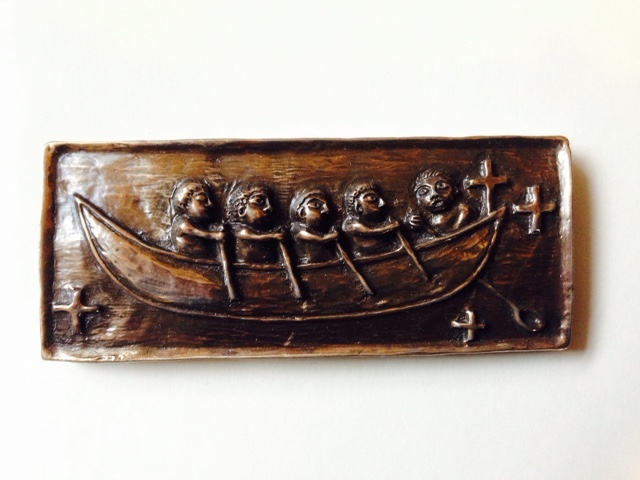
I think the same thing is being said in the following visual image, this stunning icon that Gary Rutter posted on twitter recently –
St Luke, the icon painter. Sketch for an icon
[/caption]
In other words, in the trajectory of Peter Steele, imagine if the Gospels had come to us not as words, stories of Jesus and Mary, but as pictures, of Mary and Jesus.
Posted by steve at 07:58 PM
Sunday, September 02, 2012
Mission, the end and indigenous dreamtime
I’m working my way through 2 Corinthians at the moment, reading it slowly, day by day, phrase by phrase, reflecting on the spirituality of missional leadership so evident in the words. As he struggles to plant communities of faith, be Christ-like in conflict, seek the inter-conciliar unity of the church. There are some gorgeous soundbites.
“Father of compassion” (1:3)
“we have conducted ourselves … in our relations with you, with integrity and godly sincerity” (1:12)
On Saturday while speaking, I was asked about the relationship between mission and the end. If all things are to be reconciled in Christ, why bother now?
Another soundbite, which I’d read in 2 Corinthians that morning, sprung to mind.
“God’s promises are “Yes” in Christ. And so through Christ the “Amen” is spoken by us to the glory of God.” 2 Corinthians 1:20
God has promised a future which has an end in Christ. The church participates in that mission as an “Amen.” Our participation can be a fitting “Amen,” an expression of the self-giving, trusting, vulnerable, humble life that is Christ. Equally, it can be a poor “Amen”, a hubris that is simultaneously petulant, conflicted and shallow.
Mission is our Amen to God’s promised Yes.
At this point we are messing with time, and with our participation in time.
Which perhaps links with a perspective offered by an indigenous colleague a few weeks ago. Talking about the Spirit in global cultures, he noted that the Aboriginal dreamtime stories all share a similarity. They lack an end. They create a continuous now, which provides for him a wonderful beginning, but no promise of resolution. This has caused him to find comfort in the Christian story.
Their is an assurance that God is the beginning, the dreamtime. And that God is in the end, in the compassion of Christ, who is the promise that is the final “Yes.”
Thursday, August 30, 2012
the melbourne mission
I’m in Melbourne for the weekend, speaking on mission to a church camp for Manningham Uniting. The family are flying with me and when I’m not speaking, we’ll be enjoying the sights, sounds and shops of Melbourne.

I’ve been asked to engage with their governance group on Friday evening, do 3 interactive sessions with the whole church on Saturday, then preach on Sunday. It’s something I find myself doing more and more here in Australia – speaking at church camps about mission – I’ve got another two before the years out. A camp about mission. Is this a trend? Or something more Australian than Kiwi?
Wednesday, August 29, 2012
Guerilla grafting as sign of new heaven, new earth?
Then the angel showed me the river of the water of life, as clear as crystal, flowing from the throne of God and of the Lamb down the middle of the great street of the city. On each side of the river stood the tree of life, bearing twelve crops of fruit, yielding its fruit every month. And the leaves of the tree are for the healing of the nations. Revelation 22:1-2
So is this – guerilla grafting- a sign? Or simply acts of vandalism by a romantic few?
For the full story, go here
Tuesday, August 28, 2012
conversion and the Uniting Church Preamble
It was great to drop into one of our integrative classes today for a lecture on the Missiology of Conversion.
We have introduced two compulsory Integrative topics in our new Bachelor of Ministry. Rather than assume that by some sort of informal osmosis, students somehow miraculously become able to weave together theory and practice, Bible and ministry, leadership and theology, we’ve decided that we actually need to both model and expect integration.
So the two compulsory Integrative topics explores six models of theological reflection (from Theological Reflection: Methods
To ground the models, each year a different theme is chosen. The four teaching streams at Uniting College – Bible, missiology, leadership, discipleship – speak to that theme, while the students workshop a case study from their ministry context, using one of the six suggested theological models.
The theme this year is conversion. So on behalf of the missiology stream I introduced a number of contemporary missiologies of conversion.
First, the Uniting Church Revised Preamble to the Constitution. I suggested the Preamble provided a fascinating approach to conversion – God is already present, faith must be embodied in just deeds, conversion invites all parties are in an ever-deepening Gospel process.
Second, we sat with an essay by Wilbert Shenk in Landmark Essays in Mission and World Christianity
 Third, a childrens story by Joy Cowley (Tarore and Her Book), which documents how indigenous people in New Zealand were the primary agents in the spread of the Gospel. Again, the story provides a fascinating approach to conversion – God is already present, faith must be embodied in just deeds, conversion invites all parties are in an ever-deepening Gospel process.
Fourth, we conversed
- What insights from the Preamble might guide conversion?
- What does “already encountered” (Para 3) mean for conversion?
- What practices would enable conversion to have a trajectory toward “same love and grace fully and finally revealed in Jesus Christ” (Para 3)?
- What does “integrity of the Gospel proclaimed” (Para 6) for the mission of the church, past and present?
It was a rich and energising discussion – of mission, of Uniting Church theology, of history.
Monday, August 27, 2012
Uniting College mission future
One of my tasks as Principal is to write for various Synod publications. Here is what got compiled last week for the quarterly Treasurers newsletter.

A few weeks a young couple came to see me, armed with questions about ministry in the Uniting Church. With their permission, this is some of their story.
She was born in rural Australia and moved to Adelaide to study. In 2008, as part of her degree, she did a placement in Port Augusta. She felt a stirring, a sense that she might return one day. She returned to Adelaide to continue her study. She met and married a trained youth worker.
After university study, they found employment in community ministry here in Adelaide. Together they sensed God’s call to the marginalised and poor. In order to explore this call they moved to work with Urban Neighbours of Hope (UNOH) in Sydney. They loved the values of UNOH, of Incarnational work in partnership with the lost and the least. But they still remained restless, sensing their call was not urban, but to regional South Australia.
They moved to Port Augusta, he to community youth work, she to volunteering at the aged care home in Davenport, plus paid a few days a week as part of the Aboriginal education team in the school. They found the most run down suburb and moved in. They find themselves linking with the Uniting Church, one week with Congress, the other week with Port Augusta Uniting Church.
In the Uniting Church they heard about the ministry of Deacon. Hence their visit to see me. They want to be in Port Augusta for the next 15 years, to embrace a ministry of Incarnational community development. How can their sense of call be realised in the ministries of the Uniting Church?
The Uniting Church’s understanding of ministry is that we are all called to ministry. The Basis of Union says “The Uniting Church affirms …. one Spirit has endowed the members of his church with a diversity of gifts, and that there is no gift without its corresponding service: all ministries have a part in the ministry of Christ.”
The Uniting College is about developing effective leaders of healthy, missional churches who are passionate, Christ-centred, highly skilled, mission oriented practitioners. That is you and that is me and that is our friends in Port Augusta seeking to discern their gifts and calling with the Uniting Church.
Saturday, August 25, 2012
the joys and tensions of a “church serving College”?
It is interesting to reflect on the activities of our College faculty over the last week or so.
One is speaking over the weekend to youth throughout the State about mission. Another is speaking to a chaplains retreat about the place of lament in mission and ministry. Another chaired a gathering of lay folk interested in history, church and influence. Another led a 2 day annual leadership retreat for ministers of another denomination. Another is Interstate, speaking at a young adults camp. You get a glimpse of a College faculty deeply engaged in the life and ministry of the church. Which is very life-giving.
The tension that results is around the multiple masters that a College serves. There is only so much a group of people can do. This post is another way for me to reflect on a recurring issue Can one College serve two masters: academy or church?
Thursday, August 23, 2012
taking the sense making faith challenge
I was most pleased with how the Magarey lectures whole Bible, whole people, whole mission series of retreat reflections ended. I concluded by pointed out how the whole time had been a risk. They had trusted me and they I had trusted them. Together we had trusted God and it had been rich.
So why not continue this pattern of risk together? In preparation I had identified 5 “sense” projects (gathered from Sense Making Faith Body Spirit Journey
Here was the risk. That rather than me give them some options that they might or might not to when they got back home, that they would commit to do whatever sense project was on the card they chose.
And the next time they gather, to be accountable by telling the stories of what happened.
And then I played the scene from Lion, Witch and the Wardrobe, when Lucy steps through the wardrobe into another world. It’s a wonderful 2 minutes of taking a risk, to discover a whole new world. A wonderful invitation, a great ending.
Here were the 5 sense challenges. Dare you to take close your eyes, place your finger on the screen and just do whatever one your finger is closest to ….. (more…)
Wednesday, August 22, 2012
the road trip makes sense

My first Principal “road trip” has come to an end. 11 lectures/talks in 6 days with 16 hours driving. This is part of what I did with the Churches of Christ ministers over the last few days. Around the theme of whole Bible, whole people, whole mission we explored the place of senses in the Christian journey.
If we as leaders are give the gift of senses, and people in the Bible had the gift of senses, and people in our communities have senses, then how can these common touching points be lifegiving for our mission and our ministry.
Hence the picture – a table with things to see, canned food to be used in intercession, a Saint John’s Bible: Gospels and Acts
It felt risky, leading a group of strangers into new terrain. But the feedback – from a person a Christian less than a year, to highly educated leaders, to retired ministers – was overwhelmingly positive. By locating the senses, a very wide range of engagement became possible – personal, how we read the Bible, justice, living well, being church, mission and ministry.


 )
)