Thursday, November 03, 2011
family faith: at Halloween/All Saints Day part 1

Tuesday was All Saints Day and Team Taylor were gathering for family dinner. The youngest had set up a lovely environment, with a central Christ candle and unlit tea lights.
After eating, we considered Halloween, followed by All Saints Day, a time to remember those who had shaped us. Five categories were suggested (written on the paper in the front of the pic) – life teachers, risk-takers, brave one, joke and joy tellers, nurturers.
Names were mentioned and candles were lit.
There was a growing sense that we were not alone, but surrounded by a cloud of witnesses. Many at distance both in time and geography. But still a warm and glowing presence among us.
There was also a time to be thankful for those around the table, to remind ourselves that Team Taylor has been, and can be, saints to each other, a practical expression of Christ’s love.
Very simple, but quite quietly memorable.
(This is another entry (S=saints) in dictionary of everyday spirituality. For the complete index of all entries, go here).
Tuesday, November 01, 2011
Racing for a cause: Christian responses to the horsies
Earlier this year, I gave my Reading Cultures class a case study. I had presented them with some theory – 5 different approaches that over time, Christians have chosen to relate to their culture
- withdrawal into pietism
- fusion of church and state
- reformationist, working with structures and powers to bring about change
- liberationist, prophetic action that begins with the poor and marginalised
- local congregational mission, in which the life of the communal church becomes a beacon for societal transformation.
I then gave the case study and invited them to be “mission consultants” working to identify how this case study might relate to the theory. Since today is Melbourne Cup, I offer the case study here, slightly adapted.
Racing for a cause (Southern Cross News). This year’s annual Racing Mass, to be held on Adelaide Cup weekend, will have added reason for celebration, thanks to the generosity of a local couple. They have leased their promising filly to help raise money for a local mission. The total currently stands at over $100,000. The silks of the horse will feature in the Offertory Procession of the Mass. The owner said it had been great to see the horse succeed and thereby benefit local mission. The owners connection to the local mission go back to their mother, who volunteered for 27 years in the kitchen serving meals to the homeless. The 47th Annual Racing Mass will be celebrated at 10:30 am. All are invited.
How is this church relating to culture in this case study? What are the upsides and downsides of these ways of relating?
Monday, October 31, 2011
the good company of obsessives
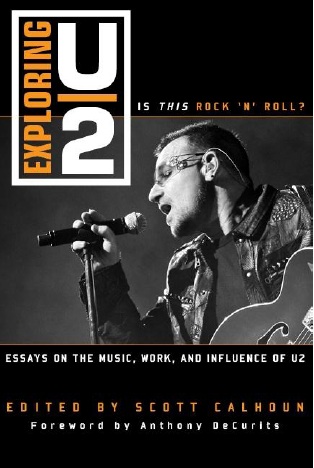
“In this book, I feel I am in the good company of obsessives.” (Exploring U2

My copy of Exploring U2: Is This Rock ‘n’ Roll?: Essays on the Music, Work, and Influence of U2
“U2 is best understood in decibels and LED lights seen through fog machines, not by reading a book. Still, what happens after listening to a U2 album or attending a concert is just as real as the music itself, and U2’s fans know that things have changed for the better because of U2. What makes this happen, why and how it happens, and how U2 has become so good at doing it are the guiding questions here. In this book, I feel I am in the good company of obsessives, and it is a delight to present them as furthering the field of U2 studies.” (xxvi-xxvii)
This time last year I was published for work on TV animation show, Bro’town. Now U2. Such are some of the fertile theological fields I drift upon 🙂
the white spaces in leader formation
Imagine a page. On it are black marks that make up words.
On it are also white spaces – the edges of the paper and the gaps between words.
Easy to overlook, yet essential for legibility, for clarity, for ease of reading.
Often when we talk formation, we concentrate on the back marks – the topics, the books, the content that needs to be internalised.
But what about the white spaces? If faith is caught much more than taught then what does it mean to cultivate the white spaces of leader formation, to be deliberate and intentional not just about developing and assessing the progress of black space internalisation, but white space formation?
The whites spaces include many things. For me, the list starts with things like mentoring, worship, spiritual practices. What would you add?
In what ways have you seen good practice in regard to the white spaces in leader formation – both in your own life and as you engage with others?
And how might we tend to the white spaces in a dispersed culture, when the academy is no longer monastic or the student’s sole community, but is one of multiple communities they are part of? How does we encourage God and the student’s work across what is in fact multiple white spaces?
Sunday, October 30, 2011
a visual vision for mission
This image became prayer for me today.

It was from an item of clothing at Pumpkin Patch. It got me thinking about a quote from Mike Frost, via Tim Hein at the mission shaped ministry course on Wednesday night
If you want to change the church more than you want to change the world, you’re NOT YET MISSIONAL.
And some things clicked for me in terms of leadership development. I’ve struggled historically with the concept of training leaders for the church. That’s because it’s often been presented as a vision to change the church.
Which is, as Mike rightly notes, is simply not missional. I need to keep hold of the vision of leading a church to build the city, rather than building the church itself. That’s what missional church leadership is all about.
For another vision for mission, see here.
Friday, October 28, 2011
Ask me about fresh expressions Synod expo
Yesterday the South Australian Synod began. During lunch, the Fresh Expressions team threw an expo. This involved some outdoor gazebos and seating, along with barbequed sausages for lunch.
 Each person was given a show bag of various resources and their were stalls that folk could browse, including books and training options through Uniting College like the mission shaped ministry course, the Bachelor of Ministry (pioneer) degree and the Master of Ministry (missional).
A team of us wore “Ask me about fresh expressions” and wandered during the lunch, engaging folk with their questions about fresh expressions. While folk ate there were a number of 5 minute soapboxes, a short, sharp exploration that we hoped would start conversations and keep the educative process going.
- What is (not) a fresh expression?
- How can an inherited expressions help a fresh expression?
- Are experiments risk?

It was a gorgeous day, with a good queue for sausages. As we ended a fourth soapbox happened, with a man standing to say how this for him was the most encouraging part of Synod and how exciting it was to be part of this type of energy and action. We duly offered him another sausage.

Thursday, October 27, 2011
airports and contemporary pilgrimage
At 7 am yesterday I needed to navigate from the Domestic terminal, to the International terminal at Auckland Airport. There are two options.
A bus.
Or a walk, of about 15 minutes.
Being a fine morning, and having been up since 4 am, I needed a stretch. On the spur of the moment, I decided not only to walk, but to walk holding a small carved wooden pilgrims cross I had brought near Durham Cathedral in September.
 It transformed the walk. What was a stroll became a spiritual exercise.
As I walked, I found myself reminded of other times I had walked holding the cross, especially at Holy Island. (See my photo essay here). During that walk, I was overwhelmed with the realisation of how many others in history have walked the walk and what it means to consider the life journey as one surrounded by pilgrims.
This turned my walk between airport terminals into prayer – for those walking with me, for those I passed, for those who have walked before and will walk into the future.
A walk + small hand held wooden cross + memory = a moment of spiritual engagement.
Wednesday, October 26, 2011
I am a pimple in the life of a century-old church
Over the weekend, the church, I used to pastor, Opawa Baptist, celebrated 100 years. It was a great thrill to be there and to hear the stories and look at the photos and to see the archival video footage. Which all served to reinforce how insignificant my 6 years of involvement was in the span of things.
I was merely a pimple in a church in which so many ministered and loved and prayed. Which feels good.
As part of the Sunday morning sermon I was invited (along with 3 other ministers in the life of church) to spend 5-8 minutes addressing the question – what was the Spirit up to? My period of ministry was from the beginning of 2004 to the start of 2010 and here’s what I said. (more…)
Saturday, October 22, 2011
Good to come home now and again. Eat some icecreams. Do some bombs.
Mr Frosty and the BMX Kid. Written and directed by Tim McLachlan from New Zealand, this was a finalist in the Your Big Break competition a global search for the next great filmmaker. The task was to capture the spirit of New Zealand in a 3 minute short film.
It’s good to come home now and again aye bro. Eat some ice creams. Do some bombs. You’re never too bro. You’re never too old.
This weekend I am home again, in New Zealand for the 100th anniversary of the church I used to lead. See some friends. Look at some views. Eat some icecreams. Not sure about the bombs, esp given the state of Lake Ellesmere. But definitely watch some rugby!
Friday, October 21, 2011
the one stand at mission shaped ministry
The mission shaped ministry course resumed in Adelaide on Wednesday night. There has been a 5 week break, in order for folk to enjoy school/university holidays, to reconnect with family and to have some time to put some legs on some ideas.
So we are now into the 2nd half of the course, when things get more practical, as we talk about starting new things, about growing fresh expressions to maturity, about discipleship and what is church.
Last night was also a bit of one-night stand. During the week, 110 Uniting Church ministers have been in Adelaide, at the National Ministers Fresh Expressions conference. Part of the week has included site visits, and so we suggested observing a mission shaped ministry course in action as an option. Given that the course is new in Australia, we hoped that this would help with momentum and understanding and sync well with the planning to extend the course into other states in Australia in 2012, especially with John Drane and Olive Fleming Drane offering train the trainer training in November this year (currently we have 25 folk booked in for that, from all of the Australian states, which is very exciting). Which meant about 60 new folk arriving on Wednesday night.
We set it up as a “fish bowl”; with the usual tables for participants in the middle, and then around in a U-shape seats for those watching. All had notes, but the interaction focused on the participants. Which felt a bit different, but they quickly got down to work and it seemed to work alright.
At least until 8:55 pm.
The plan was to separate over coffee, with the last 15 minutes being either a fresh expressions activity for regular participants. Or space for those observing to ask general questions of the course.
Just as people began to sort themselves, the bus driver announced he was leaving. At 9 pm.
So like a rush of air, the place suddenly emptied. The stand was over. With not even a chance for a quick debrief and a thanks and goodbye for the evening!
Thursday, October 20, 2011
discipleship resources
A minister friend was asking about discipleship resources. Here are some that I’ve either been recently intrigued by, or explored myself.
D:sign. The way into this resource is via 12 art images, contemporary and created especially. Supporting each image is something to do, share, watch/listen, talkback and small group. What I like about this is first that everyone can access and image. So there is a level of accessibility cf “I am the discipling expert.” Second, it uses the senses – eyes and ears and touch. Thirdly it is activist and communal, it assumes things to do and a group to do it amongst.
Lindisfarne Scriptorium/Mary Fleeson. These are high quality creative resources. They include books with art, words and prayer and wallet sized cards as reminders. There are also multi-coloured mediations, in which black and white original images are provided and you are invited to add colour and life. “As you add colour and life to the pages and ponder over the words don’t worry about going over the lines! Allow the child within to emerge fro a while and have fun!” In doing, so there is space being created for discipleship reflection. All are focused around themes of life journey and life in Christ and provide access through colour.
Labyrinth Journey via Proost. This is a bit older, but still a goodie. It comes as a CD Rom, which holds a virtual labyrinth plus a 7 week discipleship resource. Themes include journey of discovery, relationships with ourselves, each other, God the Trinity and creation, all linked to creativity and contemporary culture. Placing the labyrinth, whether real or virtual at the centre offers a very different concept of movement cf linear models.
Missional practices – Here’s a resource that we designed at Opawa. It is based on Jesus journey toward Jerusalem in Luke. It is based on 7 wallet sized cards, ie a practice as you live type resource. On the cards is an image, a Scripture, a question and a practice ie something to do. These are supported by small groups (resource questions supplied if needed), that encourage folk to work together on reflection.
Growth coaches – which offers one on one; whole of life coaching. A person meets with a coach, together they set a programme, and the coach holds them accountable. This was what started the idea , and the realisation that most discipling programmes are content based, not people based. They impart information and have set starting and ending points. How to be more flexible? It was also important to see growth as whole of life and at all life stage, not just for “new” Christians. So this is some research I did as part of a sermon series. This is our finished publicity product, which is given out to interested people. And this is an article from a New Zealand Christian newspaper about the concept.
Life shapes. This is a discipleship based on shapes – triangles, squares, pentagons etc. Each shape is connected to a different moment in discipleship – change, balance, growth, prayer, witness etc. Some folks dig this, some don’t.
Sense making faith. This uses the 5 senses to engage God. Each sense is explored for ways it brings life, and death, to being human. Each sense is explored in terms of the Christian tradition. It opens up some highly multi-sensory, experiential learning, which I love. But other’s won’t.
Wednesday, October 19, 2011
a starter for 10: fresh expressions and Uniting ministry
On Monday I gave a 90 minute opening address to the National Ministers Fresh Expressions conference. I called it A starter for 10. With about 110 Uniting Church ministers attending, I wanted to provide some ways to think about fresh expressions, but also to explore some ways to understand fresh expressions from within Uniting Church history and theology.
For those interested in fresh expressions, Aussie and Uniting style, here are some of my headings, along with the resources I drew on. (more…)
Tuesday, October 18, 2011
film review: Red Dog
A 500 word (monthly) film review by Steve Taylor (for Touchstone magazine). Film reviews of the most common contemporary films, each with a theological perspective, (over 60) back to 2005 can be found here.
Red Dog. A film review by Rev Dr Steve Taylor
At first glance, “Red dog” is a delightful movie, suitable for adults and children, a heart warming mix of human life and canine love.
A stranger arrives in a strange town. Seeking life, knocking on the door of the local pub, instead he finds himself beside the bedside of a dying dog.
Around the bedside, he hears the stories. This is no ordinary dog. This is Red Dog.
The plot is a storytellers delight. The pace is well-varied, the suspense genuine. The stories interweave, lives threaded together, each story offering a different slice of Red Dog’s life – his arrival, his elevation to dog for everyone, his finding of his true master, his role as match-maker and life-saver.
The stories produce some laugh out loud moments of sheer delight, the fights between Red Dog and Red Cat worth the ticket price alone.
Red Dog is based on a true story, of a real life statue, erected in 1979 in Dampier (an outback mining town in the Pilbura area of Western Australia). It relies on the skilled acting of Koko (playing Red Dog) and definitely panting for an Academy nomination. While Australian in accent, location and plot, Kiwi audiences will appreciate seeing a familiar face, Keisha Castle-Hughes, playing veterinary assistant become wife and mother. And in the statue of Red Dog, they will catch a glimpse of the famous Tekapo statue of the Shepherds Dog.
While at first glance a delight, a more closer look reveals a glimpse of the poor and pale reflection that is White Australia.
In a final climatic speech, as the town waits beside Red Dog’s bed, the “Pommy”, the “general” and the “politician” are contrasted with one’s mining “mates.” The speech lauds the values of loyalty and generosity, the need for a person to understand their land, to appreciate the red dust of the outback. It is a fascinating summary of so many values of Australian culture.
Ironically, sadly, the faces of those listening are all white, and the “Hear, hear” all European in accent. Their is no sign of, nor respect for, indigenous Australians, who for thousands of years before the arrival of white people, lived and loved in this red dirt.
One wonders what Red Dog, lauded for being the friend of all, would make of the absence of indigenous Australia. Surely in a plot-line based on multiple stories, it would have been possible to include at least one story of culture-crossing and the gifts and insights of the first inhabitants of the outback?
Another sinister reflection shimmers in the heat haze, that of the place of mining in Australian culture. “Red Dog” is a window into the loneliness and social dislocation that drives the Australian mineral boom and the industrialised transport lines that stain the beauty of the Outback. It is mining that is in fact driving a two-speed economy in danger of poisoning any Red Dog in their ability to be a friend for all.
Sunday, October 16, 2011
Lets talk about food: a prayer for blog action day 2011
Give us this day our daily bread. A prayer mumbled in churches all over the world today. A prayer that is an invitation to consider what and how they eat. A prayer that opens to door to a whole new way of being in mission – around tables, among strangers, with justice, generosity and humanity.
Such is a just theology of food in the Kingdom of God. But first, a short quiz about food.
- True or false: Wealthy suburbs are more likely to have fast-food outlets than poor ones.
- True or false: Healthy food is more expensive than fast food.
- True or false: 77% of Australians eat together as a family five times a week
- True or false: In Australia, more women are head chefs that men
- True or false: On a daily basis, women spend more than twice as long as men on food preparation and clean up.
- True or false: The biggest global killer is a disease called New World syndrome
(Answers, for those interested are at the bottom of this post).
My contention is this – that when Christians pray Give us this day our daily bread, we must pay attention to think about who cooks, who cleans, who eats what, and with who.
To make that practical consider a story from Australian Rebecca Huntley’s (Eating Between the Lines
A second way to be practical comes in the book by John Koenig, Soul Banquets: How Meals Become Mission in the Local Congregation
“we have seriously undervalued our church meals, both ritual and informal, as opportunities for mission … to realize this potential, we, like the disciples on the road to Emmaus, must have our eyes opened by the transforming presence of Christ at our tables.”
He provides a checklist on what it means for meals to become mission:
- This is serving graciously with human contact. Koenig cites the example of one the busiest church food kitchen in New York, in which each volunteer is expected to find ways to encourage eye contact and genuine conversation.
- This is setting tables, serving food, eating in patterns and places that speak of God’s abundance and creativity.
- This is encouraging role reversals by finding ways for all, helper and hungry, to contribute through a diversity of gifts.
- This is committing to a long-term, intentional project, a willingness to eat together a lot, because in that eating good things will happen.
Give us this day our daily bread. An invitation to take action for food, to be different around tables, among strangers, with justice, generosity and humanity. Such is a just theology of food in the Kingdom of God.
And for those who want the answers to the quiz … (more…)


 )
)