Friday, August 19, 2016
Presbyterian Church of Korea newspaper
The Presbyterian Church of Korea has a weekly newspaper and my recent 10 day visit to Korea has made “the Presbyterian news.” (Including a photo: I think I look tired, my family think I look lovely)

I don’t speak Korean but I’m told the article speaks about
– the multicultural context of NZ
– the curriculum of Knox Centre for Ministry and Leadership
– the concepts of reformed and reforming and the need to hold both in tension in the task of forming leaders and being a seminary
– the reality that being diaspora has a context, which needs to be taken seriously
– that I met on my visit to Korea the translator and readers of my Out of Bounds Church? book, translated into Korean.
Tuesday, August 16, 2016
Fiction as missiology: feedback
 I delivered my second paper today at the International Association Mission Studies: Fiction as missiology: a Creative “hapkas” Christology in Drusilla Modjeska’s “The Mountain.”. It was a complex piece of work: reading a fictive novel, Drusilla Modjeska’s The Mountain


Questions:
1. Tell us more about the author please?
2. PNG has both patrilenial and matrilenial tribes. Is this significant?
3. If you take a reader-response position to the novel, do you also take a reader-response position to the Bible?
4. Your argument depends on the relationship between ancestors and Hebrew monotheism. How different is the ancestor understandings of PNG and the ancestor understandings of the Old Testament?
5. The concept of “half-caste” is often linked with rejection. How might you weave that into your Christology?
6. Have you considered the “half-caste” Christology you were advocating in relation to global migration flows? This makes your talk of such great significance.
7. You have offered such a creative Christology. What is your methodology?
8. How might your reading be offered as a public theology to other readers of The Mountain
Affirmations:
1. That was stunning. That should have been a keynote.
2. Can I have your talk. I want to translate it into Korean as an article in Korean.
3. Your talk was so moving. I cried through parts of it.
Overall, a great experience. It was daunting to have one of the conference keynote speakers, Professor Joel Robbins, from Cambridge University in the room, especially given he had conducted his research in PNG. However, I was delighted to have him ask for a copy of my talk at the end and offer some really helpful observations.
Monday, August 15, 2016
Fiction as missiology: an indigenous Christology in Papua New Guinea
I deliver a second paper at the International Association Mission Studies, Korea on Monday. This paper is titled Fiction as missiology: a Creative “hapkas” Christology in Drusilla Modjeska’s “The Mountain.” As with my first paper, Missiological approaches to “Silence”, this takes a hobby, a holiday read of The Mountain

It is a complicated paper, but one I’m really, really pleased with. I consider it some of my most creative yet Biblically deep reflection I’ve done, helped greatly by conversation with fellow PNG kid, Mark Brett. Whether the audience agree we will soon see.
Here’s my conclusion:
In sum, I have examined fiction from outside the West and argued for a distinct and creative Christology as one result of religious change in PNG. “Hapkas” provides a way to understand ancestor gift, fully human, fully divine and the new Adam. It is a reading that attributes primary agency to an indigenous culture and offers a transformational way to understand religious change as communal participation in the art markets of twenty-first century global capitalism. It is consistent with recent Biblical scholarship regarding the Genesis narratives in the Old Testament. This suggests that to understand conversion missiologically, requires following Jesus who is “‘good’ man true” for the particularity of all indigenous cultures.
Sunday, August 14, 2016
Silence, art and global Christologies
Here is the visual I constructed to illustrate the conclusion to my International Association Mission Studies paper: “regard as valuable”: Missiological approaches to the “Silence” of religious change.

For those who value words:
To represent the fullness of Christ, both Christologically and missiologically, we need the “face of Christ” giving inspiration to artists at every stage of the Philippians arc (the U shape). We do not ask art images of Christ the Victor (right hand art image) or Jesus the baptised (left hand art image) to express a complete Christology, to capture every stage of the Philippians arc. We let them stand individually as Christological snapshots. In Silence: A Novel
, we are offered an artistic gift, that of obedience to the point of death. This is a truthful missiology which voices Christ’s silence. Such is the Christological gift of Silence: A Novel
My paper was assigned to the hour of death. For some reason the conference organisers had scheduled 5 papers back to back in a row; between 4 pm and 6:30 pm. This was at the end of a day that included a plenary session plus 5 other papers spread over 2 other sessions. My paper was the last one, at 6 pm. So I needed to up the communication. Thankfully, when you talk about film, you can show movie trailers. That, combined with the above visuals, some Steve Taylor energy and a handout (“regard as valuable”: Missiological approaches to the “Silence” of religious change handout) ensured that no-one fell asleep.
Two good questions were asked:
Q. What about the words of Christ, My God, my God, why have you forsaken me?
A. What is happening in Silence: A Novel
Q. What about the film, As it is in heaven? Is that not also both a Christ figure film and a Jesus film?
A. Not according to the definitions that I am working with from Lloyd Baugh, Imaging the Divine: Jesus and Christ-Figures in Film (Communication, Culture, and Religion)
It was good to integrate what is something of a sideline hobby – monthly film reviewing – with my research interests in missiology and indigenous Christologies. It was good to present with video and art.
Saturday, August 13, 2016
film and mission: Missiological approaches to the “Silence” of religious change
I’m presenting today at International Association Mission Studies, Korea. My paper is titled “regard as valuable”: Missiological approaches to the “Silence” of religious change. With the historical novel, Silence: A Novel
In order to engage Silence as a film, I will use Lloyd Baugh, Imaging the Divine: Jesus and Christ-Figures in Film
I’m looking forward to bringing together my research in film and in mission. My conclusion is as follows:
The gift of Silence is that it allows us to see the face of Christ as death on a cross. To represent the fullness of Christ, both Christologically and missiologically, we need the “face of Christ” giving inspiration to artists at every stage of the Philippians arc. When Christ is the Victor, the “conversion-transformation” narrative is one of triumph. We do not ask art images of Christ the Victor or Jesus the baptised to express a complete Christology, expressing every stage of the Philippians arc. We let them stand as Christological snapshots. In Silence, we are offered an artistic gift, that of obedience to the point of death. This is a truthful missiology which voices Christ’s silence. Such is the Christological gift of Silence to missiology. It provides an essential snapshot, ensuring our accounts of conversion and transformation include not only narratives of triumph, but also narratives of solidarity with Christ’s silence.
Thursday, August 11, 2016
a dream few days: Out of Bounds Church in Korea
It’s been a fascinating few days in Korea. In 2005, I published my first book, The Out of Bounds Church?: Learning to Create a Community of Faith in a Culture of Change (emergentYS)
This week a different story emerged, one that was much more local, involving a theological discerning scholar and a culturally creative publisher. Suk Whan Sung encountered my book at a Willowcreek conference. He was impressed by the theology, in contrast to many books about the missional church, which he felt were simply sociology.

Suk Whan contacted a local Korean publisher. Not once but repeatedly. I was unknown. But Suk Whan was persistent. And the publisher was a bit special.

They had a commitment to publishing not in the area of Christian inspiration but in serious engagement with culture. They have a commitment to craft: the recent books they showed me were clear, fresh and appealing. They wanted to bless culture and thus have published books not only in theology, but in general areas of culture. They publish books based not for the name of the author and how well known they are, but on content.
And so my book was published. Not by an American company expanding their market, but by a local scholar concerned about his people and a local publisher with courage and commitment to a craft.
And this week I got to meet not only translators and publishers, but also readers. I spoke at the Missional church network on Sunday evening, I spoke to the local Presbytery executive, I met a church planter who has planted two communities of faith, inspired by the title.
The feedback: the creativity of the book gives permisssion for others to dream; the theologically thinking provides important frameworks; the cultural engagement of the book provokes.
Friday, August 05, 2016
Korea bound: Missional Conversation in Seoul
 I am in Korea from 6-17 August doing a range of things, all work related. First, I am engaging with the partner churches of the Presbyterian Church of Aotearoa New Zealand. This will involve meeting with representatives from Presbyterian University Theological Seminary, the seminary of Presbyterian Church in the Republic of Korea (PROK), the urban mission program of Presbyterian Church of Korea (PCK), and the assembly office of PCK and PROK. I will be interviewed by Christian Broadcasting media.
In addition, I am meeting with two groups of ministers who have read the Korean translation of my “Out of Bounds Church?” book. This includes the person who translated my first book, The Out of Bounds Church?: Learning to Create a Community of Faith in a Culture of Change
Second, I am presenting two academic papers at International Association of Mission Studies (IAMS). The theme is Conference theme: Conversions and Transformations: Missiological Approaches to Religious Change. This conference happens every four years and I’m delighted to be able to present two papers: both on the implications for conversation of indigenous Pacific Rim Christologies.
Title: “regard as valuable”: Missiological approaches to the “Silence” of religious change
Accounts of conversion and transformation within the Christian tradition are often linked to narratives of success and expansion. Yet a truthful missiology needs to engage the entirety of the Christian story. Silence: A Novel
The book is currently being made into a movie. Directed by Martin Scorsese and due for release in 2016, it will undoubtedly rekindle debate regarding conversion and transformation, including how to understand the mission in the gaps and silences of history.
This paper will examine three missiological approaches. First, the work of Donald McGavran who has argued that lack of success in conversion and transformation is due to the strategies being deployed, particularly a lack of resources focused on evangelism. Second, the work of David Bosch who has argued that suffering is at the core of Christian mission and that silence can be an evangelistic action. Third, the work of Philip Jenkins who has argued that the Christian understanding of Easter, in both death and resurrection, is a more Christian paradigm for understanding religious change than that of progress.
Each of these missiological approaches to religious change will be applied to Silence, both the novel and movie (if released in time). The argument is that missiological approaches that speak of silence are consistent with the Apostle Paul, who asks the church in Philippi to “regard as valuable” the story of Epaphroditus.
And
Title: Fiction as missiology: an appreciation of religious change in Drusilla Modjeska’s “The Mountain”
Stanley Skreslet (Comprehending Mission: The Questions, Methods, Themes, Problems, and prospects of Missiology
, 2012) argues that missiology has been slow to examine historical fiction from outside the West. A way to respond to his challenge is presented in The Mountain (2012), a novel by acclaimed Australian writer, Drusilla Modjeska. Book One describes the five years leading up to independence in Papua New Guinea in 1973 and ends with a ‘gift child’: a hapkas boy. Book Two describes his return – the child of a black mother and white father – to the land of his birth.
In the book an account of conversion and transformation in Papua New Guinea is offered. “Of all the applause, of all the cheers, the greatest is for the Christian missions, the priests who cross the stadium with their crucifixes and their bibles …. ‘Jesus,’ … ‘good’ man true” … ‘He die on a tree. Very good. He die for PNG.’” (The Mountain
, 291). It is a surprisingly positive portrayal of conversion and transformation, referencing indigenous approval (“the greatest [applause] is for the Christian missions”) and indigenization (“He die for PNG.”)
The paper will take this notion of Jesus as good man true and analyse how this Christology interweaves with themes in The Mountain of ancestor, gift and hapkas. It will argue that The Mountain
 , 2012) argues that missiology has been slow to examine historical fiction from outside the West. A way to respond to his challenge is presented in The Mountain (2012), a novel by acclaimed Australian writer, Drusilla Modjeska. Book One describes the five years leading up to independence in Papua New Guinea in 1973 and ends with a ‘gift child’: a hapkas boy. Book Two describes his return – the child of a black mother and white father – to the land of his birth.
Best of all, I’m traveling with my partner. She also is presenting a paper at IAMS, which is just fantastic, showcasing her research:
Authentic Conversion: becoming who we are created to be
Conversion to Christianity in Australia today can be understood as resulting from non-Christians desiring, observing and experiencing genuine authenticity. Drawing on qualitative data from semi-structured interviews with recent converts to Christianity, this paper demonstrates first that religious conversion is fuelled by a desire for authenticity. Secondly, religious conversion is resourced by Christians who embrace and exhibit authenticity in their personal, social and spiritual lives. Thirdly, God enables authenticity to develop and flourish. Influenced by Charles Taylor and aspects of Trinitarian theology, the paper argues that this genuine authenticity is relational in nature: focusing not (just) on the self but also on relationship with God and significant connection with, and responsibility toward, others. This understanding rightly challenges the notion of authenticity as a narcissistic actualisation that prioritises the self over external relationships and responsibilities. When relational authenticity is sought and realised by converts, healthy transformation results. This transformation sees new converts ‘becoming’ the people they were created to be: unique persons who see their worth and their responsibilities in the light of their relationships with God and with others.
Lynne Taylor is a PhD candidate in theology at Flinders University of South Australia where she is using a methodology of grounded theory to investigate why people are becoming Christians in Australia today.
Thursday, August 04, 2016
saying no
At the start of the year I planned myself a treat. I was deep in the last days of writing my Built for Change book and I needed some light at the end of the tunnel. I love the academic stimulus provided by the annual Ecclesiology and Ethnography conference in Durham. Around that, for the last few years, I have found renewal at Holy Island. So I put in place a plan, to return to the United Kingdom in September.
I found another set of conferences around the Ecclesiology and Ethnography and submitted abstracts (total of three). Two abstracts were accepted. One wasn’t. But it was enough. I spotted a number of potential funding avenues. Over recent months, I’ve worked hard to shift the abstracts from ideas to full draft journal articles in preparation.
Over the last weeks, I’ve begun to wonder if the benefits of the treat might actually be outweighed by other realities. Academically, a number of opportunities closer to home have presented themselves. Financially, airfares are higher than I budgeted. At the same time, money is tight in academic circles. There could be some help, but not as much as I had calculated. Work-wise, there are signs I need to be grounded, not working from a laptop on the road. Family wise, I have a partner on the home stretch of a PhD and the “how can the rest of the family pitch in plan” doesn’t work as well if I’m away for a period overseas. I do need a treat, but this treat felt like it was being increasingly diminished.
Last week, I regretfully decided to withdraw my various conference presentations. I feel regret. I will miss the stimulus and the conversations and the space that is created. The networks are important. People have made decisions and given me opportunity and they will now have to reshuffle programmes.
I also feel relief. I’m glad I can say no. I very much enjoyed taking the 10 days I had blocked out with conferences and writing into the blank space of the calendar: “work on lectures”; “quiet day to read”; weekend away with family.” It has also been good to remind myself of privilege: that to even contemplate an overseas conference is in fact an enormous treat. That is a light in a tunnel in itself.
I share this story in order to honour this blog. On this blog I record things that go according to plan, including abstracts that get accepted and things that get written. So it seems fair to also record things that don’t go to plan and things that won’t get done and the ongoing unfolding of life.
Wednesday, August 03, 2016
Star Trek Beyond: a theological film review
Monthly I write a film review for Touchstone (the New Zealand Methodist magazine). Stretching back to 2005, some 100 plus films later, here is the review for August 2016.
Star Trek Beyond
A film review by Rev Dr Steve Taylor
Star Trek was born 51 years old, with a pilot episode shot in 1965. Being 51 in the entertainment industry means the need to win new friends while keeping old ones.
“Star Trek Beyond” delivers. For old fans, there is the familiarity of ship, crew and the willingness to boldly explore strange new worlds. In “Star Trek Beyond,” this means seeking to rescue a ship ambushed beyond the nebula. For new fans, the action quickly moves to warp speed, as USS Enterprise encounters the evil technologies of Commander Krall. For all fans, there is old technology, of motorbikes and VHF radio as weapons in the defeat of Krall. For Kiwi fans, there is Wellington born, Karl Urban as Dr Bones McCoy.
Being 51 means adapting to a changing world. In “Star Trek Beyond,” Sulu (John Cho) is gay, with a husband and young daughter. In addition, strong female roles are provided by the well-known figure of Lieutenant Uhura (Zoe Saldana) and the introduction of Jaylah (Sofia Boutella), becoming a rescuer despite the previous pain caused to her in an ambush by Krall.
Being 51 also means facing death. The first line in the pilot episode of 1965 belonged to Leonard Nimoy (“Check the circuit”). “Star Trek Beyond” pays homage to Nimony, who died in 2015, aged 83. This involves memorial credits, along with the young Spock (Zachary Quinto) of “Star Trek Beyond” finding strength in a photo of the original Star Trek crew, Nimoy included.
It is one thing to face the death of an elderly man, quite another that of an acting colleague in the middle of the Star Trek reboot. Anton Yelchin, who plays Chekov, died in a freak automobile accident in June 2016, aged 27. It makes poignant Captain Kirk’s (Chris Pine) toast to absent friends and the liquor taken from Chekov’s locker. In a Western society obsessed with youth, navigating the strange new world of death is an essential dimension of being 51.
Star Trek has from the beginning blended technology, action and philosophy. The pilot episode was considered cerebral and intellectual. “Star Trek Beyond” embraces philosophy by mirroring two scenes. Early on Captain Kirk meets with Commodore Paris (Shohreh Aghdashloo). In deep space, he describes how easy it is for a Captain to get lost. As the movie ends, Kirk meets again with Commodore Paris. Again Kirk notes how easy it is for Captains to get lost in deep space, yet the strength he finds in human partnership. It makes the warp speed action between these two scenes the unfolding exploration of humans facing the existential fear of losing their inner compass.
It is a question Jesus explores in Luke 15. Three parables are grouped together around the experience of being lost. What emerges is a different mirroring, in which direction comes not from human partnership, but from God, acting as seeking shepherd, searching woman and waiting father. Whether the “distant country” of Luke 15:13 can be stretched to include the strange new worlds beyond the nebula becomes the question of faith for every viewer.
Rev Dr Steve Taylor is Principal of Knox Centre for Ministry and Leadership, Dunedin. He is the author of Built for change (Mediacom: 2016) and The Out of Bounds Church? (Zondervan: 2005) and writes widely in areas of theology and popular culture, including regularly at www.emergentkiwi.org.nz.
Tuesday, August 02, 2016
Let us sing (in harmonies) a new song in this strange land
Last week, I was asked to deliver a keynote address at the Pacific Island Synod, a gathering of Samoan, Niuean, Tokelau/Tuvalu and Cook Island communities from around Aotearoa New Zealand. I was asked to address the question: How can we sing the Lord’s song in a strange land? As soon as I received the invitation, I asked a KCML colleague, Malcolm Gordon, if he might have a song to sing. A few days before, I gave him the script for my talk and he responded with a yes.
The Pacific Island Synod ended with a feast on the Saturday evening. This included a number of speeches, in which gifts were offered. With Malcolm present, I stood and announced that we as KCML had a gift, that of a song, written specifically – new – for this occasion. I noted the theme – How can we sing the Lord’s song in a strange land? – as a question not only for Pacific Island communities, but also for Malcolm and I as Palangi. Together, as diverse nations, we share a common quest, a shared mission, that of seeking God’s help in singing a new song.

Malcolm passed copies of the music around. He noted he had a melody, but that the song needed harmonies. There was an instant murmur among those gathered, with so many fine voices and such a rich tradition of song among Pacific peoples. As Malcolm began a cappella, those gathered began to improvise harmonies. Together in our diversity we produced a new song.
As the Synod Clerk wrote to me later “It was a great moment when the place just broke into song. Thanks Steve and Malcolm for such a great finish to the day. We definitely sung a new song in this strange world.”
Sunday, July 31, 2016
accessible yet substantial, incredibly helpful: Built for change book review
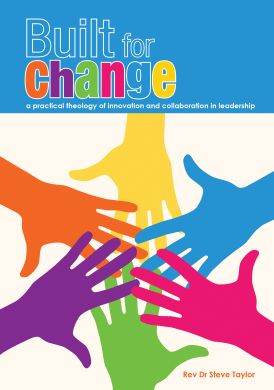
 Here is another review of Built for Change, by Peter Armstrong, a Uniting Church minister in Queensland. It is the first review to pick up on the creative (innovative) structuring of the book and to note the way that each part of the book offers differing ways into innovation, collaboration and leadership
Innovation is what Steve’s book is all about. Innovation, collaboration and leadership!
The sub-title of the book is ‘…a practical theology of innovation and collaboration in leadership’ and it is very much born out of Steve’s own work and ministry in this area. Even the book itself is somewhat innovative in the way it is set out, beginning with the ‘final chords’ of an outro and concluding with an intro. Within the metaphor of music Steve takes the reader on a journey that he himself has travelled, into the experiences, observations and reflections of collaborative innovation in the context of leadership.
The three parts of his book (between the ‘Outro’ and the ‘Intro’) are (i) Leading Outward; (ii) Leading Deeply; and (iii) Leading Inward. Each part offers differing ways of looking into innovation, collaboration and leadership. Steve offers a biblical framework from 1 Corinthians 3 and 4 looking at six roles and actions – Servant (Listens); Gardener (Plants); Builder (Structures); Managers (Resource); Fools (Risk); and Parents (Guide). He tells the story of experiences on the ground of innovation, collaboration and leadership – both observed as well as engaged. He opens up a theology of connection where leadership theory can converse with theology. And he reflects on tradition as it provides the historical context and cultural values of innovation, collaboration and leadership within institutions and communities. The final section looks at the leader personally, and again from practice and principles, Steve offers wisdom and encouragement for anyone on this journey themselves.
I found this an incredibly helpful book in that it captures wonderings and provides ways to both reflect on and engage my own sense of call to these areas. It is easy to read, in that it is accessible in its form and language, but it is substantial because, for me, it has generated so much more wondering and visioning for what is ahead for me and the church that I call home. I certainly would recommend “Built for Change” to anyone who is wondering or seeking to practice ‘fresh words and deeds’ in this time when innovation, collaboration and leadership have much to offer our church and wider community. Thanks Steve for taking the time to put all of this into a book for others to glean.
“Built for Change” is available in Australia through MediaCom Education Inc. or New Zealand through Angelwingsresources@gmail.com.
Wednesday, July 27, 2016
Pacific Island Synod bound
I’m delighted to be heading for Auckland to be part of the Pacific Island Synod over the weekend. I will be doing a keynote presentation on Friday, on the topic – singing the Lord’s song in a strange land. I’ve enjoyed the preparation.
This involves working on the bringing of greetings in five different languages and a final benediction in Samoan language. It has involved researching climate change in Pacific Islands and finding resources from Christian faith that might sustain communities entering this contemporary experience of exile.
I will also be weaving in wisdom from the Uniting Church Revised Preamble, including paragraphs that I observed having impact on Fijian Uniting Church leaders like Eseta Meneilly:
1. When the churches that formed the Uniting Church arrived in Australia as part of the process of colonisation they entered a land that had been created and sustained by the Triune God they knew in Jesus Christ.
3. The First Peoples had already encountered the Creator God before the arrival of the colonisers; the Spirit was already in the land revealing God to the people through law, custom and ceremony. The same love and grace that was finally and fully revealed in Jesus Christ sustained the First Peoples and gave them particular insights into God’s ways.
10. After much struggle and debate, in 1994 the Assembly of the Uniting Church in Australia discovered God’s call, accepted this invitation and entered into an ever deepening covenantal relationship with the Uniting Aboriginal and Islander Christian Congress. This was so that all may see a destiny together, praying and working together for a fuller expression of our reconciliation in Jesus Christ.
It has also involved seeking to understand more about a Samoan proverb: Fetu’utu’una’i’ muniao. In conversation with a number of Samoan leaders, I wonder if this is could be understood as an Oceania hermeneutic. I can see elements in fetu’utu’una’i’ muniao of the Wesleyan quadrilateral – Scripture, experience, reason, tradition – all held beautifully in an action-reflection, communal approach to voyaging. More later, after I see how fetu’utu’una’i’ muniao lands in the next few days.
Wednesday, July 20, 2016
Built for change: review by John Littleton for South Australian Anglicans
Another review of my latest book Built for Change: a practical theology of innovation and collaboration in leadership. This one was initially sent to Anglicans in South Australia.
Dear friends, I bring Steve Taylor’s new book to your attention and commend it. I enjoyed the holistic, collaborative and theologically reflective leadership demonstrated in this book. The book is a challenging and rewarding read. Careful reading provides evidence of a reflective practitioner at work. An account of adaptive leadership in practice is combined with a connectional theology of leadership and an analysis of Jesus the innovator as reported in the Gospels. The word innovation takes on a “Christological shape.” Chapter 8 is entitled “Leading myself” and introduces a section on practical and personal leadership strategies. The book shares stories and offers insight into a personal spirituality of change.
Built for Change: a practical theology of innovation and collaboration in leadership explores the six strengths that change requires, and demonstrates that collaborative change is both practical and possible. Steve wrote ‘Built for Change’ around the concluding of his placement as Principal of Uniting College in the Adelaide College of Divinity in 2015 and transitioning into his new role as Principal for Knox Centre for Ministry and Leadership in Dunedin, New Zealand.
“Built for Change” is available in Australia through MediaCom Education Inc. or New Zealand through Angelwingsresources@gmail.com.
Review 1 here;
Tuesday, July 19, 2016
living off a laptop
Driving back from Christchurch yesterday, it suddenly occurred to me that I’ve only managed one day working at my office desk, surrounded by my books and files, in the last 4 weeks. Certainly not planned!
First, there were 9 days of block course intensive in Wellington. This was followed by that one day at the office – in which I scrambled to prepare printed resources and organise for the next major piece. That was 15 days on the road. This involved 8 meetings and 5 speaking engagements, spread across 2 countries, 8 cities and towns, made possible through 5 flights and 2 rental cars.
 It wasn’t something I intentionally planned. Rather it was simply what emerged as I tried to make sense of a range of commitments and a set of practical realities.
A desire to be Knox national, rather than Knox Dunedin, combined with a rugby test in Dunedin that sent accommodation prices through the roof, made Wellington a logical option for a KCML blockcourse. An academic conference in Melbourne, made possible a few days of recovery in a friends holiday house near Sydney. A request to speak in Wellington for two days to a group of ministers (Give us this day our daily bread: spirituality of eating) made sense as a stop over coming back from Sydney. A need to connect with incoming (2017) interns and explore potential placements in the Christchurch area, made sense as a next stop after Wellington. Interns and potential placements spread between Rangiora and Geraldine made logical a rental car and so a drive from Christchurch back to Dunedin (mixed in with a lovely few nights restoration at our family holiday home). During which the realisation hit me: one day working at my office desk in the last 4 weeks.
Which meant that today, one of my team cheekily asked the rest of the team if anyone knew who I was. While another asked if I deserved a desk!
Living off a laptop is made possible because of:
1. A flexible family, willing to come with me to academic conferences and join me on holidays and road trips between Christchurch and Dunedin.
2. A focused, competent, self-sufficient work team, very secure in their roles, who get on with their tasks, whether I’m present or not.
3. Evernote and Google calendar, which helps me keep track of a range of details and notes.
4. A computer (Mac) which enables me to access material for speaking engagements as I go, allowing me to be responsive to context and room, to prepare a talk in a hotel room or beachside holiday house.
5. A cellphone, which I can tether as a hot spot and deal with email.
When I began as Principal, I wanted to be a national Principal, not a Dunedin Principal. However I never envisaged the type of movement and travel that would result. I love the richness, the mix of developing leaders, presenting research, offering professional development and dreaming futures with churches and leaders.
But I also love being home and having an office and seeing my books and settling back into the regular routines of running and (snack) writing.


 )
)