Wednesday, May 31, 2023
Art at creation’s extinction
The Art of Creation looks so interesting – interdisciplinary and what a fantastic location in which to think theologically.

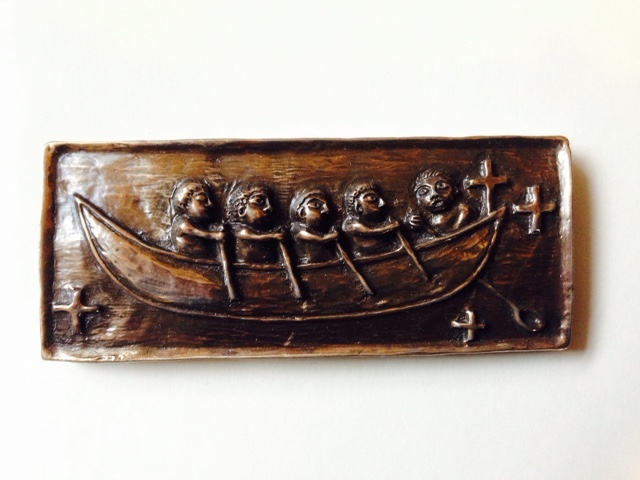
So in response to the call for papers, I have really enjoyed proposing a paper. I love how working visually opens such different ways of thinking and being. My proposed paper is titled Art at creation’s extinction: Ecological theologies in Ruysch’s Flowers in a Vase and Regan O’Callaghan’s St Paul and the Huia.
My proposed paper will work with Ruysch’s Flowers in a Vase, an artwork at the National Gallery in London and in dialogue with Regan O’Callaghan’s St Paul and the Huia at the Gallery’s neighbour, St Paul’s Cathedral.
Wednesday, May 03, 2023
an AngelWings Ltd research s/ending: kawakawa chyrsalis and kāhui whetū in 2023
How do you mark an ending?
A few weeks ago, a long and demanding research project came to a s/ending. I hit “send” on a 54,000-word research report, along with four executive summaries, each six pages long. Like any s/ending, the lead up to the deadline involved stress, the juggle of depth and readability, edits and visual appeal.
Once sent, another set of stresses emerge. How will the funders respond? The time between sending the report and gaining feedback can be lengthy. Funders need time to read and process. Can I move on, or will more work be needed?
In all this waiting, the sending is still an ending and the s/ending needs celebrating.
What was sent a few weeks ago was a unique project. First, at 26 months it was longer than usual. The report drew on hundreds of interviews and interactions, and over 250 pages of written notes.
Second, it was a research collaboration, working with someone who brought unique and different skills. So this research project meant forming a team, learning to work across cultures, appreciating each other’s strengths, navigating each other’s weaknesses and respecting each other’s realities. With research spread over 26 months during a global pandemic, the realities included lockdowns, catching of Covid during fieldwork, work and family changes. Lots to navigate! So with the sending came an ending, of a productive collaboration.

So as part of s/ending, last week over coffee, we exchanged gifts as we prepared to meet the funders. Here are both gifts, sitting on top of the four research journals full of notes and findings from the 26 months of research.
My colleague found a beautiful pottery bowl. She was drawn to the stars (kāhui whetū). The research project had been shaped by an indigenous whakataukī (proverb) about the nature of voyaging. As part of our research, we had identified stars (kāhui whetū) that we suggested could guide the funders into the future. The pottery bowl, with stars, named this unique strand of the project.
I offered a pair of hand-crafted chrysalises of the kawakawa loop moth (Cleora scriptaria). The kawakawa plant is endemic to Aotearoa, the chrysalis is sign of potential. The research project had invited us to pay attention to land and place, to value indigenous learning in new ways. The six recommendations might offer potential new ways of living for this funders.
These objects now sit on my desk, along with other objects from other AngelWings Ltd research projects. Each object reminds me of work done. Each suggests a different dimension of the craft of researching. In this case, the value of working with indigenous ways of knowing. Each invites me to keep praying for the project, in this case, for those seeking to bring change in theological education and ministry training.
What about you? How do you mark an ending?
Saturday, April 22, 2023
body work, body listening
How do you listen to your body and its movements?
A day off today provided some time to process the week gone. A key task over this week was speaking for 90 minutes to a 53,000-word report I have written. The report drew together 26 months of research into the next 20 years of the organisation.
So there was a fair bit riding on the work – for myself, for my colleague in research and for the organisation.
Which meant lots of emotions and stress – before, during and after the presentation. Including some fairly vivid nightmares of missing data across a cultural interaction.

So the climb through my local piece of bush today was a chance to pay attention to my body. During the 60-minute walk-up, three questions emerged, each from different moments during the walk.
- Where were the resting places in the 26 months gone?
- Where were the moments of unexpected delight?
- Where were the feelings of relief?
After a sit with some chocolate at the top of the stairs, the walk down was a time to reflect on the questions and enjoy pondering the Spirit’s movements.
Finally, toward the bottom, a small mountain stream provided an experience of hands immersed in water and a gentle letting go of the week gone.
How do you listen to your body and its movements?
Thursday, April 06, 2023
settler colonial theologies conference abstract
Conference abstract submitted today – “Do this in memory of me.” The role of church buildings in constructing settler colonial theologies in Aotearoa New Zealand. (Dr Steve Taylor, Independent scholar, AngelWings Ltd).
Christianity recognises itself as a religion of memory. In Eucharist, amid betrayal and before violence, Jesus calls his disciples to remember rightly.
What it means for Christianity in Aotearoa to rightly remember is challenged by “Recessional” (2010), a public artwork on display at Te Papa. Artist Murray Hewitt presents visual imagery of 61 publicly accessible historical battle sites in Aotearoa. These sites require right remembering on both sides of the Tasman, given the earliest dated memorial plaque in Anzac Park, Canberra, marks a military campaign fought in 1860-1 by the Royal Australian Navy Campaign in Aotearoa New Zealand, in which some 4% of the Māori population died (O’Malley 2016). A feature of Hewitt’s “Recessional” is the number of church buildings located close to battle sites. How do these religious communities rightly remember nearby histories of violence?
Enns and Myers (2021:10) call for settler “response-ability.” Writing as white Americans, they urge settlers to undertake identity work to understand how settler colonialism structures the relationships they inhabit. Savides (2022) argues that decolonisation offers settlers theological resources to remember rightly. Writing as a white South African, he uses themes of the cross and vulnerability in Reformed theology to demonstrate how decoloniality provides frameworks to analyse Christian entanglement in systems of Empire.
In Aotearoa, Pākehā have a distinct identity as settler. Reflection on this identity requires recognising privilege, lamenting marginalisation and learning to be better partners. This paper uses as case studies the church buildings present in Hewitt’s “Recessional.” It draws on archival records and anniversary liturgies to consider how churches do and do not pay attention to the battle sites nearby. In so doing, this paper contextualises Christian practices of anamnesis. It examines how the churches that Pākehā built are theologically forming settler identities. Trajectories for a theological ethic of settler “response-ability” are suggested.
Enns, Elaine and Ched Myers. Healing Haunted Histories: A Settler Discipleship of Decolonization. Cascade Books: Eugene, Oregon, 2021.
Murray Hewitt, Recessional (2010). Accessed 29 March 2023.
Savides, Steven. Unsettling the Settler Colonial Imagination: Decoloniality as a Theological Hermeneutic in South Africa. PhD thesis, University of Notre Dame, 2022.
O’Malley, Vincent, The Great War for New Zealand Waikato 1800-2000, Bridget Williams: Wellington, 2016.
Tuesday, April 04, 2023
thrilled with Ethnography as Pastoral Practice 2nd edition
 I’m delighted to have a piece of writing published in revised edition of Ethnography As A Pastoral Practice by Mary Moschella, who is Professor of Pastoral Care and Counseling, at Yale Divinity School.
“When Christmas angels tweet: Making matters and practical theology in researching mission online,” Ethnography as a Pastoral Practice. An Introduction, 2nd edn. by Mary Clark Moschella, SCM/Pilgrim Press, 291-305.
Delighted first to be published. It is an appendix in which I describe how I go about conducting empirical research, in this case into digital expressions of craftivism in general, and knitted Christmas angels in particular.
Delighted second, because it gives another lens on my research on craftivism.
“When ‘#xmasangels’ tweet: a Reception Study of Craftivism as Christian Witness,” Ecclesial Practices 7 (2), 2020, 143-62, (co-authored with Shannon Taylor). Doi.org/10.1163/22144471-BJA10016
The editor of the academic journal Ecclesial Practices called the article “rich”, demonstrating new “opportunities,” “skilful and sensitive application of ethnological tools” in “powerfully informing ecclesial research.”
Delighted third at the circumstances. Professor Mary Moschella sat in on a conference paper delivered at the 2019 Ecclesiology and Ethnography conference. She emailed after, asking if I could write for a revised edition of Ethnography as a Pastoral Practice, as she was looking for contemporary examples of high-quality, contemporary empirical research and would I write, not so much on the data as on the research journey.
Delighted fourth because I have used the first edition in my classes, teaching on mission, church, leadership and change. A short blog review from 2012 that I wrote is here. It’s a fantastic book. So to be published in a revised edition of a book I consider fantastic is pretty special.
Tuesday, February 14, 2023
Race, justice and mission – my 2023 University of Glasgow Library Research Fellowship
I’m delighted to have been awarded a 2023 University of Glasgow Library Research Fellowship. This provides access for a month to what is a unique archive collection of mission archives. It also provides some funds to aid with travel and accommodation, which I hope to do around September 2023.
My research project is titled Race, justice and mission and here is some of what I wrote in my application:
Understanding the past demands a contemporary reappraisal of race and justice in the expansion of empires. The history of slavery invites educational institutions to assess their complicity in education, empire and exploitation. Slavery generally tends to be framed in relation to the transatlantic slave trade. However, a unique history of coerced Pacific labour is called “blackbirding.” Pacific peoples were extracted from island communities to build sugar plantations in Australia and Fiji. Recently, scholars have called for a reappraisal of “blackbirding,” the need for new Pacific genealogies and a critical reassessment of the “racial imaginaries” at work in the empire’s expansion.
My research project aims to illuminate the Glaswegian contribution to the modern Protestant missionary enterprise. The archives at the University of Glasgow Library offer a significant resource. Several Special Collections contain pamphlets and sermons that illuminate historic attitudes to other cultures, as students from the University were encouraged into mission activity by Christian student bodies meeting in and around the campus. The University Library Missions Book collection includes descriptions by missionaries who sailed from the ports of Glasgow and wrote of their encounters with “blackbirders” in operation.
This unique archival material will be located in relation to the growing body of contemporary scholarship attuned to histories of slavery and the economic and educational complicities of British imperialism. My research project aligns with the University of Glasgow’s Historical Slavery Initiative, which seeks to respond to the University’s complicated entanglement with Scottish imperial expansion.
I am thrilled to have been awarded this Research Fellowship, grateful for the opportunity to access what is a unique collection and thankful for the help from Rev Dr Doug Gay in alerting me to the archive. I look forward to strengthening academic relationships with various colleagues and friends and am excited by the important work already being done at the University through the Historical Slavery Initiative. This research allows me to return to my roots as Melanesian born and reflect on the Pacific’s particular histories of slavery.
Wednesday, February 08, 2023
Theological Education as “Being With” the Future Church – some AngelWings Ltd applied research
I’m delighted to have an Applied Research Abstract on Theological Education published in Review of Religious Research. Steve Taylor, “Theological Education as “Being With” the Future Church: Applied Research Among Local Leaders in an Australian Baptist Denomination,” Review of Religious Research, DOI: 10.1007/s13644-021-00480-z.
Here is part of the conclusion:
“A changing world presents significant opportunities for theological colleges and seminaries to re-invent themselves. Providers of theological formation have a significant role in resourcing the future church, particularly as they attend to collaborative and relational partnerships … [including] a renewed focus on local contextual theologies, empirical research, and grassroots partnerships. Such participation requires accompanying the local church, not as a problem to be fixed or a base for recruitment, but in a shared human quest to learn in change.”
The Applied Research Abstract draws on research I did in 2021 for Whitley College (working with René Erwich and Darrell Jackson) and the Baptist Union of Victoria, listening to some 47 stakeholders. The complete report belongs to Whitley College Board.
However, the Review of Religious Research is a journal that uniquely facilitates the sharing and comparing of applied studies between denominational and academic researchers. They offer four types of articles – Original Research Articles, Research Notes, Review Articles, and Applied Research Abstracts. The Applied Research Abstract is a type of article that summarises (without any references) an applied research study. So, in dialogue with Whitley, some of the research can now be shared more widely.
The article is online and paywalled, but if folk want a pre-publication copy, just DM me.
Tuesday, January 17, 2023
Coding as pattern making
Coding. Definition – assigning a code for the purpose of identifying.

One of the research projects I’m involved in explores faith formation in church schools. I have several rich 7,000-word interviews with school chaplains. To identify learnings, I am coding. Often I code with highlighters.
This time I am coding with Word document highlighters. On the right, the Word highlighter printed out to increase my efficiency. In the centre my codes by colour and in writing. On the left and on screen one of the 7,000-word transcripts (partially obscured to preserve confidentiality) and with various colours visible as I use the Word highlighter to mark bits of the interview. Plus the Word comment function for me to write notes. Cut and pasted these notes are becoming draft results and discussion – identifying the patterns of faith formation present in the lived ministries of school chaplains, as shared through interviews as they reflect on their practice.
Slow work. Rich and listening work. Fascinating patterns emerging.
Saturday, November 05, 2022
innovation capture – a 2022 AngelWings Ltd international collaboration
A new AngelWings Ltd research project, and so a new journal – green, A4, lined. This research project, which I’m calling “Innovation capture,” is for the Diocese of Brisbane (Anglican) and with Complexability Australia. It’s a mini project, initially likely to be between 2 and 6 days. As with much of my work, it will be done remotely, from Ōtepoti (Dunedin).

The task of “Innovation capture” is to collect grassroots innovation case studies. This involves interviewing local parishes who participated through 2021 in a Diocese initiated Adapting Ministry in Complex times course. My task is to listen to their stories of action and change and then write up stories as learning case studies, with links to course content. The aim is to encourage and teach through storytelling.

It’s a project I committed to back in February 2022 but have been unable to get to, due to a range of other research contracts. So it was a relief to finally open a new journal and begin – conducting a 90-minute conversation and then drafting up a 1,000-word case study. This included discussion questions, along with links from the local story to various themes in the course content.
This is the fourth AngelWings Ltd small research project for 2022, alongside an evaluation of a student ministry in New Zealand, an evaluation of a community chaplaincy for a group in Australia and an educative course design weaving emergence and complexity theory with theology.
Monday, October 10, 2022
Article acceptance – Entrepreneurship Education and Pedagogy journal
 Stoked to get news this morning of the acceptance of a journal article in the academic journal Entrepreneurship Education and Pedagogy.

The article is titled “Lighthouse as a transdisciplinary boundary-crossing learning innovation in Christian communities” and is co-authored with Prof Christine Woods (University of Auckland) and Mark Johnston (now University of Glasgow). Together we reflect on the Lighthouse, a social innovation incubator weekend, funded by the Presbyterian Development Society, that we developed and ran for three years for the Presbyterian Church.
Social innovation in Christian contexts is greeted with suspicion by some theologians, as is talking about the apostle Paul in some business and entrepreneurship settings. So as well as running the Lighthouse, we set ourselves the task of writing for both audiences.
It was great to be published theologically last year in the International Journal of Public Theology (“Jesus as a socially (ir)responsible innovator: seeking the common good in a dialogue between wisdom Christologies and social entrepreneurship,” International Journal of Public Theology 15 (1), (2021), 119–143). (Some of story is here) ).
We then wrote for an entrepreneurship setting through the back half of 2021, reflecting on the Lighthouse as an educational innovation using two educative theories, boundary crossing and collaborative spirals. The invitation to revise and resubmit occupied late May/early June 2022. And now news of publication!
Thanks Presbyterian Development Society for believing in our funding bid :). Thanks Reviewer 2: “I thoroughly enjoyed reading this paper, it is a well-crafted and thoughtful paper that offers interesting insights and tools.”
Monday, September 26, 2022
Published – Theologies of Fulfillment in a Reciprocal Study – International Bulletin of Mission Research
 My latest journal article is now online – “Theologies of Fulfillment in a Reciprocal Study of Relationships between John Laughton and Rua Kēnana in Aotearoa New Zealand,” International Bulletin of Mission Research here.
Short abstract: Crossing the borders of religion presents challenges and provides opportunities. This article presents a contextualized case study from Aotearoa New Zealand. Photography, as a tool in discerning lived theologies, suggests a side-by-side relationship of reciprocity and particularity. Relationships across differences are revealed not in theory but in lived practices of education, worship, life and death. The argument is that Rua Kēnana and John Laughton enacted theologies of fulfillment, grounded in different epistemologies: mātauranga Māori and Enlightenment thinking.
I’m grateful for the writings of Dr Hirini Kaa and Archbishop Don Tamihere as invaluable resources in reflecting on mātauranga Māori and the life of te hāhi mihinare. I’m also grateful for the wisdom of Dr Wayne Te Kaawa in the writing and the resource and permissions of National Library of New Zealand.
Wednesday, July 06, 2022
publishing contract for Making matters and practical theology in researching mission online
Signing a publishing contract is always a great way to start the day.

This piece of writing began as a conference paper delivered at the 2019 Ecclesiology and Ethnography conference. In the audience was Mary Moschella, who is Professor of Pastoral Care and Counseling, at Yale Divinity School. At the time she was revising her book, Ethnography As A Pastoral Practice: An Introduction
I had used Ethnography As A Pastoral Practice: An Introduction
Wednesday, May 11, 2022
Ordinary knitters: theologies of making
From the ethics application:
 I am researching whether Christians can witness through acts of making. Artist and theologian Makoto Fujimura argues that the theological journey includes seeing the importance of our creative intuition and trusting that the Spirit is already at work there. Such claims invite three research tasks. First, to capture the theological journeys present in creative intuition. Second, to discern the Spirit’s work in these journeys. Third, to develop a missiology of making.
To do this, I want to begin with knitters and how they might (or might not) see their making as a spiritual practise. Jeff Astley urges the study of ordinary theology, the need to value the everyday faith understandings of the whole people of God (Ordinary Theology, 2000). Applied to making, what theologies are being made by “ordinary knitters”? In the words of Fujimura, what role does creative intuition play in the theological journey? What are knitters thinking, praying even, as they cast on and off?
I want to interview knitters in several countries who have participated in knitting projects. Firstly, I also want to interview knitters of scarves for the Common Grace Knit For Climate Action in Australia. I hope to interview knitters either together or alone and explore why they participate and what meanings they make. Second, I want to interview knitters of Christmas Angels. These include groups in Australia, New Zealand and the United Kingdom. Again, I hope to interview knitters either together or alone and explore why they participate and what meanings they make.
I will communicate to Christian organisations, for example Common Grace Knit For Climate Action and churches, that I am seeking participants. I will set up a Facebook page https://www.facebook.com/ordinaryknitters that has an advertisement along with details by which people can contact me. I will utilise a “snowballing” technique where participants could tell others about the project by referring them to the information about the project.
If you are aged over 18 years and have been involved in a knitting project (like Common Grace Knit For Climate Action or Christmas Angels or similar) and are willing to be interviewed about your experiences, we would love to hear from you.
Contact Steve Taylor (kiwidrsteve@gmail.com) or read more here or on the Ordinary Knitters facebook page.
Thursday, January 20, 2022
90 plus research interviews in 2021
As I head into the 2022 working year, I’m reflecting not only on writing done in the 2021 year gone. I’m also reflecting on research undertaken.
A highlight of 2021 was being able to conduct over 90 research interviews. This involved four different projects, for four different church denominations. In my role as Director of AngelWings Ltd I conduct quality research. In 2021, this involved requests to conduct research into future church and change, theological education, student mission and craft in mission. Most was by zoom, working internationally with folk in USA, Samoa, Fiji and Australia. There were also multiple interviews across Aotearoa both face to face and by zoom.

Photo by Chris Montgomery on Unsplash
My rough rule of thumb is that one interview involves 4 to 6 hours of work, excluding travel time. There is about 30 minutes to write introducing the project, suggesting boundaries and seeking to set up an interview. There is about 60 minutes of interview. There is about 30 minutes to individually process the interview, to either walk or journal my impressions in a research memo. Then there is the interview writeup. For most of these interviews, I compiled not a transcript but a 2-3 page summary. This is sent back to the person interviewed, so they are aware of what was heard. This also includes time if the feedback process involves corrections or suggestions for improvement. (A full transcript takes a lot longer and very few industry groups see the need for that depth of accuracy). The write-up takes about 2 hours for a 1-1 interview, longer for a focus group.
So 90 interviews, each at around 5 hours of work, meant some 450 hours of work, over 11 weeks full-time equivalent for me in 2021. What a privilege, to engage, listen and learn from thoughtful, caring and passionate people.
Interviews make knowledge. You literally see wisdom emerge in front of your eyes, as people pause and say “I’d not really thought of it like this before but …” Such is the power of qualitative research to individuals and communities.
Interviews invite diverse voices to the table. When people begin with “I’m not sure I have much to say …” you realise that unless invited, so much insight is never shared. Such is the gift of qualitative research to organisations and groups.
In 2021, I was blessed to conduct over 90 interviews, across multiple projects and diverse cultures, as part of AngelWings providing quality knowledge and insight to individuals, organisations, church denominations and theological providers.


 )
)