Thursday, May 16, 2013
I’m in the Flinders Research Spotlight
Flinders Institute for Research in the Humanities have a monthly publication, in which they focus on research achievements. My recent U2 academic conference involvement is currently “top of the fold.”
The words ‘U2’ and ‘academic’ seldom occur in the same sentence. Rock music is often considered adolescent and entertainment. So how can it be academic?
Dr Jason Hanley (Ph.D. in Musicology) has helpfully observed that rock and roll is a cultural artifact. When researched, it becomes a way of learning about ourselves and our world.
It is this potential of music to help us to begin looking at ourselves in the mirror (to appropriate Michael Jackson), that led Dr Steve Taylor from the Flinders University Department of Theology to present a research paper at the second U2 Conference (April 25-28, 2013) in Cleveland, Ohio.
Dr Taylor’s paper utilised the work of sociologist, Paul Connerton, to analyse the live concert performances of the recent U2 360 tour.
For Dr Taylor, participation in the U2 Conference breaks down the perception of the university as “ivory tower.” It also brings a necessary inter-disciplinary perspective to the work of theology, helping it to reconceive its relationship with popular culture. … full article plus picture here
Tuesday, May 14, 2013
Pentecost worship in indigenous language
Daily chapel at Uniting College today was superb. Our Director of Missiology, Rosemary Dewerse had created a visual environment. In the centre was a world map, with red counters and a red candle lit. The invitation was to lay a counter on the table, and in so doing, to name a place and situation in the world we wished to pray for.
To begin she taught us a chant, in the language of the Adnyamathanha people, from the Northern Flinders.
undakarana ardla, ngapalan yarta yanangka.
In English “The light of Christ has come into the world.”
Using indigenous clap sticks to keep the beat, we began to sing this simple refrain, a gift to us from those who’ve gone before us in this land. A people who’ve endured colonisation and hardship, exploitation and persecution, yet who have still find space to offer their language, their praise, their experience of the life of Christ come into their world.
It was a beautiful, natural, heartfelt way to be in the presence of God. It is part of a shift at Uniting College, in which in more and more ways, we are finding ourselves engaged with indigenous peoples. An important part of this has been relationship building, one to one, and then in Walking on Country, an immersion experience with our candidates for ministry at the beginning of this year.
It’s easy for this to be tokenism, and yet the result for us over recent months has instead been increased enrichment – in stories told in our midst, in shared candidate life together and now in our chapel life. The awareness of the other is becoming such gift.
And with Pentecost this week, it was a wonderful embodiment of the Spirit’s work, the enfleshing of faith in native languages, the crossing of cultural boundaries.
And how is it that we hear, each of us, in our own native language? Acts 2:8
Monday, May 13, 2013
hearing the cross as sense-exegesis
We are now three weeks into Sense Making Faith course. Each week we take a sense. We explore its use in our world today. And it’s abuse. We explore it’s use in the Christian tradition. And it’s abuse (often through neglect).
Last week we explored hearing. We brought our favourite spiritual music. We listened and made a list of all the noises we heard. We reflected on how much we miss – of ourselves, of God, of our world, because we don’t listen (ie abuse the sense of hearing).
Then we turned to the Christian tradition. What Bible stories describe God speaking, I asked?
The cross, was one response.
Let’s push that further, I said. What noises do we hear around the cross?
And we began to reflect, “hearing” the cross in a whole new way;
- tears
- wailing
- nails being hammered
- gamblers rolling dice
- centurion ordering
- a last breathe being drawn
- thunder
- a curtain being torn
Within two minutes, we had engaged the cross in a much deeper, richer way. This, I suggested, was “sense-exegesis.” We have taken a sense, one sense, and applied it to Scripture. We can do this with any passage. And with any sense.
For more on sense-exegesis, see here and here.
Thursday, May 09, 2013
Pilgrimage spirituality interaction
Darren Wright, who so long ago did a very thorough blog review of my Out of Bounds Church book, is interacting with my recent Old Testament festival spirituality talk.
to be honest the idea of seeing our liturgical year being split into 6ish gatherings connected to festivals (we already naturally celebrate 3 festivals in christmas, easter and harvest) sounded like a beautiful and sustainable idea for many people at the conference. People seemed so attracted to the idea of festivals that the other ways of exploring community, spirituality and faith seemed overlooked by many of the group, so with that in mind I thought I’d like to explore each of the categories leaving Festivals to the last.
He is taking each of the categories I introduced – temple, festival, pilgrimage, table, sacred site – starting with pilgrimage.
He explores rural life, driving, weekly bike club rides that exist in almost every town, a driving holiday, transporting cattle/stock along the stock trails, harvesting and sowing (where in Australia one sits alone on a huge machine for days on end). Even geocaching.
Pilgrimage as practice opens up the possibility of seeing the tractor as a space for liturgical & ritual practices, the car/vehicle as one drives between Hillston and Sydney as a space for faith and connection. The task for us now is to develop ideas that help the spiritual practice of pilgrimage develop and professional travellers ways to engage with the region they’re driving through in deep spiritual reflection.
It’s a creative piece of work.
Wednesday, May 08, 2013
Ecclesiology and Ethnography: a “down under” perspective
News today that my academic paper for the ANZATS (Australia New Zealand Association Theological Schools) combined conference 29 June-2 July, in Auckland, New Zealand, has been accepted. The conference theme is Christians in Communities – Christians as Communities.
Ecclesiology and Ethnography: a “down under” perspective
The aim of this paper is to introduce a new area of theological investigation and offer a “down under” response. It will be argued that a new Eerdmans Studies series, launched with paired volumes, Perspectives on Ecclesiology and Ethnography

The first section of this paper will outline this new Studies series and a number of theoretical moves, including the use of empirical research as a theological necessity, appreciating knowledge as a perichoretic practice and valuing ecclesial situatedness.
The second section of the paper will offer a “down under” response to what has initially been a trans-Atlantic conversation. This will include a methodological engagement with indigenous perspectives on qualitative research. It will demonstrate similarities between the Studies in Ecclesiology and Ethnography series and themes articulated by Linda Tuhiwai Smith (recently honoured as a Companion of the New Zealand Order of Merit), including valuing qualitative research, seeking community transformation and encouraging research situated in communities of tradition.
However Smith also identifies ways in which research has been an instrument of colonization. Hence a third section of this paper will employ Smith’s “Community up” framework for researcher conduct to analyse a number of case studies present in the Studies in Ecclesiology and Ethnography series. It will be argued that a pivotal point exists in the work of Paul Murray and Matthew Guest, in which the ethnographer is freed to offer the marginalized a new voice and consequently bring change to ecclesial communities.
Dr Steve Taylor
Senior Lecturer, Flinders University
Principal, Uniting College
Tuesday, May 07, 2013
breath prayers as communion
At communion yesterday (as well as offering a missional introduction), I wanted to try and embody the great prayer of thanksgiving. It is a prayer that is often patterned on salvation history, moving from creation, through the people of Israel, to Jesus, with the saints. One way to offer embodiment, and experience embodiment, is through the simple act of breathing.
I’d also been thinking about brains. As you do!

projectors magnetic field
And the fact that apparently connections between neurons in the brain produces an electrical charge. With every electrical charge comes a corresponding magnetic field. And that although magnetic fields rapidly lose their force, they never completely dissipate. So every thought and memory ever produced still lives, as an infinitesimal magnetic trace. So how to engage with that reality at communion?
Deep breath.
God we breathe in air. As we do, we thank you for creation, for the air we breathe, the birds that sing in the morning, the colour of the gum trees.
Deep breath.
God we breathe in air. Air breathed by others. As we do, we thank you for those who’ve gone before, for the prophets and saints who’ve showed us how to live life and seek justice.
Deep breath.
God we breathe in air. Air breathed by others, including the God-man Jesus. As we do, we thankyou for the humanity of Jesus’ breath, the places he walked, the people he healed, the grace he offered, the words he said.
And so we pray together the prayer, Jesus invited us to pray …. and we recall the words of Jesus, who took bread ….
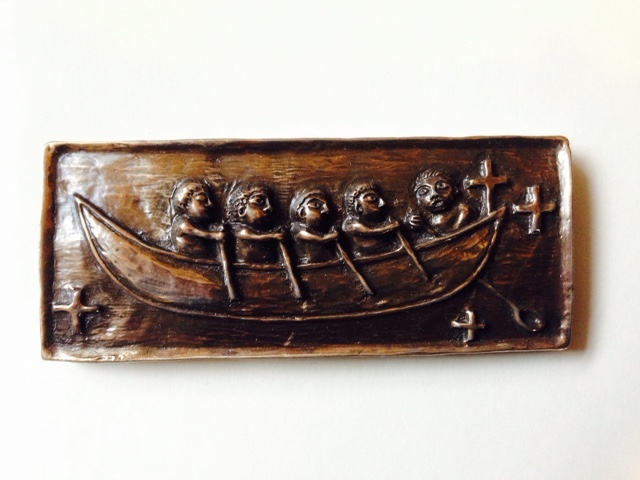
Creationary: a space to be creative with the lectionary (in this case, visual images on themes of pilgrimage). For more resources go here.
Monday, May 06, 2013
missional communion
An introduction to communion that I shared today, working with our candidates, faculty and visiting ministers, gathered around the topic of self-care.
There is a story of some ministers gathering. Much like us today, to wrestle with ministry. In the question time, a question is raised. A person aware of their world, concerned about the church. How can we bring people to the altar?
The response is made. Is the question how do we bring people to the altar? Or is the question, how do we bring the altar to people?
An important reminder as we gather. It is not that we come to communion, but that in communion God comes to us. In this we are invited to participate in God’s mission.
Yes, it is about our care. In communion God feeds us, centres us, re-values us around grace and redemption.
But it is more than that. It is also about care for the church. In communion God feeds the church, centres the church, re-values the church around grace and redemption.
But it is more than that. It is also about care for the world. In communion God wants to feed the world, wants to centre the world, wants to re-value the world around grace and redemption.
And so we pray; Spirit, fall on us, that these elements of bread and wine may be for us a participation in your life, love and mission, your bringing the altar to people.
Sunday, May 05, 2013
original of the species
for my kids
One of the optional events at the U2 conference in Cleveland included a discussion of U2’s music by Rev Kurt Wiesner, an Episcopal priest and U2 fan. He took a reader response approach, that a song can mean more than it’s original, authorial intent. On that basis he showed the video, noted that it was written by Bono for the daughter of a friend. He then asked a number of questions that generated a rich discussion. These included a key phrase, what might the song be saying about growing up, what if the voice of the singer was God talking to us?
Friday, May 03, 2013
Festival spirituality stories: Spin and Fibre Festival
I’m starting a research project, wanting to collect stories of Festival spirituality. It is an extension of a brief idea I sketched in my The Out of Bounds Church?: Learning to Create a Community of Faith in a Culture of Change (emergentYS)
Festival spirituality (working definition): an occasional period of community gathering for celebration, in which Christians intentionally participate, seeking to make the shalom of God more visible.
This Festival spirituality story – Spin and Fibre Festival comes from Frontier News, May 2013, 8-10. It relates to the 35th Bothwell International Highland Spin In and Fibre Festival, a biennial event held in Tasmania and comes from an interview with Rev Meg Evans, Patrol Minister, Midlands, Tasmania.
Held every two years, Meg is the unofficial chaplain for the festival, which was started by a group of Uniting Church women who were spinning wool to raise funds to restore the church tower. Bothwell is one of the smaller communities in the Patrol located in the Central Highlands, 70 km northwest of Hobart. It has a long history in Merino wool production and the festival remains a huge event for both local and international visitors showcasing crafts and skills associated with superfine wool.
“On the Friday, we shear a sheep for the fleece, and then we hold a ‘Blessing of the Fleece.’ The wool is given out to people to spin during the weekend. On the Sunday I hold a service in the school gym, surrounded by all this wonderful creativity. It is just a great community celebration.”
“People come and tell me how much they enjoy it. I think the fact that the Church is there speaks to people.”
Some interesting things to note
- gift – the involvement of the church begins with “Blessing”. This suggests a thankfulness. What is blessed (the Fleece) is then given away to participants
- risk – This clearly involves risk, that the gift might not be “unwrapped,” might not be utilised. Or it might be “wrapped” in a way contrary to the values of the giver.
- theology of creation – the connection to wool, as the product of local industry, as the lifeblood of what this community, this land, produces. A celebration both of the gift of wool, but also of the creative gifts that surround wool – “crafts and skills associated with superfine wool.”
- being church as spun (interwoven) presence, first in being close enough to the land to be aan initiating participant, second in being a worshipping presence through the festival, both from the initial blessing through to the service, third in the theology of Meg, “the fact that the Church is there speaks to people.” The church began this event, but was willing to give it away. The church is willing to be one of many participants, many strands, in the fibre of this event. It does not need to own it nor control it.
So this Festival spirituality is mission as chaplain, celebrating creation, with particular attention to presence, participation, gift and risk.
Questions for discussion
- I wonder what things might be worth celebrating in your community – what gifts of “creation” and “creativity” you could bless?
- I wonder how you might take risks and invite people to participate in these gifts?
- What might an authentic presence look like? Think about this both from your perspective as a church and from the perspective of visitors and locals.
Wednesday, May 01, 2013
Pop culture, Steve Averill, U2 and the Incarnation
Steve Averill, Senior Art Director at AMP Visual, was one of the keynote speakers at the recent U2 conference. He was introduced as speaking on what it means to turn sound into a vision. It was an important statement, a reminder that music is so much more than sound.
Steve Averill has designed nearly all of U2’s album covers. Many have won industry awards. He structured his talk around album covers, working his way through the U2 album sleeves he has designed. As he discussed colours, font styles, images and influences, you became aware of how much thought, care and imagination go into what we hold, the CD cover, what we wear, the concert T-shirt, what we see, the branding on the U2 publicity.
He noted the quirky eccentricities of the covers – that Bono wanted Bible verses on the cover of All you can’t leave behind, and so they added them in via the airport gate signs, that the picture used on No line on the Horizon was by artist Hiroshi Sugimoto. He was not willing for their to be any branding on his art. The solution was to etch branding onto the plastic CD sleeve.
He showed us the album covers that were influential, the album sleeves the band own, they listen to, they like – The Ramones, The Beatles.
Dr Jason Hanley, who holds a Ph.D. in Musicology, introduced and interviewed Steve Averill. He began by noting that rock and roll is a material culture. When you look at it, when you research it, when discuss it, you are learning about yourself, about your world, about your culture.
This should make sense to Christian theologians. The Incarnation, God coming in human body, is an honouring of the human body, of the senses, of what we see, feel and touch. Pop culture should thus be an easy and obvious area of theological research, both as an exercise in Incarnation, and as a way of helping us see ourselves, our culture, our world.
Monday, April 29, 2013
Head and heart: a U2 conference review
I will remember this U2 conference for the way it brought together both head and heart.
It began for me with Natalie Baker’s fan film and the stories from fans of how U2’s music helped them avoid suicide and assist their healing from childhood sex abuse. Suddenly U2 was more than entertainment and the conference more than academic. It was inviting us into deep places.
It quickly went deeper, with Bill Carter sharing about his engagement with U2 in the Zooropa tour. His stories, of persuading Serbians to drive past sniper alley in order to share, via ZooTv, their story of living through the bombing of their city, took us even deeper, into the humanity that can emerge amongst inhumanity.
Finally, the presentation by Steve Averill was a further reminder that music is so much more than music. His sharing about the development of U2’s albums documented the visual and tactile side of music – the album and CD cover, the merchandising. It was a reminder that music is about communication, the colours and photos carefully selected to try and capture the essence of the music.
There were more many other highlights but for me, I will remember the head and heart being invited to be whole bodied.
Perhaps it was the jet lag. Flying overseas is always a disorientating experience, so perhaps the way my body responded was to seek another heartbeat.
Perhaps it was the venue, more compact, which encouraged more interaction and engagement.
But I suspect there was more going on, an important corrective for the work “academic”, which can easily hide behind footnote and theory, and in doing, so walk past the beating heart and whole body.
Thanks to all those who made the head and heart possible, especially the Calhoun’s.
For those interested, a brief summary of my contribution to the conference is here. And here is my review of the first, 2009, U2 conference.
Sunday, April 28, 2013
Let us in the sound. My U2 conference paper
Some really positive, engaged, thoughtful response to my U2 conference paper this morning.
My argument is that U2 concerts act as corporate memory makers. I used as a theoretical conversation partner Paul Connerton’s How Societies Remember
- Concert-rical repetition, an adaptation of Connerton
- Verbal repetition, in which I looked at the different between album lyrics and live performance, using the U22 album. This data generated a corporate memory making around remembering the local, remembering the concert history and remembering people past.
- Gestural repetition, in which I looked at Bono’s gestures, drawing on photos of live performance in From the Ground Up, the official photobook of the U2 360 tour.
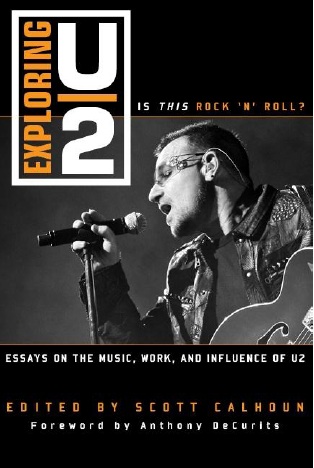
All of which seemed to generate, as I said, some really rich conversation. So it looks like it has the legs to turn into a publication, either in Journal of Religion and Popular Culture or in the book that is intended from this conference, and which will accompany Exploring U2, the book that emerged from the first conference.
Thursday, April 25, 2013
Let me in the sound of U2 conference
The last few days of my sabbatical and I’m heading Stateside, to attend the U2 conference.
I’ll collect my T-shirt.

I’ll present my paper – on which there has been quite some to-ing and fro-ing. It has taken a bit of detour as I wrote it, and is now focused on how U2 act as corporate memory makers, through analysis of U2’s live performance, including Bono’s physical performance gestures.
I’ll check out the conference and enjoy the input including Steve Averill, U2’s designer and Bill Carter, the journalist who provided U2’s links with Sarajevo during the dark days of the Bosnian war, plus the other academic papers.
And I’ll return, flying back Sunday. A very short trip stateside.
The last U2 conference (which was the first and also had a T-shirt!), was a whole lot of fun, so expecting the same.
Wednesday, April 24, 2013
Gender matters: Startups with women more likely to succeed
Here’s another one in the gender matters series.
Startups with Female Directors Have Better Chance of Survival. Newly incorporated companies with one female director have a 27% lower risk of becoming insolvent than comparable firms with all-male boards, says a team led by Nick Wilson of Leeds University Business School in the UK. The effect decreases as the number of female directors rises, suggesting that what matters is diversity rather than the specific number of women on the board. Past research shows that groups with greater gender diversity generate more-innovative thinking in problem solving.
Source – this piece of research in International Small Business Journal.
For more on gender matters
- my emerging church research does gender matter in faith development?
- women’s faith development is in alienation, through awakenings, by relationality
- What do Lo-ruhamah in Hosea 1, Namaan’s wife’s slave girl in 2 Kings 5, the slave girl in Philippi in Acts 16, Jarius daughter in the Gospels have in common?
- do women lead differently?


 )
)